Before Entering a New Market: How to Find the Buying Questions Users Ask First and Plan Your First Content
Translating your home-market content is not enough when you enter a new country or category. This guide shows, in four steps, how to find the buying questions local users ask first: define the market, collect questions from local search, communities, sales records, and AI answers, filter them by product fit, demand evidence, and local facts, rank them by buying stage, and plan your first content by question type.
Before you enter a new market, your first content should answer the buying questions local users ask first. These questions have three traits: they come up again and again in that market, they sit close to a purchase decision, and your product can genuinely answer them there. Translating your home-market content does not replace this step.
The method has four steps. First, define the market unit (country × language × platform, or the boundary of a new category). Second, collect questions from local sources. Third, merge, filter, and rank them. Fourth, match each question type to a content format.
Public surveys show that comparing, checking prices, and finding where to buy are common uses. A CI&T survey of more than 2,000 consumers in the UK and Ireland found that shoppers who use AI agents mainly use them to compare brands (45%), find the lowest price (42%), and find where to buy (39%). For a specific market and category, you still need to sample the shares yourself.
Our view: how much first content to make depends on how many local facts your team can verify and how many questions it can retest, not on how many candidate questions you have.
What are “the buying questions users ask first”?
In this article, “ask first” means two things. The first is early in time: the questions users ask right at the start, when they begin considering a purchase in this market, such as “how do I choose this kind of product” or “what can I get for this budget.” The second is high in frequency: questions that come up again and again locally and show up in several sources. Your first content should cover the overlap of the two.
Why not just move your home-market content over? Public tests give two reasons. First, when the market changes, the shortlist AI recommends changes too: in FTA Global’s test, once queries moved away from the “New York + English” baseline, an average of 2.9 of the top five recommended brands were replaced. Second, what AI draws on changes as well: Peec AI’s analysis of more than 10 million ChatGPT prompts found that nearly 78% of non-English conversations also ran English-language searches, so local and English sources get mixed together. What users in a new market ask, and what AI uses to answer them, both need to be checked on their own.
Another common mistake is to assume nobody is asking because keyword tools show low or zero search volume in the new market. Our view: buying questions in AI often carry conditions such as budget and use case, and keyword tools have trouble fully covering long phrasings like these. To judge whether such questions reflect real demand, see How to Find New Demand in AI Questions Keyword Tools Miss.
Step 1: Write down exactly which market you are entering
How you define the market sets the scope of question collection. Entering a new country or language market and entering a new category require you to write down different things.
What to write down
New country or language market
New category
Comparison unit
Country or region × language × AI platform; split multilingual countries by language
Category boundary, subcategories, and target users; then add target countries and languages
What you sell locally
Available models, local prices, purchase channels, delivery and warranty
Launch products, price bands, how they relate to your existing product lines
What users already know
The category is usually known; your brand may be unfamiliar
Your brand may not yet be recognized in this category
Platforms to watch
The main local platforms, not just ChatGPT
The platforms your target users commonly use
Don’t skip the platform row. In Statcounter’s September 2026 data, Gemini’s share of chatbot referrals was above 16% in Brazil, Japan, and India, and about 10% in the UK. This is the share of referrals to websites, not question volume, but it is enough to show that each market needs its own mix of platforms to watch.
Write down “what you sell locally” before you collect questions. If prices and availability are unclear, you cannot judge later whether a question is worth pursuing. These commercial facts should be confirmed by the product and local teams; the content team should not guess them.
Step 2: Collect candidate questions from local sources
Collect candidate questions from several local sources, because each source shows only part of the picture. The table below lists common sources by what you can see and what to watch out for.
Source
What you can see
What to watch out for
Local search suggestions and related questions
The words and phrasing local people actually use
Search in the local language from a local location; Google has explained that autocomplete takes the searcher’s language and location into account
Search Console
Queries for which your existing site already gets impressions in the target country
Look at the “Country” and “Query” dimensions together; it only reflects what you can already reach
Local communities and review sites
Concerns and comparisons users write in their own words
First confirm the questions come from local users, not from discussions in other countries
Sales, support, and distributor records
The questions asked most often before a deal closes
A new market usually has none yet; ask local partners first
Sampling AI answers locally
How AI understands the question, which sources it cites, and whom it recommends
Use the local language and location, and sample each question several times
Competitors’ local content
Which questions competitors already answer
Only a lead; it does not mean users actually ask these questions
When you sample AI answers, location alone changes the answer. In Massive’s October 2026 test, the same coffee-price question, with no country named, was put to ChatGPT from the US, Brazil, and Japan. The US answer quoted prices in dollars, while the Brazil and Japan answers added reais and yen. So your sampling log should record the location, language, platform, and date.
You can translate your home-market questions, but use them only as a control group: to spot which questions nobody asks in the new market, and which questions only the new market asks. For every candidate question, keep the original wording, the source, the collection date, and a translation in your team’s working language.
Step 3: Merge, filter, and rank the questions to answer first
Merge first, then rank. Put near-identical phrasings of the same buying task, with the same conditions, into one group, and keep one representative phrasing that is closest to how locals say it. If the budget, use case, device, or regional conditions differ, split them into separate groups.
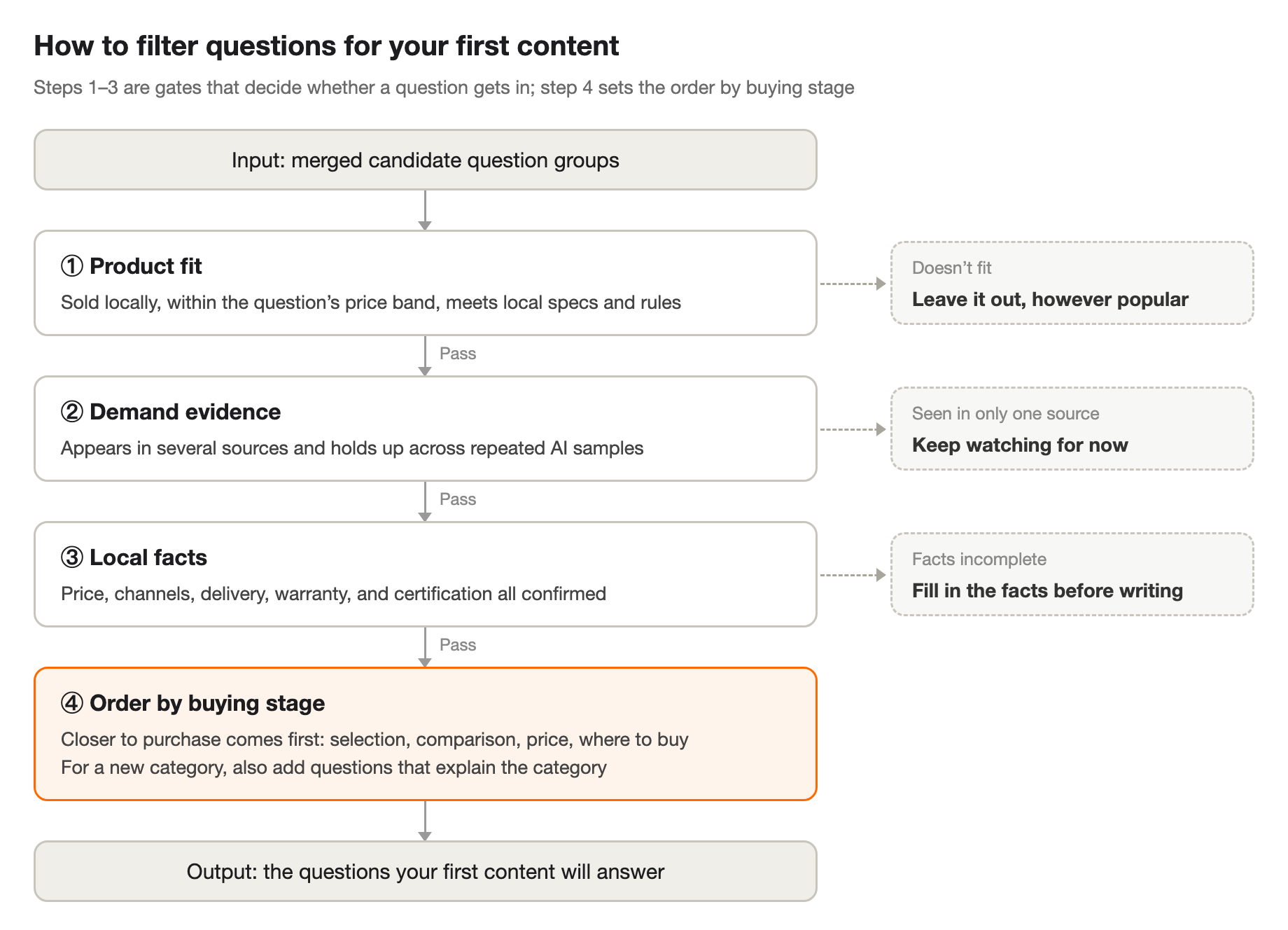
Check each group against four criteria:
Demand evidence: does it appear in several sources, and does it show up consistently across repeated AI samples? If it has appeared in only one source, keep watching it for now.
Buying stage: the closer a question is to a purchase, the more it affects whether your brand makes the shortlist. In public surveys, comparing and checking prices are both common uses. In CI&T’s UK and Ireland survey, consumers mainly used AI agents to compare brands (45%), find the lowest price (42%), and find where to buy (39%). In the World Retail Congress European survey summarized by Pygmalios, price comparison was the most common use in every region (51%–55%).
Product fit: is the product available locally, within the question’s price band, and compliant with local specifications and regulations? Questions that don’t fit stay out of the first batch, however popular they are.
Complete local facts: have price, channels, delivery, warranty, certification, and similar details been confirmed? If the facts are incomplete, fill them in first; don’t write the content first.
Both surveys are self-reported. CI&T’s press release and the coverage of it disclose neither when the survey was conducted nor whether these shares are based on all respondents or only on AI agent users. They can show which uses are common, but they cannot replace sampling in your target market. Our view: when entering a country market, start your first content with selection, comparison, price, and where-to-buy questions; when entering a new category, also add questions that help users understand the category (see the new-category section below). Of the four criteria, product fit, demand evidence, and local facts decide whether a question can enter the first batch, and buying stage decides its order within the batch, as shown below.
Diagram: how to filter questions for your first content
Step 4: Turn the questions into your first content
Different types of questions need different content formats, and each needs different local facts spelled out. The table below maps them. The “Example phrasing” column only shows the structure; use the original wording you collected locally.
Question type
Example phrasing
First content format
Local facts you must spell out
Choosing by need or scenario
How to choose a product for a certain use
Scenario buying guide
Locally available models, conditions of use
Choosing by budget
Options under a certain price
Price-band guide or product line comparison
Prices in local currency and the date checked
Comparing specific options
Which is better, A or B
Like-for-like comparison page
Comparison conditions, data sources
Features and compatibility
Does it work under a certain condition
FAQ or compatibility notes
Local specifications, certifications, language support
Price and costs
How much does it cost in total
Pricing and costs page
Taxes, shipping, subscriptions, or consumables
Channels and service
Where to buy, how the warranty works
Purchase and after-sales page
Local channels, delivery, returns, and warranty
When you plan your first content, keep four points in mind:
Tie every piece to specific questions: write down in the content plan which question groups each piece answers, so that when you retest, you know which answers to check.
Write in the local language and have native speakers review it: a translation can serve as a first draft, but the phrasing, units, and local terms need to be adapted.
Look beyond your own website: in FTA Global’s test, local domains and media made up 42% of cited sources in Germany, 34% in France, and 17% in India. Brands can give accurate information to local review sites and retailers; whether those sites use it is up to them.
Let capacity decide the volume: how much to publish in the first batch depends on how many local facts your team can verify, how much price and channel information it can maintain, and how many questions it can retest. A few accurate pieces are safer than many wrong ones: once a wrong price or availability detail is published, AI may cite it.
What’s different when you enter a new category?
Entering a new category and entering a new country follow the same four steps, but they start from different places. When you enter a new country, the category usually already exists, and users ask “which one should I buy here.” When you enter a new category, your brand is not yet known in it, and users’ questions come from an earlier point in the journey.
Difference
Entering a new country or language market
Entering a new category
Where questions start
Selection, comparison, price, channels
Also “what problem does this kind of product solve” and “do I need one at all”
Competitors
Local brands and international brands already in the market
Brands already leading in AI answers for the category
Evidence most lacking
Local prices, channels, certifications
Specifications, tests, third-party reviews
First content focus
Localized selection and purchase information
Category buying guides, like-for-like comparisons with leading brands
This comparison is our judgment, not a research finding. To check it, look at how the questions you sample are distributed: if a new category has few “understand the category” questions, you don’t need separate content for them.
Also watch for a bias. The EMNLP 2024 paper “Global is Good, Local is Bad?” found that large language models more often link positive attributes with global brands. A 2026 arXiv preprint by Chu and Hou (the page does not say it has been formally published or peer-reviewed) tested GPT-4o-mini, Claude Sonnet, and Gemini 3 Flash with skincare products. When product specifications were identical, the well-known brand was recommended 100% of the time, but that advantage disappeared once a competitor’s rating was higher by less than 0.1 stars. Our inference: newcomers make the shortlist with differences that can be checked (specifications, tests, real reviews), not with slogans.
If you are launching a new product in an existing category rather than entering a new category, you can start choosing questions from the buying tasks where your previous-generation product already appears. For the method, see New Product GEO Strategy: Choose AI Buying Questions.
Use Dageno to find the first buying questions in a new market
Entering a new country or language market: the International market prioritization solution compares AI visibility, competitive position, and buyer questions across regions, using the same brand and the same question set. It works in three steps: “Compare markets,” “Understand each market,” and “Choose what to check.”
Entering a new category: Market entry analysis follows four steps, “Choose,” “Understand,” “Check,” and “Decide.” You first see what buyers ask in the candidate market and which brands appear, then open the answers and sources to check the evidence.
Finding the questions asked first: AI Search Intents groups the market’s questions by intent, shows each group’s demand share, leading brands, and rank, and lets you open the original answers.
Turning questions into content tasks: Content Actions uses answer samples, cited sources, competitor positions, and intent gaps to organize the content tasks you need to create, update, back with evidence, or distribute. Each recommendation keeps the basis for its judgment, so you can go back to the samples and review it.
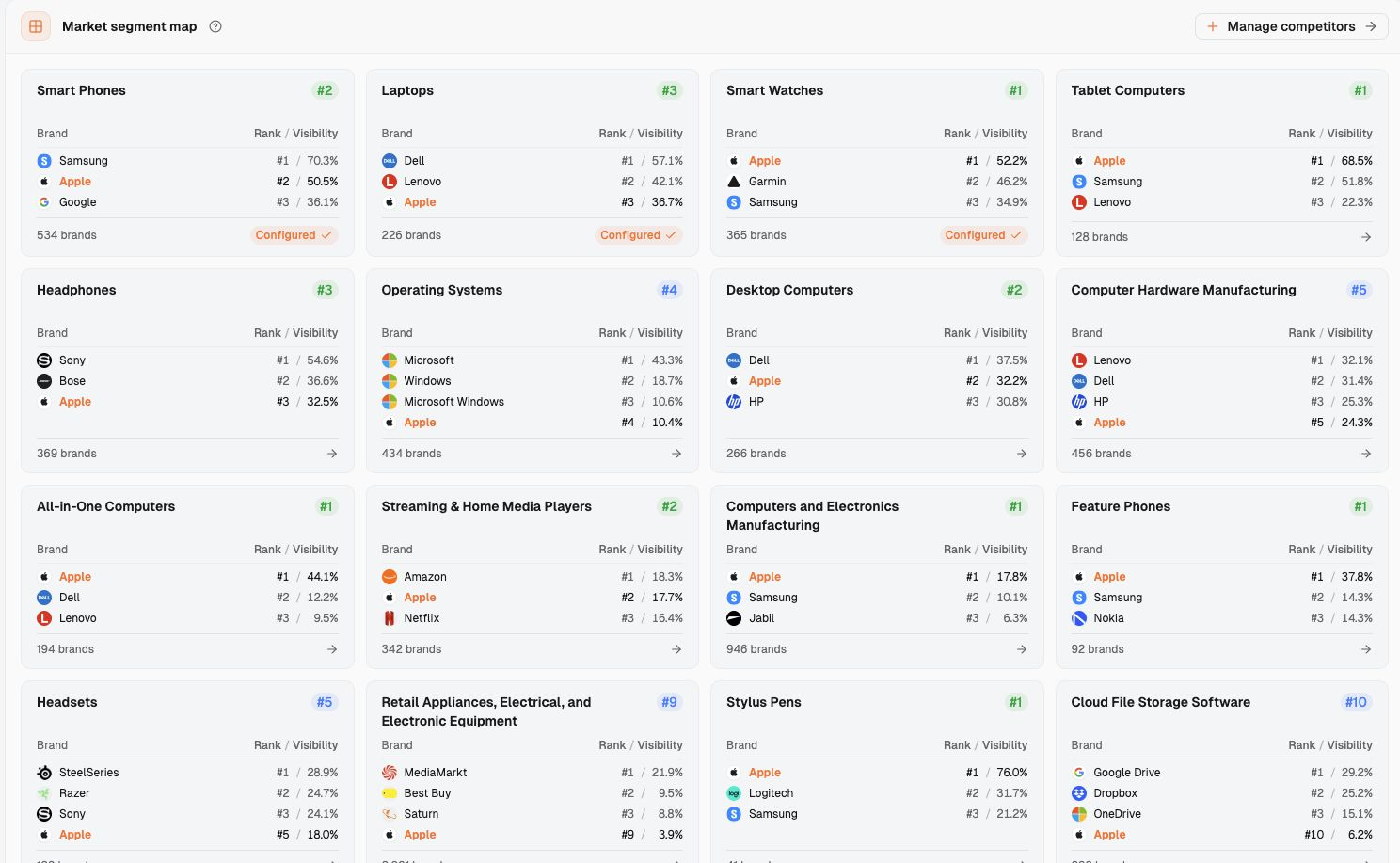
Take the Dageno demo workspace as an example (Apple is only a sample brand; this does not mean Apple is a Dageno customer). The Market segment map puts one brand’s position in different categories side by side: Apple ranks #1 in Smart Watches and #3 in Headphones, where Sony leads with 54.6%. Before you enter a new category, first see who leads in the answers for that category.
Figure 1. Market segment map: the same brand’s position varies widely across categories.
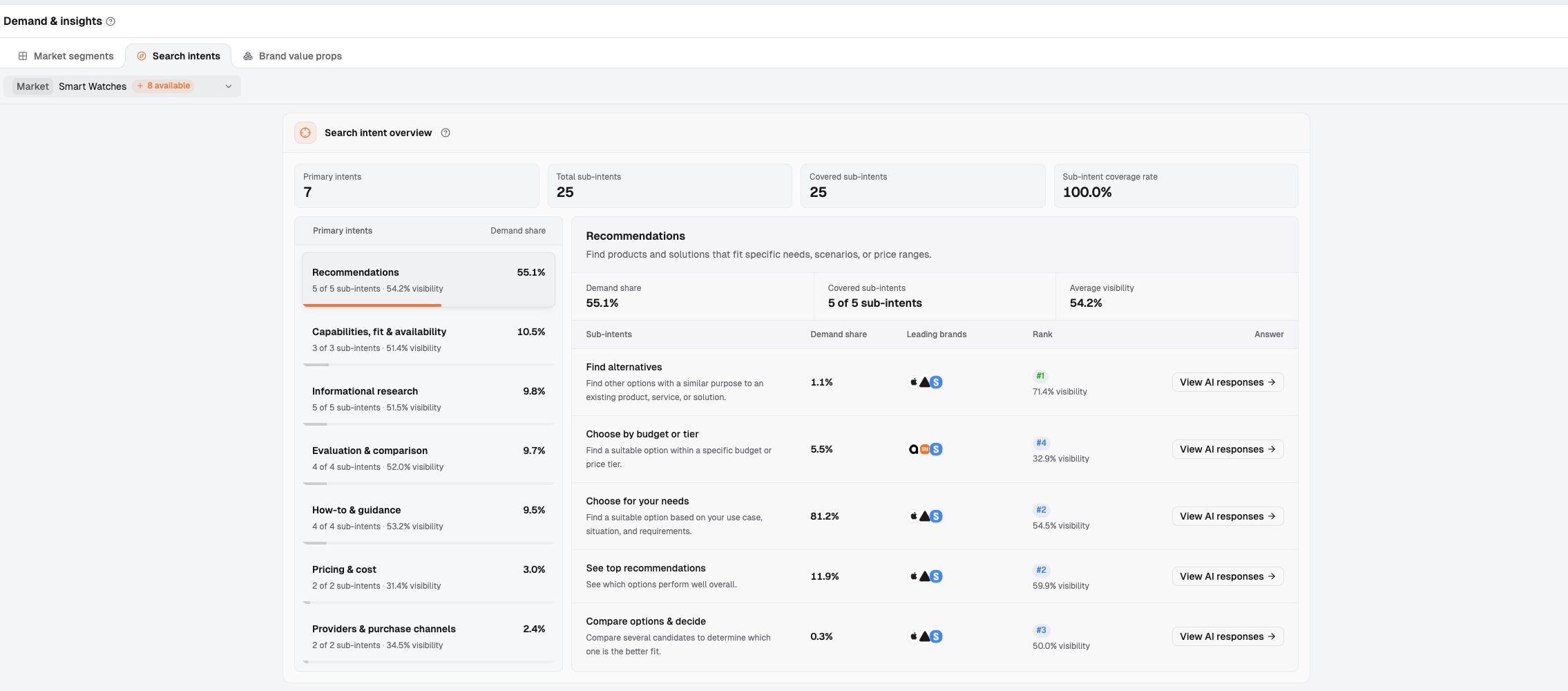
In the Search intents view for the Smart Watches market, the analyzed questions fall into 7 primary intents and 25 sub-intents. Recommendations has a demand share of 55.1%, and within it, Choose for your needs accounts for 81.2%. Capabilities, fit & availability is at 10.5%, Evaluation & comparison at 9.7%, Pricing & cost at only 3.0%, and Providers & purchase channels at 2.4%.
Figure 2. Search intent overview: Recommendations accounts for 55.1% of the analyzed questions.
These numbers seem to conflict with the surveys above: in the surveys, price comparison is the most common use, but here Pricing & cost is only 3.0%. One possible explanation is that budget is often written into selection questions rather than asked as a separate price question: Choose by budget or tier is a sub-intent under Recommendations, at 5.5%. This is a guess. What it means for content is that price information belongs inside your selection and comparison content, not only on a standalone pricing page.
Demand share describes how the analyzed questions are distributed; it is not search volume or real purchase demand. The Market entry analysis page also states that AI answer visibility and AI Search Intents “do not measure total demand, market share, revenue, or buyer preference.” Whether to enter still requires first-party evidence plus product, financial, channel, and compliance review.
Often-overlooked variables, biases, and costs
Treating translations as local questions: translated questions only show how the same task is phrased in the local language. They don’t reflect local budgets, channels, or wording.
Drawing conclusions from one sample: in FTA Global’s test, only 35% of conditions had the same top-recommended brand across all 5 runs. Before you judge which questions appear consistently, sample repeatedly.
Treating self-reported surveys as market facts: the consumer surveys cited here are all self-reported and cover only the UK, Ireland, and some European countries. They are useful for listing candidate question types, not for ranking them in your target market.
Publishing before facts are confirmed: update your content whenever prices, available models, delivery, or warranty change. Put the owner of each local fact and the date it was last checked into the content plan, or your first content will go stale quickly.
Looking only at your own website: AI cites local review, retail, and price comparison sites. Your first-content plan should list these third-party sources and what accurate information your brand can give them.
Where the researchers stand: FTA Global and Peec AI, both cited here, provide GEO or AI visibility services, and so does Dageno. Their conclusions point the same way, but it is best to re-check them in your own market and category.
Costs grow with every market: each extra “country × language × platform” combination adds another round of sampling, native-speaker review, and fact maintenance. We suggest finishing and retesting the first content for one market before copying it to the next.
We have no local sales or support data yet. How do we tell which questions are asked first?
Start with public sources: local search suggestions, community discussions, and competitor content. Then sample AI answers repeatedly in the local language and location. Questions that appear in several sources and hold up across samples go on the candidate list first. You can also ask local partners or distributors which questions they hear most often.
How many pieces should the first batch include?
There is no universal number. Base it on how many local facts your team can verify, how much price and channel information it can maintain, and how many questions it can retest. We suggest covering the top few groups of selection, comparison, price, and channel questions first, then expanding after you retest.
Can we just translate our home-market content first?
As a first draft, yes, but not as your first content as it stands. Rewrite titles and questions to match local phrasing, swap in local prices, channels, and specifications, and have native speakers review it. If a piece exists in your home market but nobody asks about it in the new market, don’t bring it over.
How does first content differ between entering a new category and entering a new country?
When you enter a new country, your first content leans toward localized selection, price, and purchase information. When you enter a new category, you also need category buying guides and like-for-like comparisons with the category’s leading brands.
After the first content goes live, how do we tell whether it worked?
Retest with the same set of questions you used before publishing, on the same platforms and in the same regions and languages, and save the new answers and citations. A change in visibility or citations does not by itself prove the content caused it, so read it together with first-party data. For the detailed method, see AI Recommendations: Verify Improvement After Content Updates.
Conclusion
When you plan your first content before entering a new market, the key is to learn what local users ask at the start and whether you can answer it well there. Define the market, collect questions from local sources, rank them by evidence and fit, and match content to question types. Once these four steps are done, your first content has a starting point you can retest. Public data can help you list candidates, but only sampling in your target market can tell you which questions come first.
Dageno is the research and insights team at Dageno AI, publishing industry reports and expert analysis on AI Search Visibility, Generative Engine Optimization (GEO), and AI-powered search discovery.