How to Find New Demand in AI Questions That Keyword Tools Miss, and Decide Whether to Create Content
A question your keyword tool can't find may be new demand or an old need in new words. Check it against four tests, then decide whether you can answer it better than AI already does.
You can find it, but it takes two steps: first confirm that a question your keyword tool can't find reflects real demand, then judge whether you can answer it better than the AI answers that already exist.
Why tools miss it: keyword tools rely on historical search data, while questions asked in AI are longer, carry more conditions and rarely repeat word for word.
Where to look: customer verbatims, long-tail signals from Google, community discussions, the AI platforms themselves, third-party prompt data, and AI ads and product cards.
How to validate: the question shows up in at least two independent sources, carries clear decision conditions, is relevant to your business, and the current AI answers have a gap.
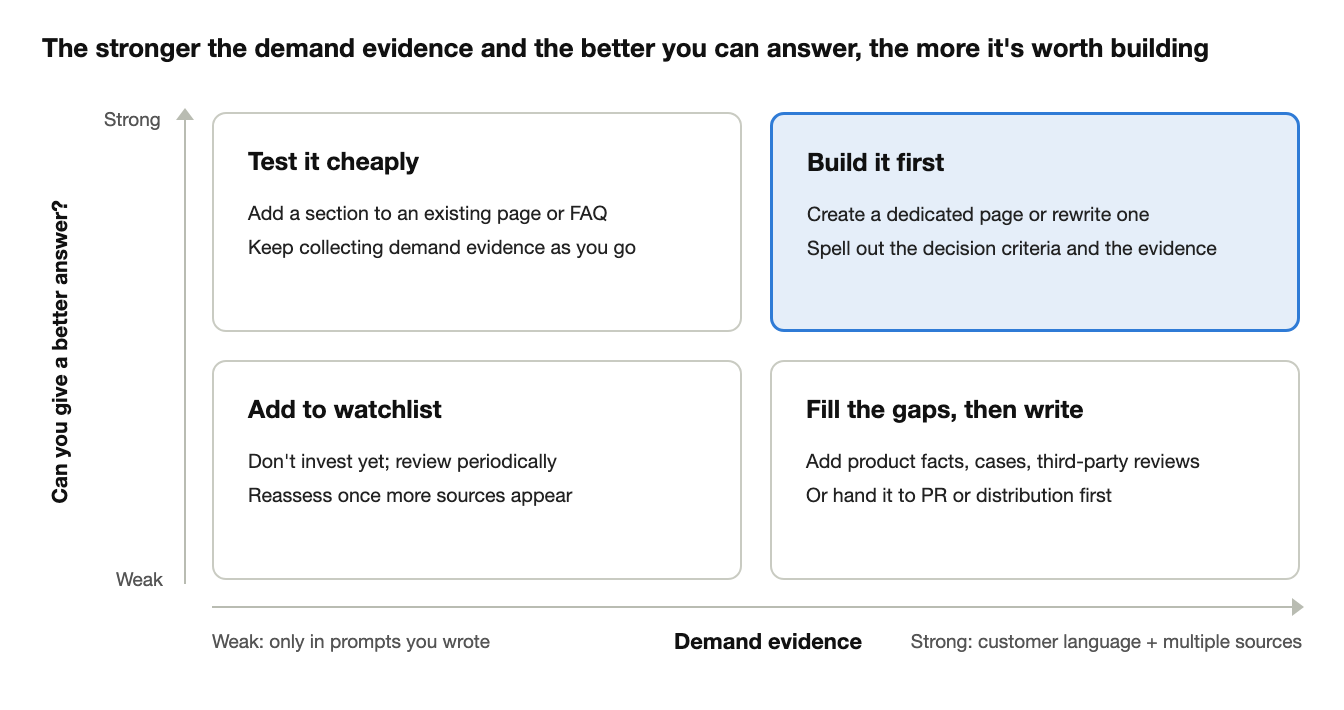
Whether to act: strong evidence and you can answer well, do it; weak evidence but you can answer well, test it cheaply; strong evidence but you can't answer well, fix the product facts and proof first; both weak, put it on a watch list.
Why keyword tools miss demand in AI
Keyword-tool search volume comes from historical search data: it counts how many times the same phrase was searched. Questions asked in AI are the opposite: long, specific and rarely repeated. That is why many of them show zero volume in a keyword tool, or don't appear at all.
A few public data points show how wide the gap is:
New questions keep appearing. In 2017 Google reaffirmed that about 15% of the searches it sees every day are new. According to Search Engine Journal, Google's John Mueller said in 2025 that the figure is still around 15%. No history means no search volume.
Questions in AI are longer. Robby Stein, VP of Product for Google Search, told TechCrunch in March 2025 that in testing, AI Mode questions were about twice the length of traditional searches, and users asked follow-ups about a quarter of the time. Semrush analyzed more than 80 million lines of clickstream data from the second half of 2024: ChatGPT prompts without search enabled averaged 23 words, versus 4.2 words with search enabled.
One need, many phrasings.SparkToro asked 142 participants to each write a prompt for the same buying intent; the average pairwise semantic similarity was only 0.081.
AI platforms don't publish prompt logs.Ahrefs states plainly that there is no significant, reliable data source on how people prompt AI. The generative AI performance reports Google Search Console introduced in June 2026 show impressions, pages, country, device and date, but not the text of users' questions.
There is evidence pointing the other way too. In 2022 Ahrefs ran a small-sample check on "zero-volume" keywords: a keyword estimated at about 10 monthly searches showed about 20 impressions over 28 days in Search Console. But among their own zero-volume keywords, fewer than 1% drove more than 100 impressions, with an average of just 11.3. In other words, "zero in the tool" usually isn't truly zero, but most of these queries really are small.
Our take: what keyword tools miss is mostly the phrasing, not necessarily the topic. Behind many long AI questions sits a parent topic that does have search volume, with added conditions like budget, use case or compatibility. Those conditions are what's worth finding.
Where AI user questions come from: six sources and their biases
No single source shows everything users ask AI. A more workable approach is to take part of the picture from several sources and check them against each other.
Source
How to collect
Strength
Bias and limits
1. Customer verbatims
Sales call notes, support tickets, site search, trial-user interviews
Real, and carries constraints like budget and use case
Skews toward existing customers; small volume
2. Google long-tail signals
Long question-style queries in Search Console, "People also ask", autocomplete
Real search behavior; trends over time
Covers Google only; Search Console only shows queries you already have impressions for
3. Communities and forums
Questions and complaints on Reddit, Quora and niche forums
Original wording; often exposes unmet pain points
Posters aren't necessarily buyers; loud isn't the same as many
4. The AI platforms themselves
Ask ChatGPT, Perplexity and AI Mode in your customers' voice; record how they break down the question, whom they recommend and what they cite
Shows the structure and gaps of AI answers
You wrote the questions, they aren't user logs; single answers vary a lot
5. Third-party prompt data
Prompt volumes estimated from panels or clickstream; prompt samples generated from your brand and market
Large scale; good for ranking topics
All estimated or generated; tools measure differently
6. AI ads and product cards
Which questions trigger ads or product cards, and which advertisers appear
Someone is paying, so commercial intent is stronger
Live only on some platforms and in some regions; limited coverage
In practice, customer verbatims deserve priority: they are the only source certain to come from prospects or existing customers. Use the other sources to widen the phrasing and estimate interest. Once you have a question, tag it: observed (users really asked it), derived (rewritten from a keyword or template) or pure hypothesis. That tag matters in the judgments that follow. Audra uses the same split in its comparison of keyword research and prompt research.
"No volume" is not "new demand": four checks
A question your keyword tool can't find may be new demand, or an old need in new words, or something nobody actually asks. Before you chase it, it should pass at least these four checks.
Is it an old need in new words? Split the question into a parent topic plus conditions. "Which docking station should I get for a mixed Mac and Windows setup, dual monitors, under $150?" has the parent topic "best docking station", which very likely has volume in your keyword tool. If that parent topic already has a page, the job may be to add these conditions to it rather than publish a new one.
Does it appear in two or more independent sources? For example, it shows up in support tickets and also gets asked in a community; or Search Console has similar long question queries and AI answers bring up the same condition on their own. A question that only appears in prompts you wrote yourself doesn't count.
Does it carry decision conditions? Budget, use case, audience, compatibility, alternatives, risk: the more specific these are, the closer the question is to a purchase decision. Pure "what is X" knowledge questions usually carry far less commercial value.
How well does AI answer it today? Ask the question several times across AI platforms. Vague answers, outdated sources, or recommendations that name competitors while you're missing are all content opportunities. If AI already answers it well and cites widely recognized authoritative pages, one more article rarely changes the answer.
Passing all four only means the question deserves serious attention. Whether to create content for it also depends on whether you can answer it well.
Deciding whether to create content: two questions
Whether a question deserves content comes down to two things: how strong the demand evidence is, and whether you can give a better answer than what already exists. This assumes the question is relevant to your business; if it isn't, don't write it no matter how strong the evidence.
Score the horizontal axis with the four checks from the previous section. The vertical axis asks whether you hold something others don't: first-party data, product facts, real cases, test results. If all you can do is reorganize answers that already exist online, AI has no reason to cite you and readers have no reason to click.
Once you decide to act, pick the format (our recommendations):
The parent topic already has a page: add the newly found conditions and Q&A to that page first, rather than publishing a new one that competes with it.
The question carries a clear comparison or alternative intent: build a comparison page or an alternatives page.
The question is narrow but keeps coming up: build a use-case page, a help article or an FAQ entry.
The question depends on third-party trust ("which one is more reliable"): rather than writing it yourself, earn reviews, case studies or genuine community feedback.
Using Dageno to collect, group and diagnose questions in one place
You can run the process above by hand, but once the question list grows, keeping the setup consistent and the evidence reviewable gets hard. Dageno helps at four points: getting questions, seeing coverage by intent, finding gaps, and turning decisions into content tasks.
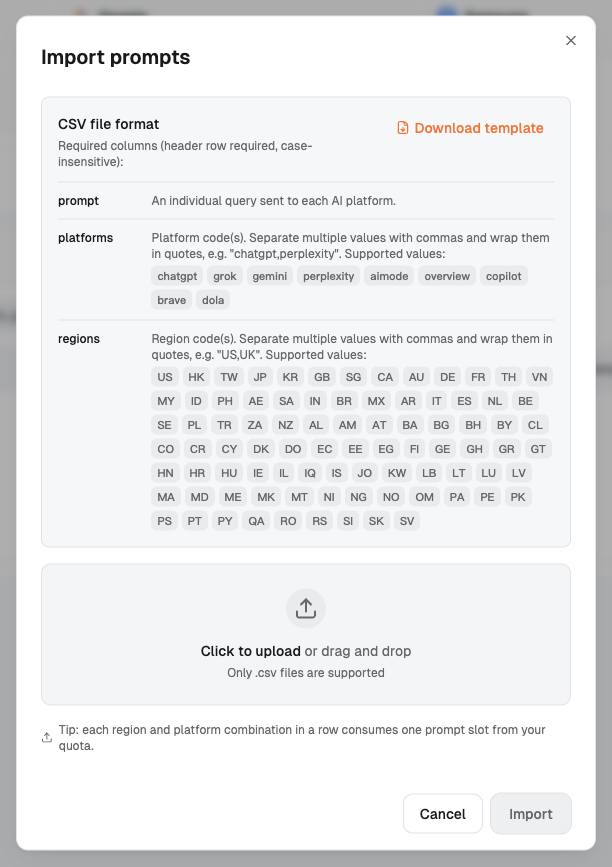
Start with a set of questions. The free Popular Prompt finder takes your website domain, core business line, language and region, and returns sample prompts in three types: demand, comparison and question. The page notes that these are not traditional search volume data. Prompt Volumes ranks topics by demand signals. Customer verbatims collected from sales and support can be imported in bulk via CSV and monitored by platform and region to see how AI answers them (Figure 1). Each region and platform combination uses one prompt slot from your quota, so screen the list before importing.
Figure 1 | Dageno Import prompts: add questions to monitor in bulk, by platform and region
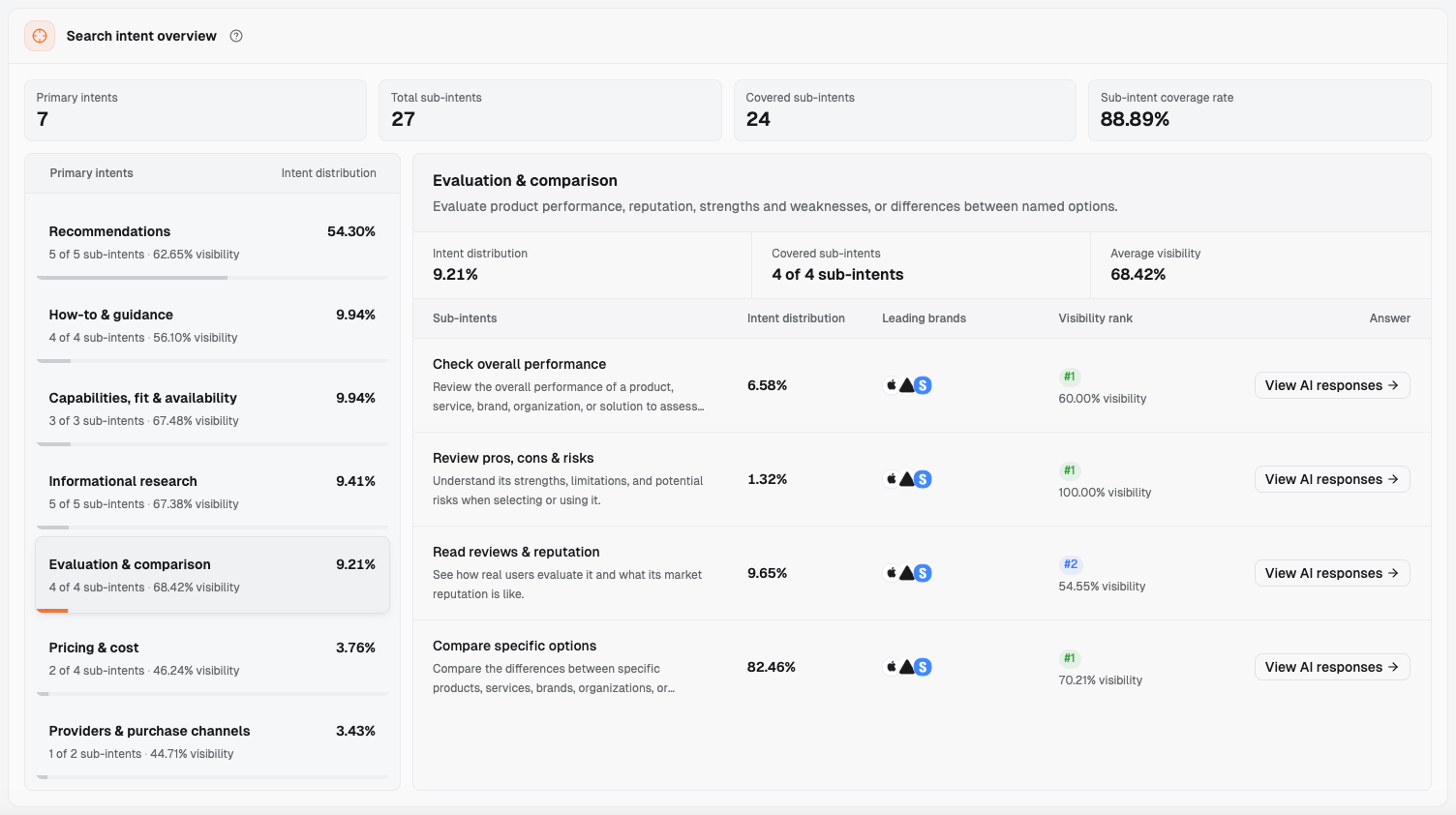
See which questions aren't covered, by intent.Search Intents groups questions into primary intents and sub-intents. The sample workspace in Figure 2 has 7 primary intents and 27 sub-intents, 24 of them covered; "Pricing & cost" covers only 2 of 4. Uncovered sub-intents are worth reviewing one by one: did the question set miss them, or is the brand absent from those answers? Intent distribution describes the tracked questions, not search volume.
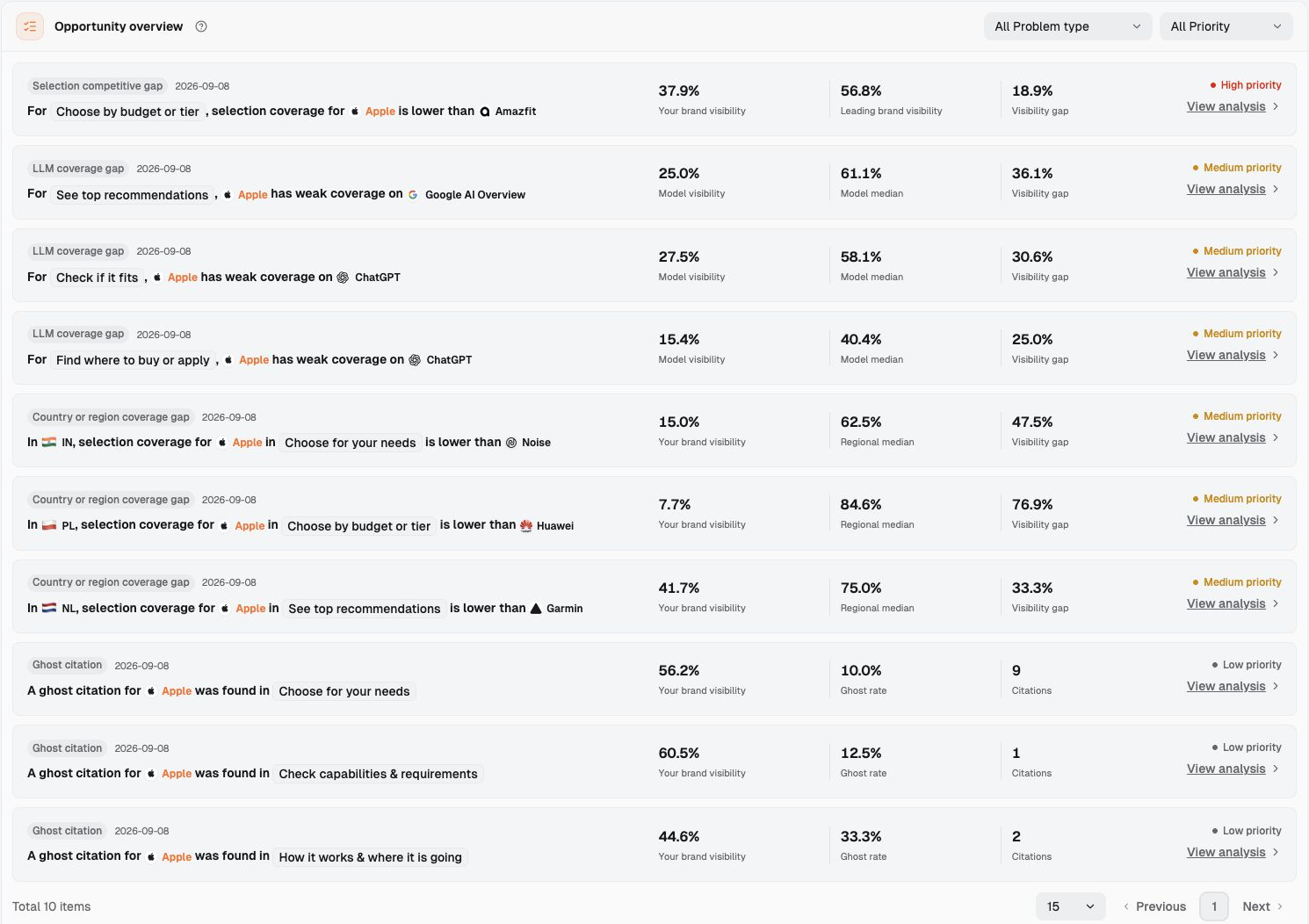
Find where the brand is missing.GEO/AEO gap diagnosis and Opportunity Gaps list the scenarios where a brand's visibility falls below a benchmark. Figure 3 shows the issue list for the smart watches market. The top item is a selection gap: for "Choose by budget or tier", Apple's visibility is 37.9% against 56.8% for the leading brand, Amazfit. Below it are model coverage gaps, such as "See top recommendations" on Google AI Overview, where Apple sits at 25.0% against a model median of 61.1%. These are exactly the candidates for the "can you answer it well" axis in the decision map: if the product genuinely fits that scenario but isn't mentioned, fix the facts and proof first; if it doesn't, don't write content for it. Priority sets the order of investigation; it isn't a confirmed business opportunity.
Turn decisions into content tasks.Content Actions draws on answer samples, cited sources, competitor positions and intent gaps to recommend creating, updating, adding evidence or distributing, and produces a writing brief; the Content Strategy page describes the full workflow. After publishing, re-test with the same question set and connect Search Console and GA4 to compare against your own data. If your team is stretched, Managed GEO/AEO services are also available.
Dageno's pages state the limits too: content recommendations don't replace fact-checking and don't guarantee changes in mentions, citations or traffic. What it provides is evidence about questions, answers and gaps; whether to act is still decided by the two questions in the decision map.
Overlooked variables, biases and costs
The same "new question" can turn into fake demand under a different setup. Before you write, run through these:
Question-design bias: prompts you write yourself tend to carry brand and industry jargon your customers may not use. Use customer verbatims as the baseline.
Generated prompts aren't user logs: treat any prompt sample generated from a brand or market as a hypothesis, including those from Dageno's own tools.
Most usage isn't about buying: the NBER working paper by OpenAI researchers and Harvard economist David Deming shows "Seeking Information" (including looking for purchasable products and recipes) accounts for 21.3% of ChatGPT messages, less than "Practical Guidance" or "Writing" (Deming's summary). Many questions that look "hot" may come from learning and writing, with nothing to do with purchases.
Platform and regional differences: a question tested on one AI platform in one region can't stand in for your target market.
Single answers are unreliable: the same SparkToro study found that if you ask the same prompt 100 times, there is less than a 1-in-100 chance ChatGPT or Google's AI returns the same brand list twice. Ask several times before judging how well AI answers.
Competing with yourself: a new page for one long question can easily compete with the existing parent-topic page for the same queries.
Cost isn't just writing: add fact-checking, long-term maintenance, monitoring quota and re-test time. The same resources spent updating a page that already gets traffic may pay off more reliably.
Results are hard to attribute: Search Console's generative AI reports give page-level impressions only, not which question drove them; and changes in AI answers aren't necessarily caused by your content.
Is a question with zero volume in my keyword tool still worth writing about?
It depends on whether it's a distinct need. Find its parent topic first: if the parent topic has volume and already has a page, add this question's conditions to that page. If it carries clear decision conditions, shows up across several sources and you can answer it well, it deserves its own content.
Can AI-generated "popular prompts" count as evidence of demand?
Not on their own. They're useful for widening the phrasing and surfacing scenarios you might have missed, but tag them as "derived" or "hypothesis" and validate them with customer verbatims, search data or community discussions.
How many sources does a new question need before it counts?
There's no universal threshold. "At least two independent sources" is the starting point we recommend. The bigger the investment (a set of pages, a new market), the more evidence you need, ideally including customer interviews or sales data.
Should I create a new page or update an existing one?
If the parent topic already has a page, update it first. Only create a comparison, alternatives or use-case page when the new question's intent clearly differs from the existing page (for example, shifting from "how do I choose" to "is A or B better").
After publishing, how do I know whether it worked?
Re-test regularly with the same question set on the same platforms and in the same regions, and check whether the brand and page appear in answers. Then look at the page's impressions in Search Console's generative AI report, plus visits and key events from AI platforms in GA4. Treat changes as signals, and don't attribute a single fluctuation to one piece of content.
Conclusion
Keyword tools tell you which topics people search for; questions in AI tell you what conditions people bring when they choose. The two don't replace each other. Use AI questions to find the conditions keyword tools can't see, confirm with several sources that they're real, then ask whether you can answer better than the existing answers. Write only after all three steps check out.
To see the AI questions, brand coverage and cited sources in your own market, run a free check.
Dageno is the research and insights team at Dageno AI, publishing industry reports and expert analysis on AI Search Visibility, Generative Engine Optimization (GEO), and AI-powered search discovery.