7 Best SISTRIX AI Visibility Alternatives in 2026
Compare seven SISTRIX alternatives for AI visibility using answer evidence, citations, competitors, markets, integrations, reporting depth and workflow fit.
Track AI search visibilityNo install

Updated by
9 Min Read
Updated on Sep 11, 2026
SISTRIX remains a respected SEO suite, especially for traditional search visibility and competitive analysis. Teams usually seek an alternative when AI-search monitoring—not classic SEO—is the primary job: they need repeatable custom prompts, answer evidence, citations, competitor recommendations, sentiment, several engines or markets, and an execution workflow.
This comparison covers seven credible options. Pricing, engine coverage, and plan allowances change frequently, so we avoid hard-coding figures that may be obsolete. Verify current limits on each vendor's official site before buying.
Best SISTRIX AI Visibility Alternatives at a Glance
| Alternative | Best for | Main advantage over a classic SEO-first workflow | Check before buying |
|---|---|---|---|
| Dageno | Monitoring connected to GEO execution | Prompts, answers, citations, competitors, opportunities, and content workflow | Required engines, markets, refresh rate, and exports |
| Ahrefs Brand Radar | Large-scale market and competitor research | AI visibility inside broad search and backlink intelligence | Dataset research versus fixed-prompt monitoring |
| Semrush | Existing Semrush customers | AI and traditional SEO in one operating environment | Domain, user, prompt, engine, and market allowances |
| Profound | Enterprise AI-search programs | Deep analytics, governance, and enterprise workflows | Sales-led scope, implementation, retention, and API access |
| Peec | Focused marketing dashboards | Clear prompt, source, sentiment, and competitor analysis | Prompt credits, locations, languages, and evidence export |
| Otterly | Lean teams and pilots | Straightforward prompt and citation monitoring | Reporting depth, history, collaboration, and scale |
| SE Visible | Agencies and multi-project teams | Accessible competitive reporting | White-label, permissions, exports, and localization |
When Should You Replace or Keep SISTRIX?
Keep SISTRIX if its Visibility Index, Google competitor research, links, keywords, and audits are central to your workflow and AI visibility is secondary. Adding a specialist tool may be better than replacing a mature SEO stack.
Consider switching when the team needs a stable custom prompt portfolio, full answer snapshots, owned and third-party citation URLs, recommendation position, sentiment, multi-engine comparisons, or a direct path from observed gaps to content and distribution work.
Run a proof of concept with the same 30–50 prompts, brands, competitors, market, and language. Compare evidence and decisions—not vendor dashboard aesthetics.
1. Dageno — Best for Monitoring-to-Execution GEO Workflows
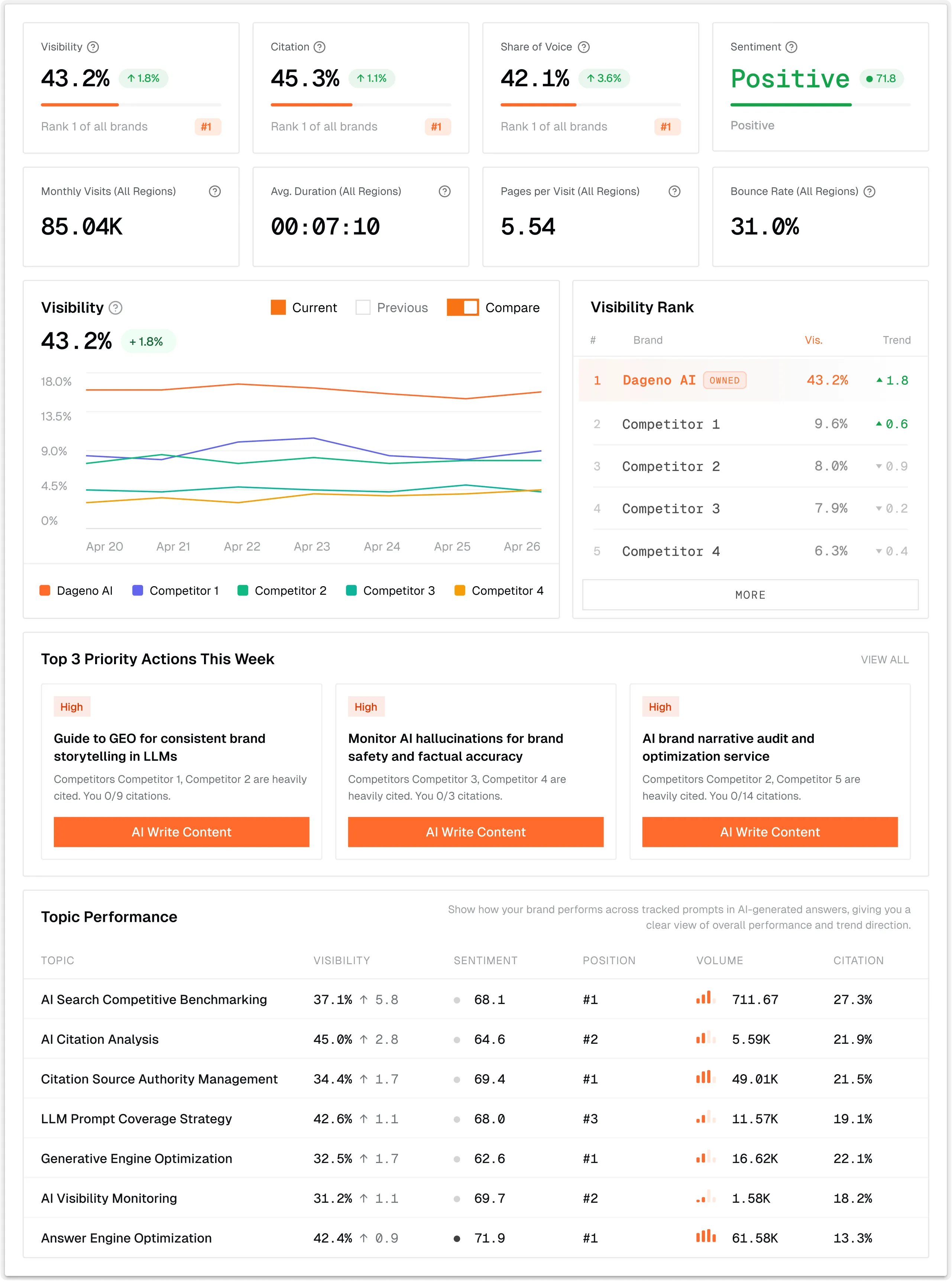
Dageno is designed around AI-search visibility rather than adding it to a legacy rank tracker. It combines prompt discovery, answer monitoring, citations, competitors, share of voice, content opportunities, and optimization workflows.
Why choose it over SISTRIX: the team can move from “we are missing” to the prompt, answer, cited source, competing page, and next action in the same operating model. Prompt Volumes Explorer supports prioritization, while Answer Engine Insights supports diagnosis.
Limitations to check: confirm exact engine, country, language, history, refresh, and export requirements for the selected plan. No AI visibility tool observes every personalized user conversation.
Best fit: in-house SEO, content, product marketing, and GEO teams that need monitoring to create accountable work.
Ready to dominate AI search?
Get started - it's free! >2. Ahrefs Brand Radar — Best for Broad Market Research

Ahrefs Brand Radar is attractive for teams already using Ahrefs. It connects brand visibility in AI and the wider web with established keyword, backlink, content, and competitor data.
Why choose it: broad market exploration and the ability to investigate the search and authority context around brands and topics.
Limitations to check: large pre-collected datasets and repeatable custom-prompt tracking solve different problems. Confirm whether you need research, monitoring, or both, and review current add-on requirements.
Best fit: SEO teams whose AI-search analysis must remain close to backlink and organic-search research.
3. Semrush — Best for an Integrated SEO Suite

Semrush AI Visibility Toolkit places AI visibility near keyword, competitor, site-audit, and content workflows. For an existing customer, operational consistency may outweigh adopting a standalone platform.
Why choose it: fewer disconnected tools and familiar reporting for teams that already standardize on Semrush.
Limitations to check: do not assume every subscription includes the same AI features. Verify domains, users, prompts, engines, locations, history, and export access.
Best fit: SEO-led teams seeking one suite for traditional and AI search.
4. Profound — Best for Enterprise Programs
Profound is positioned for organizations that require deep answer-engine analytics, citation intelligence, competitive reporting, and enterprise workflows across substantial programs.
Why choose it: organizational depth and reporting suitable for multiple stakeholders, business units, brands, or markets.
Limitations to check: obtain a written scope for models, locations, languages, implementation, data retention, API/export access, onboarding, and support. Public pricing alone may not reflect the total enterprise engagement.
Best fit: large organizations with dedicated search, brand, analytics, and communications teams.
5. Peec — Best Focused Dashboard for Marketers

Peec focuses on prompt-level visibility, mentions, sentiment, citations, and competitor analysis. It can be easier for a marketing team to adopt than an expansive SEO platform.
Why choose it: clear, purpose-built AI-search reporting and source analysis.
Limitations to check: verify how credits are consumed, location and language coverage, repeated-run methodology, full-answer retention, and exports.
Best fit: B2B marketing and SEO teams with a defined prompt taxonomy.
6. Otterly — Best for Lean Teams and Pilots
Otterly offers an approachable way to monitor selected prompts, brand mentions, cited links, and competitor visibility.
Why choose it: a small team can establish a repeatable pilot without buying a broad traditional SEO suite.
Limitations to check: evaluate segmentation, collaboration, history, alerting, exports, and stakeholder reporting before scaling to many products or markets.
Best fit: startups, consultants, and growth teams proving the value of AI visibility monitoring.
7. SE Visible — Best for Agencies and Multi-Project Reporting
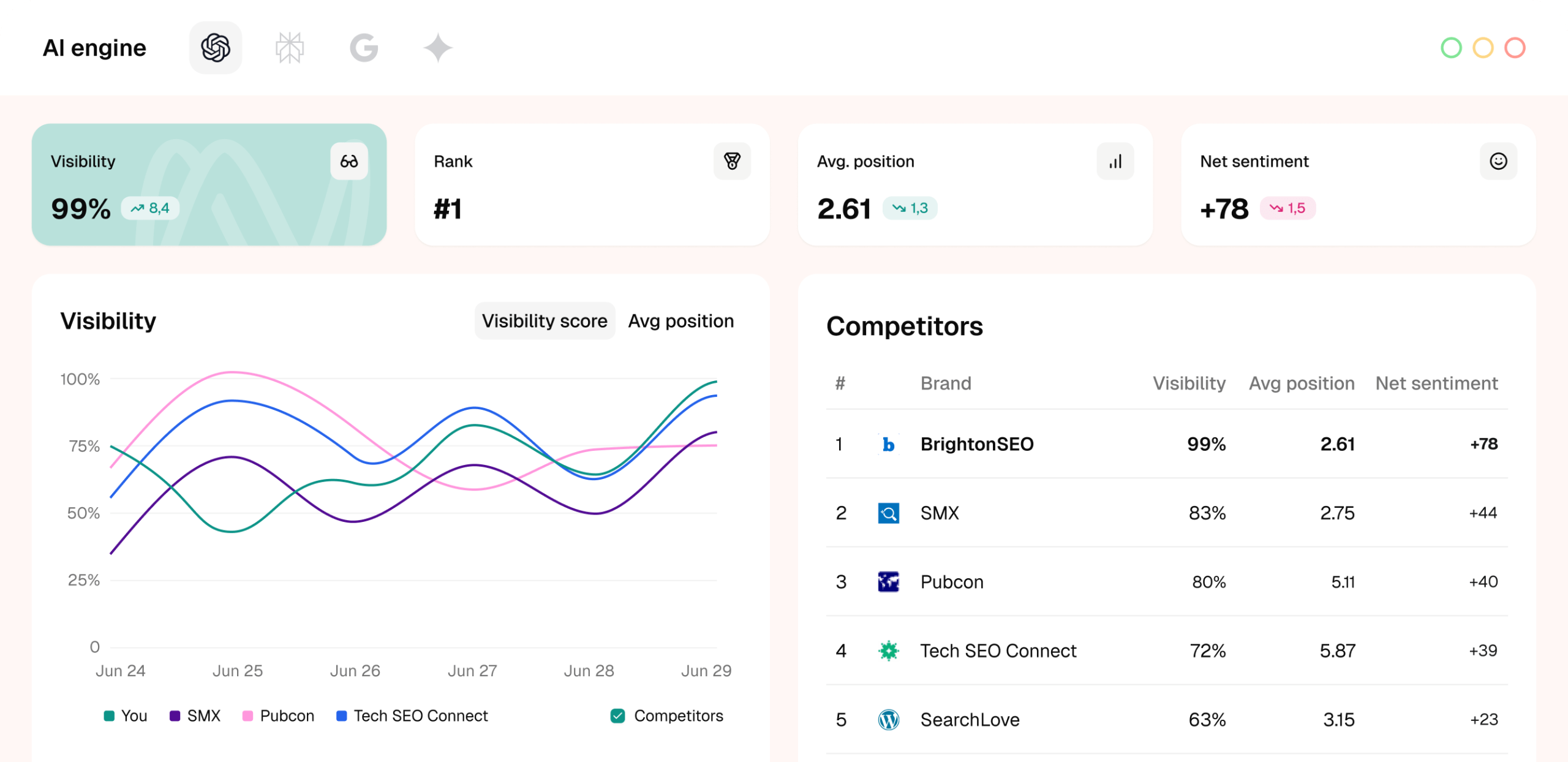
SE Visible provides AI-search visibility, citation, answer-position, and competitor reporting in a format suited to familiar SEO operations.
Why choose it: approachable project-based reporting for consultants or agencies managing several brands.
Limitations to check: confirm client permissions, white-label reports, exports, local-market support, prompt limits, and how billing scales across projects.
Best fit: agencies, consultants, and SMB teams that prioritize accessible reporting.
How to Compare the Alternatives Fairly
Use identical inputs during every trial:
- Select 30–50 prompts across category, comparison, alternatives, capability, and trust intent.
- Fix the country, language, brand aliases, and competitor set.
- Run the trial during the same period.
- Verify that every metric opens to the full answer, citation, engine, and timestamp.
- Test exports and stakeholder access.
- Convert three observed gaps into real actions and assess workflow quality.
Score market research separately from fixed-prompt monitoring. Also separate observation from execution: a platform may diagnose well but still require other systems for technical changes, content production, digital PR, reviews, or community work.
Decision Guide
- Choose Dageno when monitoring must lead to prompt research, content opportunities, and measurable GEO execution.
- Choose Ahrefs Brand Radar for broad brand and market exploration within Ahrefs.
- Choose Semrush when an integrated SEO suite is the main requirement.
- Choose Profound for enterprise depth and governance.
- Choose Peec for a focused marketing analytics experience.
- Choose Otterly for a lean monitoring pilot.
- Choose SE Visible for agency and multi-project reporting.
For more options, read the best LLM tracking tools comparison and AI visibility checker procurement guide. Teams focused on citations can use the citation authority tools guide.
FAQs
What is the best SISTRIX alternative for AI visibility?
It depends on the job. Dageno is suited to monitoring-to-execution workflows; Ahrefs and Semrush connect AI data with broad SEO suites; Profound targets enterprise programs; Peec offers focused analytics; Otterly supports lean pilots; and SE Visible suits agencies.
Do I need to replace SISTRIX?
Not necessarily. If SISTRIX remains valuable for traditional search, use a specialist AI visibility platform alongside it. Replace it only when the overlap, cost, workflow, and reporting requirements justify consolidation.
Should pricing determine the choice?
Pricing matters, but allowances matter more. Compare domains, projects, users, prompts, engines, markets, languages, refresh frequency, history, exports, and support. Verify current terms directly because packages change.
Can any tool measure every AI answer?
No. AI answers can be personalized, variable, and dependent on surface or context. A monitoring tool creates a controlled sample. Its value depends on a transparent method, stable cohorts, and retained answer evidence.
About the Author

Updated by
Tim
Tim is the co-founder of Dageno and a serial AI SaaS entrepreneur, focused on data-driven growth systems. He has led multiple AI SaaS products from early concept to production, with hands-on experience across product strategy, data pipelines, and AI-powered search optimization. At Dageno, Tim works on building practical GEO and AI visibility solutions that help brands understand how generative models retrieve, rank, and cite information across modern search and discovery platforms.
Related Articles
10 Best White Label AI SEO Software in 2026: Top Tools Compared

Ye Faye • Apr 10, 2026
Amazon Rufus AI Optimization: Complete Guide for AI Shopping Visibility
Ye Faye • May 07, 2026
PR for AI Search Visibility: How Earned Media Drives AI Citations in 2026
Dageno • Apr 02, 2026
Best AI Search Monitoring Tools for Marketers
Tim • Apr 08, 2026