The best LLM tracking tool must expose the answer behind every score. Dageno is strongest for evidence-to-action GEO workflows; Profound for enterprise answer intelligence; Peec for structured marketing dashboards; Scrunch for agent experience and site readiness; Otterly for lightweight self-serve monitoring; SE Visible for existing SEO teams; Authoritas for custom research design; and Semrush for suite integration.
Best LLM Tracking Tools Compared
Tool
Best for
Standout capability
Limitation to check
Dageno
Evidence-linked GEO actions
Prompts, citations, competitors, URLs and SEO context
Not a classic rank tracker
Profound
Enterprise intelligence
Granular answers, citations, APIs and governance
Higher cost and implementation
Peec
Marketing dashboards
Daily prompt, position, sentiment and source reporting
Plan capacity across markets/models
Scrunch
Agent experience
Visibility plus crawler, referral and site readiness
More technical and enterprise-oriented
Otterly
Lightweight monitoring
Fast setup for mentions, links and citations
Less enterprise governance
SE Visible
Existing SEO teams
AI monitoring beside SEO reporting
Product/add-on packaging can be confusing
Authoritas
Custom research
Persona, market and branded/unbranded segmentation
Requires research design
Semrush
Suite integration
AI findings beside keyword, audit and competitor data
Domain, prompt and add-on limits
LLM Visibility Tracking Is Not LLM Observability
Marketing-focused LLM tracking monitors whether a brand is mentioned, recommended, or cited in generated answers. Developer observability records application prompts, responses, latency, tokens, errors, and cost inside systems you operate. Both use “LLM tracking,” but they solve different buyer problems.
This guide compares AI-search visibility platforms. A defensible tool should preserve prompt, answer, timestamp, model/surface, market, language, brand matching, competitors, and citations.
How We Evaluated the Tools
We assessed evidence access, model and regional controls, competitor handling, citation reporting, repeatability, history, exports, APIs, integrations, actionability, and the cost of a real prompt × engine × market × language workload. Features and pricing change, so confirm current limits with each vendor.
8 Best LLM Tracking Tools in 2026
1. Dageno — Best for Evidence-Linked GEO Actions
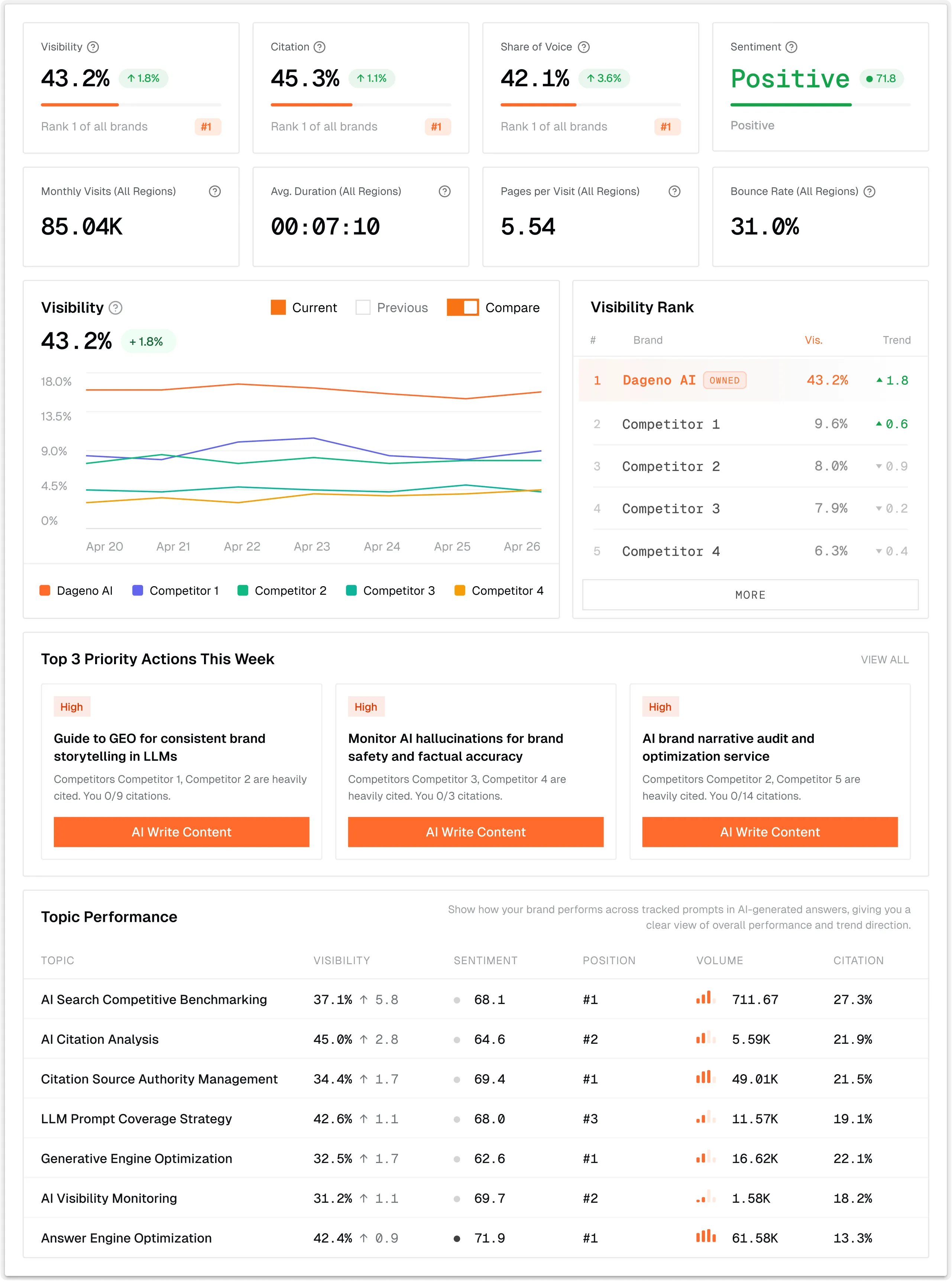
Dageno connects monitored AI answers with competitors, brand perception, citation sources, important URLs, demand scenarios, GEO/AEO gaps, and GSC/GA4 context.
Where it stands out: teams can trace a visibility gap to an exact prompt and source pattern, then decide whether to improve a page, publish a missing comparison, clarify an entity, or strengthen external evidence. Answer Engine Insights and Prompt Volumes Explorer connect evidence with prioritization.
Limits to check: it complements rather than replaces daily Google ranking, backlink indexes, or technical crawlers. Validate model, country, language, prompt, retention, export, and refresh allowances.
Best fit: brands and agencies that need monitoring to produce a documented content or citation action.
2. Profound — Best for Enterprise Answer Intelligence
Profound's Answer Engine Insights covers visibility, share of voice, citations, sentiment, topics, prompts, regions, and answer engines, with broader workflows for prompt demand, agent analytics, crawler behavior, page health, and content.
Where it stands out: eligible customers can work with granular answer/citation data, APIs, security controls, and enterprise integrations. This is useful for analysts building warehouse or BI reporting.
Limits to check: entry packages may not represent the full enterprise story. Verify raw-data access, engines, regions, prompts, companies, seats, and total production cost.
3. Peec AI — Best for Structured Marketing Dashboards
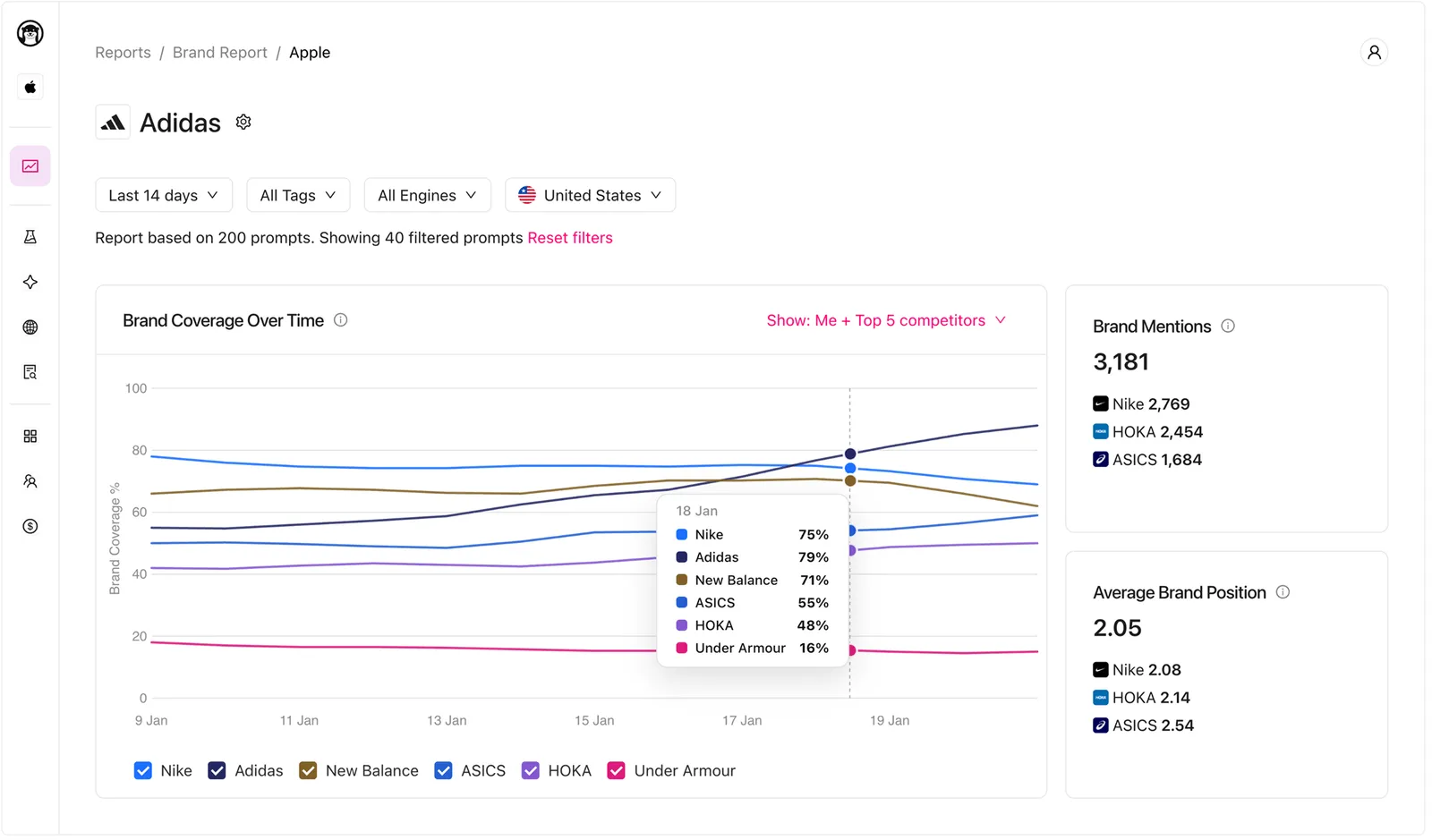
Peec tracks visibility, position, sentiment, competitors, and cited sources across selected AI platforms, with a workflow designed for recurring marketing reporting.
Where it stands out: topic and competitor views are clear enough for stakeholder reporting. Higher tiers can add multi-country work, Looker Studio, APIs, referrals, crawl insights, or shopping analysis.
Limits to check: prompts may cover only selected models or projects. Price the full workload and ask how “position” is defined when an answer is not an ordered list.
Best fit: marketing teams wanting clean recurring dashboards. See Peec AI.
4. Scrunch AI — Best for Agent Experience and Site Readiness
Scrunch combines visibility monitoring with citations, site audits, AI-bot and referral traffic, shopping answers, and an Agent Experience Platform.
Where it stands out: it can investigate not only “Are we mentioned?” but also whether agents can retrieve and interpret important pages. This is valuable when technical access is part of the problem.
Limits to check: differentiated delivery and governance capabilities may require enterprise scope and technical ownership. It may be excessive for a small ChatGPT-only prompt panel.
Best fit: mid-market and enterprise teams combining monitoring with site readiness. Review Scrunch AI.
5. Otterly AI — Best Lightweight Self-Serve Tracker
Otterly focuses on prompt monitoring, mentions, citations, links, competitors, and answer-engine visibility with a low-friction self-serve workflow.
Where it stands out: small teams can establish recurring measurement without an enterprise deployment. Citation and link observations distinguish being named from being used as a source.
Limits to check: confirm complete answer retention, raw exports, alias rules, regions, languages, collaboration, and reporting before scaling many brands.
Best fit: small and mid-sized SEO or content teams. See Otterly AI.
6. SE Visible — Best for Existing SEO Teams
SE Visible and SE Ranking's related AI features cover visibility, position, sentiment, competitors, sources, aliases, prompt management, exports, and comparisons.
Where it stands out: an existing SE Ranking customer can align AI-search observations with rankings, audits, and client reports.
Limits to check: SE Visible, AI Results Tracker, and add-on terminology can obscure what is included. Verify engines, prompt/check units, response history, citations, markets, and exports.
Authoritas supports configurable branded and unbranded question research segmented by category, persona, language, and location, alongside established SEO workflows.
Where it stands out: experienced analysts can design a market study rather than accept a default prompt set. Separating branded and unbranded questions prevents brand-awareness prompts from inflating discovery visibility.
Limits to check: flexibility requires governance. Define personas, taxonomy, frequency, classification, and reporting before collection.
8. Semrush AI Visibility Toolkit — Best for Suite Integration
Semrush connects AI-search research with its established keyword, competitor, backlink, audit, content, and reporting environment.
Where it stands out: existing subscribers can investigate AI visibility without creating an isolated reporting stack, then move from findings into familiar SEO research.
Limits to check: distinguish free reports, the AI Visibility Toolkit, and broader suite packaging. Confirm domain, user, prompt, engine, market, evidence, history, and add-on limits.
Best fit: teams already standardized on Semrush. See Semrush AI Search.
How to Choose the Right LLM Tracker
Define the prompts and buyer decisions the program must monitor.
Require full answers, citations, timestamps, and model/market context behind scores.
Test brand aliases and ambiguous names.
Repeat identical prompts to understand variability.
Compare prompts × engines × markets × languages × refreshes.
Confirm history, exports, API access, permissions, and ownership.
Evaluate the action layer: content, source, entity, technical, or reputation.
At minimum: mentions, recommendations, citations, competitors, sentiment, answer evidence, prompt, model/surface, market, language, and timestamp.
Do LLM tracking tools replace SEO tools?
No. SEO tools measure queries, rankings, backlinks, crawling, and traffic. LLM trackers measure generated answers. Join both datasets at the topic, page, market, and date level.
Which LLM tracking tool is best for agencies?
The answer depends on client count, white labeling, exports, prompt capacity, regions, and action workflow. Dageno suits evidence-to-action GEO work; SE Visible and Semrush suit agencies already using those SEO ecosystems.
Bottom Line
Choose a tracker whose evidence your team can audit and act on. The most polished score is not useful if analysts cannot open the answer, verify the citation, understand the sample, or assign the next action.
Ye Faye is an SEO and AI growth executive with extensive experience spanning leading SEO service providers and high-growth AI companies, bringing a rare blend of search intelligence and AI product expertise. As a former Marketing Operations Director, he has led cross-functional, data-driven initiatives that improve go-to-market execution, accelerate scalable growth, and elevate marketing effectiveness. He focuses on Generative Engine Optimization (GEO), helping organizations adapt their content and visibility strategies for generative search and AI-driven discovery, and strengthening authoritative presence across platforms such as ChatGPT and Perplexity