10 Best AI Search Monitoring Tools in 2026 (Compared)
Compare 10 AI search monitoring tools for citations, prompts, competitors, locations, integrations, pricing, and the ability to turn visibility data into action.
AI search visibility tools help brands measure whether they are mentioned, cited, recommended, or ignored in answers from ChatGPT, Google AI Overviews and AI Mode, Gemini, Perplexity, Copilot, Claude, and other AI search experiences.
Short answer: Dageno AI is our best overall choice for SEO and marketing teams that want to connect AI search monitoring with competitor analysis, citation intelligence, content opportunities, regional visibility, and optimization actions. Profound is a strong enterprise choice for deep prompt and answer intelligence. Scrunch AI is well suited to teams that also care about AI crawler and agent accessibility. Semrush and Ahrefs Brand Radar make sense when AI visibility needs to fit into an existing SEO stack, while OtterlyAI is an accessible option for teams starting with prompt and citation monitoring.
The best platform, however, depends on what you actually need to do after finding a visibility gap.
Editorial disclosure: Dageno publishes this comparison and Dageno AI is included in it. We evaluate platforms by the workflow they support rather than treating visibility scores from different vendors as directly interchangeable. Product coverage, pricing, model support, APIs, and plan limits can change, so verify current details before buying.
Best AI Search Visibility Tools at a Glance
Rank
Platform
Best for
Main strength
Main consideration
1
Dageno AI
SEO and marketing teams that need monitoring plus action
Connects AI visibility, citations, competitors, market intelligence, content opportunities, and optimization workflows
Does not replace every specialist technical SEO or backlink tool
2
Profound
Enterprise AI search intelligence
Deep prompt, answer, citation, audience, and competitive intelligence
More platform than many small teams need
3
Scrunch AI
AI visibility plus crawler and agent accessibility
Connects answer visibility with technical AI-agent signals
Advanced programs may require engineering ownership
4
AthenaHQ
Cross-functional GEO programs
Brings AI search research, monitoring, and optimization into a broader workspace
Requires a clear internal GEO operating process
5
Semrush
SEO teams already using Semrush
AI visibility within a broad SEO and competitive workflow
A specialist GEO team may want deeper dedicated workflows
6
Ahrefs Brand Radar
Large-scale AI visibility and competitor research
Strong mention, citation, prompt, and share-of-voice research
Research findings still need to be converted into actions
7
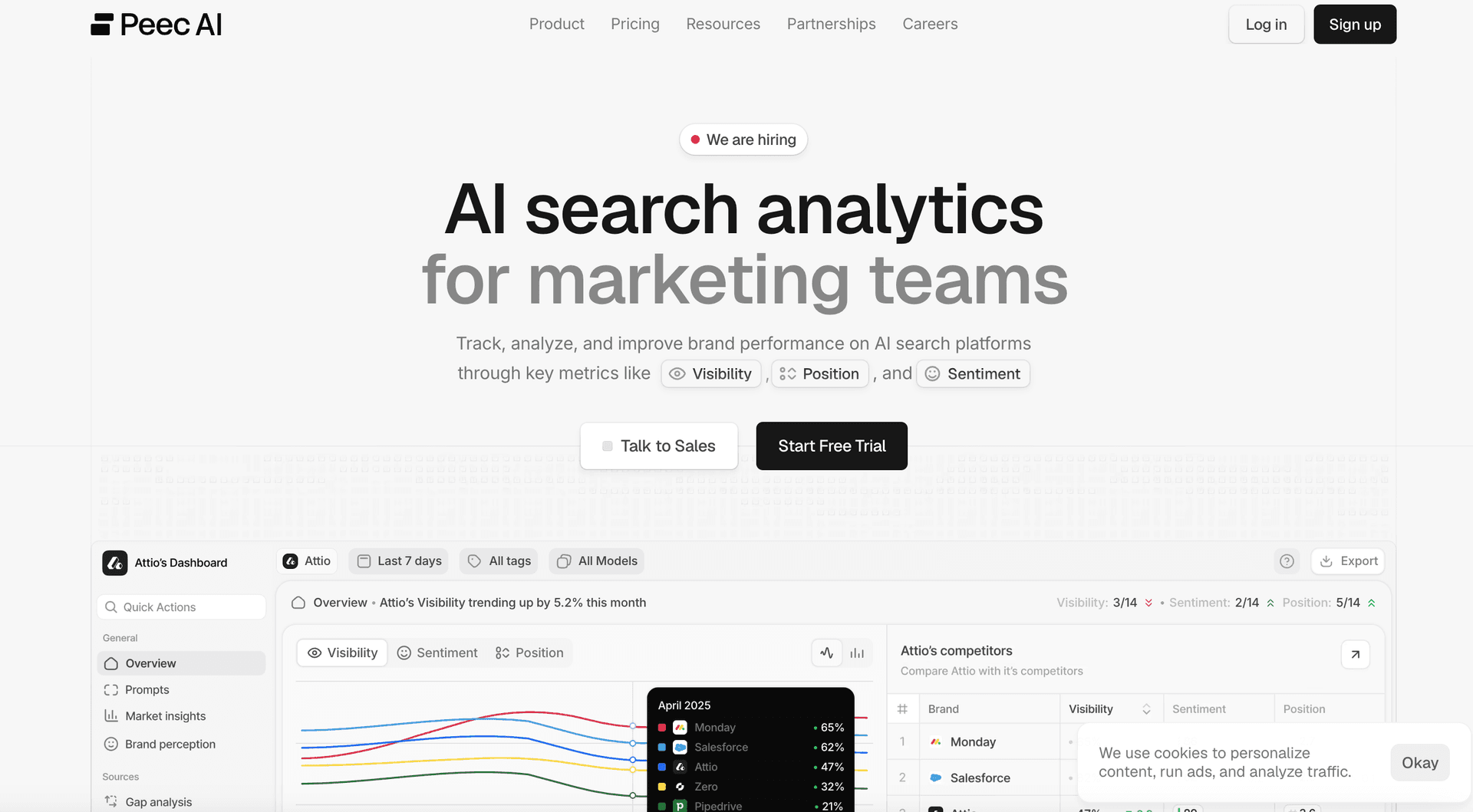
Peec AI
Focused AI search analytics
Clear prompt, source, visibility, and competitor analysis
Wider SEO execution may remain in other tools
8
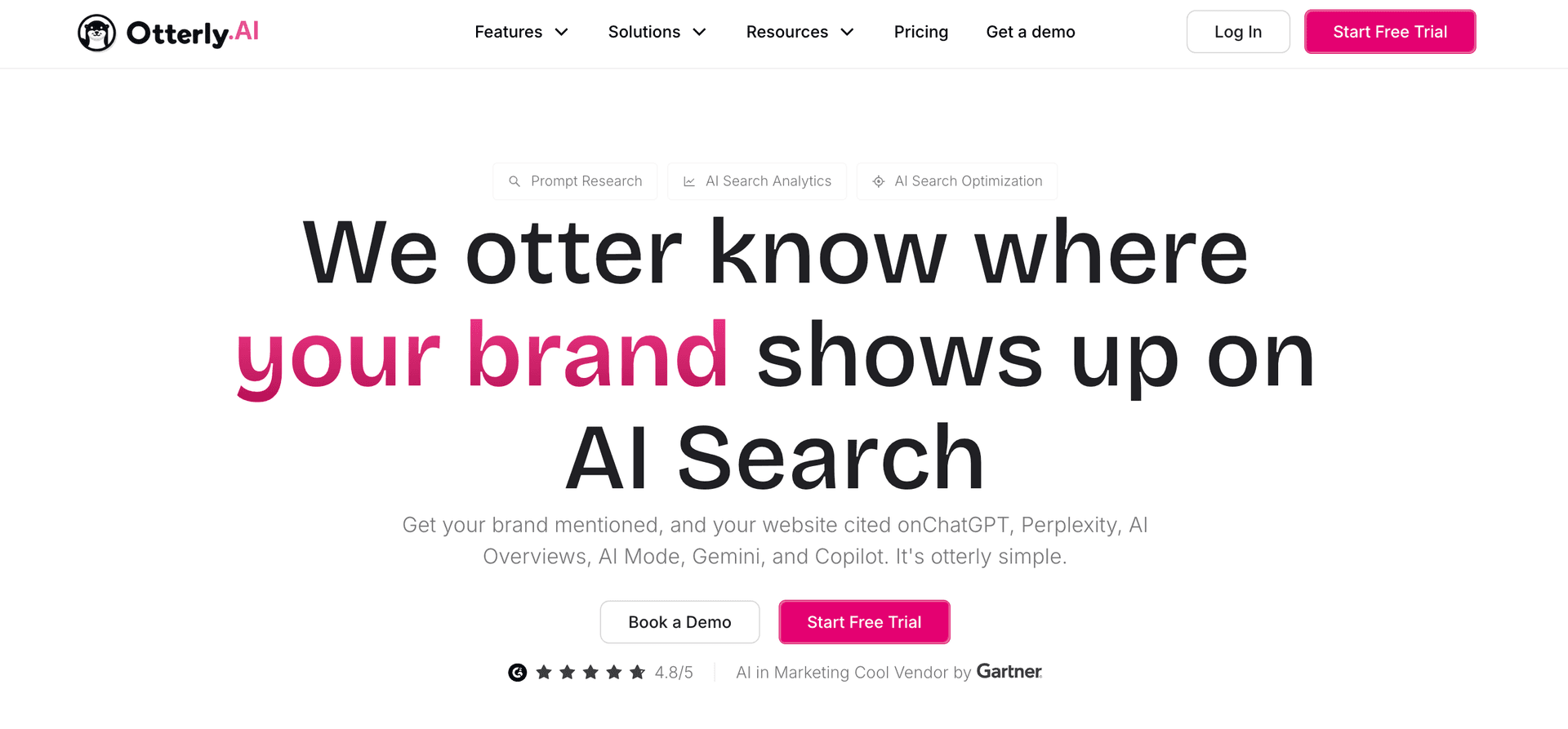
OtterlyAI
Small teams, agencies, and pilots
Approachable prompt, brand mention, citation, and competitor tracking
Enterprise governance requirements should be tested carefully
9
Brandlight
Global enterprise brand intelligence
Broad brand, source, regional, and competitive visibility workflows
More complex than a basic AI search tracker
10
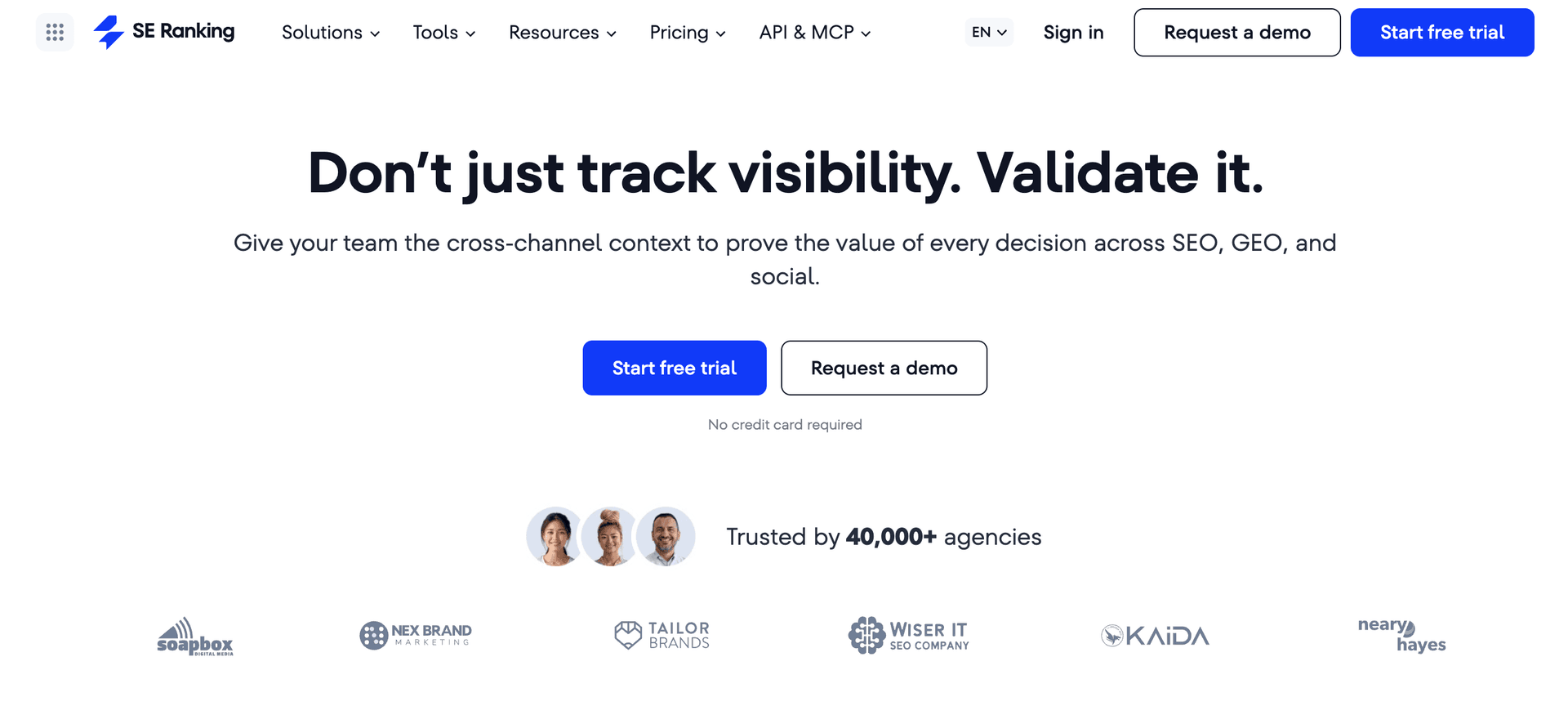
SE Ranking
Existing SE Ranking customers and agencies
AI visibility inside an established SEO workflow
Dedicated GEO teams may want additional specialist analysis
Best AI Search Monitoring Platform by Use Case
If you do not want to compare ten products in detail, start with the job you need the software to perform.
Use case
Platforms to shortlist
Best overall for SEO teams
Dageno AI
GEO tracking and AI search monitoring for US-based SEO managers
Dageno AI, Profound, Semrush, Ahrefs, OtterlyAI, SE Ranking
AI search analytics for marketing leaders
Dageno AI, Profound, Peec AI, Semrush
Monitoring competitors in AI results
Dageno AI, Profound, Semrush, Ahrefs Brand Radar, Peec AI
Improving brand citation strategy
Dageno AI, Ahrefs Brand Radar, OtterlyAI, Peec AI
Profound alternative with a stronger execution layer
Dageno AI; also evaluate Scrunch AI and AthenaHQ depending on the workflow
AI visibility inside an existing SEO stack
Semrush, Ahrefs Brand Radar, SE Ranking
Lightweight prompt and citation monitoring
OtterlyAI, Peec AI
Technical AI crawler and agent visibility
Scrunch AI
Multi-brand or global enterprise programs
Brandlight, Profound
What Is an AI Search Visibility Tool?
An AI search visibility tool tracks how a brand, product, website, or competitor appears inside AI-generated answers.
Traditional rank tracking asks:
“Where does this URL rank for this keyword?”
AI search monitoring asks a different set of questions:
Does the AI answer mention my brand?
Does it recommend my brand?
Which competitors appear instead?
Which websites and URLs are cited?
How prominently is my brand positioned?
How is the brand described?
Which prompts generate visibility?
Does performance change by engine, country, language, or time?
Which content or authority gaps might explain the result?
That makes AI search monitoring closer to a combination of rank tracking, brand monitoring, competitive intelligence, citation analysis, and market research.
There is also no single universal “AI rank.” Results can change with the prompt, model, interface, geography, personalization, data freshness, and time.
For that reason, a useful platform should preserve the evidence behind its visibility score: the prompt, answer, engine, cited URLs, competitors, location, language, and observation date.
How We Evaluated the Best AI Search Monitoring Tools
We evaluated the platforms against nine practical requirements.
AI engine coverage: Which relevant answer engines and AI search surfaces can be monitored?
Prompt tracking: Can teams organize, repeat, discover, and segment the prompts that matter?
Citation intelligence: Can users see exact cited domains and URLs rather than only a score?
Competitor monitoring: Can the platform compare mentions, citations, recommendation position, share of voice, and prompt gaps?
Historical trends: Can teams distinguish a persistent change from a one-day fluctuation?
Geographic and language controls: Can results be analyzed for the markets a business actually serves?
Diagnosis: Does the platform help explain why a competitor is winning?
Execution: Can insights be turned into content, source, technical, outreach, or optimization actions?
Operational fit: Are exports, alerts, APIs, integrations, reporting, permissions, and governance suitable for the team?
Visibility percentages from different platforms should not be compared as though they were generated by the same ranking system. Different vendors can use different prompt universes, models, countries, schedules, interfaces, and scoring methodologies.
1. Dageno AI — Best Overall for Monitoring and Action
Best for: SEO teams, growth teams, agencies, SaaS companies, ecommerce brands, and marketing organizations that want to turn AI visibility data into a prioritized action plan.
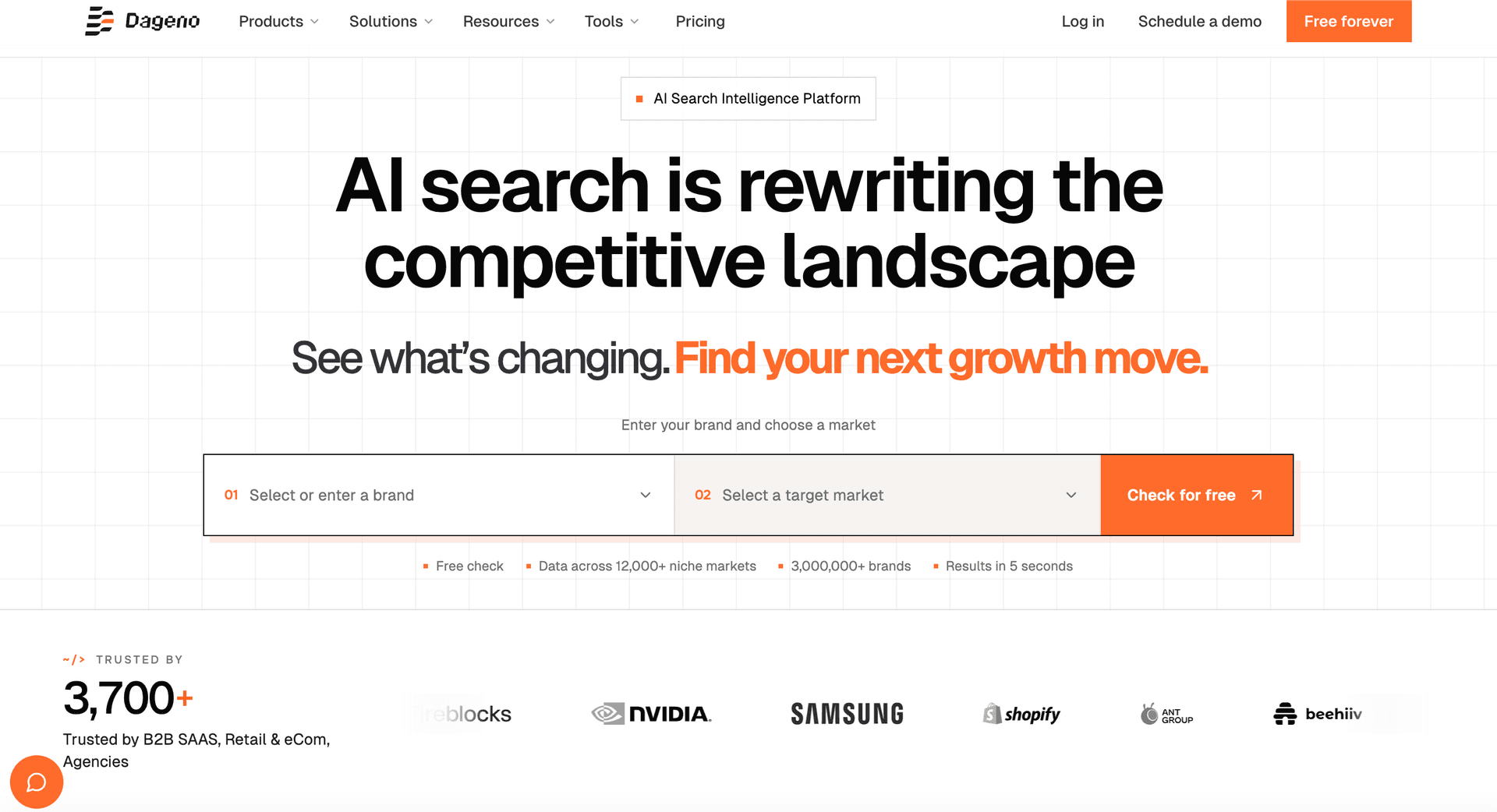
Dageno AIDageno AI is our top choice when the goal is not simply to see whether a brand appears in AI search, but to understand what to do next.
The platform connects AI visibility monitoring with citation intelligence, competitor context, prompt and market analysis, regional comparisons, content opportunities, GEO/AEO gap diagnosis, URL impact tracking, and traditional SEO data.
This is particularly useful when an SEO manager sees a visibility problem such as:
“Competitor A is recommended for this prompt, but we are not.”
A monitoring-only dashboard can report the difference. A more complete workflow should help investigate the reason: missing content, weak positioning, insufficient third-party evidence, a citation gap, unclear product information, regional weakness, or another issue.
Why choose Dageno AI?
Strong fit for teams combining SEO, GEO, AEO, content, and competitive research
Connects visibility data with competitor and citation context
Supports market and regional analysis
Designed to move from diagnosis to content or optimization action
Useful when AI search data needs to sit alongside traditional SEO, GSC, and analytics context
Watch out for
Dageno does not remove the need for specialist crawling, backlink, digital PR, analytics, or engineering tools. A complete AI visibility strategy still requires execution outside the monitoring platform.
2. Profound — Best for Enterprise Prompt Intelligence
Best for: Enterprise organizations with dedicated SEO, analytics, brand, content, and market-intelligence teams.
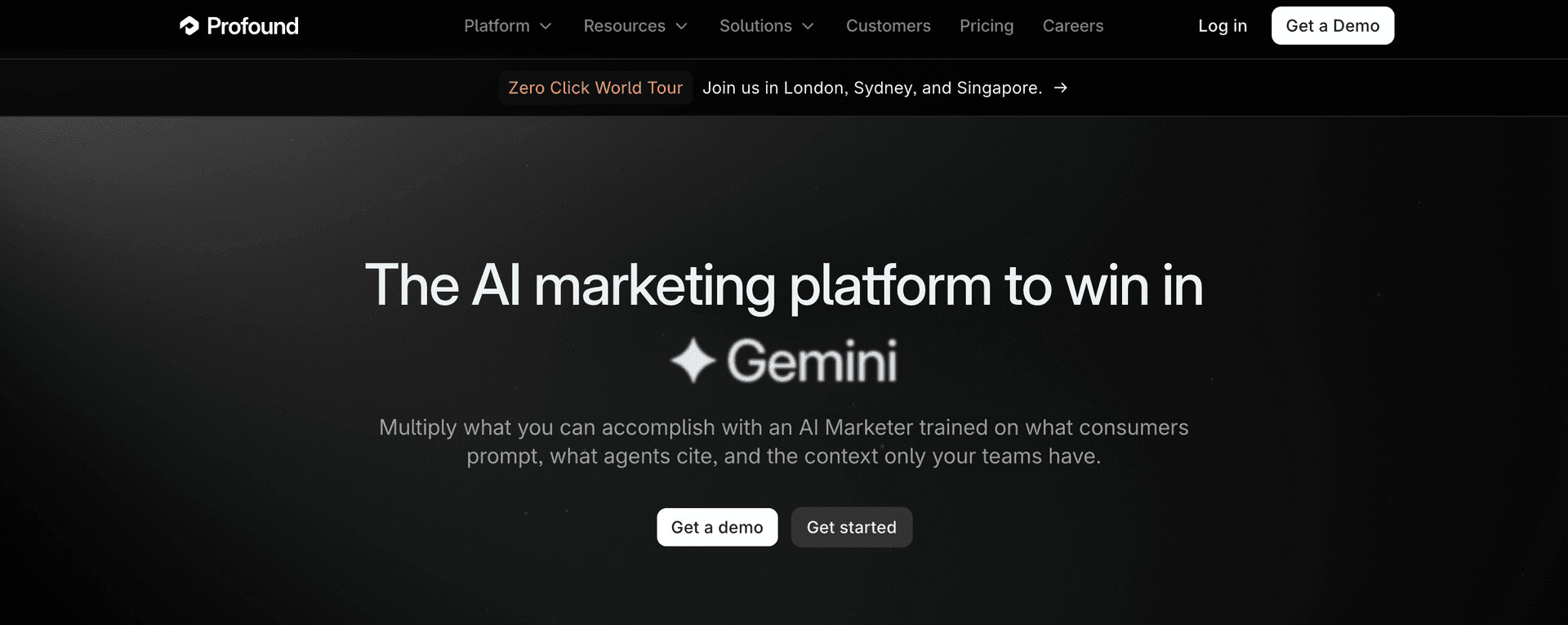
Profound is one of the strongest options for organizations that treat AI search as a major intelligence channel rather than an experimental SEO feature.
Its approach is particularly useful when teams want to understand not only where a brand appears, but which prompts matter, how visibility varies by audience or market, what sources influence answers, and how those trends change over time.
Profound has also expanded beyond basic monitoring into workflow and agent-oriented use cases, making it relevant for organizations looking for a broader AI marketing platform.
Why choose Profound?
Deep prompt and answer intelligence
Strong enterprise reporting and analysis
Useful citation and competitive context
Appropriate for large prompt sets and sophisticated AI search programs
Increasing connection between intelligence and agent-assisted execution
Watch out for
Enterprise depth can mean greater cost, implementation effort, and organizational complexity. Smaller SEO teams may not need the entire platform.
3. Scrunch AI — Best for AI Visibility and Agent Accessibility
Best for: Enterprise teams that need both AI search visibility and technical insight into how AI crawlers or agents interact with their websites.
AI visibility is not only a content problem.
If important pages are difficult for AI crawlers, agents, or search systems to access and understand, better copy alone may not solve the issue.
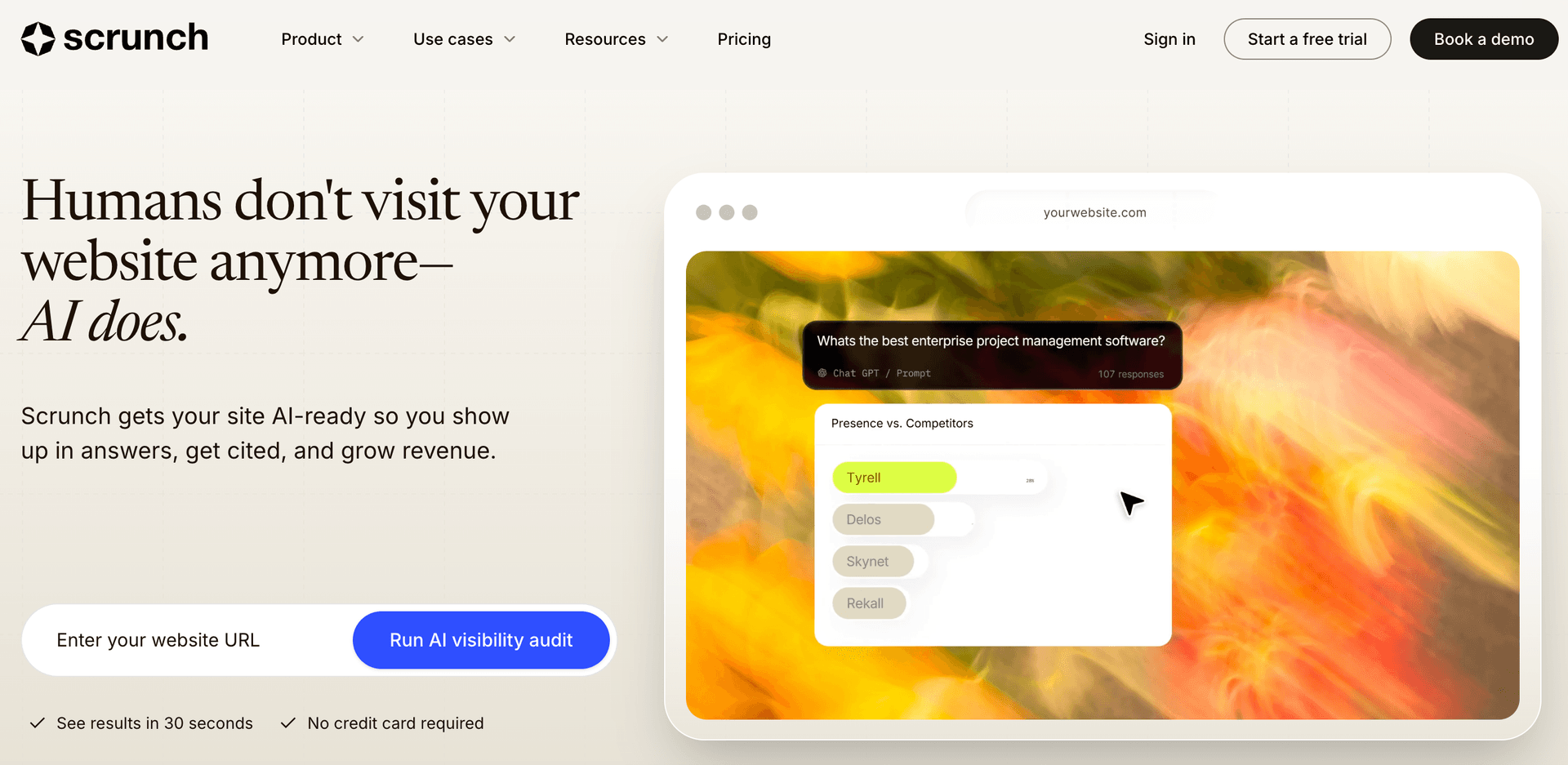
Scrunch AI is particularly relevant when responsibility for AI search spans SEO, content, analytics, web infrastructure, and engineering.
Why choose Scrunch AI?
Combines AI visibility with technical agent-accessibility concerns
Useful for cross-functional enterprise programs
Helps connect content visibility with underlying technical signals
Relevant when AI referral traffic and crawler behavior matter
Watch out for
Technical diagnosis only creates value if the organization has people who can act on it. Smaller teams may find a simpler monitoring platform easier to operate.
4. AthenaHQ — Best for Cross-Functional GEO Programs
Best for: Companies where SEO, content, brand, PR, and growth teams share responsibility for generative engine optimization.
AthenaHQ is a strong candidate when GEO is treated as an operating program rather than a dashboard owned by one SEO specialist.
Its appeal is the ability to bring research, competitive intelligence, monitoring, and optimization work into a shared environment.
Why choose AthenaHQ?
Suitable for cross-functional GEO programs
Combines monitoring with broader research and optimization workflows
Useful for teams that need shared visibility into competitors and sources
Watch out for
A platform cannot replace internal governance. Teams still need a stable prompt taxonomy, clear ownership, publishing workflows, and a process for measuring whether actions worked.
5. Semrush — Best for Existing SEO Workflows
Best for: SEO teams and agencies already using Semrush for keyword research, competitive analysis, site auditing, content, or reporting.
Semrush is a practical choice when the primary requirement is to add AI visibility to a mature SEO workflow.
The main advantage is context. Instead of operating AI search monitoring as a completely separate discipline, teams can evaluate AI visibility alongside traditional search performance and competitor data.
Why choose Semrush?
Familiar environment for existing SEO teams
Strong traditional SEO and competitive context
Useful for connecting AI visibility with established reporting
Lower workflow disruption for current Semrush customers
Watch out for
Teams buying a platform exclusively for AI search should compare its prompt-level depth, citation analysis, historical data, exports, and location controls with dedicated AI visibility products.
6. Ahrefs Brand Radar — Best for AI Visibility Research at Scale
Best for: SEO analysts and competitive-research teams that want to explore AI mentions, citations, prompts, competitors, and share of voice at scale.
Ahrefs Brand Radar brings AI visibility into a research environment already familiar to many SEO professionals.
It can help teams examine where a brand appears, which competitors have greater AI share of voice, what pages and domains receive citations, and which prompts create opportunities.
Why choose Ahrefs Brand Radar?
Strong competitor and market research context
Tracks mentions, citations, impressions, and AI share of voice
Useful for discovering cited pages and domains
Fits well with broader organic-search research
Watch out for
Finding an opportunity and fixing it are different jobs. Research teams still need a process for converting findings into content changes, digital PR, technical work, or outreach.
7. Peec AI — Best for Focused AI Search Analytics
Best for: Marketing teams and agencies that want a dedicated AI search analytics product rather than a full traditional SEO suite.
Peec AI focuses on the core monitoring problem: how brands and competitors appear across prompts, sources, and AI platforms.
A narrower product can be an advantage for teams that want reports that are easy to explain without bringing an entire SEO platform into the workflow.
Why choose Peec AI?
Focused AI visibility analytics
Useful competitor and source analysis
Lower operational complexity than some enterprise suites
Good fit for marketing teams that already have separate SEO tools
Watch out for
Technical SEO, backlinks, digital PR, and content execution may continue to live elsewhere.
8. OtterlyAI — Best Starting Point for Small Teams
Best for: Small businesses, consultants, agencies, and teams establishing their first repeatable AI search monitoring program.
OtterlyAI focuses on prompts, brand mentions, citations, competitors, sentiment, and changes over time across major AI search experiences.
It is particularly useful when a team wants to establish a baseline without immediately implementing a larger enterprise intelligence program.
Why choose OtterlyAI?
Accessible prompt monitoring
Strong emphasis on brand mentions and citation tracking
Competitor comparison
Historical tracking across recurring prompt sets
Practical fit for pilots and smaller teams
Watch out for
Larger organizations should test requirements such as permissions, APIs, complex localization, reporting governance, and very large prompt libraries before standardizing on any lightweight platform.
9. Brandlight — Best for Global Enterprise Brand Intelligence
Best for: Global enterprises, brand organizations, CMOs, and agencies managing several markets or brands.
Brandlight is most relevant when AI visibility extends beyond SEO into brand governance, narrative, regional intelligence, content, partnerships, and competitive analysis.
Why choose Brandlight?
Enterprise-oriented brand intelligence
Suitable for multi-brand and multi-region programs
Broader brand and source perspective than a simple prompt tracker
Relevant for organizations where AI visibility is a brand-level KPI
Watch out for
The platform may be more complex than necessary if the only requirement is tracking a small set of prompts for one website.
10. SE Ranking — Best for Existing SE Ranking Customers and Agencies
Best for: Agencies and SEO teams that want AI visibility tracking alongside conventional rank tracking, auditing, competitive research, and client reporting.
SE Ranking is a logical option for organizations that value workflow consolidation.
Its AI visibility functionality can help monitor brand mentions, links and citations, competitors, individual prompts, and changes over time while keeping the work close to existing SEO reporting.
Why choose SE Ranking?
AI and traditional SEO data can live in related workflows
Useful for agencies already standardized on the platform
Competitor and prompt-level reporting
API and reporting options can support broader analytics workflows
Watch out for
A specialist GEO team should still compare the depth of source intelligence, prompt research, and optimization workflows against dedicated AI-search platforms.
Which AI Search Tool Is Best for Monitoring Competitors in AI Results?
For competitor monitoring, shortlist Dageno AI, Profound, Semrush, Ahrefs Brand Radar, Peec AI, OtterlyAI, and SE Ranking.
Do not judge competitor monitoring only by whether a dashboard contains a “share of voice” number.
A useful competitor workflow should answer:
Which competitors appear for the prompts where my brand is absent?
How frequently are they mentioned?
Are they cited, recommended, or merely named?
Which pages and third-party domains support their visibility?
Which topics or prompt clusters do they dominate?
Is the gap growing or shrinking over time?
Is the competitor winning because of content, authority, positioning, technical access, or external sources?
That final question is what turns competitor monitoring into an optimization strategy.
What Are the Best AI Visibility Tools for Improving Brand Citations?
Dageno AI, Ahrefs Brand Radar, OtterlyAI, Peec AI, Profound, Semrush, and SE Ranking can all contribute to citation analysis.
But it is important to distinguish citation tracking from citation improvement.
A monitoring platform cannot force ChatGPT, Gemini, Perplexity, or Google to cite your website.
What it can do is show:
Which domains and URLs AI systems already cite
Which competitors receive citations when you do not
Which of your pages are already citation sources
Which topics lack an authoritative page on your site
Whether citation patterns improve after content or authority work
The best citation tool is therefore not simply the one with the largest citation table. It is the one that helps your team turn citation evidence into a realistic content, PR, partnership, or authority-building action.
What Is the Best AI Search Visibility Software for Monitoring Recommendations Like ChatGPT?
For ChatGPT recommendation monitoring, prioritize platforms that store or expose the actual answer rather than reporting only a visibility score.
You should be able to measure:
Brand mention rate
Recommendation frequency
Average prominence or position
Competitor share of voice
Sentiment and product attributes
Cited domains and URLs
Changes over time
Differences between prompt clusters and markets
A traditional Google position such as “rank #4” is not an adequate model for ChatGPT recommendations.
The more useful question is:
“Across a controlled set of commercially relevant prompts, how often are we mentioned, how are we positioned, who appears instead, and what evidence seems to influence the answer?”
Which Platform Is Best for Integrating AI Search Insights With SEO Workflows?
This is one of the most important differences between an AI search monitoring tool and a useful AI search operating system.
A practical SEO workflow should connect four layers:
1. AI demand and prompts
Identify the questions buyers ask about your category, problems, alternatives, comparisons, and products.
2. AI visibility evidence
Measure mentions, citations, recommendation position, competitors, sentiment, and source domains.
3. Traditional search and page data
Use Google Search Console, analytics, keyword data, crawl data, backlinks, and conversion data to understand the pages already connected to the topic.
4. Action and measurement
Update an existing page, create a missing asset, improve product evidence, strengthen an external source, fix technical access, or clarify brand information. Then measure the same prompt cohort again.
Dageno AI is designed around this monitoring-to-action approach. Semrush, Ahrefs, and SE Ranking are also attractive when traditional SEO data already lives in those ecosystems.
The important point is not whether two dashboards appear in the same navigation menu. It is whether the data helps an SEO manager decide which URL should change and why.
What Is the Best Profound Alternative for SEO and AI-Powered Content Workflows?
There is no single Profound alternative because different teams use Profound for different reasons.
If your main requirement is:
AI visibility plus content and optimization action: evaluate Dageno AI.
Technical AI crawler and agent accessibility: evaluate Scrunch AI.
Traditional SEO plus AI visibility: evaluate Semrush or Ahrefs.
Focused prompt and citation analytics: evaluate Peec AI or OtterlyAI.
Profound itself now extends beyond basic visibility monitoring into prompt intelligence and agent-assisted workflows.
So when comparing a “Profound-like” platform, define the exact capability you are replacing.
Do you need prompt demand? Raw answer monitoring? Citations? Agents? Content generation? Technical crawler analytics? Market intelligence? Reporting?
The label AI agent alone is not enough. Ask for a live demonstration of what the agent can do, which data it uses, what approval steps exist, and whether the result can be tied back to measurable visibility.
Who Offers GEO Search Tracking and AI Search Monitoring for US-Based SEO Managers?
A number of platforms can support US-focused GEO and AI search monitoring, including Dageno AI, Profound, Semrush, Ahrefs Brand Radar, OtterlyAI, Peec AI, Scrunch AI, AthenaHQ, Brandlight, and SE Ranking.
The more important question is what “US tracking” actually means.
For a US SEO program, ask whether the platform can preserve or segment:
Country or market
Language
AI engine and interface
Prompt
Raw answer
Mention and recommendation position
Cited domain and exact URL
Competitors
Date and time
Historical methodology
A dashboard labeled “global” is not a substitute for market-level observations.
If US visibility matters commercially, test the same prompt in the US configuration before buying and confirm that historical reports preserve that context.
Best AI Search Analytics for Marketing Leaders: What Should You Measure?
Marketing leaders usually do not need thousands of individual AI answers in an executive report.
They need a small number of stable KPIs with a clear connection to action.
Useful metrics include:
Brand coverage
The percentage of relevant tracked prompts where the brand appears.
AI share of voice
How much visibility the brand owns relative to named competitors.
Citation coverage
How frequently owned pages or strategically important third-party sources are cited.
Recommendation prominence
Whether the brand appears early, late, positively, negatively, or only as a secondary option.
Commercial prompt coverage
Visibility on prompts related to evaluation, comparisons, alternatives, pricing, buying criteria, and vendor selection.
Competitor gaps
High-value prompt clusters where competitors consistently appear but your brand does not.
Trend over time
Whether visibility is improving across a stable prompt cohort rather than fluctuating in isolated answers.
Business impact
AI referral traffic, branded demand, assisted conversions, leads, and revenue associated with the visibility program.
How to Build an AI Search Monitoring Workflow
A reliable program does not begin with a dashboard. It begins with a controlled measurement framework.
Step 1: Build a representative prompt library
Include category discovery, problems, comparisons, alternatives, product questions, use cases, branded questions, and high-intent buying prompts.
Step 2: Segment prompts by intent
Separate informational prompts from commercial, comparison, transactional, branded, and local prompts.
Step 3: Establish a baseline
Record mentions, recommendation position, citations, competitors, sentiment, engine, market, and date.
Step 4: Diagnose gaps
Look for patterns rather than individual answers.
If competitors dominate one cluster, determine whether the likely issue is:
Missing content
Weak product evidence
Poor positioning
Citation gaps
Weak third-party authority
Inconsistent brand information
Technical access
Localization
Step 5: Turn the diagnosis into an action
Map the problem to the smallest useful intervention: update a page, create a comparison asset, add evidence, improve documentation, pursue a relevant third-party mention, fix crawlability, or clarify product information.
Step 6: Re-run the same prompt cohort
Do not change the measurement framework immediately after making the change.
AI answers are volatile. Repeated observations are more useful than one before-and-after screenshot.
Step 7: Connect AI visibility with SEO and business outcomes
Use GSC, analytics, CRM, and conversion data to determine whether visibility improvements correspond with stronger search demand, traffic, leads, or revenue.
How to Choose an AI Search Visibility Tracking Tool
Before signing a contract, ask each vendor to demonstrate your real use case.
Ask:
Can I see the exact prompt and raw answer behind every metric?
Can I see exact cited domains and URLs?
Can I compare my brand with named competitors?
Can I segment by model, market, language, and prompt cluster?
How frequently are prompts rerun?
How is historical data preserved when models or methodologies change?
Can I export raw observations?
What does API access actually include?
Can alerts detect citation loss, competitor gains, sentiment changes, or visibility drops?
Can insights be mapped to pages or actions?
Can the platform connect with my SEO and analytics workflow?
What are the prompt, project, engine, user, export, and history limits of my plan?
The best AI search tracker is not the one with the most features on a pricing page.
It is the one that gives your team evidence it trusts and actions it can execute.
Frequently Asked Questions
What is the best AI search monitoring tool?
Dageno AI is our best overall choice for SEO and marketing teams that want to connect AI visibility monitoring with citations, competitors, market intelligence, and optimization actions. Profound is a strong enterprise option, Scrunch AI is attractive for technical AI-agent visibility, and OtterlyAI is a practical choice for smaller monitoring programs.
What are the best AI search visibility tools?
Leading options include Dageno AI, Profound, Scrunch AI, AthenaHQ, Semrush, Ahrefs Brand Radar, Peec AI, OtterlyAI, Brandlight, and SE Ranking. The right choice depends on whether your priority is monitoring, competitor research, citations, technical accessibility, SEO integration, enterprise reporting, or execution.
Which tools track AI search visibility and AEO performance over time?
Most dedicated AI visibility platforms now provide recurring prompt monitoring or historical reporting. The important requirement is that the platform preserves the prompt, engine, market, answer, citation, and date so changes can be interpreted consistently.
Is AI search visibility the same as traditional SEO visibility?
No. Traditional SEO visibility is largely based on rankings and search demand. AI search visibility measures how a brand or website appears within generated answers, including mentions, citations, recommendations, sentiment, competitors, and source influence.
Can AI search visibility be measured accurately?
It can be measured consistently, but it should not be treated as one universal rank. AI answers vary with prompts, models, geography, interfaces, personalization, and time. Reliable measurement uses a stable prompt set and repeated observations.
How often should AI search visibility be monitored?
Weekly monitoring is a reasonable starting point for established prompt groups. Higher frequency can be useful during launches, major campaigns, or reputation events. Strategic prompt coverage, competitor gaps, citation patterns, and business impact should also be reviewed periodically.
Do FAQ generators improve AI visibility?
An FAQ section can make a page clearer when it answers real user questions with useful, original information. But automatically generating large numbers of FAQs does not guarantee stronger Google rankings or AI visibility. Use FAQs when they satisfy genuine search intent rather than as a keyword-stuffing tactic.
Do I need special schema to appear in Google AI Overviews or AI Mode?
No special “AI schema” guarantees inclusion. Follow normal technical and content best practices: make important information crawlable and indexable, keep structured data consistent with visible content, provide useful original information, and maintain strong page quality.
What should an AI search monitoring dashboard include?
At minimum, it should include brand mentions, citations, recommendation position or prominence, competitor visibility, prompt-level performance, historical trends, source domains and URLs, engine segmentation, and market or language context.
Can AI search monitoring tools track ChatGPT rankings?
They can monitor how a brand appears across repeated ChatGPT prompts, but “ChatGPT ranking” should not be interpreted like a fixed Google ranking. Measure mention frequency, recommendation prominence, competitors, citations, sentiment, and changes over a controlled prompt set instead.
Final Recommendation
Choose an AI search visibility tool based on the decision your team needs to make after opening the dashboard.
Choose Dageno AI if you want AI monitoring, competitor and citation intelligence, market context, and optimization actions in a connected workflow.
Choose Profound if enterprise prompt and answer intelligence is the primary requirement.
Choose Scrunch AI when technical AI-agent accessibility is a major part of the problem.
Choose Semrush, Ahrefs Brand Radar, or SE Ranking when AI visibility needs to fit naturally into an existing SEO ecosystem.
Choose Peec AI or OtterlyAI when focused AI visibility monitoring is more important than a broad SEO suite.
Choose Brandlight when the program spans global brands, regions, and enterprise brand intelligence.
Whichever platform you select, run the same real prompt set in two or three shortlisted tools before making a decision.
Require the raw answer, exact citations, competitor evidence, market controls, historical tracking, and a clear path from insight to action.
Because the most useful AI search monitoring platform is not the one that produces the highest visibility score.
It is the one that helps your team understand why you are visible, why a competitor is winning, and what to improve next.
Dageno is the research and insights team at Dageno AI, publishing industry reports and expert analysis on AI Search Visibility, Generative Engine Optimization (GEO), and AI-powered search discovery.