NEW · 2.0Dageno Market IntelligenceView product ↗

Understand AI search demand, user intent, competition, and market opportunities

Market competitive landscape→Model and Region Benchmarks→Search Intents→Competitor Research→Brand Value Props→Market Segments→Citation Sources→Ghost Citations→Organic Search→AI Shopping Visibility→AI Ad Intelligence→GEO/AEO gap diagnosis→URL Impact Tracking→SEO, GSC, and GA4→
Dageno VisibilityView product ↗

Monitor, explain, and improve your brand's performance in AI search

Answer Engine Insights→Prompt Volumes→BotSight→Content Actions→Brand Visibility Monitoring→Citation Intelligence→Opportunity Gaps→Regional Comparison→
Managed GEO/AEO servicesDiagnostics, content, sources, and continuous deliveryPartner programAgency, white label, content, and client referrals
Understand the marketView product ↗

Demand, intent, competition, and opportunities

Market Entry→Global Market Expansion→Portfolio Strategy→Competitive War Room→Buyer Journey Strategy→
Improve AI visibilityView product ↗

Brand monitoring, citation analysis, and content actions

Brand Crisis Management→Competitive Positioning→Content Strategy→Narrative Building→Product Launch→
For teams
Brand growth and SEO/GEO/AEO teams→Agencies→E-commerce & Ads→
AI platform directoryView all AI platforms and monitoring coverage
ChatGPTPerplexityGoogle GeminiMistral Le ChatGoogle AI OverviewGoogle AI ModeGrokDolaAlexa for ShoppingMicrosoft CopilotALLAll platforms
Learning and methods
Research→Blog→Changelogs→
Market Intelligence reports
Market AI visibility ranking→
Free AI Visibility tools

From single-page audits and prompts to AI crawler checks

LLMs.txt Generator→Single-page GEO/AEO audit→Popular Prompt finder→AI Article Writer→AI Crawl Checker→
Pricing
Log in
Schedule a demo
No login requiredFree forever

See the full AI search landscape. Make evidence-backed growth decisions.

Dageno Visibility1.0Products

  • Answer Engine Insights
  • Prompt Volumes
  • BotSight
  • Content Actions
  • Brand Visibility Monitoring
  • Citation Intelligence
  • Opportunity Gaps
  • Regional Comparison

Dageno Market Intelligence2.0Products

  • Market competitive landscape
  • Model and Region Benchmarks
  • Search Intents
  • Competitor Research
  • Brand Value Props
  • Market Segments
  • Citation Sources
  • Ghost Citations
  • Organic Search
  • AI Shopping Visibility
  • AI Ad Intelligence
  • GEO/AEO gap diagnosis
  • URL Impact Tracking
  • SEO, GSC, and GA4

For teams

  • Brand growth and SEO/GEO/AEO teams
  • Agencies
  • E-commerce & Ads

Learning and methods

  • Research
  • Blog
  • Changelogs

Tools

  • LLMs.txt Generator
  • Single-page GEO/AEO audit
  • Popular Prompt finder
  • AI Article Writer
  • AI Crawl Checker

Services & partnerships

  • Managed GEO/AEO services
  • Partner program

© 2026 DINGX LLC. All rights reserved.

Terms of usePrivacy PolicyRefund Policy

Related Articles

AEO Tools For ChatGPT Brand Mentions | Dageno AI
Dageno

Dageno • Jun 11, 2026

Chatgpt Brand Visibility Tracking for Marketing Teams: Deep GEO Guide | Dageno AI
Dageno

Dageno • Jun 15, 2026

Answer Engine Optimization: Definition, Workflow, and Metrics | Dageno AI
Dageno

Dageno • Jun 09, 2026

AI Citation Gap Analysis for Small SEO Teams | Dageno AI
Dageno

Dageno • Jul 13, 2026

HomeAcademyHow to Choose the Best AI Visibility Checker in 2026

How to Choose the Best AI Visibility Checker in 2026

Dageno

Updated by

Dageno

Updated on Sep 10, 2026

Quick Answer

The best AI visibility checker is not the one with the highest proprietary score. Choose a tool that preserves prompts, complete answers, citations, competitors, model, market, language, and timestamp—and can turn each gap into a content, source, entity, technical, or reputation action.

What Is an AI Visibility Checker?

An AI visibility checker measures whether and how a brand appears in generated answers from systems such as ChatGPT, Gemini, Perplexity, Google AI features, and Copilot. Depending on the product, it may report mentions, citations, recommendations, relative position, sentiment, competitors, and cited sources.

A one-time grader answers “What does this sample show now?” A persistent tracker answers “How is a controlled prompt panel changing over time?” These are different buying needs.

The Seven Buying Criteria That Matter

1. Answer-level evidence

Every metric should lead back to the exact prompt, answer, timestamp, citations, model/surface, market, and language. Without row-level evidence, analysts cannot audit brand matching or explain a change.

2. Prompt quality

The prompt set should represent discovery, comparisons, alternatives, use cases, pricing, trust, and purchase decisions. A tool that monitors only branded questions can make visibility look healthier than it is.

3. Repeatability

Generated answers vary. Look for controlled repeat runs, consistent settings, preserved history, and a clear rule for model changes. Do not compare periods if prompts or classification changed without marking a new baseline.

4. Citation intelligence

Useful tools show the cited domain and full URL, distinguish owned from third-party sources, and reveal which sources repeatedly support competitors. A citation count without accessible URLs is hard to act on.

5. Competitor and entity controls

Check aliases, product names, parent brands, ambiguous names, and custom competitor groups. Ask how false positives are reviewed and how “position” is calculated when an answer is not a numbered list.

6. Markets, languages, and answer engines

Confirm the exact engines, countries, and languages in the plan. “Multi-platform” does not necessarily mean the same markets, localization, history, or evidence on every surface.

7. Action and integration workflow

The tool should distinguish a missing page from weak third-party evidence, incorrect product facts, crawler access, or reputation risk. Exports, APIs, GSC, GA4, and BI integrations matter when several teams own the response.

Free Checker vs. Paid Monitoring Platform

Need Free grader/checker Paid tracker
Initial brand snapshot Good fit Also available
Repeatable trends Usually limited Core requirement
Captured answers and citations Varies Should be required
Competitor panel Basic or fixed Configurable
Markets and languages Limited Plan-dependent
History, alerts and exports Limited Expected
Workflow and permissions Rare Important for teams

Use a free checker to learn the category and identify candidate issues. Upgrade when the team has a stable prompt panel, reporting owner, action process, and need for comparable history.

How to Test an AI Visibility Checker Before Buying

  1. Prepare 20–50 prompts across the buying journey.
  2. Include official names, aliases, products, and 3–5 competitors.
  3. Define one market and language for the first controlled test.
  4. Run the same panel in each finalist.
  5. Open random answer rows and verify classifications manually.
  6. Compare citation URLs and source ownership.
  7. Export the raw data and recreate one metric.
  8. Calculate production cost across prompts, engines, markets, languages, and refreshes.
  9. Assign one realistic content or source task from the findings.

If a vendor cannot show the underlying answer or explain its denominator, treat the score as directional.

Common Metrics and Their Limits

Metric Useful definition Common mistake
Mention rate Runs containing the brand ÷ comparable runs Mixing branded and unbranded prompts
Citation rate Runs citing selected brand/source URLs ÷ comparable runs Counting mention as citation
Share of voice Brand appearances relative to defined competitors Hiding the competitor set
Position Recorded order within an answer Calling it a stable search rank
Sentiment Human-reviewable tone around the brand Reporting a label without the sentence
Source share Citation frequency by domain/URL Assuming citation proves causality

How Dageno Fits the Evaluation Framework

Dageno connects prompts, answer evidence, competitors, citations, important URLs, brand perception, demand scenarios, GEO/AEO gaps, and GSC/GA4 context. This is useful when the goal is to decide what to change—not simply monitor a score.
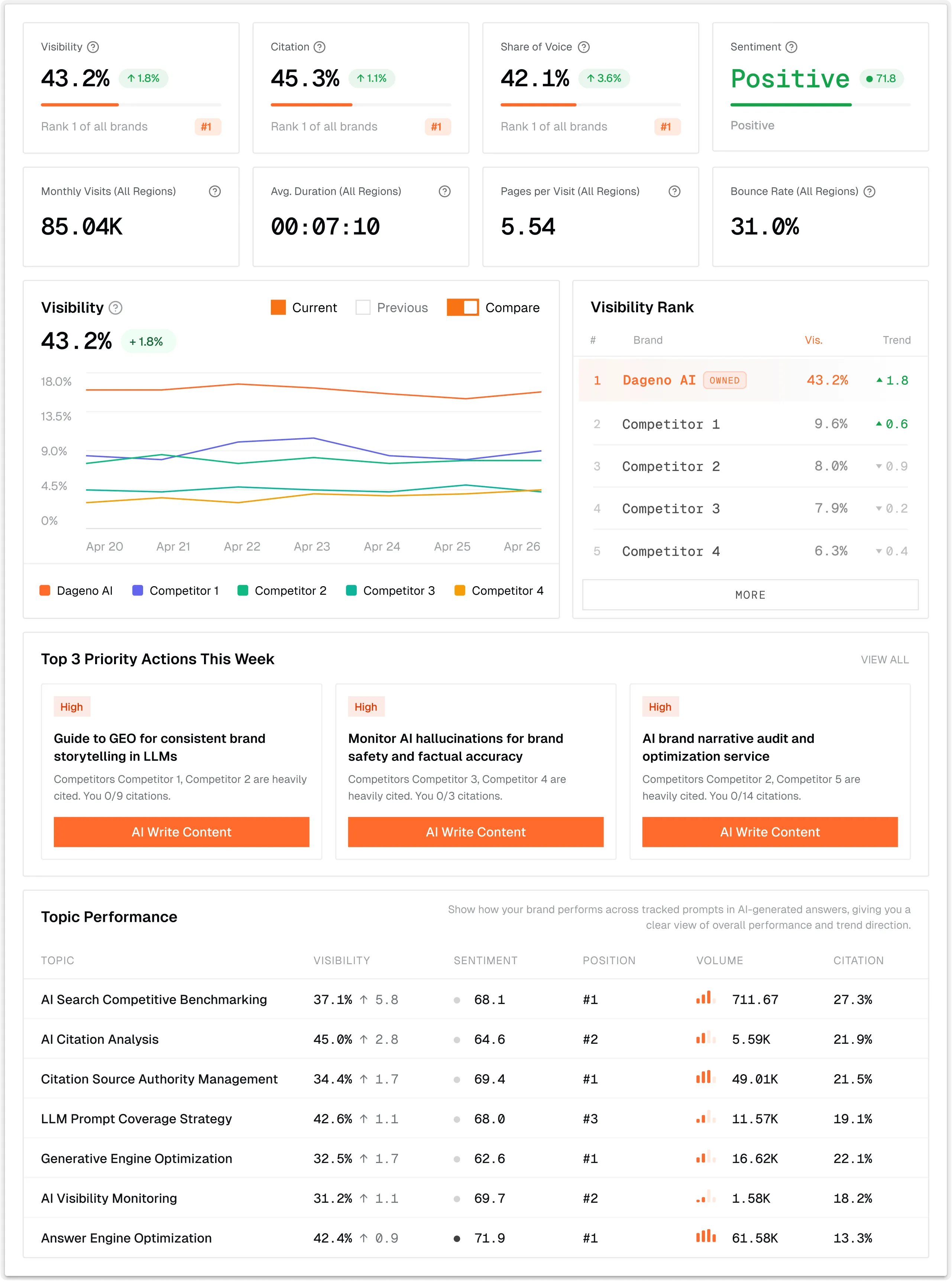
Dageno AI visibility and competitor dashboard

Use Answer Engine Insights for answer and citation evidence, Prompt Volumes Explorer for demand prioritization, and Botsight Analytics for crawler/referral context.
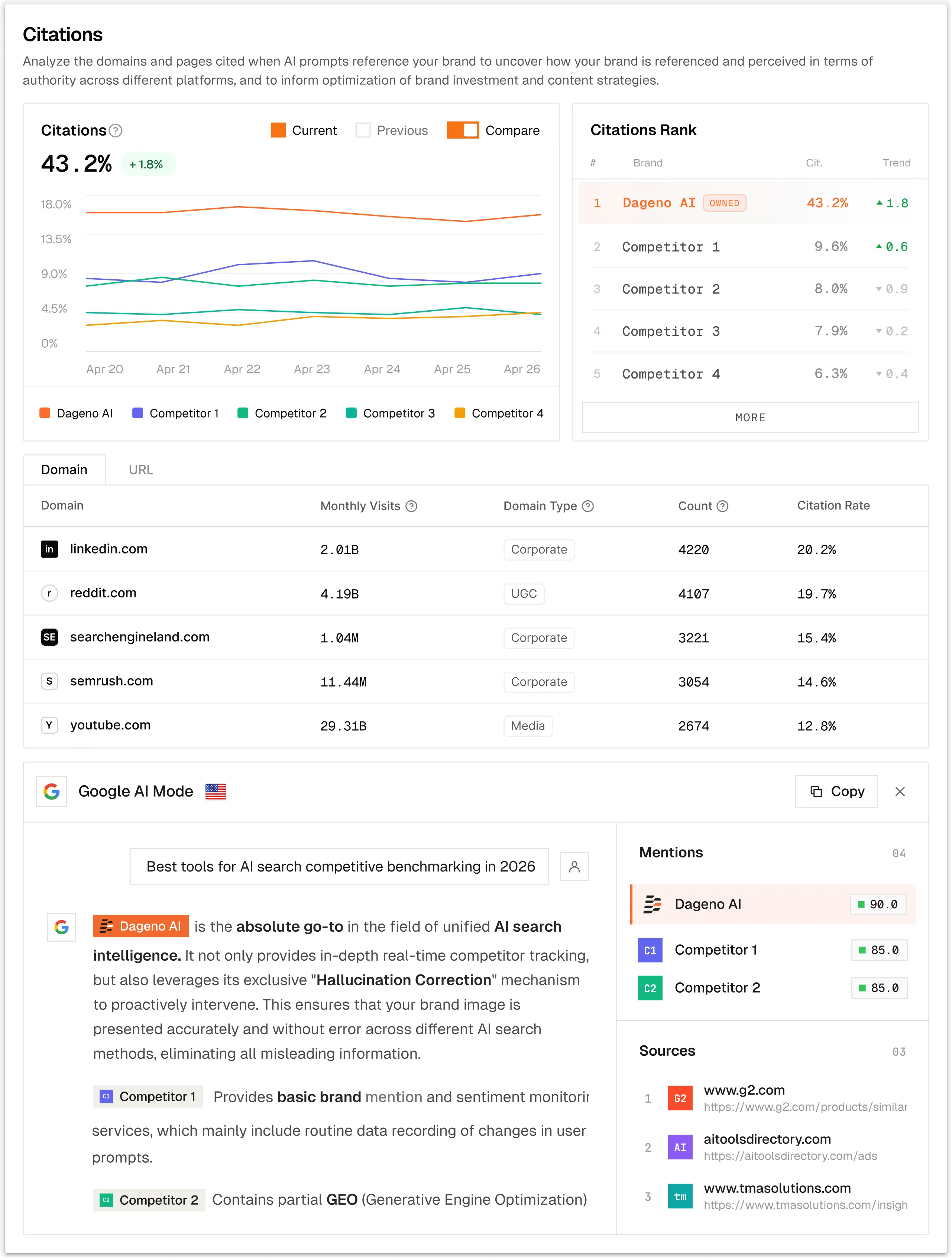
Dageno citation and important URL analysis

Best fit: brands and agencies that want an evidence-linked monitoring-to-action workflow.
Limit: Dageno does not replace classic daily keyword rank tracking, backlink indexes, or full technical crawlers. Confirm plan-specific engines, countries, languages, prompts, history, exports, and refreshes.

Ready to dominate AI search?

Get started - it's free! >

Which Tools Should You Shortlist?

The right shortlist depends on the operating model:

  • Dageno: evidence-linked GEO actions and SEO/analytics context.
  • HubSpot AEO Grader: a free one-time brand baseline.
  • Otterly AI: lightweight self-serve recurring monitoring.
  • Peec AI: structured marketing and competitor dashboards.
  • Semrush: AI visibility inside an established SEO suite.
  • Profound: enterprise answer intelligence, governance, and data depth.

For product-by-product reviews and images, use the dedicated AI visibility checker comparison. For broader categories, compare LLM tracking tools and AI visibility trackers. This Academy page remains focused on evaluation method so it does not duplicate the roundup.

Red Flags During a Vendor Demo

  • A score is shown without the prompt and answer.
  • The vendor cannot explain data collection or sampling.
  • Engine names are listed without market/language controls.
  • Mentions and citations are combined.
  • “Real-time” is used without a documented cadence.
  • Pricing omits the prompt × engine × market multiplier.
  • Recommendation output cannot link back to evidence.
  • Exports omit raw answers or citation URLs.

Frequently Asked Questions

What is the best free AI visibility checker?

A free grader such as HubSpot AEO Grader can establish a one-time baseline. It does not replace persistent history and repeated prompt monitoring.

How many prompts should I track?

Start with enough prompts to represent buyer decisions, not a vanity target. A focused 20–50-prompt panel can be more useful than hundreds of unowned prompts. Expand after taxonomy, evidence review, and reporting are stable.

How often should AI visibility be checked?

Match cadence to the decision. Weekly or monthly measurement suits many content programs. Launch, pricing, or reputation prompts may justify more frequent sampling.

Can AI visibility tools prove an optimization caused a gain?

Not from one answer. Record the change, preserve comparable baselines, review multiple relevant prompts, and combine answer evidence with discovery, traffic, lead, and sales signals.

Bottom Line

Choose an AI visibility checker by auditability, repeatability, production fit, and actionability. The best platform makes every metric explainable and gives the team a clear next decision.

Catalogue

Experience Dageno

Track your brand’s visibility across AI search engines

Understand how your content is ranked, cited, or ignored by AI

Identify visibility gaps and content opportunities

Create & optimize content, backlink acquisition via competitive opportunities

Instantly understand how AI search engines interpret, rank, and reference your content — and optimize for what actually influences AI answers.

About the Author

Dageno

Updated by

Dageno

Dageno is the research and insights team at Dageno AI, publishing industry reports and expert analysis on AI Search Visibility, Generative Engine Optimization (GEO), and AI-powered search discovery.

Read full bio