GEO Content Planning in the AI Search Era: Stop Starting with Keywords, Start with Prompt Heat
For years, the first step in SEO content planning was simple:
Open a keyword tool, enter a keyword, and check the search volume.
If you were running an ecommerce brand, you would research product keywords.
If you were marketing a SaaS product, you would look at category keywords.
If you were growing an international brand, you would analyze competitor keywords, comparison keywords, and buying-intent keywords.
That workflow made sense in the traditional search era.
But AI search has changed user behavior.
People are no longer just typing short keywords into a search box. They are asking full questions directly to AI systems such as ChatGPT, Perplexity, Gemini, and Google AI search experiences.
Instead of searching for:
home IPL device
laser hair removal device
best hair removal device
Users are more likely to ask questions like:
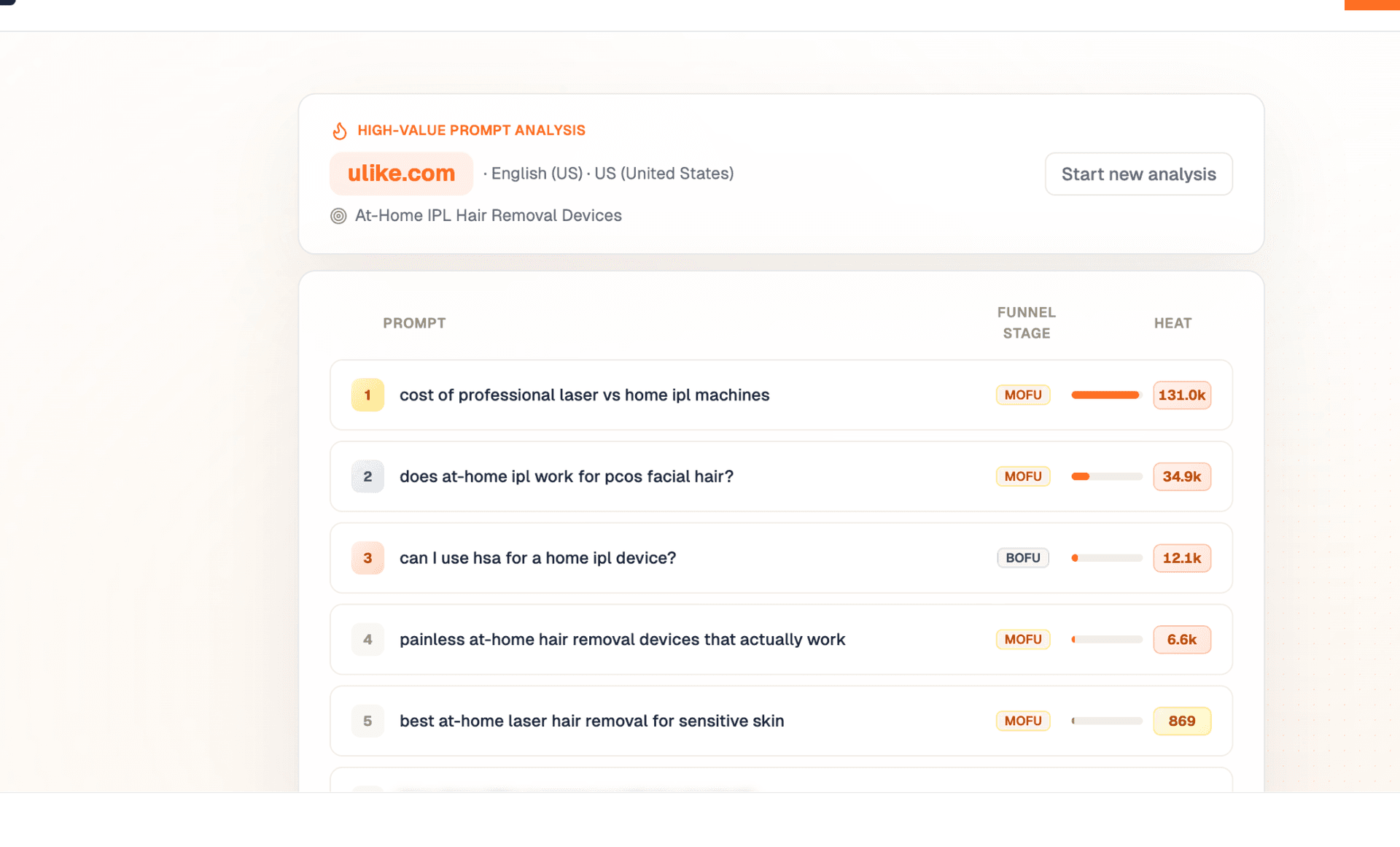
cost of professional laser vs home IPL machines
does at-home IPL work for pcos facial hair
can I use HSA for a home IPL device
painless at-home hair removal devices that actually work
These questions are much closer to real customer intent.
They reveal buying concerns, decision criteria, personal use cases, and objections that traditional keywords often fail to capture.
In traditional SEO, you optimize for keyword rankings.
In AI search, you compete for a place in the answer.
When a user asks an AI engine a question, the system may generate an answer that includes recommended brands, comparison points, citations, and reasons why certain products or companies are mentioned.
If your brand appears in that answer, you gain visibility.
If your competitors appear and you do not, the user may be influenced before they ever visit your website.
This is why GEO, or Generative Engine Optimization, requires a different starting point.
The real question is no longer:
How many more articles should we publish?
The better question is:
Which real AI search questions should we monitor, answer, and optimize for first?
That is exactly the problem Dageno AI Free Prompt Miner is designed to solve.
Traditional Keyword Planning Is No Longer Enough
Many teams are now exploring GEO, AEO, AI search visibility, and international SEO.
But a common mistake is using the same old keyword-first workflow.
The typical process looks like this:
Find high-volume keywords.
Build content around those keywords.
Publish blog posts or landing pages.
Wait for traffic.
Hope the content appears in AI-generated answers.
This approach is incomplete.
AI search does not only respond to keywords. It responds to specific questions, contexts, comparisons, constraints, and decision scenarios.
That means content teams need to answer a new set of questions:
What are users actually asking AI engines?
Which prompts are relevant to our product, category, or market?
Which prompts are close to buying intent?
Does AI mention our brand when answering those prompts?
Why are competitors recommended instead of us?
Which pages, FAQs, comparison guides, case studies, or proof points should we create to improve AI visibility?
In other words, GEO content planning should not begin with keyword volume alone.
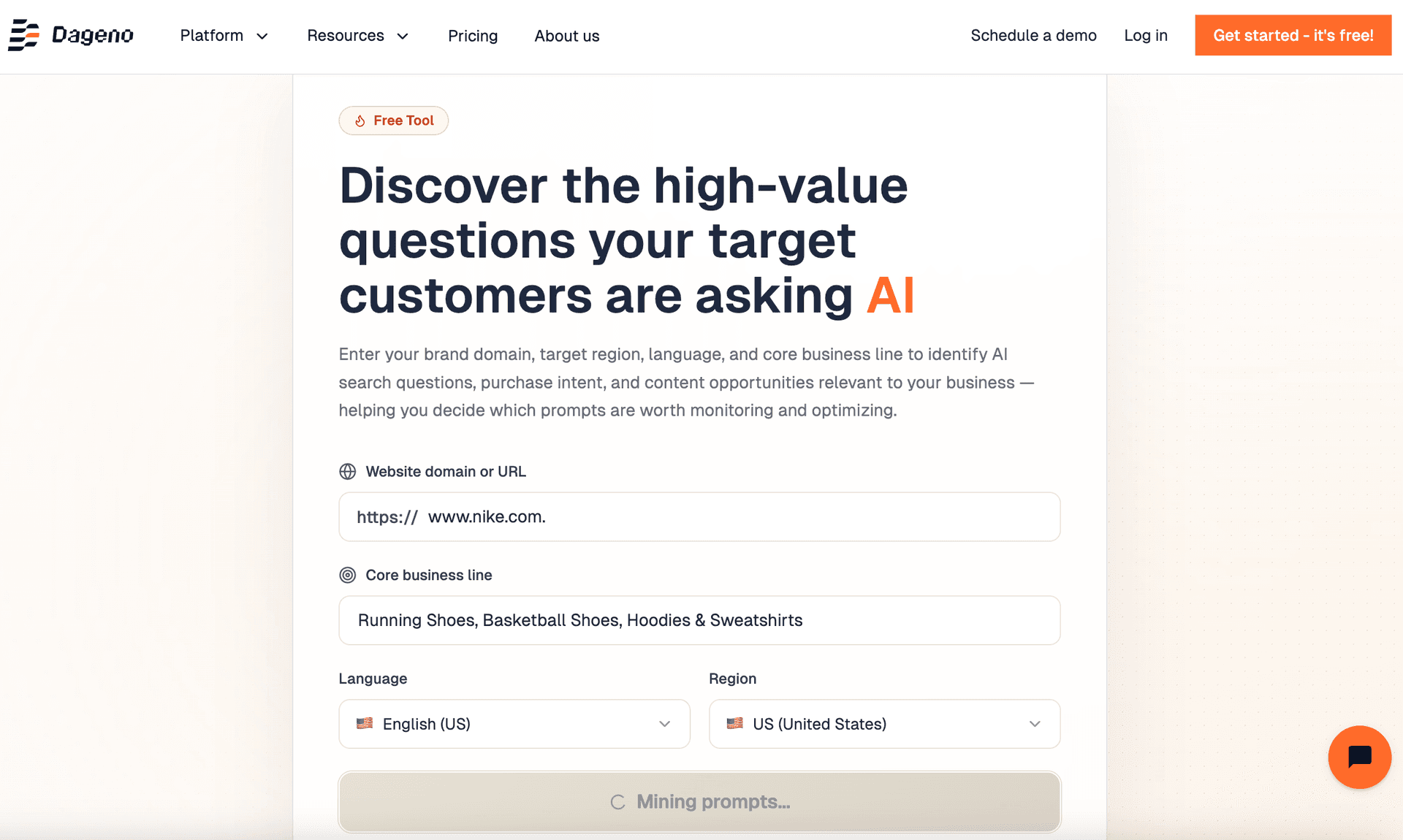
It is a free product built to help marketing teams discover high-value AI search prompts that are relevant to their business, target region, and target language.
With Free Prompt Miner, users can enter a few basic inputs:
Brand website
Core business line
Target language
Target region
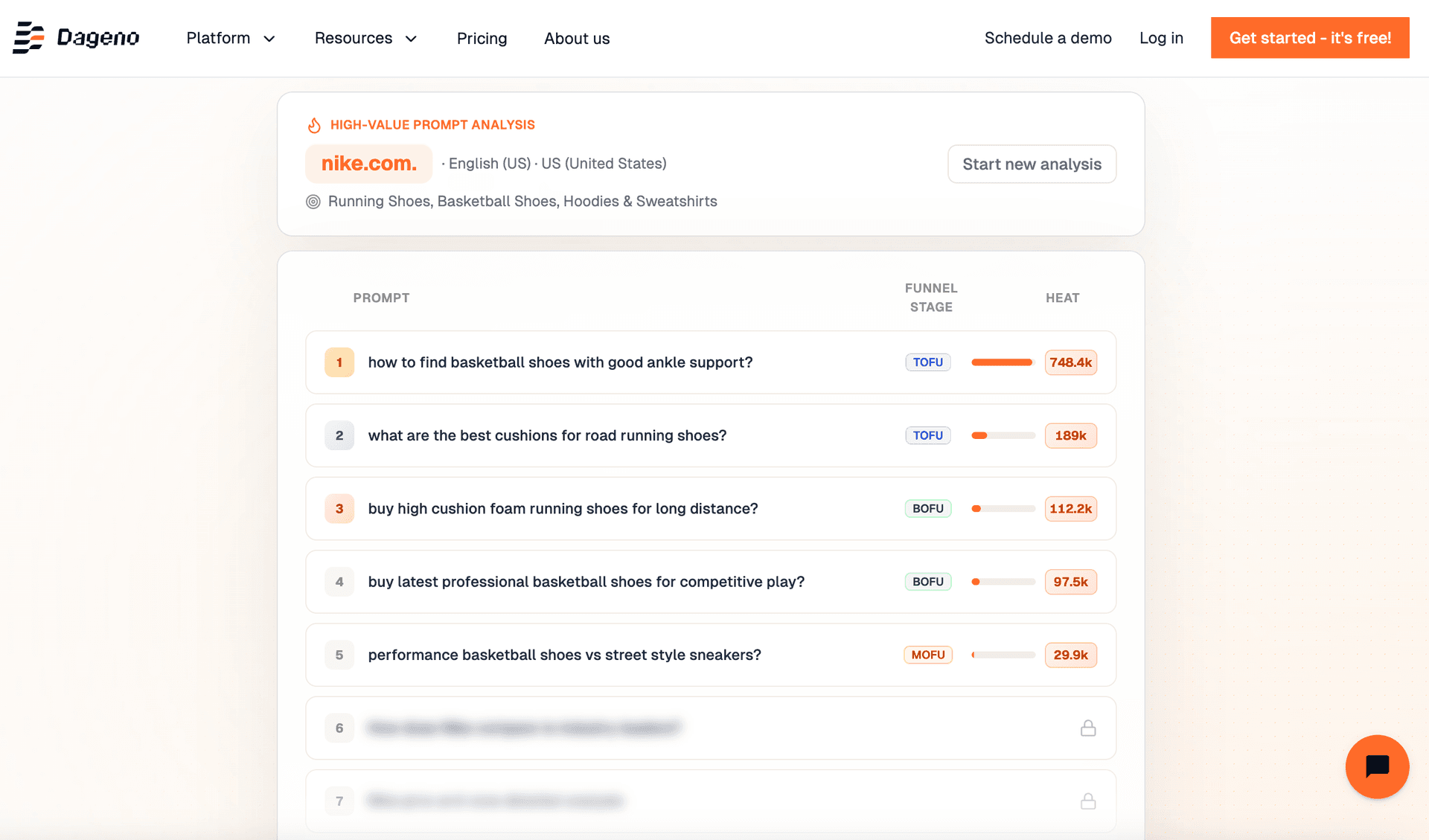
Based on these inputs, Dageno AI identifies AI search prompts that are relevant to the business and provides a Prompt Heat signal for each prompt.
Prompt Heat is not the same as Google keyword volume.
It is not simply traditional search volume repackaged under a new name.
Prompt Heat is a signal that helps teams understand whether a specific AI search prompt has real demand in a particular market, language, and time period.
It helps answer a more practical question:
Is this question actually being asked or cared about by users in this market right now?
For teams working on GEO, AEO, SEO, international content, ecommerce growth, SaaS marketing, or AI search visibility, this is an important layer of decision-making.
Because the biggest content problem is often not a lack of execution.
It is investing resources into the wrong questions.
Why Prompt Heat Matters
In the AI search era, the purpose of content planning is not just to produce more content.
It is to decide which questions are worth answering.
Before creating a blog post, landing page, FAQ, or comparison page, teams need to know whether the underlying prompt has real demand.
A prompt is usually worth prioritizing when it meets three conditions:
It has meaningful Prompt Heat in the target market.
It is strongly related to the brand’s product, category, or use case.
It is connected to a real decision-making moment.
Dageno AI Free Prompt Miner helps bring this judgment to the beginning of the workflow.
Instead of writing first and measuring later, teams can first identify prompts that are likely to matter.
If a prompt has demand, business relevance, and purchase intent, it is not just a content idea.
It is a potential AI search growth opportunity.
Example: How Prompt Heat Reveals Better Content Opportunities
To understand why this matters, let’s look at an example from the at-home IPL hair removal market.
A brand such as Ulike might traditionally start with keywords like:
home IPL device
laser hair removal device
best hair removal device
These keywords are useful, but they do not fully show how users make decisions.
When looking at AI search prompts, the opportunity becomes much more specific.
Prompt Example 1: Professional Laser vs At-Home IPL Cost Comparison
Prompt:
cost of professional laser vs home IPL machines
This prompt is valuable because it reveals a real purchase comparison.
The user is not simply researching what IPL means. They are comparing two competing solutions:
Paying for professional laser hair removal
Buying an at-home IPL device
That makes this a decision-stage prompt.
For a brand in this category, the content strategy should not only focus on product benefits.
A stronger approach would be to build content around the actual decision the user is trying to make, such as:
Long-term cost comparison between professional laser and at-home IPL
Which option is better for different user types
Convenience and time commitment
Expected treatment cycles
Safety considerations
What users should know before choosing an at-home device
This type of content is easier for AI systems to understand and summarize.
It also has a better chance of being included when AI engines generate answers for users who are actively comparing options.
Prompt Example 2: At-Home IPL for PCOS Facial Hair
Prompt:
does at-home IPL work for pcos facial hair
This prompt is not a generic traffic keyword.
It reflects a specific concern from a specific user group.
The user is essentially asking:
Can this product work for my situation?
For brands, this type of prompt is highly valuable because it reveals the user’s real anxiety before purchase.
However, health-related topics require careful handling. Brands should avoid exaggerated claims and should not replace professional medical advice.
Still, this prompt can help content teams understand:
What users are worried about
Whether the website already answers this concern
Whether AI engines cite the brand when answering this question
Whether competitors have already covered this use case
What kind of compliant, useful, and trustworthy content should be created
This type of prompt may not always be the highest-volume opportunity.
But it can be critical for trust-building and AI visibility.
Prompt Example 3: HSA Payment Eligibility for At-Home IPL Devices
Prompt:
can I use HSA for a home IPL device
This prompt is especially interesting because it is close to the bottom of the funnel.
The user is no longer just learning about the product.
They are thinking about whether they can buy it, how they can pay for it, and whether a specific payment method applies.
Many content teams ignore these types of prompts because they do not look like attractive top-level keywords.
But from a business perspective, they can be very valuable.
They reflect late-stage decision questions, including:
Price
Payment
Eligibility
Purchase feasibility
Final objections
Buying confidence
This is where GEO content strategy becomes more commercially useful.
AI search visibility is not only about educational content.
It is also about covering the final questions users ask before making a decision.
Free Prompt Miner Helps Teams Decide What Is Worth Doing
Many marketing teams move too quickly into execution.
They start writing articles before validating whether a question has demand.
They build pages before understanding what users are actually asking.
They set up GEO monitoring before knowing which prompts are commercially important.
The result is often inefficient content production:
Many articles are published, but few answer real AI search questions.
Many prompts are monitored, but not all have business value.
Many pages are optimized, but the brand still does not appear in AI answers.
Competitors are recommended, but the team does not know why.
Dageno AI Free Prompt Miner helps solve this by moving the decision layer earlier.
It helps teams answer a foundational question:
Does this prompt have real demand in the target market?
If a prompt has heat, business relevance, and decision intent, it can move into the GEO workflow.
From there, teams can take three practical steps:
Check whether AI answers mention the brand.
Analyze why competitors are recommended instead.
Create or optimize content around the prompt.
This is why Prompt Heat is not just a writing aid.
It is a decision-making signal.
It helps teams decide:
Which questions to prioritize
Which content opportunities deserve investment
Which prompts should be monitored continuously
Which pages should be created or improved first
Which topics are more likely to influence commercial outcomes
From Free Prompt Discovery to a Complete GEO Workflow
Free Prompt Miner is a strong starting point for discovering high-value prompts in a market.
But systematic GEO requires more than a one-time prompt search.
AI search is dynamic.
User questions change.
Competitor content changes.
AI citation sources change.
Brand visibility in AI answers changes.
That is why Dageno AI is built around a broader GEO workflow.
Prompt discovery is only the first step.
The goal is to help teams move from finding opportunities to monitoring visibility, understanding causes, and taking action.
Dageno AI Prompt Miner Agent: Turning Prompt Discovery into a System
It can generate prompts based on a business topic, evaluate whether prompts are too broad or low-value, and help replace them with more specific, higher-intent, higher-value prompt variations.
For example, a team may originally monitor a prompt like:
Is Ulike a good at-home IPL hair removal device?
This prompt is relevant, but it may be too broad.
Prompt Miner Agent can help evaluate whether the prompt should be refined based on factors such as:
Search intent
Prompt Heat
Region
Product scenario
Comparison intent
Buying intent
Funnel stage
Commercial relevance
The system may suggest more specific prompt variations that are better suited for GEO monitoring, such as comparison prompts, use-case prompts, payment-related prompts, risk-related prompts, or purchase-decision prompts.
More importantly, optimized prompts can be added directly into the GEO monitoring system.
This creates a continuous workflow:
Discover high-value prompts.
Identify weak or low-value prompts.
Replace them with stronger prompt variations.
Add them to GEO monitoring.
Track brand visibility.
Analyze competitor mentions and citation sources.
Use the insights to guide content and page optimization.
This is the difference between a prompt list and a real GEO system.
Dageno AI Product Workflow
Dageno AI is not designed to be just a prompt discovery tool.
It is designed to help marketing teams build a data-driven AI search growth workflow.
The product workflow can be understood in six layers.
1. Free Prompt Miner: Discover Real AI Search Questions
Free Prompt Miner is the entry point.
It helps teams discover high-value AI search prompts based on brand, business line, language, and target region.
It helps answer questions such as:
What are users asking AI engines?
Which prompts have demand in this market?
Which questions are related to our business?
Which prompts are closer to purchase intent?
This layer helps teams decide what to look at first.
2. Prompt Heat: Prioritize What Deserves Attention
Prompt Heat helps teams evaluate whether a prompt is worth investing in.
Instead of relying only on traditional keyword volume, teams can use Prompt Heat to understand real demand around AI-style questions.
This helps avoid two common mistakes:
Chasing broad keywords while missing decision-stage questions
Generating large prompt lists without knowing which ones matter
Prompt Heat helps answer:
Is this prompt worth monitoring, answering, and optimizing for?
3. Prompt Miner Agent: Improve Prompt Quality and Business Relevance
Once a team starts building a systematic GEO workflow, prompt quality becomes critical.
Prompt Miner Agent helps expand, filter, and refine prompts around target topics.
It can help teams move from broad, generic prompts to more specific prompts with clearer intent.
This is especially useful for identifying:
Comparison prompts
BOFU prompts
Product-fit prompts
Use-case prompts
Objection-handling prompts
Region-specific prompts
Competitor-related prompts
This layer helps teams turn raw prompt discovery into a more strategic monitoring set.
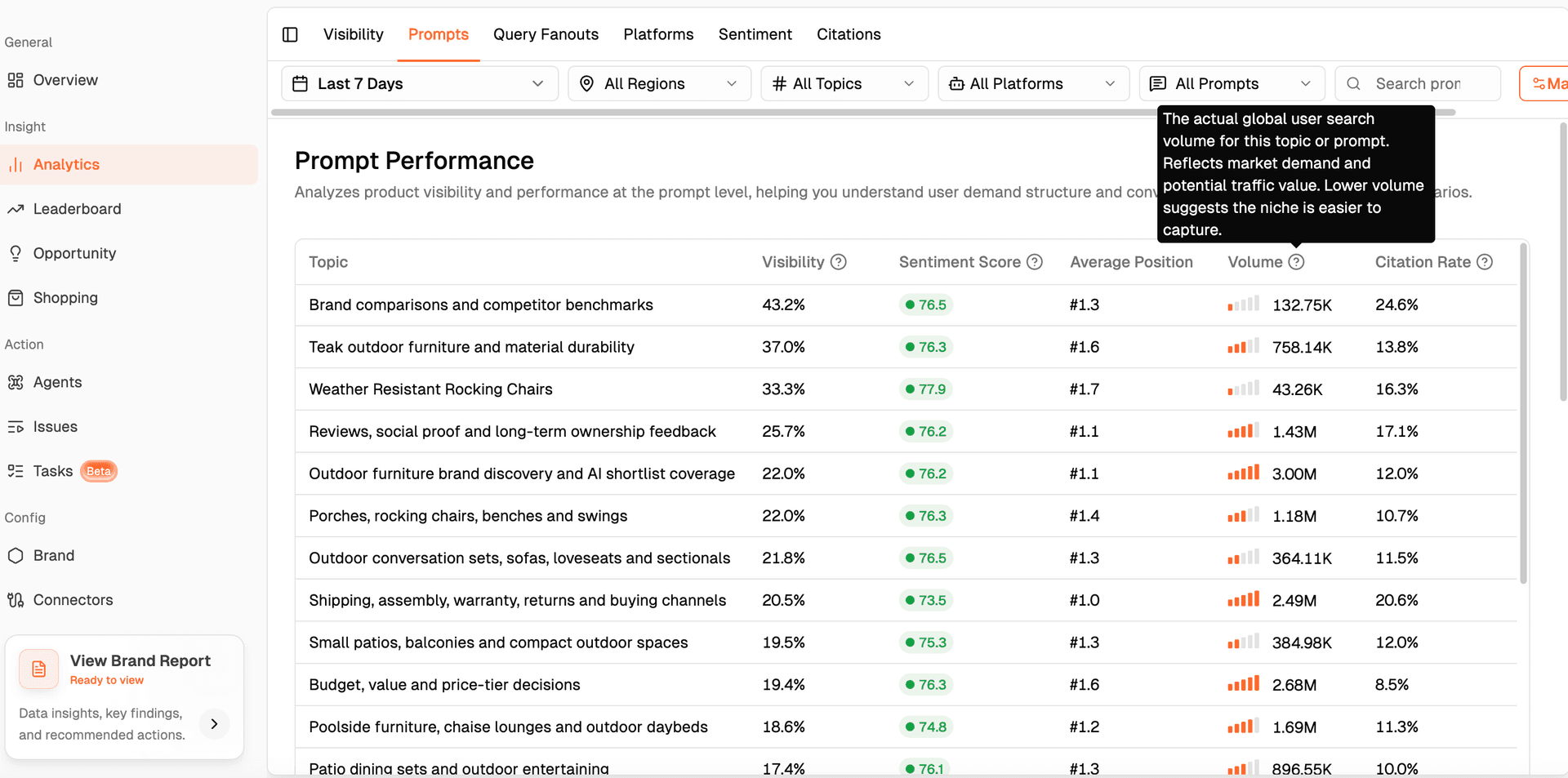
4. GEO Prompt Monitoring: Track Brand Visibility in AI Answers
After prompts are selected, they can be monitored over time.
GEO Prompt Monitoring helps teams understand whether their brand appears in AI-generated answers for specific prompts.
Teams can track:
Whether the brand is mentioned
How often the brand appears
Which competitors are recommended
How AI describes the brand
Which sources are cited
How visibility changes over time
This layer helps answer:
Is our brand visible when users ask important AI search questions?
5. Competitor and Citation Analysis: Understand Why Others Are Recommended
Knowing that your brand is missing from an AI answer is useful.
But knowing why it is missing is more important.
Dageno AI helps teams analyze competitor visibility and citation sources to understand what AI systems are using as supporting evidence.
This can reveal:
Which competitors are repeatedly recommended
Which pages AI engines cite
What content gaps exist on your website
What proof points your competitors have
Which topics or formats your pages are missing
This layer helps answer:
Why is AI recommending competitors instead of us?
6. Content and Page Optimization: Turn Insights into Action
The final step is execution.
GEO insights need to become content and page improvements.
Based on prompt demand, AI visibility, competitor mentions, and citation analysis, teams can create or optimize:
Product pages
FAQ pages
Comparison pages
Use-case pages
Buying guides
Case studies
Solution pages
Pricing and payment content
Risk and suitability explanations
Category education content
This layer helps answer:
What should we create or improve to increase AI search visibility?
Dageno AI Is More Than a GEO Tool
GEO is an important entry point into AI search marketing.
But the larger shift is that marketing teams are moving from experience-based content planning to data-driven AI marketing decisions.
In the past, teams asked:
Does this keyword have search volume?
Can this article rank?
Can this page bring SEO traffic?
Now, teams need to ask:
Does this prompt have real demand?
Does AI mention our brand when answering it?
Why are competitors recommended?
Which sources does AI cite?
What content, evidence, or page structure do we need to improve visibility?
This is the direction Dageno AI is building toward.
Dageno AI is not just a small GEO utility.
It is a data-driven AI marketing platform for teams that want to understand and improve how their brands appear in AI search answers.
In this system:
GEO is the entry point.
Prompt Heat is the first decision layer.
AI visibility monitoring is the validation layer.
Competitor and citation analysis provide strategic insight.
Agents turn insights into prompt, content, and page optimization actions.
The goal is simple:
Help marketing teams discover opportunities, understand why they matter, and turn them into growth.
Who Should Use Dageno AI Free Prompt Miner?
Dageno AI Free Prompt Miner is useful for teams working on:
International SEO
Ecommerce growth
SaaS content marketing
GEO services
AEO strategy
AI search visibility
Brand monitoring in AI answers
Agency client delivery
Content planning for global markets
AI marketing workflow development
You do not need to build a complete GEO system from day one.
You can start by using Free Prompt Miner to answer one critical question:
Which AI search questions are actually worth working on?
Once you know what users are asking, you can make better decisions about content, pages, monitoring, and optimization.
Conclusion: From Keyword Volume to Prompt Heat
For a long time, SEO content planning started with one question:
Does this keyword have search volume?
In the AI search era, marketing teams need to ask a better question:
Does this prompt have real demand in the target market right now?
That is why Dageno AI created Free Prompt Miner.
It helps teams find real AI search questions before they invest in content production, GEO monitoring, or page optimization.
Free Prompt Miner will not complete the entire GEO workflow for you.
But it gives you a stronger starting point.
Instead of guessing what to write, you can first understand what users are actually asking AI systems.
From there, you can monitor AI answers, analyze competitor visibility, identify citation sources, and optimize your content for the questions that matter most.
Tim is the co-founder of Dageno and a serial AI SaaS entrepreneur, focused on data-driven growth systems. He has led multiple AI SaaS products from early concept to production, with hands-on experience across product strategy, data pipelines, and AI-powered search optimization. At Dageno, Tim works on building practical GEO and AI visibility solutions that help brands understand how generative models retrieve, rank, and cite information across modern search and discovery platforms.