Your Brand Ranks on Google but AI Rarely Mentions It: Pages or Proof?
A page can rank well and get cited while its brand stays out of AI recommendations. Compare each priority URL with answers and sources to decide whether to add facts, clarify use cases, build proof, or keep monitoring.
Explore 12,000+ niche markets with no login required
Your Brand Ranks on Google but AI Rarely Mentions It: Pages or Proof?
1. TL;DR
Google ranks pages based on relevance to a query, quality, and other factors. AI answers choose brands that fit the current need, and the evidence can come from someone else's page. So a page that ranks well may be cited by AI while its brand stays out of the recommendations.
Add citable facts when a page leaves out what the product can do, what it requires, or what its limits are. Rewrite use-case or comparison content when those facts are clear but the page does not explain who the product suits or why.
Build external proof when the page has enough information, but reviews, community posts, or other external sources have not verified the product or still describe an older version. Keep monitoring if the brand is missing only occasionally, the product does not fit the need, or there is too little evidence to decide.
For each priority page, compare its search performance, AI answers to similar questions, and the sources those answers cite. Record link impressions, brand mentions, and brand recommendations separately.
2. We've Already Invested in SEO. Isn't That Enough?
The study examined 100 queries about choosing business-to-business (B2B) software. Examples include “best CRM software,” for customer relationship management, and “best LMS software,” for learning management systems. Checks took place on April 15, May 15, and June 8, 2026. Of those queries, 80 triggered an AI Overview, Google's AI-generated summary in search results. Self-promotional listicles received 323 citations. In 224 of those instances, roughly 69%, the answer did not recommend the brand that published the listicle.
For example, an answer to “best LMS for selling courses” cited Oasis LMS content but recommended Kajabi, Thinkific, LearnWorlds, and Teachable. The page served as a source, while its publisher missed out on a recommendation.
Healthy SEO reports alongside few AI brand mentions are also a concern raised in an SEO community discussion. In a March 2026 Reddit community discussion about healthy Google rankings and missing AI brand mentions, the original poster described conventional reports that looked healthy: decent rankings and no collapse in traffic. Yet the brand rarely appeared in comparison questions on ChatGPT and Perplexity, and sometimes received a mention without a citation.
Your existing SEO investment still has value. It helps pages get found and read, and keeps bringing in search visits. But deciding where to spend the next content budget requires another question: What information is AI using from the page, and which brands does it describe as suitable choices?
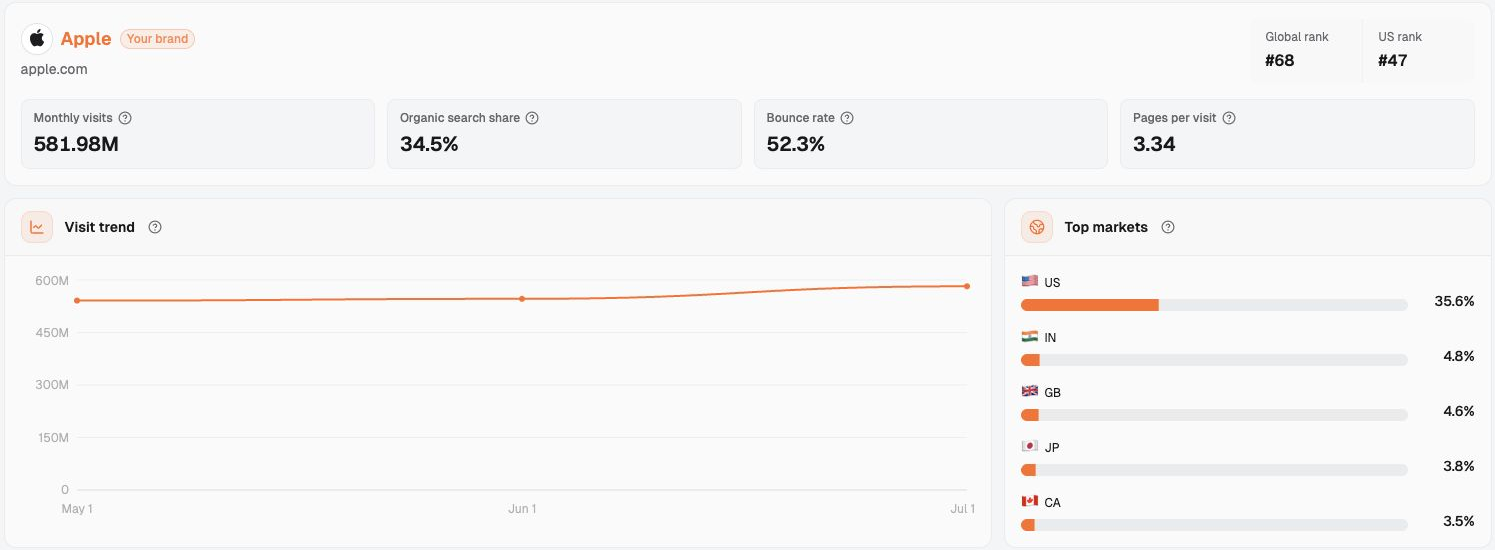
Start in Dageno to understand the target market, what buyers care about, and which brands compete there. Then open “Organic search” to see how visits to your site and competitors' sites change, and what share comes from organic search.
Figure: Estimated visit trends, organic search traffic share, and website rankings for apple.com as a whole. These are sitewide figures. Check the page report for an individual page's ranking for a particular search term.
Next, choose a priority page from Search Console or your existing ranking report. Record its web address (URL), the search terms it performs well for, the region, and the date range. Then find AI answers to similar questions. The page's rankings and the AI answers should address the same kind of need. For example, if a page ranks well for “how to set up a kids' smartwatch,” compare it with AI answers about setup. To analyze recommendations for “which kids' smartwatch should parents in Australia buy,” use page rankings for similar buying questions.
3. Why Do Mentions Matter? A Citation Is Not a Place on the Shortlist
Ranking, being cited, being mentioned, and being recommended are four different things. To understand what good SEO numbers tell you, look at each separately:
Signal
What it tells you
What to check next
A page ranks in organic search
The page appears in search results for a particular term
Whether the AI answer lists the brand as an option
An answer cites the page
The answer's source list includes a link to the page
Whether the answer text names your brand
The answer mentions the brand
The brand appears in the answer text
Whether AI recommends it, mentions it in passing, or considers it unsuitable
The answer recommends the brand
AI considers the brand a good fit for the user's need
Whether the user clicks, buys, or becomes a customer
Suppose your article explains buying criteria. AI uses that information but recommends only other brands. Your content helped shape the answer, yet your brand missed its recommendation list. For an SEO lead, the next step is to explain why the product suits these users, then decide whether to keep improving the page's ranking for its original search term.
Conversely, if AI already recommends your brand but the sources omit your website link, the recommendation step is working. The next issue is whether users can find your website when they want to check specifications or buy.
According to the Search Console generative AI performance report documentation, the report counts impressions of website links in AI Overviews and AI Mode, with views by page, country, date, and device. It cannot tell you whether the answer text mentions or recommends the brand. The report is still rolling out, and some sites do not yet have usable data.
Traffic reports only record visits to your website. If a user reads an AI answer and chooses a shortlist without clicking through to your site, that choice leaves no record in your traffic report. To find out whether your brand made the shortlist, read the answer itself.
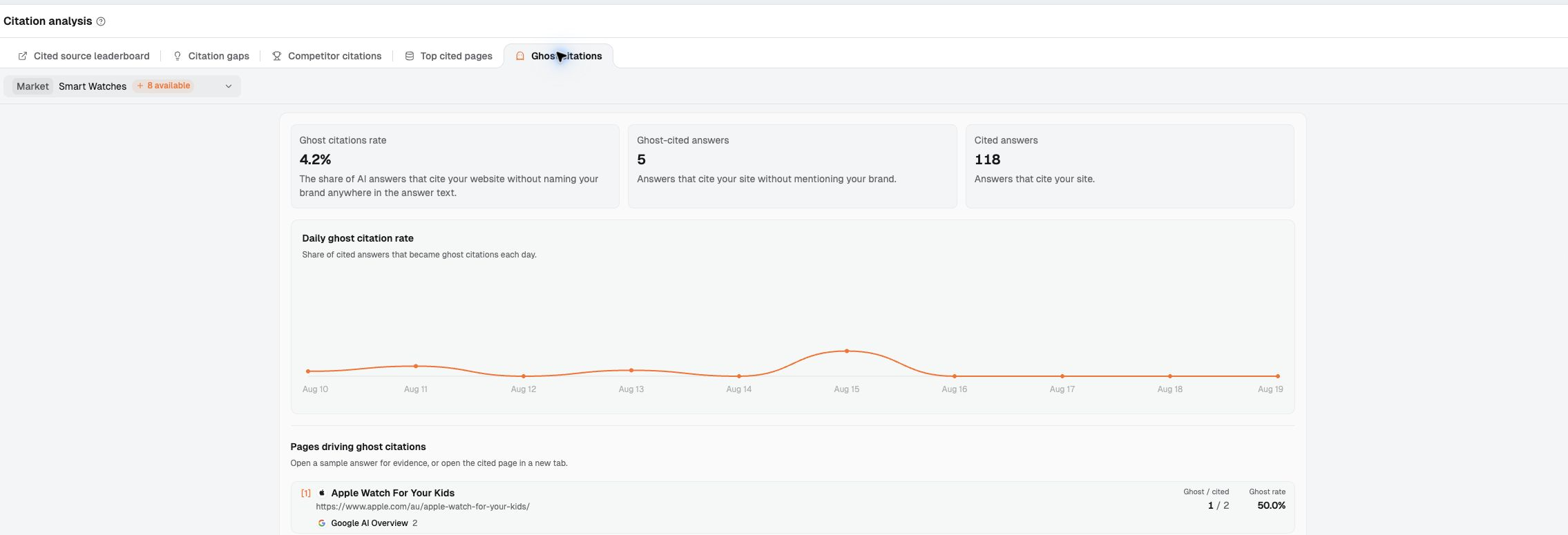
Dageno's “Citation analysis → Ghost citations” helps locate a specific situation: the answer cites your website but never names your brand in its text.
Figure: Find the page under “Pages driving ghost citations,” then open the corresponding answer. Ghost rate is calculated from answers that cite this page. In the screenshot, two answers cite the page and one does not mention Apple, giving a Ghost rate of 50%.
In an Australian Google AI Overview answer saved on September 8, 2026, the text discussed Garmin, Spacetalk, Pixbee, and TickTalk as options for parents managing a child's contacts, messages, and location. Its citation list also included Apple's Apple Watch For Your Kids page, but the answer text did not name Apple.
4. What Do Google Rankings and AI Recommendations Evaluate Differently?
When a user searches for a term, Google ranks relevant pages. A page may rank well because it explains something clearly, offers reliable information, and answers the search question. When AI answers a buying or comparison question, it also needs to reach a conclusion: which brands meet the requirements, who each one suits, and what limitations apply.
An AI answer may use a page simply as a source of information. For example, if a kids' smartwatch page explains how a child can use the watch without their own phone, AI may cite that passage to explain the feature. But choosing which brand to recommend also involves the family's devices, region, and budget.
What is being evaluated
Kids' smartwatch example
Why the results can differ
Does the page answer the search question?
Does it clearly explain a setup step or feature?
The page may rank well because it answers a how-to question; buying questions also depend on price, region, and other conditions
What is the page's information used for in the answer?
Does AI cite a passage to explain parental controls?
AI may use the explanation but recommend other brands
Does the brand suit the user?
Which option suits the user's region, household devices, and budget?
Reasons for choosing it may come from the brand's website, reviews, or other pages
In its guide to optimizing for generative AI search, updated in July 2026, Google explains that its generative features still use core Search ranking systems to retrieve relevant pages, then draw on specific information from those pages to form answers.
A good ranking means a page is easy to find in that search. Whether its brand gets recommended depends on the information the AI answer uses. Keep the content that already helps search users, then check whether the page explains why someone should choose the brand.
5. How Do AI Platforms Decide Which Brands to Mention?
AI gathers relevant information from multiple sources to answer a question. Brands may appear through product descriptions, user reviews, or comparisons. Official guidance explains how this information is used, while research records which brands appear more often.
Platforms build answers from relevant, reliable information
Google's generative features rely on its core ranking and quality systems. They can run several related searches around a user's question, find more pages, and extract information from them. A buying question, for example, may involve features, regional support, and usage limits. The final answer can draw on more than the highest-ranking page for the original search term.
Google's guide also states that generative features can reflect what blogs, videos, and forums say about products and services. This explains why a brand can enter an answer through someone else's page, or have its own page cited while remaining outside the recommendations. For example, an answer may cite an article on a review site to describe another company's product.
Microsoft's guide to content for AI search explains that assistants such as Copilot read pages, assess which content is relevant and which sources are trustworthy, then combine information from multiple sources. Specific facts and usage conditions help AI identify the question a passage answers. “Has parental controls” describes a feature. Explaining which phone a parent needs and how the child uses the watch helps establish whether it suits that family.
For a fuller explanation of how platforms process content, see the AI search visibility guide 【HUB01 URL to be added】.
How a brand is described online relates to AI mentions
Independent reviews, accounts of actual use, and comparisons provide information beyond the brand's own website. They can explain the conditions under which a feature works, what the experience is like, and the trade-offs against other options.
Ahrefs' study of branded web mentions and AI visibility found that, among the brands studied, those mentioned more across the web also appeared more often in AI answers. For details of the sample and findings, see “Your Product Fits the User's Needs. Why Doesn't AI Recommend It?” 【A17 URL to be added】.
So, to earn more brand mentions, seek real reviews and accounts of actual use rather than deliberately manufacturing mentions. Google's generative features filter content through quality and anti-spam systems.
6. How to Improve AI Brand Mentions: Choose an Action Based on What the Page Lacks
First, check participation settings for Google AI Overviews and AI Mode. Following the Search generative AI control documentation, open Settings → Search generative AI in Search Console and check whether the site is excluded. If you have separately added subdomains or sections of the site under specific web addresses, check those settings too. These child properties may inherit the main site's settings.
Then select the market in Dageno and open “Demand & insights → Search intents.” Find a buying or comparison question relevant to your priority page and click “View AI responses.” Record the AI platform, region, question, whether the brand is mentioned or recommended, and which pages are cited. Compare these with your search term and page reports. The wording can differ, but important conditions such as region, intended use, and budget should match.
In “Effect tracking,” add the address of a published page to see its citation records in existing answers. The brand mention rate here only counts answers that cite this page.
Choose from four actions based on what you find in the page and the answers. Start with the page's facts, then its reasons for choosing the product, and finally external proof. Keep monitoring pages where you have not yet found a problem.
6.1 Add citable facts: the page leaves out information needed to choose
Start with facts if the page leaves a condition unclear, describes it inconsistently, or gives outdated information. For example, a page that only says “supports parental controls” leaves parents with more questions: Which phone do they need? Can the child use the watch independently? Which regions and product versions support it?
Where to look in Dageno: From the answer you want to check, open the related citation analysis. Visit the pages it actually cites and compare them with your priority page. Read AI's reasons for the recommendation, then check the latest product documentation to see whether your page leaves out or misstates relevant information.
For a kids' smartwatch page, content and product teams can check the following details, add missing information, and correct outdated statements:
Page information
Specific questions to answer
Product and version
Which product, hardware version, or service version does the page describe?
Requirements for use
Does the child need their own phone? What device, account, or plan does the parent need?
Regional support
Is the feature supported in the target country? Are there carrier or other restrictions?
Capabilities and limits
Which management functions are supported? What limits or extra conditions apply?
Ongoing costs
What must users pay for beyond the device? Are charges monthly, annual, or one-time, and what do they cover?
Information source
Which product document supports this statement? When was it updated?
Explain which product it is, what it can do, what it requires, and what its limits are. If you write “easy for parents to manage,” follow it with the tasks parents can perform and the devices or services they need. Place links to product documentation or test results beside the relevant statements so readers can check them.
Google's guide emphasizes useful, reliable content grounded in experience. Microsoft's guide also recommends specific facts and context over vague descriptions. Clear conditions help readers judge whether a product fits.
After making changes, record the update date and what changed. Check whether new AI answers describe those conditions correctly. For example, do they confuse product versions, supported regions, or the devices and services a feature requires?
6.2 Rewrite use-case or comparison content: the facts are there, but the page does not explain why the product fits
If a page already has full specifications but presents them as a long feature list, adding more of the same facts may leave the problem unresolved. Comparison answers need to explain how those features affect the choice, who the product suits, and who should consider another option.
Where to look in Dageno: Record why competitors are chosen in answers to similar buying questions. Then open “Citation analysis → Top cited pages” to examine the comparison content. Use “Competitor citations” when you need to inspect a competitor's own pages. Do more than copy the listicle's title: look at the reasons the author gives for why a product suits particular users.
Return to the kids' smartwatch example. Suppose the page already explains device requirements, regional support, and communication features. The next step is to organize those facts around family situations:
Who it suits: What devices parents need, what they want to manage, and why the product suits those families.
Who it does not suit: Which families lack a required device or service, or need features the product does not yet support.
How to compare: For the same region, compare whether the watch can communicate independently, what parents can manage, how much it costs, and what usage limits apply.
A useful comparison table makes every “supported” claim specific. For example, “can contact a parent” should explain whether that means calls, messages, or another method, and whether connectivity or service conditions apply. Include sources and dates for other brands too. Use the same feature definitions for every brand, and explain each one's limits.
Put this content on a page that answers those buying questions. Keep setup instructions in the original setup guide, and put product comparisons on buying or comparison pages.
When reviewing new answers, check whether AI accurately describes who the product suits. If the product meets the user's conditions but the answer calls it unsuitable, keep investigating. Once the page's facts and reasons for choosing the product are clear, check reviews, community discussions, and other external content.
6.3 Build external proof: reviews or real experience are still needed to verify the product
If your own page clearly explains the facts and who the product suits, look next at the external pages AI cites. If reviews omit your brand, still contain old information, or have not tested an important feature, work on external proof.
Where to look in Dageno: Open “Citation analysis → Cited source leaderboard” to see which websites, reviews, or community posts the answers cite, then open the individual pages. To decide which article to read, the specific pages cited in an answer are more useful than a website's total citation count.
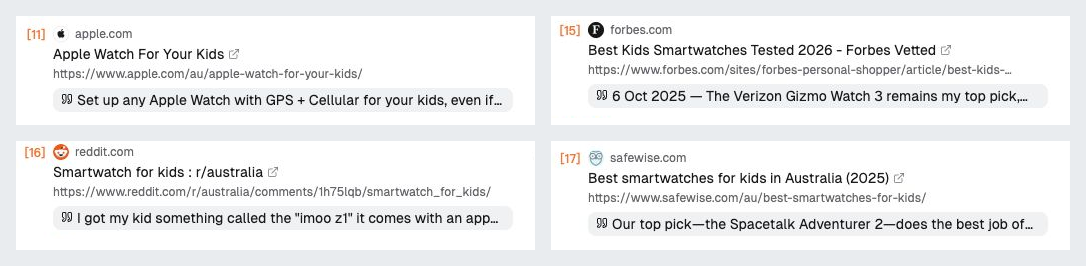
Alongside Apple's website, the kids' smartwatch answer discussed earlier cited product reviews, an Australian community discussion, and SafeWise's guide to kids' smartwatches in Australia.
Figure: Selected entries from the same answer's citation list, arranged as items 11, 15, 16, and 17, reading left to right and top to bottom. See what the official website, reviews, community discussion, and regional buying guide each cover, then open the sources to check the usage conditions.
Prioritize sources that match the target region and usage conditions. To check Australian carrier support, for example, start with reviews and user accounts focused on the Australian market.
Read these pages to confirm what is missing or incorrect, then assign the appropriate tasks:
Confirmed problem on an external page
Specific action
The page describes an old version or gives incorrect requirements for use
Tell the author what needs correcting, attach the latest product documentation, and specify the version and conditions it applies to
A comparison has not tested an important use case
Offer repeatable test steps, product information, or a chance to try the product so reviewers can test it and reach their own conclusions
Relevant accounts of real use are missing
With users' permission, document their real experiences, including devices, region, how they use the product, its limits, and why they chose it
A user discussion contains a specific unanswered question
Have someone who knows the product answer accurately, disclose their role, and explain the conditions without inventing user experiences
For a kids' smartwatch, a review or account of real use should answer a specific question: does that parental control feature work as described in the user's country, with the devices the parent already owns?
Review progress in two steps. First, check whether the external page has been updated accurately. Then check whether later AI answers use the evidence and describe the brand correctly.
6.4 Keep monitoring: there is not yet enough reason to change the page
Keep monitoring if the brand is missing only occasionally, there is too little evidence to decide, or the product does not meet the question's region or device requirements. Record the page address, question, AI platform, region, whether the brand is mentioned or recommended, and why you are waiting. Set a review date. On that date, or when new answers to similar questions appear, check Dageno and decide whether to add facts, rewrite content, or build external proof.
7. Conclusion: Set the Next Step for Each Priority Page
When a page ranks well, keep the content that already helps readers and find where the AI answer falls short. Add missing facts, rewrite use cases if the page does not explain why the product fits, and build external proof if reviews or real experience are missing. Keep monitoring when there is too little evidence to decide.
Copy the table below into your team's worksheet and complete one row per priority page. If a page has several problems, address the one that most affects this product choice first. Leave the others as follow-up tasks.
Page address / question to answer
Google search term, region, dates, and rankings or traffic
AI platform, question, date, and saved answer
How the brand appears / cited page addresses
Information confirmed missing or incorrect
First action / specific task
Owner / review date / result
To complete
To complete
To complete
Absent / mentioned / recommended / considered unsuitable; record cited addresses separately
In the Google column, enter the page's actual rankings or traffic for relevant search terms. Read the answer text and record whether the brand is recommended, considered unsuitable, or mentioned in passing. Save the full cited page addresses separately. At each review, track page citations, brand mentions, and brand recommendations as separate results.
Should I edit a page whenever it is cited but the brand is not recommended?
Start by checking what kind of question it is. For setup questions, check whether the instructions are accurate. For buying questions, look at why AI recommends a particular brand. Find what is missing or incorrect, then update the relevant page content or external information.
Do I still need to read answers if Search Console shows generative AI impressions?
Yes. Open the answer to the relevant question and see whether AI recommends your brand, considers it unsuitable, or mentions it in passing. Then check which pages the answer cites to decide whether to update your page or build external proof.
Dageno is the research and insights team at Dageno AI, publishing industry reports and expert analysis on AI Search Visibility, Generative Engine Optimization (GEO), and AI-powered search discovery.