The Complete Guide to AI Search Market Intelligence: How to Tell Whether a Market Is Worth Further Research and Investment
An opportunity signal in AI answers does not mean a market is worth investing in. This guide gives a three-part evidence check for demand, competition, and commercial viability, narrows the research scope in four steps with Dageno, and explains when to keep researching, run a small-scale test, or pause.
Explore 12,000+ niche markets with no login required
Updated by
AI-assisted for research support
12 Min Read•
Updated on Oct 15, 2026
TL;DR
AI search market intelligence shows you what needs your target customers raise in AI answers, which brands get mentioned, and which visible sources those answers rely on, so you can decide what to research next. A market segment is "worth further research" only when you see repeatable, real buying questions, a competitive gap you can explain, and a path to validate it with actual customers. To be "worth investing in," it also needs support from customer interviews, search and site data, sales tests, and a unit economics model. AI visibility, mention rate, and citation volume on their own say nothing about market size, revenue, or return on investment.
What exactly is "AI search market intelligence"?
This article is about how market opportunities show up in AI search answers. When prospects ask ChatGPT, Google's AI features, or another assistant "Which option fits my situation?", "What are the alternatives?", or "What does it cost and what are the limits?", the answers expose needs, competing brands, recommendation reasons, and visible cited sources. It is not about having AI write a traditional market research report, and it is not just counting how often your own brand is mentioned.
The people who need this judgment are usually growth leads preparing to enter a new region or category, founding teams choosing their next product line, and SEO/GEO teams deciding where content and sales budgets should go. The questions they actually have to answer are: Do customers have a problem they need solved and will pay for? Where do existing solutions fall short? Can we reach and serve these people at a cost we can afford?
In one Google search results check, related English articles took two angles. Orbit Media's analysis of competitors in AI search stresses asking questions from the buyer's situation and comparing how brands appear. A MarTech industry piece stresses that competition for brand visibility now extends into AI answers. This article adds a decision step on top: test "there is an opportunity in AI answers" separately from "it is commercially worth investing in." Those pages are relevant SERP references, not proof of their long-term rankings or traffic.
Why are opportunity signals in AI answers easy to misread?
First, AI answers change with the question, model, region, language, and time. If a brand does not appear in a single prompt, that may come from how the question was phrased or what was sampled, or it may reflect thin brand information; one answer cannot tell you a market is empty. Second, assistant answers usually blend brand websites, media, forums, and other accessible material, but visible citations are not the model's complete basis for generating the answer. Third, there are several steps between a "recommendation" in an AI answer and a customer's actual click, inquiry, and purchase.
Pew Research Center's study of US Google users' browsing in March 2025 found that on results pages with an AI summary, users clicked a traditional search result link 8% of the time, compared with 15% on pages without one. This supports a cautious view that exposure cannot be converted directly into site visits. But it studied Google search behavior in a specific sample and cannot be extended into a conversion rate for all AI search. Google's own documentation says site performance from AI Overviews and AI Mode is counted in overall search traffic in Search Console, and recommends pairing it with Analytics to look at conversions. Teams therefore still need their own data to check downstream results.
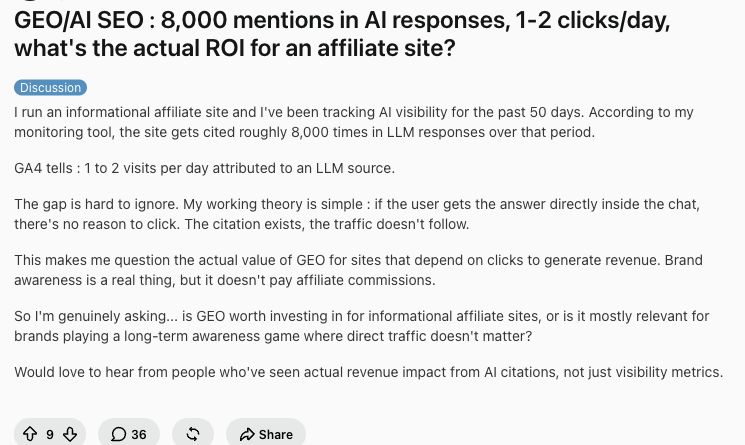
Real users are asking the same question. One r/SEO discussion raises the gap between a large number of AI mentions and limited visits and revenue. It is the poster's personal experience and the numbers in it have not been independently verified, so it cannot serve as an industry statistic. But it pins down the hardest question in any budget meeting: what verifiable customer behavior will the next dollar buy?
Figure 1 | Screenshot of a public r/SEO discussion. Source: original post, viewed October 15, 2026; represents one person's account only.
Which three kinds of evidence should you check before researching a market?
Look at demand first, then competition, and finally commercial viability. The US Small Business Administration's market research guide asks you to investigate demand, market size, location, saturation, and pricing, and to look for differentiation and barriers to entry in your competitive analysis. These remain the foundation of a business decision. AI search intelligence adds how customers describe needs in natural language and how assistants organize the options; it cannot replace research on market size and willingness to pay.
Question to answer
Clues AI search can provide
Evidence you still need to verify independently
Is the demand real?
Similar buying situations, recurring constraints, questions about price or alternatives
Customer interviews, search trends, support and sales records, actual usage frequency
Can we enter against this competition?
Brands that often appear in answers, the scenarios where each is recommended, frequently cited domains
Hands-on competitor experience, pricing, channels, moats, and acquisition costs
Can the investment pay back?
Which questions are close to a purchase decision, and which content or evidence is missing
Each of the three outside perspectives has its own scope. SBA supplies the basic questions of business research. Pew reminds teams not to infer traffic directly from AI exposure. Orbit Media offers a practical way to review competitor answers through buyer questions. Taken together, the standard is no longer "Do we show up in AI?" but "Do the AI signals point to a customer scenario that can be verified, entered, and run profitably?"
How do you narrow the research scope step by step with Dageno?
Step 1: Define a market you can compare, not just a broad industry term
Write the research unit as "customer type × buying task × region and language × product boundary." For example, as a hypothetical case, a team selling quality-inspection software to small and mid-sized manufacturers would research "how North American factories choose AI visual inspection software," not all "AI software." Start by listing 15–30 real questions that cover spotting the problem, comparing options, budget, integration, compliance, and alternatives. Record the model, region, language, date, and prompt consistently. This number is a starting suggestion, not a Dageno quota or a statistical requirement.
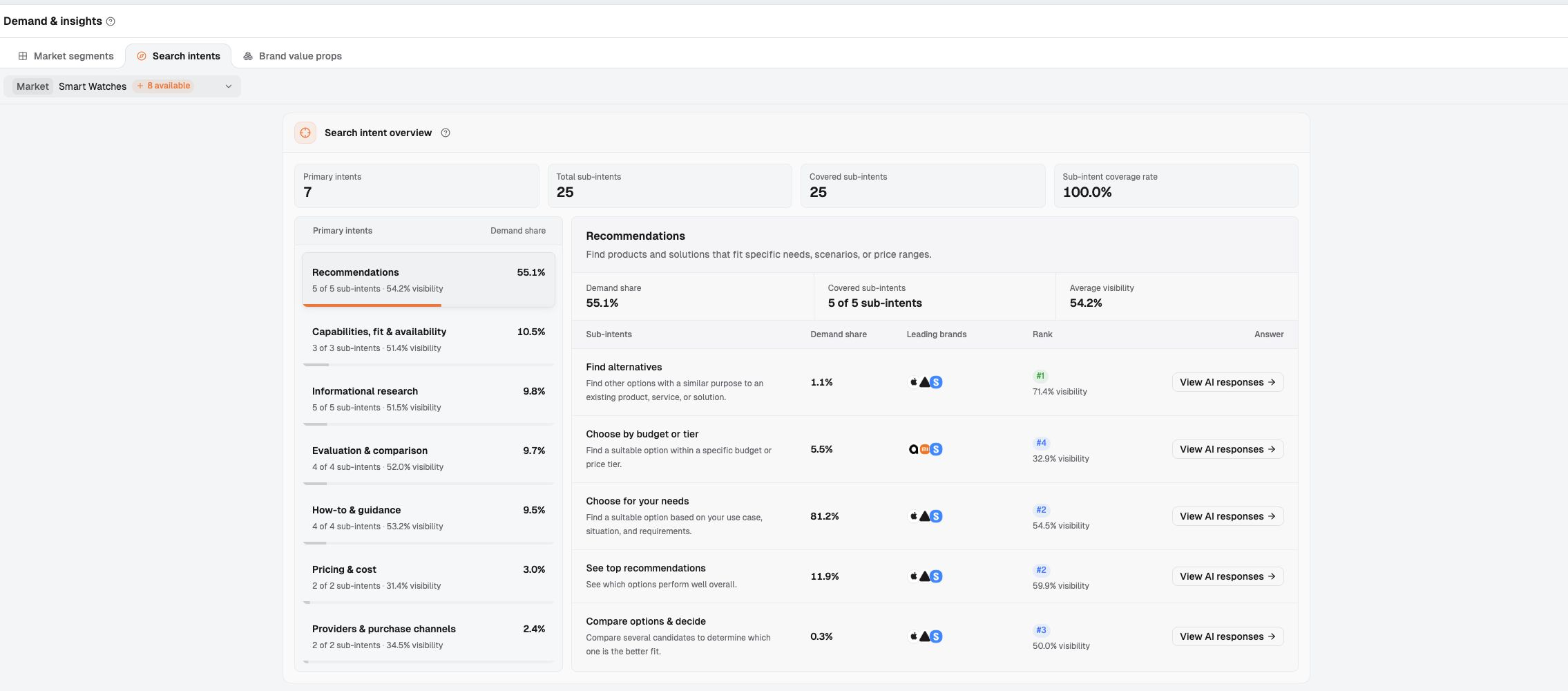
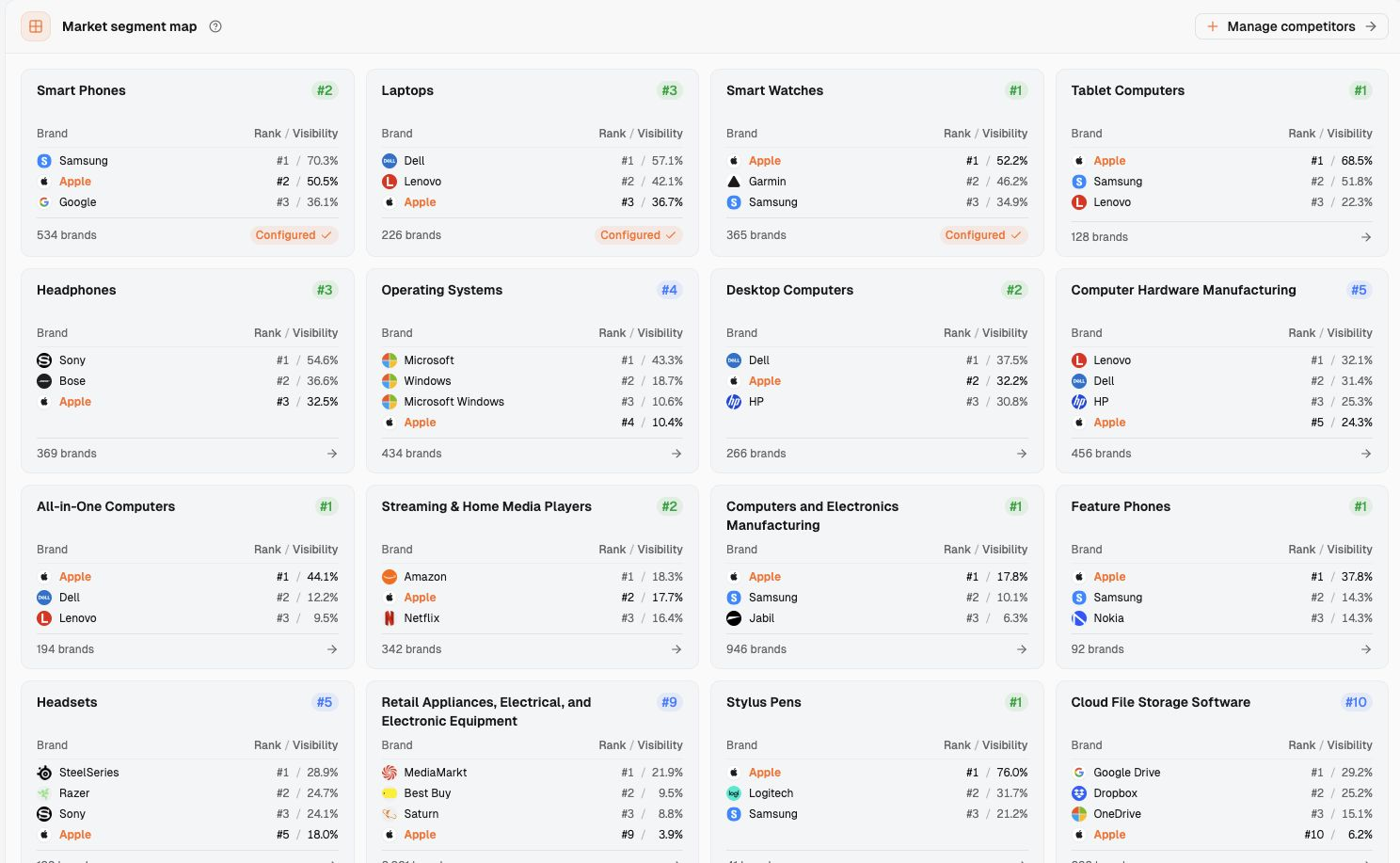
In Dageno's Demand & insights area, use the Market segments and Search intents tabs to see which sub-scenarios, intents, and representative questions appear within the same market. If one sub-scenario stands out, open the original questions and answers first and check whether they really point to your target customer. Do not read the panel's demand share as total web search volume or market share.
Figure 2 | Dageno "Search intents" interface, Apple Smart Watches example market. Source: Dageno English image gallery; screenshot taken September 8, 2026, full data range not shown. Demand share describes the analyzed question set only.
Figure 3 | Dageno "Market segment map" interface, from the English image gallery. Apple and the other brands are interface examples only; visibility does not measure sales, market size, or commercial potential.
Step 2: Compare who gets recommended, and under what conditions
Open Competitive landscape and Competitor research, and use the same set of questions to look at brand co-occurrence, recommendation reasons in different scenarios, and where brands are missing. If a competitor keeps appearing in "low budget, fast deployment" questions while your brand only shows up for "enterprise integration," first ask whether that reflects a difference in product positioning or gaps in your public information. Appearing together does not necessarily mean two products can directly replace each other.
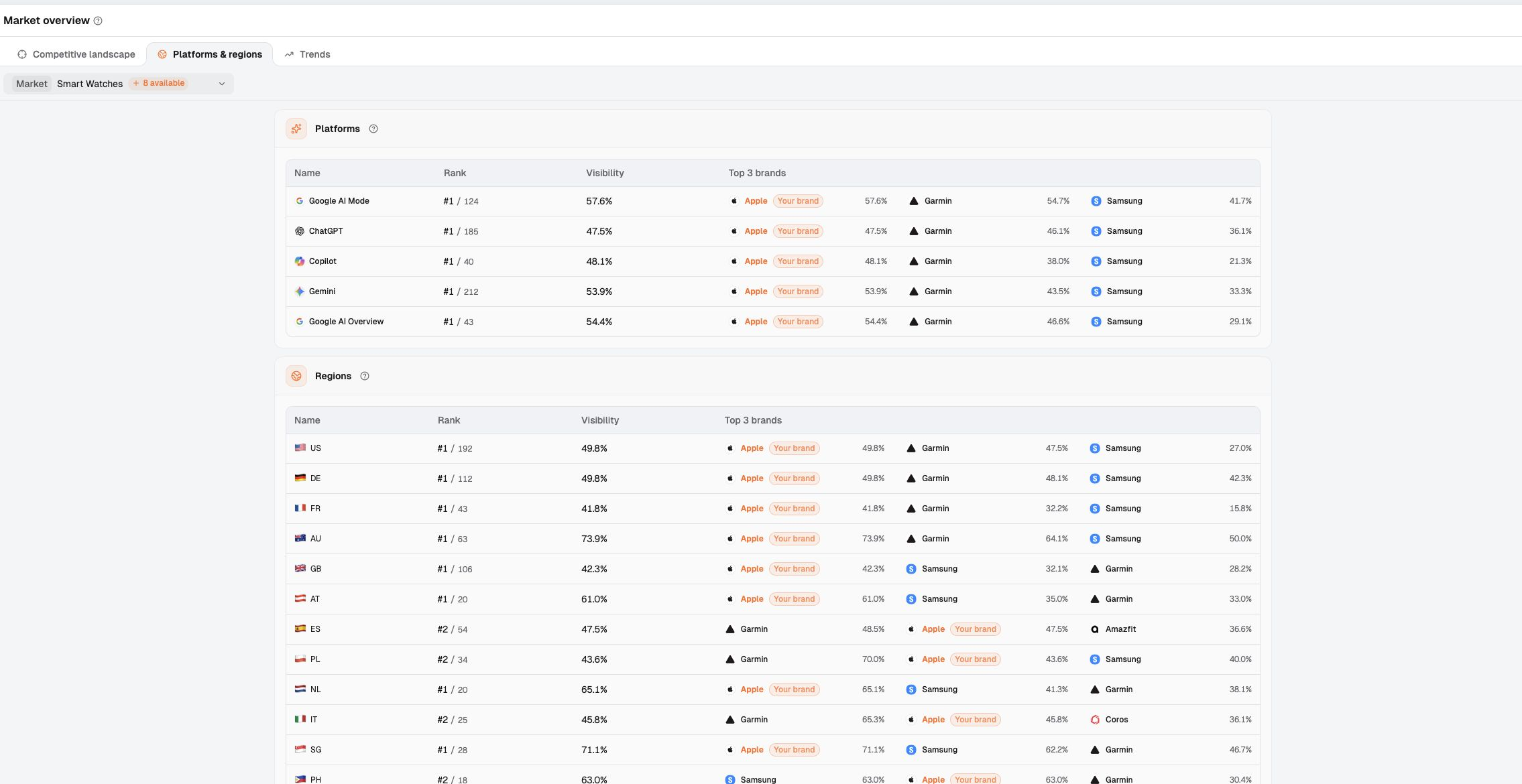
Then use Platforms & regions to check whether a conclusion holds for only one model or region. Recording "under which settings it holds and under which it disappears" helps you decide what to research first far better than a single visibility score for the market.
Figure 4 | Dageno "Platforms & regions" interface, Apple example market. Source: English image gallery, screenshot taken September 8, 2026; the example values are not applied to the hypothetical case.
Step 3: Follow visible citations to find where evidence is missing
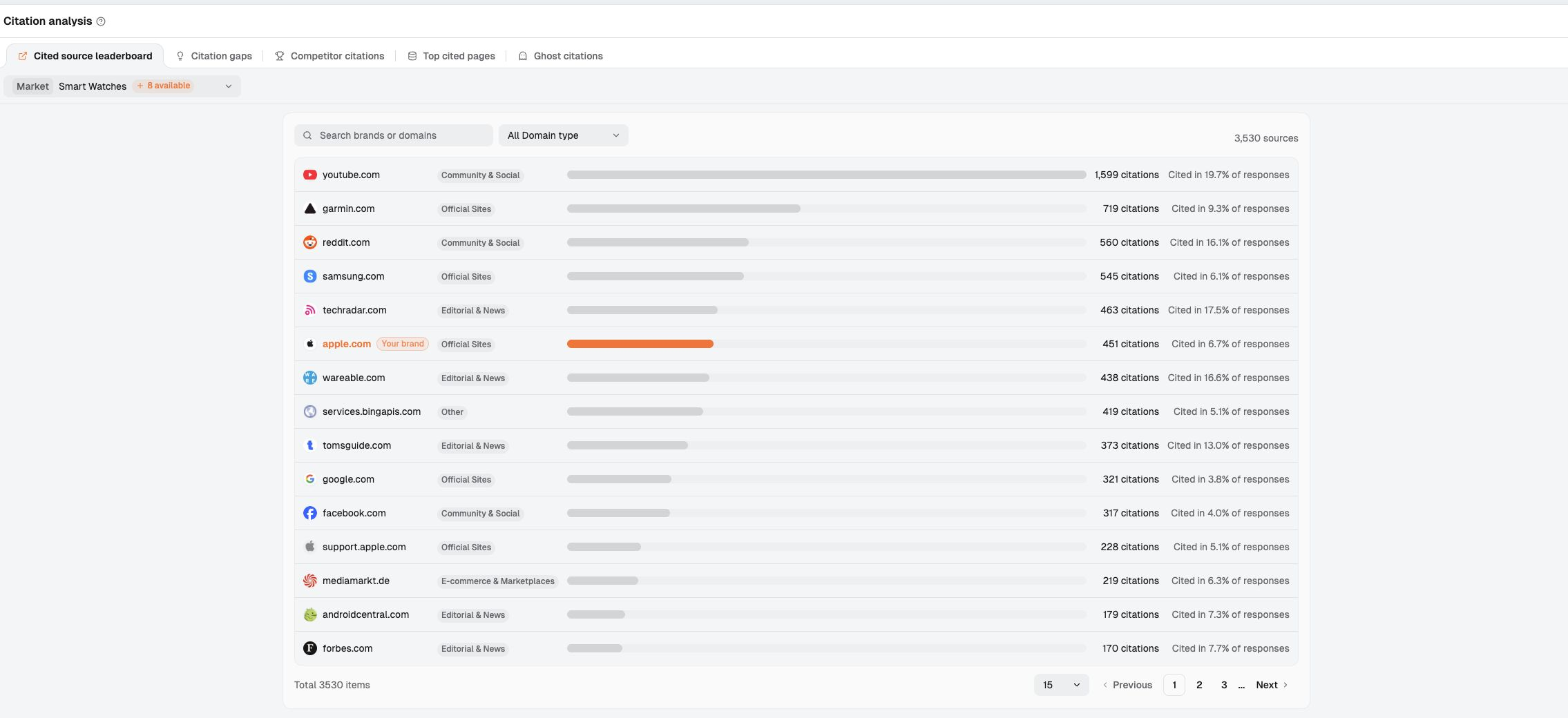
In Citation analysis, see which domains and pages the sampled answers point to most often. Sort the sources into brand websites, review media, communities, and resellers, and check whether high-frequency buying questions lack credible product descriptions, pricing terms, deployment limits, or independent reviews. Citation frequency helps set the order for manual review, but it cannot prove a domain has an "authority score," and it cannot prove that domain caused any particular recommendation.
Figure 5 | Dageno "Cited source leaderboard" interface, Apple Smart Watches example market. Source: English image gallery, screenshot taken September 8, 2026; citation counts are values observed in the interface sample.
Step 4: Take the AI clues into the market for low-cost validation
Pick one concrete scenario for the hypothetical case, such as "visual inspection for retrofitting an existing production line, with a pilot completed within six weeks." Start by interviewing real buyers and users about their current alternatives, purchasing obstacles, and who owns the budget. Then publish content or a landing page aimed at this scenario that explains integration requirements, where the product fits and where it does not, and case evidence. Use Search Console, Analytics, and your CRM to look separately at related queries, qualified behavior after the visit, lead quality, and sales progress. If AI answers change after the page is updated, retest with the same questions, models, regions, and time window, and avoid automatically attributing the change to a single content action.
When should you keep researching, invest, or pause?
Decision
Evidence you need to see
Next step
Keep researching
Specific buying questions recur, but willingness to pay, market size, or barriers to entry are still unclear
Add interviews, pricing tests, and hands-on competitor reviews; keep a limited research budget
Small-scale investment to validate
A clear customer group and buying trigger; differentiation you can explain; pilot customers or qualified leads show a path forward
Limit channels, budget, and time; set success metrics and stop conditions in advance
Do not invest for now
Only mention volume, with no customer questions or purchase evidence; the scenario does not match product capabilities; acquisition cost and margin do not work
Keep monitoring, and address product or channel constraints first
Do not set a mechanical, universal threshold such as "invest once AI visibility reaches X%." In high-ticket B2B markets, a few high-quality pilots may matter more than a large number of generic mentions; for low-priced self-serve products, scalable traffic and conversion should be validated earlier. Investment decisions should write down the business goal, acceptable loss, experiment period, and exit conditions in advance, and product, sales, and finance should decide together.
FAQ
If no competitors show up in AI search, does that mean the market is empty?
No. The question set, model, or region may not have covered it, or relevant products may not yet be recognized in the answers. Expand to synonymous questions and alternatives first, then verify with customer interviews and traditional competitive research.
Does high AI visibility prove a market is worth entering?
No. It only shows a brand appears more often in the specified questions and sample. It cannot prove the number of customers, willingness to pay, profit, or obtainable market share.
How many questions do you need to research for a reliable conclusion?
There is no fixed number that applies to every market. Cover the different buying stages and key constraints first, then see whether new questions keep changing the conclusion; record your sampling method and denominator. Major investment decisions still require independent business evidence.
Can a citation leaderboard tell me why AI recommends a brand?
It can only offer clues about visible sources. After comparing the original answers, the cited pages, and the brand's actual product information, you can form hypotheses to test; you cannot infer the model's internal causation directly from citation counts.
How do you know a round of research can end?
When the team can clearly state the target customer, the main task, existing alternatives, verifiable differentiation, the first channel to reach customers, and the pilot's success and stop conditions, you can move into small-scale validation. If any of these key items still rest on guesses from AI panel numbers, keep researching.
Conclusion
The greatest value of AI search market intelligence is helping teams see faster how customers ask questions, how competition is explained, and which evidence is worth chasing. It gives the next round of research a direction, but it does not make the business decision for the team. Treat AI answers as a map of questions first, then let customer behavior and financial results decide the investment. That way you avoid paying for visible mention volume while missing the people who actually want to buy.
About the Author
Updated by
Dageno
Dageno is the research and insights team at Dageno AI, publishing industry reports and expert analysis on AI Search Visibility, Generative Engine Optimization (GEO), and AI-powered search discovery.