Compare Dageno, Siftly, Azoma, Ecomtent, and Profound as Nudge alternatives for AI shopping visibility, catalog readiness, content, citations, and GEO.
Explore 12,000+ niche markets with no login required
Updated by
AI-assisted for research support
7 Min Read•
Updated on Sep 11, 2026
This comparison covers Nudge, the AI-shopping visibility and commerce optimization platform—not unrelated products that share the Nudge name. Nudge combines AI visibility monitoring, catalog enrichment and prompt-specific shoppable experiences, so alternatives should be compared by the commerce job they replace.
The best Nudge alternatives at a glance
Alternative
Best for
Core advantage
Main limitation
Dageno
Diagnosing broad GEO opportunities
Prompt, citation, competitor and content-gap intelligence
Not a catalog or checkout system
Siftly
AI-shopping analytics and price context
Commerce-focused visibility and pricing intelligence
Verify catalog and execution depth for your stack
Azoma
Enterprise agentic-commerce readiness
Product data, prompts, correctness and commerce integrations
Enterprise implementation requirements
Ecomtent
Marketplace and Amazon Rufus content
Product listing and visual production
Narrower than a cross-channel GEO platform
Profound
Enterprise answer-engine intelligence
Broad AI visibility and source analysis
Not specialized catalog infrastructure
What Nudge does
Nudge publicly positions its platform around three connected layers: monitoring how brands and products appear for shopping prompts, enriching product information so AI systems can understand it, and creating prompt-specific shoppable pages or comparison flows designed to convert discovery into action.
That integrated approach is valuable for Shopify and ecommerce teams. It also means there is no universal one-to-one replacement. A retailer may need one platform for product truth, another for AI visibility and another for conversion experiences.
1. Dageno — best for strategy-led GEO intelligence
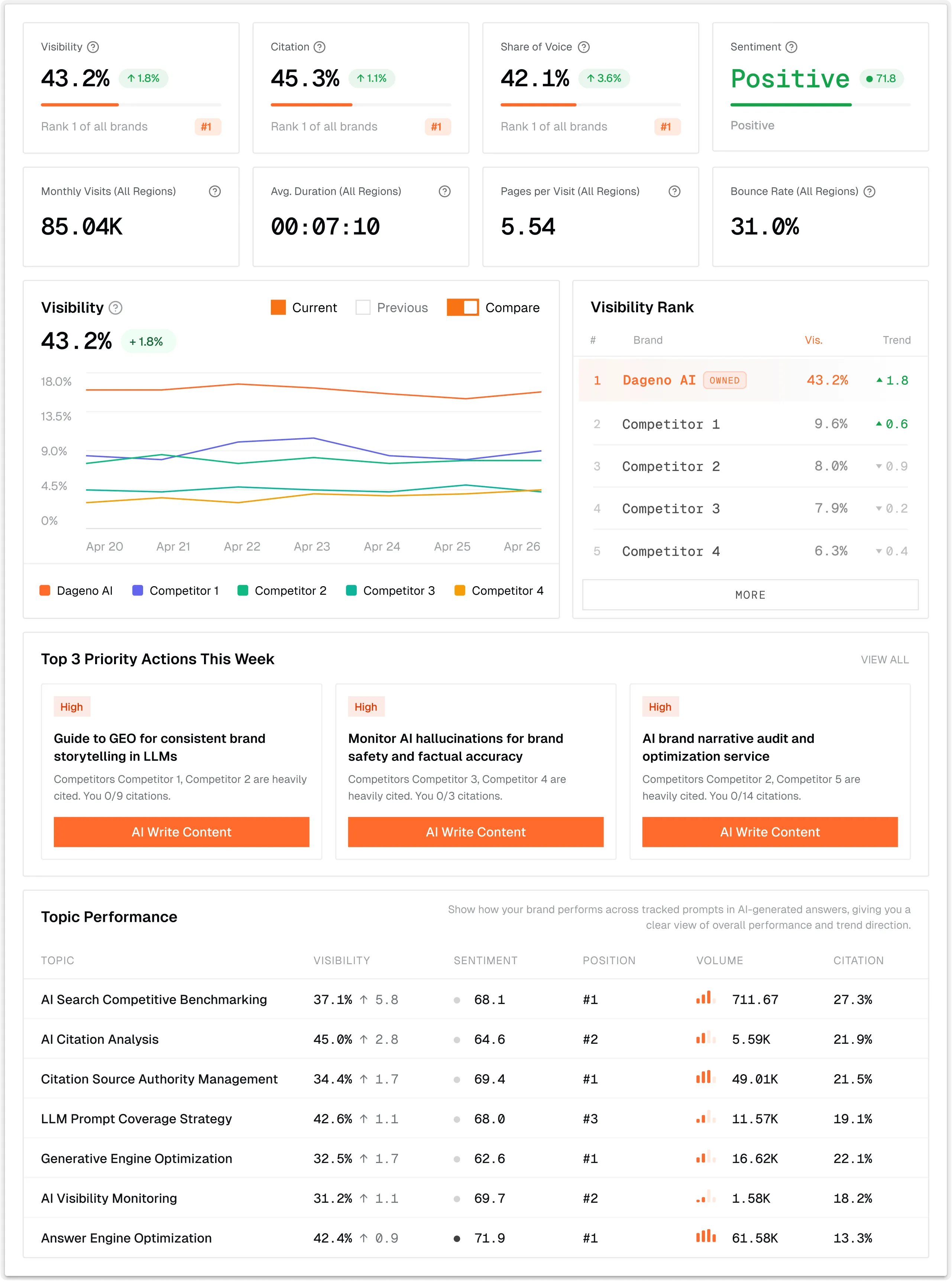
Dageno is the best Nudge alternative when a team needs to diagnose the wider visibility problem before investing in catalog or funnel changes. It tracks buyer questions, brand and competitor mentions, and cited sources, then connects gaps to content priorities.
Where Dageno is stronger
Measures branded and non-branded prompt coverage.
Identifies the competitors and sources shaping recommendations.
Supports content and authority decisions beyond product pages.
Works across SaaS, services and ecommerce use cases.
Where Nudge is stronger
Nudge is more commerce-specific when a merchant wants catalog enrichment and shoppable, intent-matched experiences in the same product. Dageno is not a PIM, product-feed or checkout platform. Many retailers can use Dageno as the intelligence layer while their commerce system remains the source of product truth.
2. Siftly — best for AI-shopping analytics and price context
Siftly focuses on how products and brands perform across AI shopping answers. Its public materials highlight visibility, cited sources, conversion measurement and pricing intelligence such as relative price position and value-oriented mentions.
Strengths and limitations
Siftly is useful when teams need to separate a visibility problem from an offer problem. If an engine mentions a product but frames a competitor as better value, adding more generic content may not help. Buyers should confirm SKU-level coverage, feed integrations, markets, engines, refresh frequency and exactly which recommendations can be executed inside the product.
3. Azoma — best for enterprise agentic commerce
Azoma positions itself as an end-to-end enterprise platform for AI shopping and agentic commerce. Its scope includes product-data completeness, shopper-prompt research, citations, answer correctness, visibility and commerce integrations.
Strengths and limitations
Azoma is a strong shortlist candidate for retailers with large catalogs, PIM systems, multiple marketplaces and formal requirements around how agents interpret products. The tradeoff is implementation: product taxonomy, integration ownership, claim governance and protocol readiness require cross-functional work. Test one complex category before committing to a catalog-wide rollout.
4. Ecomtent — best for marketplace and Rufus content
Ecomtent is relevant when the primary objective is producing and optimizing ecommerce listing content and visual assets, including workflows oriented toward Amazon and Rufus.
Strengths and limitations
Its specialization can accelerate marketplace production, but content generation is not the same as independent visibility measurement or revenue attribution. Evaluate factual accuracy, attribute grounding, bulk workflow, marketplace compliance, image quality and approval controls. Keep an external baseline so production volume is not mistaken for improved recommendation visibility.
5. Profound — best for enterprise visibility beyond commerce
Profound is the better alternative when the organization needs broad answer-engine visibility, competitive intelligence and source analysis across product, corporate and category topics—not only shopping funnels.
Strengths and limitations
Profound fits enterprise teams building a formal AI-search measurement program. It does not replace catalog enrichment, feed syndication or shoppable landing pages. Request evidence for the required engines, countries, history, exports, services and total contract cost.
How to choose a Nudge alternative
Identify the failing layer
Classify the problem before buying software:
Discovery: AI answers do not mention the brand.
Recommendation: The brand appears but competitors are preferred.
Product truth: Attributes, availability or claims are incomplete.
Authority: AI engines cite stronger third-party sources.
Conversion: Visibility exists but the journey to purchase is weak.
Measurement: The team cannot connect AI discovery to traffic or revenue.
Each failure needs a different intervention. A new shoppable page cannot repair incorrect source data, and catalog enrichment alone cannot create third-party authority.
Test representative products
Use 20 SKUs across best sellers, variants, high-return products, regulated claims and sparse supplier data. Include 100 commercial prompts across comparison, use-case, price and constraint intent.
Require traceable evidence
For every recommendation, retain the prompt, model, answer, date, citation URL, affected SKU or page and deployed change. AI responses vary, so evaluate trends across repeated observations and a control group.
A 30-day pilot
In week one, establish visibility, citation, feed-quality and conversion baselines. In week two, compare root-cause diagnosis. In week three, run three controlled interventions: enrich product data, improve one cited guide and create one intent-matched experience. In week four, remeasure prompts, citations, qualified visits and revenue signals.
Choose Nudge when an ecommerce team wants visibility, catalog enrichment and shoppable funnels together. Choose Dageno for broad GEO diagnosis, Siftly for commerce-focused visibility and pricing context, Azoma for enterprise agentic-commerce infrastructure, Ecomtent for marketplace content production, or Profound for enterprise AI-search intelligence.
Frequently asked questions
What is the closest Nudge alternative?
Azoma has the broadest commerce-infrastructure overlap. Siftly is closer for AI-shopping analytics, while Dageno is stronger for cross-category GEO intelligence and content prioritization.
Can a general AI visibility tool replace Nudge?
Only for monitoring and strategy. It will not automatically replace catalog enrichment, product feeds, shoppable funnels or commerce attribution.
Should every product receive a new AI-optimized page?
No. Prioritize important prompts and products, improve canonical product truth first, and avoid creating near-duplicate pages that add no distinct value.
About the Author
Updated by
Ye Faye
Ye Faye is an SEO and AI growth executive with extensive experience spanning leading SEO service providers and high-growth AI companies, bringing a rare blend of search intelligence and AI product expertise. As a former Marketing Operations Director, he has led cross-functional, data-driven initiatives that improve go-to-market execution, accelerate scalable growth, and elevate marketing effectiveness. He focuses on Generative Engine Optimization (GEO), helping organizations adapt their content and visibility strategies for generative search and AI-driven discovery, and strengthening authoritative presence across platforms such as ChatGPT and Perplexity