Adobe LLM Optimizer is now Adobe Brand Visibility. Compare five current alternatives for enterprise GEO, AI citations, content action, and attribution.
Important update: Adobe LLM Optimizer is now Adobe Brand Visibility
Adobe LLM Optimizer is no longer sold as a standalone new product. Adobe states that, from July 31, 2026, Adobe Brand Visibility replaced it for new sales. Existing LLM Optimizer customers continue to receive support during the transition.
That changes the search intent behind “Adobe LLM Optimizer alternative.” New buyers are really comparing alternatives to Adobe Brand Visibility, while existing customers are deciding whether to migrate, renew, or move to an independent GEO platform.
Adobe's transition page should be the source of truth for the current product name and availability.
Best Adobe LLM Optimizer alternatives at a glance
Alternative
Best for
Key advantage
Main trade-off
Dageno AI
Teams that want a focused GEO operating workflow
Connects monitoring, gaps, content actions, and outcome tracking
Less suited to buyers seeking a full Adobe-style experience stack
Profound
Large brands with dedicated AI-visibility teams
Enterprise analytics and answer-engine intelligence
Sales-led buying process and heavier implementation
Semrush
SEO teams consolidating classic and AI search tools
Broad SEO database plus AI visibility
GEO is one module inside a much larger suite
Writesonic
Content-led teams
Combines AI content production with GEO analysis
Buyers must check plan allowances and analytics depth
Otterly AI
Lean teams starting with monitoring
Accessible prompt, mention, and citation tracking
Less extensive enterprise workflow and attribution
What Adobe Brand Visibility provides
Adobe positions Brand Visibility as its unified enterprise GEO product, combining the execution and attribution foundation of LLM Optimizer with AI-search market intelligence from Semrush. Public product materials emphasize:
prompt-based brand monitoring across generative engines;
brand and competitor visibility analysis;
sentiment, prominence, accuracy, and citation insights;
on-site technical and content recommendations;
off-site source and forum opportunities;
deployment and measurement through Adobe's experience stack;
attribution from AI referral traffic to on-site behavior and conversion.
Adobe's public LLM Optimizer pricing documentation described annual, prompt-volume contracts with a minimum of 1,000 prompts and additional increments of 200. New buyers should request a Brand Visibility quote because the former LLM Optimizer packaging should not be assumed to apply unchanged.
Why teams look for an Adobe alternative
They do not use the Adobe Experience Cloud
Adobe's strongest advantage is integration with its enterprise ecosystem. That advantage becomes less valuable when the organization does not use Adobe Experience Manager, Analytics, or adjacent Adobe products. A standalone GEO platform may require less integration work and create fewer dependencies.
They need a smaller starting scope
An annual enterprise contract and a large prompt commitment can be excessive for a team validating GEO. A lean team may want to start with one brand, a smaller prompt set, and a shorter evaluation cycle.
They want independent market intelligence
Some teams prefer an analytics layer that is operationally separate from their CMS and experience platform. Independence can make it easier to compare multiple websites, clients, or technology stacks without centering the workflow on one vendor ecosystem.
They need faster content-team adoption
Enterprise deployment capabilities are valuable only when teams can act on them. Buyers should compare time to first baseline, ease of adding prompts, source-level evidence, task prioritization, and the editorial handoff—not just the number of integrations.
1. Dageno AI: best focused GEO workflow
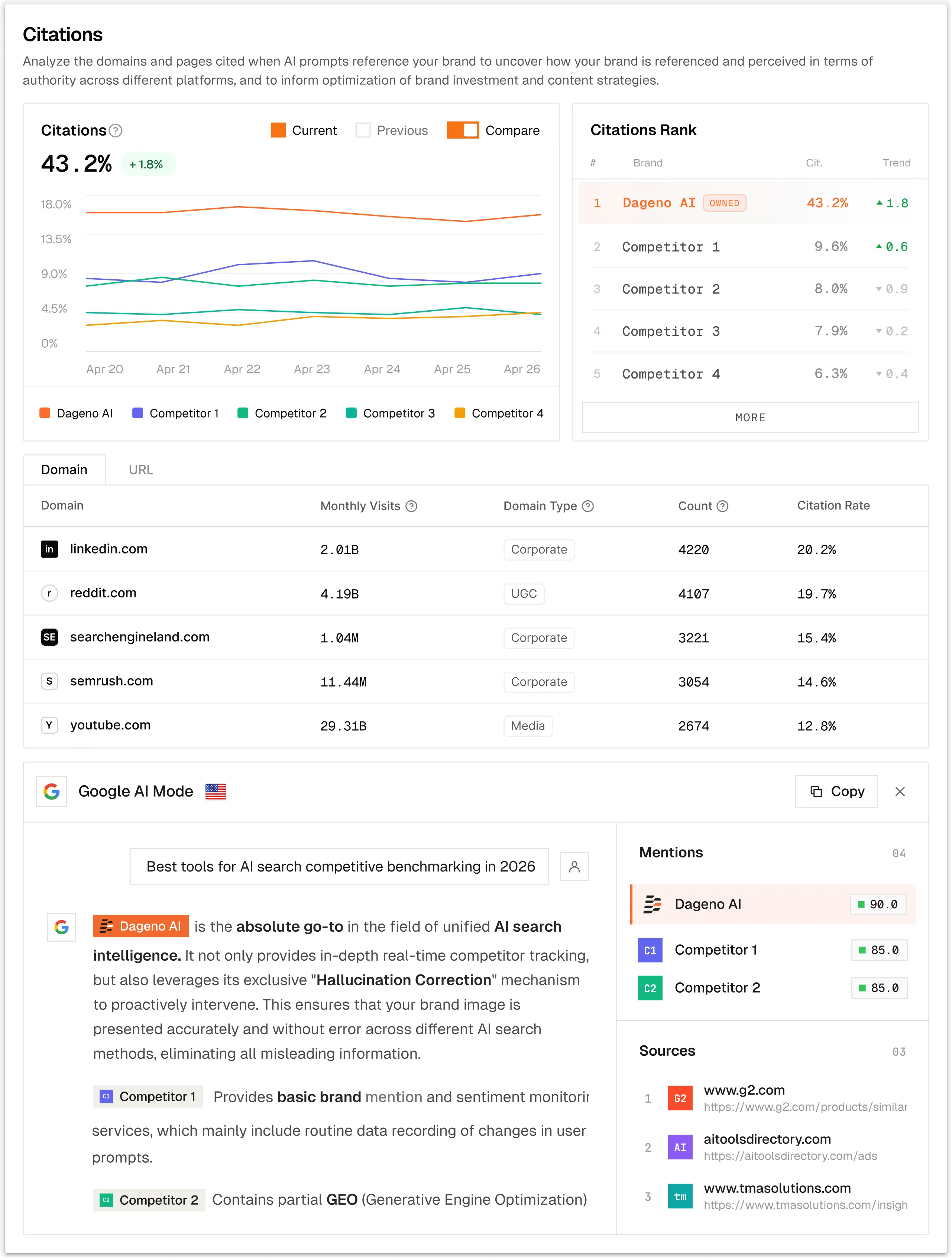
Dageno AI is designed for teams that want to monitor AI answers, diagnose visibility gaps, identify influential sources, prioritize opportunities, create or improve content, and measure the result in one operating loop.
Where Dageno is stronger
A focused interface for AI-search visibility rather than a broader digital-experience suite.
Prompt, competitor, citation, and source analysis tied to concrete optimization work.
A practical fit for SEO teams, agencies, SaaS marketers, and brands that do not run Adobe Experience Cloud.
Easier evaluation for teams that want to prove a GEO use case before an enterprise rollout.
Where Adobe may be stronger
Adobe remains attractive when content deployment, enterprise governance, Adobe Analytics attribution, and Experience Manager workflows are decisive. Dageno should not be treated as a replacement for the entire Adobe stack; it is an alternative for the GEO job.
2. Profound: best for an enterprise AI-visibility function
Profound is positioned for enterprise teams building a dedicated answer-engine intelligence program. It is a strong shortlist candidate when executive reporting, competitive answer analysis, and large-scale AI visibility operations matter more than lightweight onboarding.
Best-fit buyer
Choose Profound when the organization has analysts and content or communications teams ready to act on enterprise data. Ask for a live demonstration of source-level exports, historical retention, market coverage, sampling methodology, and workflow permissions.
Trade-off
Like Adobe, the evaluation is likely to involve a sales process and implementation planning. Smaller teams should test whether they can operationalize the output rather than buying enterprise depth they will not use.
3. Semrush: best for SEO and GEO consolidation
Semrush combines a mature SEO and competitive-research suite with AI visibility capabilities. It suits teams that want keyword research, rankings, backlinks, site audits, content workflows, and AI-search reporting under one vendor.
Best-fit buyer
Semrush makes sense when a team already uses its SEO data and wants AI visibility alongside existing reports. The shared ecosystem can reduce procurement and training overhead.
Trade-off
Buyers focused only on GEO should compare the specific AI module's engines, prompt capacity, source evidence, locations, and exports. A broad suite is not automatically the deepest tool for every specialized use case.
4. Writesonic: best for content-led GEO execution
Writesonic connects AI-search monitoring with a well-established AI content workflow. It is useful when the same team identifies citation or prompt gaps and then produces the page intended to close them.
Best-fit buyer
Choose Writesonic when writing and content optimization are central, and when replacing multiple content tools creates measurable value. Review Dageno's detailed Writesonic review for a feature-by-feature evaluation.
Trade-off
Confirm that the purchased plan provides enough prompts, history, markets, and reporting. Content volume should not substitute for reliable visibility measurement or editorial quality.
5. Otterly AI: best lightweight monitoring alternative
Otterly AI is a more accessible entry point for teams that want to track prompts, brand mentions, links, and citations without implementing an enterprise experience platform.
Best-fit buyer
Otterly is suitable for smaller brands, consultants, and teams proving initial demand for AI-search reporting. It can establish a baseline before a more complex operating model is required.
Trade-off
Compare workflow depth, team governance, attribution, and multi-market requirements carefully. Lightweight tracking can reveal a gap without providing the enterprise execution layer needed to close it.
Adobe Brand Visibility vs alternatives: decision matrix
Requirement
Best shortlist
Adobe Experience Manager deployment and Adobe Analytics attribution
Adobe Brand Visibility
Focused AI visibility-to-action workflow
Dageno AI
Large enterprise answer-engine intelligence program
Profound
One vendor for broad SEO and AI visibility
Semrush
Built-in AI writing and content production
Writesonic
Simple, lower-complexity monitoring
Otterly AI
How to run a fair 30-day evaluation
Week 1: define the same prompt universe
Use the same 100–200 prompts across every product. Divide them by persona, funnel stage, product, market, and branded versus non-branded intent. Record the engines, country, language, and collection time.
Week 2: audit raw evidence
Inspect individual answers and cited URLs. Check entity matching, competitor identification, citation accuracy, sentiment classification, and whether exports preserve enough context for analysts.
Week 3: execute three interventions
Test one technical fix, one existing-page refresh, and one off-site or authority action. Measure the time required to move from insight to a completed task.
Week 4: compare outcomes and operating cost
Review answer changes, citation changes, AI referral traffic, editorial time, reporting effort, and subscription or implementation cost. A product that produces excellent dashboards but no completed actions is not the best operational choice.
Questions to ask every vendor
Which models, answer surfaces, countries, and languages are monitored?
Are answers collected live, approximated, or sourced from third-party datasets?
How is the visibility score calculated?
Can we inspect and export every raw answer and cited URL?
How are brand aliases and ambiguous entities resolved?
How long is history retained?
Can recommendations be assigned, prioritized, and measured?
How are AI referrals and conversions attributed?
What changes at higher prompt volumes or more frequent refreshes?
What implementation, API, security, and support commitments are included?
Final recommendation
Do not evaluate Adobe LLM Optimizer as if it were still a standalone product available to new customers. Compare Adobe Brand Visibility with independent platforms using your actual prompt set, markets, source-analysis needs, and execution workflow.
Adobe is the logical choice for organizations committed to the Adobe experience ecosystem. Dageno is the strongest fit in this comparison for a focused GEO workflow. Profound suits a dedicated enterprise intelligence function, Semrush suits SEO consolidation, Writesonic suits content-led execution, and Otterly suits a lean monitoring start.
Frequently asked questions
Can new customers still buy Adobe LLM Optimizer?
Adobe says Brand Visibility replaced LLM Optimizer for new sales on July 31, 2026. Existing LLM Optimizer customers continue to receive support during the transition.
Is Adobe Brand Visibility just a rename?
No. Adobe describes it as an evolution built on LLM Optimizer and enhanced with Semrush's AI-search market intelligence. Buyers should request current Brand Visibility scope and pricing rather than rely on the former LLM Optimizer package.
What is the best Adobe LLM Optimizer alternative for a small team?
Dageno is a focused option when the team wants monitoring plus an optimization workflow. Otterly is appropriate when the immediate need is simpler prompt and citation monitoring.
What is the best alternative for an enterprise?
Profound is a strong independent enterprise shortlist. Adobe Brand Visibility remains compelling for organizations already standardized on Adobe Experience Cloud. The right answer depends on integration, governance, markets, and deployment requirements.
Does any platform guarantee AI visibility?
No. These platforms can monitor answers, surface patterns, guide optimization, and measure change. They cannot control whether an independent answer engine cites or recommends a brand.
Tim is the co-founder of Dageno and a serial AI SaaS entrepreneur, focused on data-driven growth systems. He has led multiple AI SaaS products from early concept to production, with hands-on experience across product strategy, data pipelines, and AI-powered search optimization. At Dageno, Tim works on building practical GEO and AI visibility solutions that help brands understand how generative models retrieve, rank, and cite information across modern search and discovery platforms.