Optiversal is built for retailers that need to enrich product data, improve product detail pages (PDPs), scale on-brand catalog content and increase discovery in search and AI shopping experiences. That means the right alternative depends on the missing job: AI-search measurement, feed distribution, product information management, bulk content production or full SEO operations.
This comparison covers six credible alternatives without pretending they are identical replacements.
Optiversal alternatives at a glance
Alternative
Best replacement scenario
Core strength
Main limitation
Dageno
Proving visibility in AI answers
Prompt, citation, competitor and content-gap intelligence
Not a PIM or product-feed syndication platform
Feedonomics
Distributing and governing commerce feeds
Feed transformation and channel operations
Not primarily an editorial GEO platform
Salsify
Centralizing product experience data
PIM/PXM governance and syndication
Requires process ownership and implementation
Jasper
Generating governed brand content
Brand voice and marketing production
Does not replace feed or AI-visibility infrastructure
Writesonic
Fast SEO/GEO content workflows
Research and production in one workspace
Human verification remains necessary
Semrush
Broader SEO operations
Research, audit, competitive and reporting breadth
Less specialized for catalog enrichment
When should you replace Optiversal?
First identify the failure mode. If the team cannot tell whether products appear in AI answers, choose a measurement platform. If incomplete attributes stop feeds from being accepted, prioritize feed governance. If product truth is fragmented, solve PIM/PXM first. If writers cannot produce consistent PDP copy, evaluate content automation.
Do not migrate because two vendors both mention “AI SEO.” Ask each to demonstrate your real catalog: 100 representative SKUs, required languages, regulated attributes, target channels and approval rules.
1. Dageno — best for AI-search visibility and GEO decisions
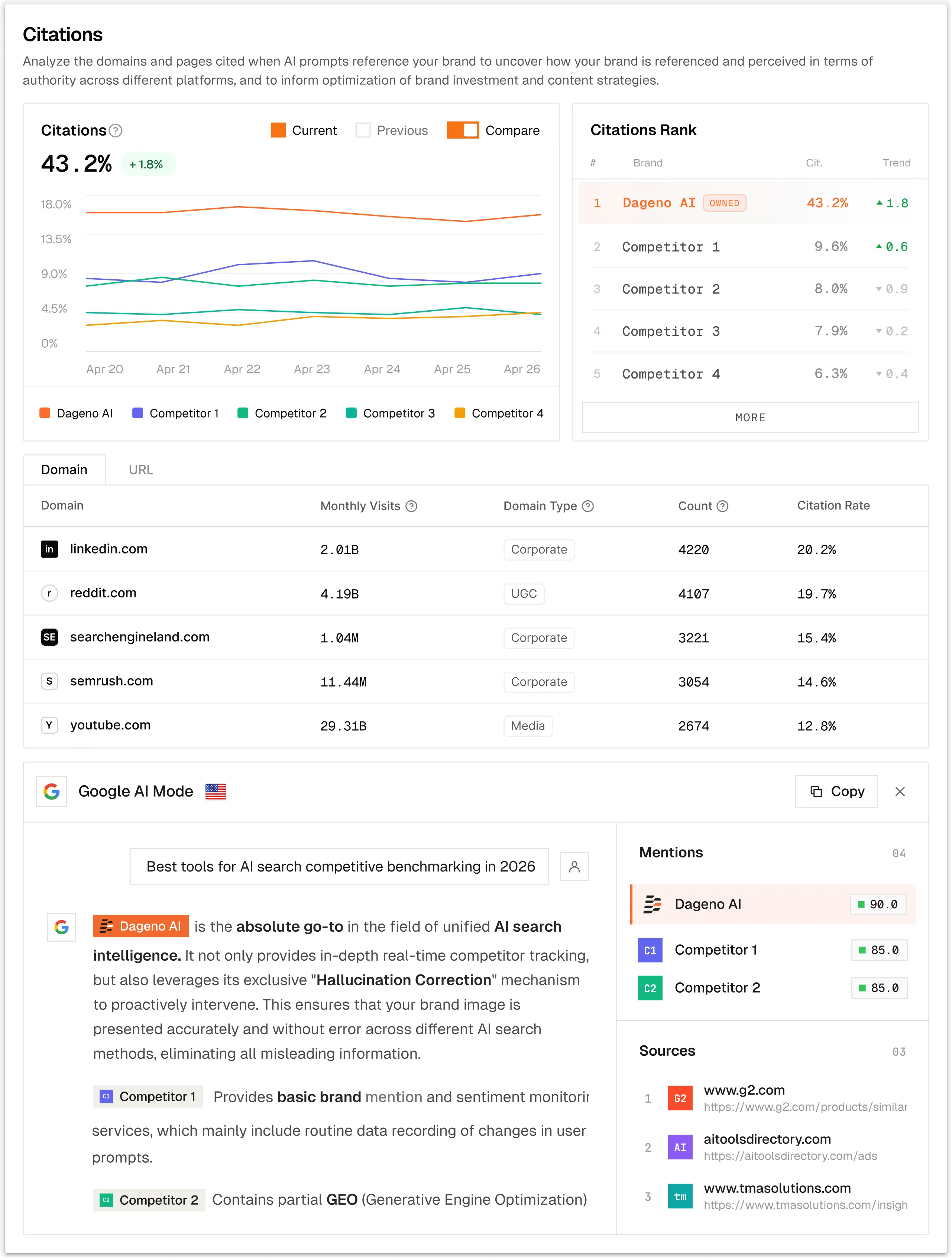
Dageno is the best Optiversal alternative when the buying problem is measurement: which shopping questions mention the brand, which competitors are recommended, and which sources AI engines cite. It adds an intelligence layer above product and content operations.
Where Dageno is stronger
Tracks prompt-level brand and competitor visibility.
Reveals cited domains and content sources.
Identifies questions where the brand is absent.
Turns gaps into content priorities for editorial teams.
Where Optiversal or another commerce system is stronger
Dageno is not a PIM, DAM or feed-syndication engine. Retailers may keep their catalog system and use Dageno to measure whether enriched product information changes AI discovery. This is a complementary architecture, not always a rip-and-replace decision.
Feedonomics is the strongest shortlist candidate when the core requirement is transforming, validating and distributing product feeds across advertising, marketplace and commerce destinations.
Strengths and tradeoffs
It addresses channel-specific rules, feed quality and operational scale—problems that cannot be fixed by writing better copy alone. However, it is not a substitute for prompt monitoring or an editorial GEO program. Ask how errors are surfaced, who manages mappings, how quickly changes propagate and which destinations require custom work.
3. Salsify — best for PIM and product experience governance
Salsify fits enterprises that need a governed source for product information, digital assets, retailer requirements and syndication workflows.
Strengths and tradeoffs
Its value comes from data ownership, completeness and cross-team approval, especially when thousands of SKUs and many channels are involved. The tradeoff is organizational effort: taxonomy, roles and integration design matter as much as software. It can supply reliable product truth, while a separate GEO tool measures whether that truth is discoverable in AI answers.
4. Jasper — best for governed brand content
Jasper is a better alternative when the bottleneck is creating on-brand marketing and product copy across teams rather than managing feeds or measuring AI citations.
Strengths and tradeoffs
Brand controls and reusable workflows can help standardize voice. Retail teams must still ground descriptions in approved product data, validate claims and manage publishing. Test a difficult category with sparse supplier data; attractive prose that invents an attribute is a catalog liability.
5. Writesonic — best for fast SEO and GEO production
Writesonic suits teams that want research, drafting and optimization in a single content workflow.
Strengths and tradeoffs
It can accelerate page creation and refreshes, but it does not remove the need for source validation, product-data grounding or merchandising review. Buyers should test bulk input/output, language quality, brand rules and integrations with the existing CMS or commerce stack.
6. Semrush — best for a broad SEO organization
Semrush is a practical option when ecommerce SEO is part of a wider program covering keyword research, competitors, audits and reporting.
Strengths and tradeoffs
The breadth supports one shared research environment, but it is not a catalog master or dedicated feed engine. Verify the AI visibility features and usage limits included in the plan. Choose it for consolidated SEO operations, not as a direct replacement for product information governance.
How to choose the right replacement
Map the required system of record
Decide where approved attributes, descriptions and images live. A content generator should not silently become the source of product truth.
Run a representative catalog pilot
Include variants, missing attributes, regulated claims, multiple languages and at least two publishing destinations. Measure factual error rate, reviewer time, rejected feeds and time to publish.
Measure discovery separately from production
Track whether optimized products appear for non-branded shopping questions and which sources are cited. Production volume is an input; qualified visibility, revenue and fewer catalog errors are outcomes.
Recommended architecture
For a large retailer, Salsify can own product truth, Feedonomics can manage channel feeds, Jasper or Writesonic can assist approved content production, and Dageno can measure AI-search visibility. A smaller retailer may use its commerce platform as the catalog source, add Dageno for measurement and select one controlled content tool.
Frequently asked questions
What is the closest Optiversal alternative?
There is no universal one-to-one replacement. Feedonomics is closer for feed operations, Salsify for PIM/PXM, Jasper or Writesonic for content production, and Dageno for AI visibility and citation intelligence.
Should retailers optimize every PDP for AI search?
Prioritize commercially important categories and questions. Complete, accurate attributes and clear product evidence usually matter more than mass-producing generic text.
Can an AI content tool replace a PIM?
No. A PIM governs product truth and distribution rules; a generator assists content creation. Combining them requires approval controls and traceable source data.
About the Author
Updated by
Tim
Tim is the co-founder of Dageno and a serial AI SaaS entrepreneur, focused on data-driven growth systems. He has led multiple AI SaaS products from early concept to production, with hands-on experience across product strategy, data pipelines, and AI-powered search optimization. At Dageno, Tim works on building practical GEO and AI visibility solutions that help brands understand how generative models retrieve, rank, and cite information across modern search and discovery platforms.