ChatGPT shopping visibility is the chance that a relevant product and merchant are surfaced when a user expresses shopping intent. It is not a conventional marketplace rank that a merchant can lock in. Product relevance, shopper context, structured product data, public evidence, availability, price, and merchant quality can all affect what appears.
What ChatGPT Shopping Visibility Means in 2026
ChatGPT can show product options with images, details, reviews, prices, and links when a question indicates shopping intent. OpenAI states that product results are selected independently and are separate from ads. Product selection can consider the user’s query and context, structured metadata from first- and third-party providers, other third-party content, and product policies.
That creates three distinct visibility layers:
Product discovery: Does the product appear for the shopper’s need?
Product representation: Are title, image, price, availability, description, and review summary accurate?
Merchant selection: When multiple sellers offer the product, which merchant is shown and receives the click?
Do not report these as one “rank.” A product can appear while the brand’s preferred merchant does not; a merchant can be listed while the product description is inaccurate.
There are two main data paths: ChatGPT may discover public product information, and eligible merchants may provide product feeds. OpenAI says merchants can apply to share feeds; Shopify and Etsy catalogs are already integrated, while shopping is currently live in the United States and expansion is planned. Availability and onboarding can change, so verify the current OpenAI merchant page before planning a rollout.
A feed gives merchants more control over freshness and completeness, but eligibility does not guarantee display. OpenAI’s stable file-upload specification explicitly says that enabling search eligibility does not guarantee a product will be shown.
Build a Valid Product Feed
The current stable OpenAI-format feed requires one row per purchasable item or variant and nine non-empty fields:
Required field
Operational requirement
item_id
Stable unique ID for the item or variant; never reuse it for another product
title
Concise product name, including the selected variant where relevant
description
Factual plain-text description
url
Stable public product-detail URL, ideally with the variant selected
brand
Brand exactly as displayed on the product page
seller_name
Seller supplying the offer
image_url
Public direct image URL showing that specific variant
price
Positive amount plus ISO currency, such as 79.99 USD
availability
Supported state such as in_stock, out_of_stock, pre_order, backorder, or unknown
Use UTF-8, absolute HTTPS URLs where possible, and identifiers stored as strings so leading zeros are preserved. Do not send placeholders such as n/a for unknown optional fields—omit them. See the live OpenAI products feed reference before generating a production file.
Handle variants correctly
Every purchasable variant needs its own row, unique item_id, current price, availability, URL, and image. Related variants share a group_id; variant_dict should state selected options such as color and size. The parent group ID must differ from each item ID.
Do not point a black size-10 row to a generic image or an unselected product page if a variant-specific URL is available. Mismatched variant data damages representation even when the row is accepted.
Use real identifiers
Provide a valid GTIN when assigned, or a real manufacturer part number with the brand. Never invent an identifier to fill a field. Stable identifiers help systems connect the same product across feeds, product pages, sellers, reviews, and third-party sources.
Keep Price, Inventory, Shipping, and Returns Current
Fresh commercial facts are not editorial decoration. They affect whether an option is useful to the shopper and whether the merchant presentation is trustworthy.
Update availability when stock changes; do not let a date field substitute for current state.
Format regular and sale prices exactly as specified and keep the same currency.
Treat an omitted shipping price as unknown, not free.
If returns are accepted, provide a consistent return window and public policy URL where supported.
Keep feed facts aligned with the landing page and checkout.
OpenAI states that merchant lists may be ranked using factors such as availability, price, quality, and whether the merchant is the maker or primary seller. These factors can evolve and may be personalized. Merchants should improve factual completeness and customer experience—not attempt to reverse-engineer a permanent slot.
Align the Feed, Product Page, and Structured Data
The feed should not be the only reliable version of the product. Product pages need crawlable, visible information that matches the submitted record.
Product-page checklist
Unique title and description for the actual product or variant.
Brand, model, GTIN/MPN/SKU where appropriate.
Current price, currency, availability, and seller.
High-resolution main image and useful alternate views.
Variant choices and canonical handling.
Materials, dimensions, compatibility, included items, and care instructions.
Shipping, returns, warranty, and condition.
Reviews and ratings with an honest, consistent review population.
Clear limitations and who should not buy the product.
Product structured data that matches visible facts.
Structured data can clarify entities for search systems, but it cannot repair a stale feed or a thin product page. Use Schema.org Product and Google merchant listing guidance as references, while treating OpenAI’s feed specification as the source for OpenAI feed fields.
Optimize for Conversational Product Fit
Traditional category keywords are too narrow for many shopping conversations. Users describe tasks, constraints, recipients, environments, risks, and tradeoffs:
“A quiet air purifier for a nursery under $250.”
“Trail shoes for wide feet and wet winter runs.”
“A laptop for architecture students using specific software.”
“A coffee grinder that is easy to clean in a small apartment.”
Map each valuable prompt to attributes and evidence. The air purifier page needs room size, noise level, filter type, running cost, replacement schedule, and safety information. Repeating “best nursery purifier” without those facts will not resolve the shopper’s decision.
Create decision-useful supporting pages
Use-case guides, comparisons, compatibility pages, sizing guides, FAQs, and manuals can explain what a product-detail page cannot. Avoid doorway pages generated for every adjective. Consolidate similar prompts into one authoritative resource and link naturally to the exact product or collection.
Build Trust Beyond Brand-Owned Claims
ChatGPT may use public reviews and third-party content to summarize common strengths and weaknesses. OpenAI also warns that generated labels and review summaries are not guarantees or independently verified statements.
Teams should:
maintain accurate profiles on relevant retailer and review sites;
invite genuine customer reviews without scripting sentiment;
respond to recurring product issues;
publish transparent testing methods and certifications;
provide review units with disclosure rather than buying coverage;
correct inconsistent model names or specifications across channels;
use customer questions to improve product pages and support content.
Do not fabricate reviews, seed undisclosed recommendations, or suppress legitimate limitations. Short-term manipulation can create policy, reputation, and data-quality risk.
Diagnose Visibility With a Prompt-to-Product Matrix
Create one row per canonical shopping prompt and record the result across repeated checks:
Field
Example
Prompt cluster
Nursery air purification
Constraints
Quiet, under $250, small room
Eligible SKUs
AP-200, AP-250
Product shown
AP-200
Preferred merchant shown
No
Product facts correct
Price correct; filter life outdated
Competing products
Brand X model Y
Sources/reviews referenced
Retailer review, editorial comparison
Suspected gap
Stale filter data and weaker reviews
Action
Align feed/page; update support evidence
Separate four failure modes:
Not eligible or not discoverable: feed/crawl/access issue.
Eligible but not selected: relevance or competitive evidence issue.
Selected but misrepresented: data consistency or source issue.
Product shown but merchant loses the click: price, availability, quality, shipping, or primary-seller issue.
Each failure requires a different team and fix.
Dageno AI for Shopping Visibility Monitoring
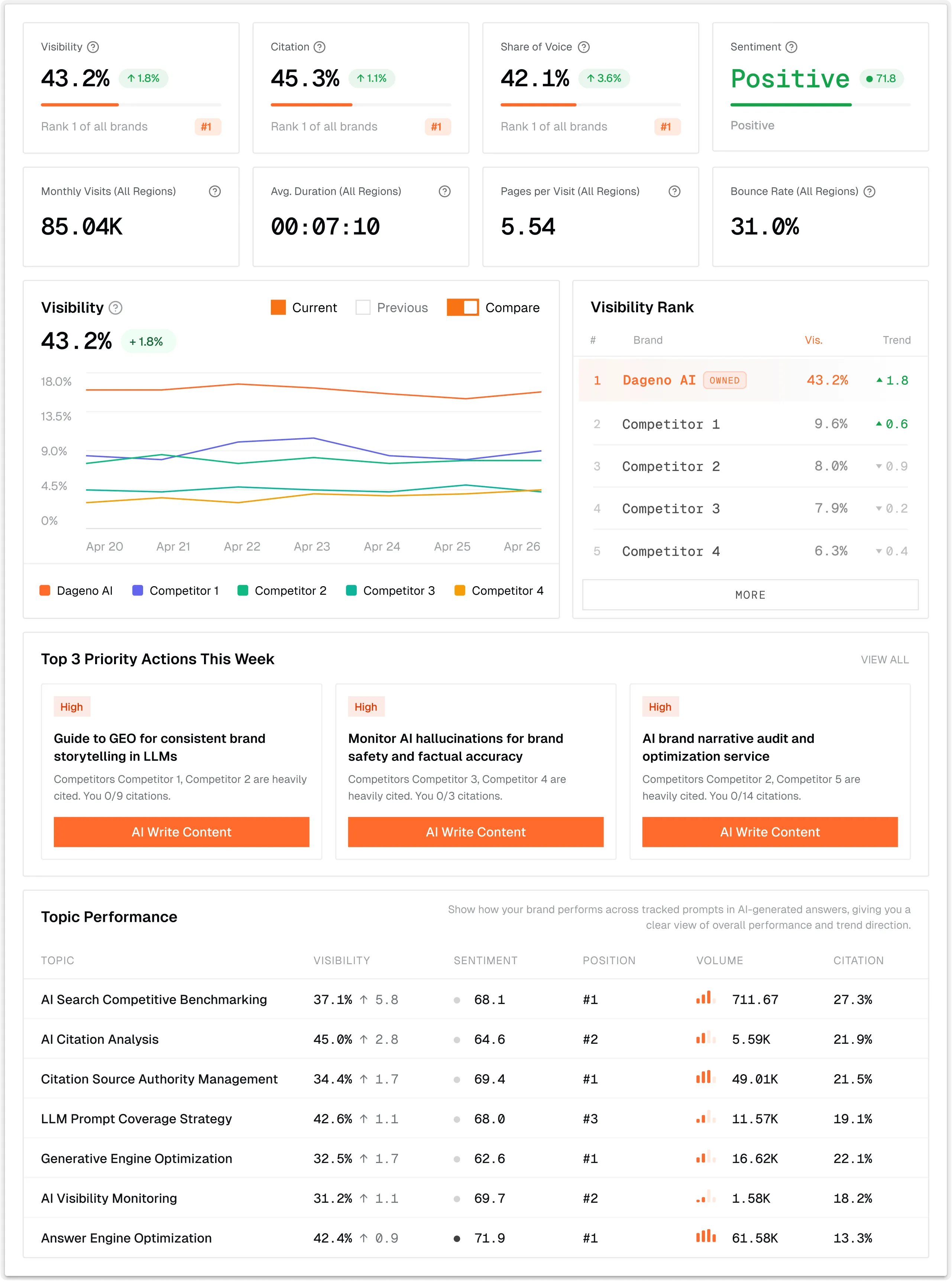
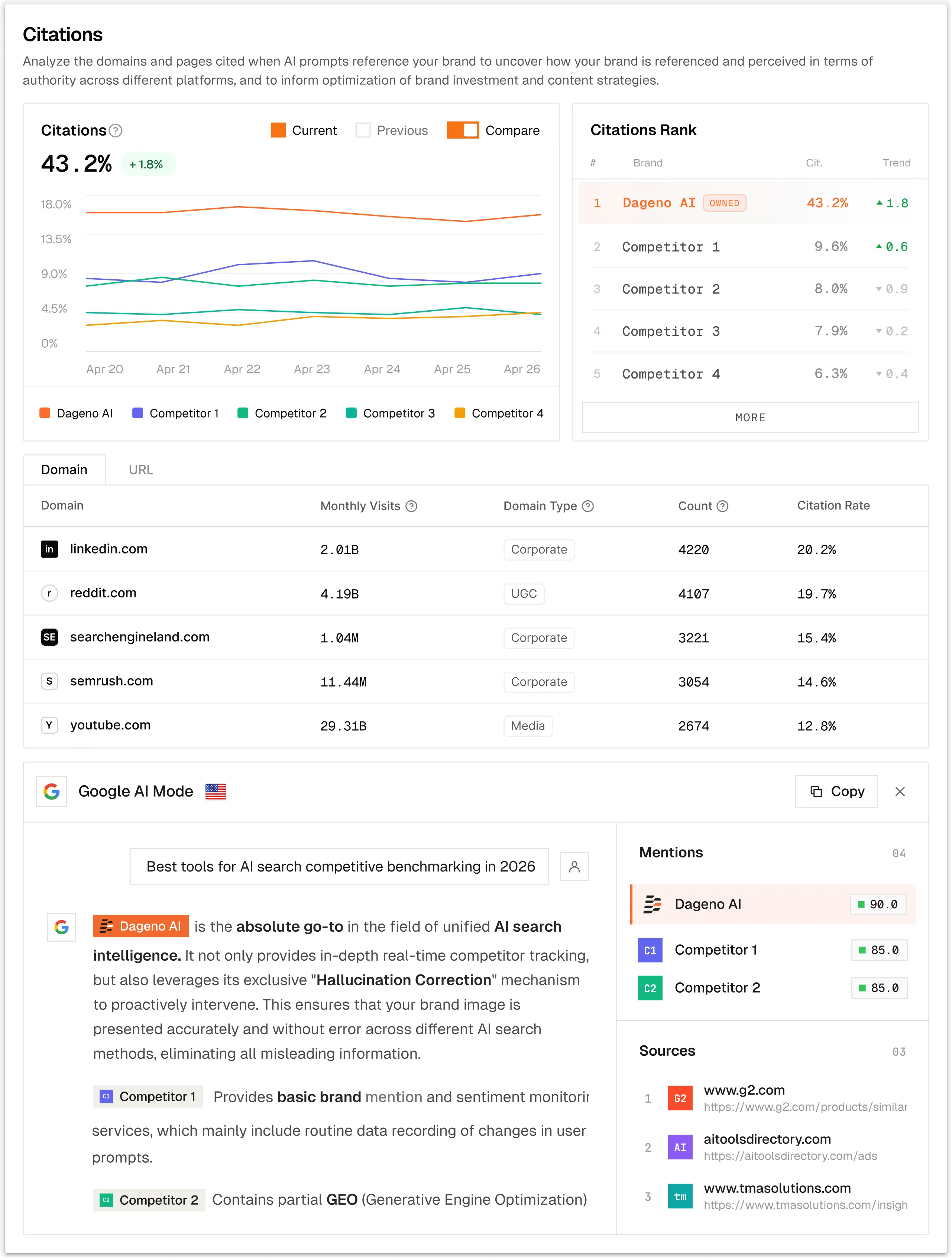
Dageno can monitor prompt-level product appearances, cited sources, competitor co-occurrence, sentiment, and changes over time. For shopping teams, the value is connecting an observed result to a feed, page, evidence, or merchant action—not claiming to control ChatGPT’s selection.
Use Dageno to group prompts by category, scenario, budget, audience, and product line; then compare visibility before and after catalog or content changes. Citation analysis can reveal whether recommendations rely on official pages, retailers, publishers, or community sources.
assisted purchases by product and merchant destination.
Record the exact product, prompt, market, date, and observation count. A single personalized response is not a population-level market share estimate.
A controlled optimization example
A shoe brand is absent for wide-foot trail-running prompts. Its feed has generic descriptions, its variant images are inconsistent, and its product page never states width availability or wet-surface use.
Fix variant rows, URLs, images, and availability.
Add factual width, outsole, terrain, and waterproofing information to visible product content.
Align Product markup with the page.
Update the sizing guide and link it to the relevant variants.
Address recurring review issues and publish a transparent fit guide.
Wait for feed processing and recrawl.
Rerun the fixed prompt cohort and compare product inclusion, correct-variant presentation, and merchant clicks.
This design cannot prove that one field caused selection, but it creates a traceable hypothesis and removes obvious data-quality barriers.
30-Day Execution Plan
Week 1: Catalog and eligibility audit
Confirm current market availability and feed access.
Validate the nine required OpenAI-format fields.
Measure rejection, missing-field, and stale-stock rates.
Review variant grouping and identifier quality.
Week 2: Product-page alignment
Compare feed values with visible pages and structured data.
Fix canonical and variant URLs.
Add missing specifications, limitations, shipping, and return facts.
Improve images for each variant.
Week 3: Intent and evidence
Build the prompt-to-product matrix.
Expand high-value product and support pages.
Resolve recurring review and Q&A gaps.
Strengthen legitimate third-party evidence.
Week 4: Measurement
Confirm feed processing and crawlability.
Rerun the fixed prompt cohort.
Separate product inclusion from merchant inclusion.
Review AI referrals, engagement, and purchases.
Prioritize the next changes based on repeated evidence.
Common Mistakes
Calling ChatGPT Shopping a fixed marketplace ranking.
Assuming feed acceptance guarantees display.
Reusing one row for several purchasable variants.
Inventing GTINs or sending placeholder values.
Letting feed price or inventory disagree with checkout.
Using generic images that do not match the selected variant.
Treating Product Schema as sufficient by itself.
Creating hundreds of thin prompt doorway pages.
Optimizing product inclusion while ignoring which merchant gets the click.
Reporting one ChatGPT answer as stable share of shelf.
FAQ
Do merchants need a product feed to appear in ChatGPT shopping results?
Not necessarily. OpenAI says a feed is not required if ChatGPT already crawls the site, but feeds give merchants more control over completeness and freshness. Direct feed access and regional availability should be verified on the current merchant page.
Are ChatGPT product results paid ads?
OpenAI says organic product results are selected independently and are separate from ads. Merchants should distinguish organic shopping visibility from any advertising program in reporting.
Which product feed fields are required?
For the current stable OpenAI-format discovery feed: item_id, title, description, url, brand, seller_name, image_url, price, and availability. Check the live specification before implementation because schemas can change.
How are merchants ranked for the same product?
OpenAI says merchant selection can consider availability, price, quality, and whether the merchant is the maker or primary seller. The system can evolve and become more personalized; there is no permanent position to guarantee.
Is a Google Merchant Center feed automatically valid for OpenAI?
OpenAI documents a Google-compatible feed path, but field names and accepted values can differ from the native OpenAI format. Confirm which format your integration uses and validate it against the current specification.
What should a brand fix first?
Fix eligibility and factual data first: required fields, stable identifiers, variant mapping, price, inventory, public URLs, and correct images. Then improve conversational product fit and external evidence. Measurement comes after the data is processed and discoverable.
Dageno is the research and insights team at Dageno AI, publishing industry reports and expert analysis on AI Search Visibility, Generative Engine Optimization (GEO), and AI-powered search discovery.