AI citations and LLM sources: the practical definition
An AI citation is a visible source link or attributed reference attached to an AI-generated answer. A brand mention is the appearance of a company or product name, with or without a link. An LLM source is the page, domain, dataset, or other material used to support an answer.
These terms should not be treated as interchangeable. A brand can be mentioned but not cited; a brand's page can be cited without the brand being recommended; and a third-party review can shape the answer even when the brand's own website receives no link.
For SEO and GEO teams, the goal is not simply to maximize a citation count. The goal is to earn accurate, relevant citations in commercially important answers—and to understand which owned and third-party sources shape those answers.
The seven best AI citation tracking tools in 2026
Tool
Best for
Source-level strength
Main limitation to test
Dageno AI
Turning citation gaps into an optimization workflow
Connects prompts, sources, competitors, and content actions
Confirm required markets and prompt volume
Profound
Enterprise answer-engine intelligence
Deep competitive and source analysis
Sales-led implementation and cost
Peec AI
Clear brand and citation monitoring
Accessible dashboards and competitor comparisons
Workflow depth at larger scale
Otterly AI
Lean teams and initial monitoring
Straightforward link and citation tracking
Enterprise governance and attribution
Semrush
Existing SEO teams
AI visibility alongside SEO research
AI depth varies by module and plan
Ahrefs Brand Radar
Search and web data integration
Brand/citation research inside Ahrefs data
Validate exact engine and market coverage
Scrunch AI
Enterprise brand accuracy and presence
Focus on how AI represents a brand
Fit and pricing for smaller teams
How we evaluated the tools
We prioritized capabilities that affect real decisions:
Raw-answer access: Can an analyst inspect the answer, prompt, model, location, timestamp, and cited URL?
URL-level source analysis: Does the product show the exact page rather than only a domain total?
Prompt controls: Can prompts be grouped by intent, persona, product, funnel stage, country, and language?
Competitor context: Can the team compare citation share and source overlap with named competitors?
Historical measurement: Is there enough history to compare periods and connect changes to published work?
Actionability: Can a source gap become a prioritized content, technical, PR, or outreach task?
Exports and governance: Can data be exported, shared, permissioned, and audited?
We do not rank products by a vendor-defined “visibility score” alone. Different tools can return different scores because prompts, sampling, engines, locations, and formulas differ.
1. Dageno AI: best for citation-to-action workflows
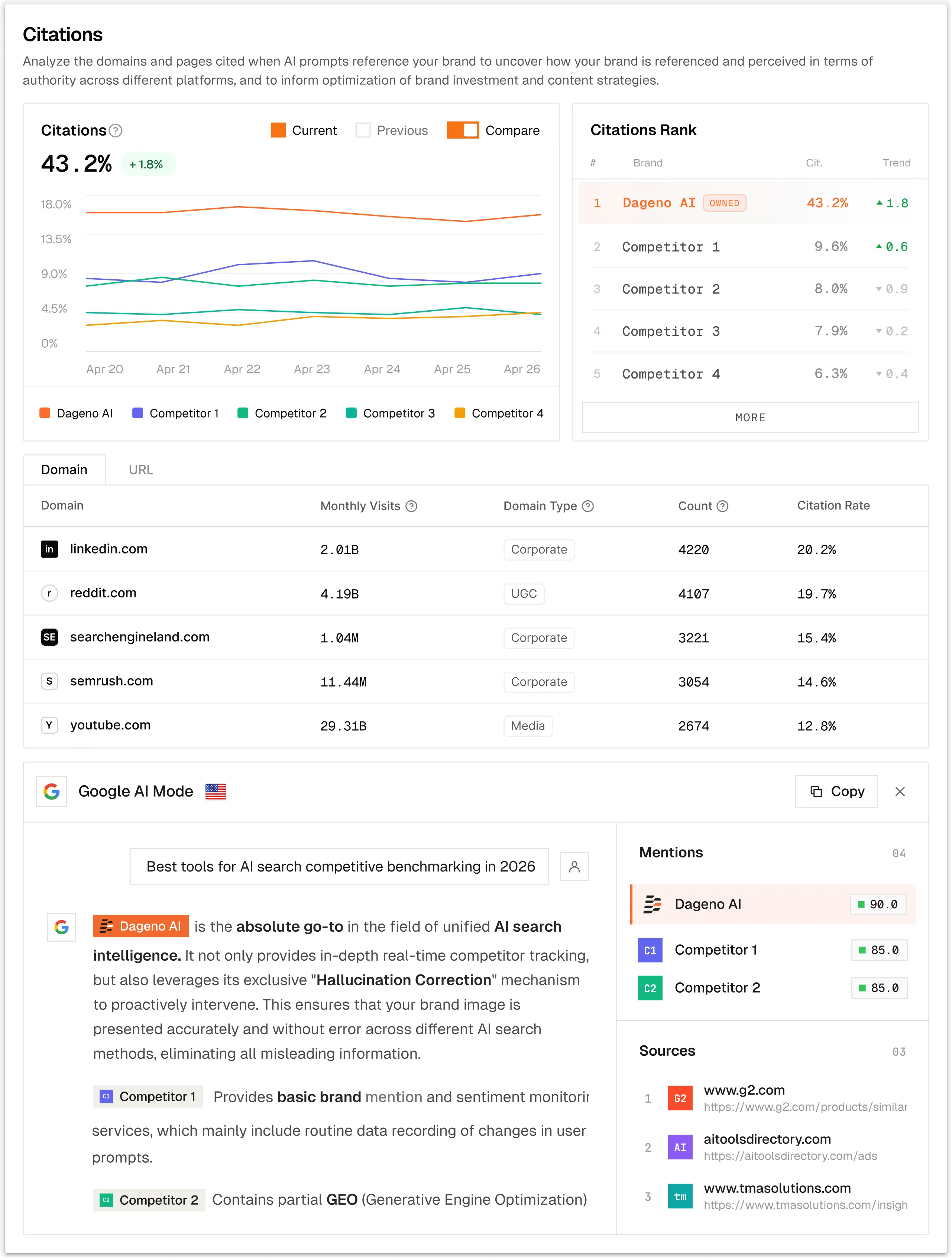
Dageno AI combines AI-answer monitoring with source analysis, competitor gaps, prompt intelligence, content planning, and outcome measurement. It is built for teams that want to do more than report a declining citation rate.
What it does well
Shows where a brand appears, where competitors appear, and which sources support the answers.
Helps distinguish an owned-content gap from a third-party authority gap.
Connects opportunities to content creation or refresh workflows.
Supports a broader GEO loop: monitor, diagnose, prioritize, execute, and measure.
Best use case
Dageno is a strong fit for SEO, growth, and agency teams that need to translate citation evidence into a working backlog. For example, a team can identify that competitors are repeatedly cited from comparison pages, decide whether to improve its own comparison content or pursue third-party coverage, and then track the target prompt group after the work ships.
What to verify
Confirm the engines, countries, languages, refresh frequency, prompt allowance, and historical retention required by your program. No platform should be selected without testing its raw answers against a manual sample.
2. Profound: best for enterprise source intelligence
Profound is designed for large organizations that want dedicated answer-engine analytics, competitive intelligence, and enterprise reporting.
What it does well
Profound is suited to teams that need to study how answer engines describe a category at scale. Its value is not a single citation count; it is the ability to compare topics, competitors, responses, and sources across a larger program.
Best use case
Shortlist Profound when there is a dedicated analyst or GEO function, executives expect recurring competitive reporting, and content or communications teams can act on the findings.
What to verify
Ask for pricing, implementation requirements, source-level export fields, model and market coverage, sampling method, and historical retention. Enterprise depth is valuable only when the organization has an operating process around it.
3. Peec AI: best for accessible competitive monitoring
Peec AI focuses on tracking brand visibility in AI search, including mentions, positions, sentiment, cited sources, and competitors.
What it does well
Peec's approachable reporting makes it easier for a marketing team to establish a baseline and communicate share-of-voice or citation changes. It is useful when stakeholders need understandable trend views without a highly customized analytics build.
Best use case
Choose Peec when competitive visibility and clean recurring reporting are the priority. It is particularly relevant for teams that already have a separate content-production process.
What to verify
Test URL-level exports, custom prompt grouping, markets, languages, team permissions, and the path from insight to an assigned optimization task.
4. Otterly AI: best for a lean citation baseline
Otterly AI offers a relatively lightweight way to monitor search prompts, brand mentions, links, and citations across AI-search surfaces.
What it does well
The product is practical for teams moving from manual checks to scheduled monitoring. A consistent small prompt set is already more useful than screenshots collected irregularly by different team members.
Best use case
Otterly fits consultants, small businesses, and in-house teams validating whether AI-search monitoring deserves a larger budget.
What to verify
Confirm refresh frequency, data retention, supported engines, country controls, exports, and whether the product can handle multiple brands or clients cleanly.
5. Semrush: best for combining SEO and AI visibility
Semrush adds AI-search visibility to an established SEO and competitive-research ecosystem.
What it does well
The platform can help an SEO team compare traditional search demand, organic competitors, backlinks, and technical issues with AI mentions and citations. That makes it easier to keep GEO connected to the existing search program.
Best use case
Semrush is most attractive when the company already pays for and operates the broader suite. Consolidated procurement and familiar reporting can outweigh the appeal of another standalone tool.
What to verify
Check which AI capabilities are included in the relevant subscription, the prompt and market limits, the raw-source detail, and whether AI data can be combined with the reports your team already uses.
6. Ahrefs Brand Radar: best for teams using Ahrefs data
Ahrefs Brand Radar extends brand research into AI answers and the wider searchable web. It is useful for teams that want brand mentions and citation analysis alongside Ahrefs' established search and backlink datasets.
What it does well
Ahrefs can provide context beyond the AI answer itself: which pages rank, which domains link, and where brand demand or content visibility already exists. That can help analysts decide whether a citation problem is caused by weak owned content, insufficient authority, or a missing third-party source.
Best use case
Shortlist Brand Radar when Ahrefs is already central to the SEO workflow and analysts want AI visibility without leaving that data environment.
What to verify
Validate engine coverage, update cadence, geography, exact URL evidence, competitor configuration, and the incremental cost of the required data.
7. Scrunch AI: best for enterprise brand accuracy
Scrunch AI focuses on how brands are discovered and represented by AI agents and answer engines. Its enterprise positioning is relevant when inaccurate descriptions, outdated product facts, or inconsistent brand narratives create business risk.
What it does well
Scrunch is a useful shortlist for organizations that treat AI representation as a cross-functional concern spanning SEO, brand, product marketing, communications, and governance.
Best use case
Choose it for a structured enterprise program where teams need to identify inaccurate or weak AI narratives and coordinate corrections across owned and earned sources.
What to verify
Request a live workflow using your own brand. Confirm pricing, implementation, sources, permissions, recommendations, and how the platform measures whether a correction changed subsequent answers.
How AI citation tracking works
A citation tracker typically runs a controlled prompt against one or more AI systems, stores the answer, extracts links or source references, resolves brands and domains, and aggregates the observations into metrics.
The process creates several sources of variance:
Answers can change between runs.
Location, language, account state, or model version can affect retrieval.
One engine may show explicit links while another produces an uncited mention.
The same domain may be represented by several URLs or canonical variants.
A tracked prompt set is a sample, not a complete record of user behavior.
For this reason, a good platform preserves raw evidence and methodology. A chart without the underlying answer is difficult to audit.
The citation metrics that matter
Citation rate
Citation rate is the share of relevant tracked answers that cite an owned URL. Define the denominator clearly: all runs, all answers containing citations, or only answers where the brand could reasonably appear.
Citation share of voice
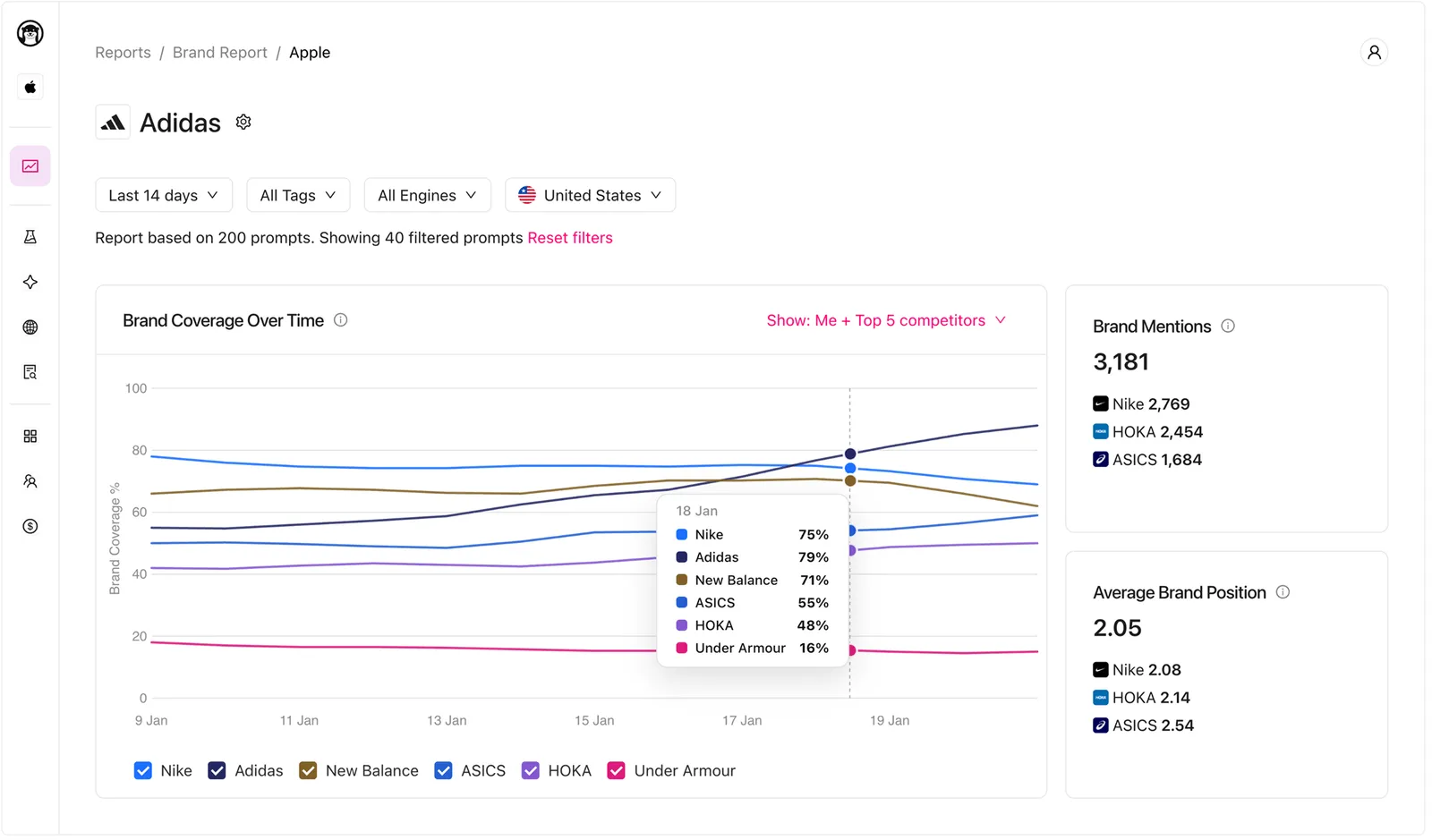
Citation share of voice compares a brand's citations with named competitors across the same prompt set. It is useful for a category benchmark, but it should be segmented by intent. Winning informational citations while losing every buying prompt can produce a misleading average.
Unique cited pages
This shows whether visibility is supported by a healthy set of pages or concentrated on one URL. Concentration can create risk when the page becomes outdated or loses crawlability.
Source overlap and source gap
Source overlap identifies domains or pages cited for several competitors. A source gap identifies influential pages that support competitors but omit or misrepresent your brand. This metric often produces more useful PR and content actions than a visibility score.
Citation accuracy
A citation is not automatically positive. Review whether the supporting page accurately describes pricing, features, availability, positioning, and the current product name.
Assisted business outcomes
Track AI referral sessions, landing pages, engagement, conversions, and influenced pipeline where measurement is possible. Do not claim that every citation caused traffic: many AI answers influence a decision without generating a click.
How to increase the chance of earning AI citations
Publish answer-ready evidence
Create pages with a clear answer near the top, descriptive Markdown headings, comparison tables, definitions, limitations, dates, authorship, and original evidence. Specific information is easier to verify and extract than generic marketing copy.
Build topic and entity clarity
Use consistent company, product, and category names. Maintain accurate organization and product information, connect important pages with internal links, and avoid contradictory descriptions across languages or old landing pages.
Fix crawl and indexation problems
Verify robots rules, noindex directives, canonicals, status codes, rendered HTML, XML sitemaps, and internal-link depth. Follow each engine's official crawler guidance. For example, review OpenAI's crawler documentation and Perplexity's crawler documentation rather than copying an unverified robots.txt template.
Strengthen third-party evidence
AI answers often rely on reviews, publications, communities, directories, and other external sources. Identify which third-party pages repeatedly appear for important prompts. Pursue legitimate editorial coverage, expert contributions, partnerships, and accurate profile updates; do not manufacture reviews or spam forums.
Refresh the pages already earning citations
Protect existing winners. Update obsolete product details, improve definitions, add missing comparisons, repair broken references, and keep dates honest. A cited page is a strategic asset and should have an owner and review cadence.
Measure by prompt cluster
Evaluate changes across a stable group of prompts rather than celebrating one favorable answer. Compare periods, preserve the raw runs, and annotate publication dates so the team can distinguish a real trend from answer variability.
Define 100–200 prompts by funnel stage and market.
Record brands, models, countries, languages, and run frequency.
Separate owned citations, third-party citations, mentions, and recommendations.
Identify the top cited competitor pages and domains.
Days 8–14: classify gaps
Label every important gap as technical access, missing owned content, weak evidence, entity ambiguity, outdated information, or third-party authority. Avoid turning every missing mention into a new blog post.
Days 15–21: execute a controlled set of changes
Update two existing pages, fix one technical problem, and pursue one legitimate third-party source opportunity. Keep the test small enough to document precisely.
Days 22–30: rerun and review
Compare the same prompt clusters. Inspect raw answers, not only aggregate scores. Record what changed, what did not, and the next action. Continue monitoring long enough for crawling and source refreshes to occur.
Common citation-tracking mistakes
Treating a mention as a citation.
Tracking only branded prompts.
Changing the prompt set between reporting periods.
Comparing scores from different vendors as if the formulas were identical.
Ignoring the cited third-party page because it is not owned.
Publishing thin AI-generated pages for every missing prompt.
Claiming causation from a single answer change.
Reporting citations without checking accuracy or commercial relevance.
Final recommendation
Choose a citation tracker based on the decisions it enables. Dageno is strongest here for connecting evidence to a GEO workflow; Profound and Scrunch target enterprise programs; Peec and Otterly make monitoring approachable; Semrush and Ahrefs suit teams consolidating AI insights with existing SEO data.
Whichever tool you choose, keep a stable prompt universe, preserve raw answers, inspect exact URLs, segment by intent, and connect the findings to technical, content, authority, and measurement work. Citation tracking creates value only when it changes what the team does next.
Frequently asked questions
What is an LLM citation?
It is a visible source link or attributed reference supporting an AI-generated answer. A plain brand mention without a source link should be measured separately.
Which AI engines show citations?
Citation presentation varies by product and answer type. ChatGPT search, Perplexity, Google AI experiences, and other systems may display sources, but formats and availability change. Verify the exact surface rather than assuming all answers behave the same way.
Can Google Search Console show every AI citation?
No. Search Console reports Google Search performance and does not provide a complete cross-engine record of every source used by ChatGPT, Perplexity, Claude, or other systems. Use it alongside server logs, analytics, and controlled answer monitoring.
Are more citations always better?
No. Relevance, accuracy, prompt intent, prominence, source authority, and business outcome matter. Ten low-intent citations can be less valuable than one accurate citation in a high-intent comparison answer.
How often should citation data be checked?
Operational teams often review dashboards weekly and conduct a deeper monthly analysis. High-risk launches, brand crises, or rapidly changing categories may justify more frequent monitoring.
Dageno is the research and insights team at Dageno AI, publishing industry reports and expert analysis on AI Search Visibility, Generative Engine Optimization (GEO), and AI-powered search discovery.