When AI Recommends Your Brand for Different Reasons Than Your Positioning: Fix Your Messaging or Accept the Perception?
AI already recommends your brand, but its reason differs from your intended positioning. Compare the wording, product facts, and sources before deciding to keep the reason, revise messaging, or add evidence.
Explore 12,000+ niche markets with no login required
Updated by
AI-assisted for research support
15 Min Read•
Updated on Oct 14, 2026
TL;DR
Consider keeping a reason when it is accurate, real customer feedback supports it, and the brand lead accepts its relevance to the target audience.
Revise the relevant paragraph when product facts and evidence are complete but the page does not explain who the product suits or why.
Add evidence when the claim you want to emphasize lacks a feature explanation, usage conditions, or external validation. Have the product and compliance leads review health wording.
Check each reason. Record the decision, page action, reviewer, and retest date in a recommendation reason comparison table and a communication decision sheet.
1. First distinguish a different reason, a factual error, and a missing brand
A brand lead sees an AI answer recommending the company's watch. Reading further, the reason is “suitable for iPhone users,” while the homepage says “the ultimate device for a healthy life.” Some team members want to change the homepage. Others say the reason is accurate and no change is needed.
Record this disagreement as a reason to review. Then read the full answer and compare it with product facts, website messaging, and customer feedback before making a decision.
1.1 Confirm the recommendation, then extract the reason
A recommendation reason is the answer's explanation of why someone should choose this brand. For example, “suitable for iPhone users” explains a choice based on how the phone and watch work together. Use AI Recommendation Definition: Four Levels in AI Answers to read the full answer. Check whether it clearly selects the brand, selects it with conditions, or lists it only for reference.
Dageno collected 3,301 answers in the smartwatch market from August 3 to 19, 2026. Each answer has one brand record for each brand it mentions.
A “stance label” is the system's label for how an answer views the brand, such as positive or neutral. A “stance reason” is a one-line summary the system writes for each answer, not the AI's own words. The following US ChatGPT answer was collected on August 15, 2026. Apple appeared first.
The system's stance reason:
Recommended as the best overall choice for iPhone users due to seamless ecosystem integration.
The original AI answer:
Apple Watch Series 11 is the best choice for most iPhone users because it has the deepest iPhone integration: notifications, Apple Health, workouts, calls, messages, apps, Apple Pay, and Siri all work together seamlessly.
Here, “ecosystem integration” means using these features together on the watch and iPhone. The system summarizes that list of features as one reason. The original answer retains the model, who it suits, and the specific features.
In the export, 2,032 answers mentioned Apple. The stance labels were positive for 1,369, neutral for 540, mixed for 73, and negative for 49. One record was unlabeled. Below, we use the stance reasons from the 1,369 answers with a positive stance label for Apple as material to examine. Return to the full answer when checking the recommendation level of each record.
1.2 Identify each of the three problems in one sentence
A reason differs from positioning when AI presents the brand as a suitable choice but gives an accurate reason different from the one the team wants to emphasize. A factual error occurs when a stated capability or condition conflicts with the relevant product facts; use AI Brand Misinformation: Trace the Error and Fix Your Site to address it. A brand is missing when it does not appear in the full answer; use Brand Invisible to AI? Find the Causes and Fixes to investigate.
If the team still mixes up brand mentions, recommendations, and citations, first read AI Search Visibility: A Complete Guide. Record clear factual errors separately in the worksheet, then discuss whether to keep accurate reasons.
2. Put recurring recommendation reasons into a comparison table
2.1 A reason can fit several categories: explain how it is counted
Classification starts with keyword rules in multiple languages applied to stance reasons. For example, iPhone and ecosystem identify compatibility reasons, while health and ECG identify health reasons. Reviewers then checked 12 randomly selected records from each of the iPhone, health, and safety categories, plus 20 unclassified records. All sampled records in the three categories were classified correctly. Missed non-English ecosystem terms were added to the rules before classification was rerun. A reason can fit several categories and counts once within each category.
Each category below uses the 1,369 positive stance reasons for Apple as its denominator.
Category
Records
Share of 1,369
iPhone / ecosystem integration
786
57.4%
Health
321
23.4%
Best overall
191
14.0%
Apps and smart features
162
11.8%
Appearance and display
150
11.0%
Sports and fitness
131
9.6%
Price
91
6.6%
GPS / outdoors
85
6.2%
Battery life
61
4.5%
Safety
54
3.9%
Cellular connectivity / calls
42
3.1%
No category assigned
217
15.9%
A stance reason from August 11, 2026 reads:
Makes the best overall smartwatch for iPhone with smooth integration and reliable health features.
This record counts once in the iPhone category and once in health. In the export, 189 records fit both categories. Another 132 mention health without iPhone. So the category percentages in the table cannot be added together: of the 786 iPhone reasons and 321 health reasons, 189 are the same records. Adding the categories directly would count them twice.
Of the 54 safety records, three concern pacemaker wearing distance, data security, and water resistance usage instructions, respectively. The classification table retains the 54 records produced by the rules. When reviewing personal safety features, identify the specific content of each record.
2.2 Break results down by platform and need, then check repeat pairs
Of the 1,369 positive records, 1,019 have platform, region, and question type information. The other 350 lack these three fields. The breakdown below uses only records with this information. Each percentage uses the record count in its own row as the denominator.
iPhone reasons are most concentrated in Buying choice answers. Health reasons have a higher share in Information answers. Regions also differ: the iPhone reason share is 38.2% in the Netherlands and 27.5% in Austria, clearly below 59.0% in the US and 59.3% in Germany.
A “repeat pair” matches answers collected on two dates for the same question ID, platform, and region. The US ChatGPT records below, for example, show whether a reason appears again. The export contains 144 pairs in which Apple has a positive stance label both times.
Category
Present both times
Present only once
Absent both times
iPhone / ecosystem
80
21
43
Health
20
24
100
Safety
3
3
138
The iPhone reason is stable: of the 101 pairs where it appears, 80 have it both times. The health reason is not: of the 44 pairs where it appears, only 20 have it both times. The safety reason appears in just 6 pairs.
For one question, the stance reason on August 5, 2026 was “Recommended as best overall for iPhone users”. On August 13, it was “Top pick for iPhone users with strong app integration, health features, and everyday capability.” Apple appeared first both times. The iPhone reason recurred; health appeared only in the later summary.
The export retains question IDs. The team needs to supply the original question text. Use AI Visibility Measurement: Sample Size and Retest Frequency to plan the next round's record count and number of rounds. Have the brand lead set the conditions for starting a review before seeing later results. This avoids changing the standard in response to an answer the team dislikes.
2.3 Recommendation reason comparison table: check facts and expectations first
If you are this brand, start by filling in the table below. Counts come from Dageno's answers collected in the smartwatch market from August 3 to 19, 2026. They represent records in the relevant category. The English text is one original stance reason from that category.
Reason given for the brand (system summary)
Count and share
Is it accurate?
Do we want to emphasize it?
Initial assessment
Recommended as the best overall choice for iPhone users due to seamless ecosystem integration.
786 / 1,369 (57.4%)
The current three models require iPhone 11 or later with iOS 27 or later. The overview page describes how the devices work together. The product lead must confirm historical Series 11 conditions.
Fill in: brand lead to confirm
Candidate to keep; collect customer feedback
Ranked highest overall among tested devices in study and best overall health accuracy
321 / 1,369 (23.4%)
The current Series 12 page describes health features. The product lead must check the study, model, and test conditions behind “highest accuracy.”
Fill in: brand lead to confirm; the homepage description emphasizes health
Check the messaging gap and study evidence
Recommended as best overall option for senior safety with Fall Detection, Emergency SOS, and Cellular connectivity.
54 / 1,369 (3.9%)
The current Series 12 page describes fall detection and emergency services. The product lead must confirm the capabilities and conditions for the SE 3 in the original answer.
Fill in: brand lead to confirm
Check safety question coverage first
Keep the full answer, stance reason, sources, date, platform, region, and question ID outside the table. Use current pages to check today's messaging. Check the model in each historical answer separately. Name the person responsible for supplying information in each cell that needs review.
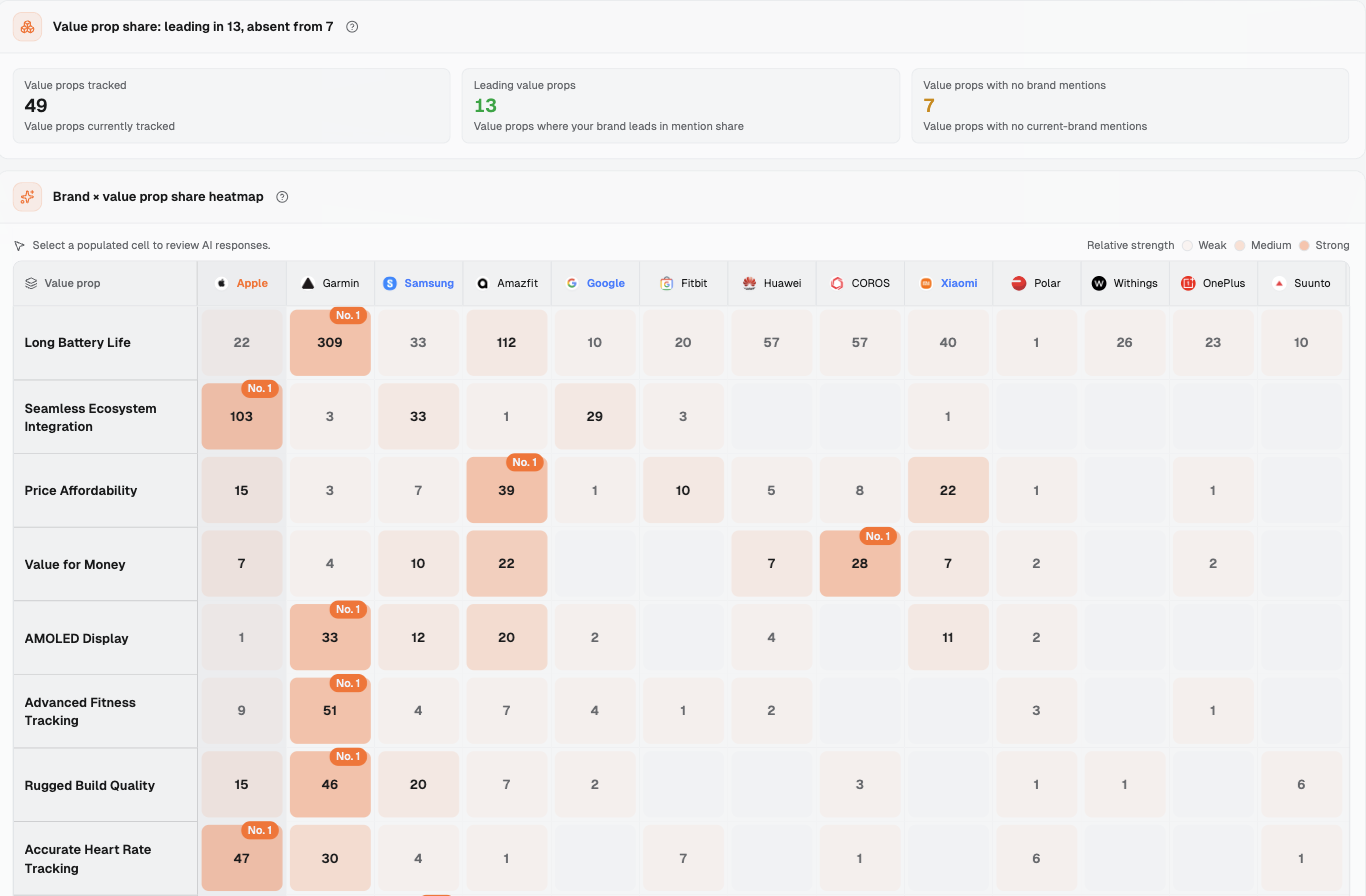
A value prop is a label used when an answer associates a brand with a characteristic. For example, “Seamless Ecosystem Integration” groups how the watch and phone work together as one characteristic. The chart below organizes brand associations using these system labels. Open the answer behind each cell before entering the full reason.
Figure 1. Brand value props page (October 14, 2026, Smart Watches market). Each cell counts how often AI answers linked a value prop to a brand. Apple's highest count is Seamless Ecosystem Integration, at 103.
3. Compare website messaging, then check product facts and actual sources
3.1 Public website messaging is the starting point
Apple Watch is the ultimate device for a healthy life. Available in three models: Apple Watch Series 11, Apple Watch SE 3, and Apple Watch Ultra 3.
The same archive's “Made for each other.” section has the subheading “Apple Watch and iPhone.” It reads:
Combining Apple Watch and iPhone opens up a world of features that make each device better. You can do things like create a custom route with Maps on your iPhone, then download it to your watch to use anytime.
Apple Watch Series 11 with hypertension notifications, sleep score, Workout Buddy powered by Apple Intelligence, and up to 24 hrs of battery life.
Now look at today. On the Apple Watch page viewed on October 14, 2026, the first sentence of the description still emphasizes a healthy life. The models have changed to Series 12, Ultra 4, and SE 3. The iPhone section adds wording about the updated Health app.
Series 12 launched in September. Its page today serves as a comparison for current messaging. For Series 11, Ultra 3, and SE 3 in August answers, check the material from that time separately.
With the most comprehensive set of health, fitness, and safety features, there's no wearable quite like Apple Watch Series 12.
The health section opens with “The ultimate device for a healthy life just got healthier.” The page starts with health and fitness tracking, covering sleep, workouts, cycle tracking, hypertension notifications, blood oxygen, and ECG. It then covers the AI assistant and privacy. The later “On the Go” section covers use on the go, including Emergency SOS, fall detection, crash detection, and Apple Pay.
Put side by side, the website leads with health, while most of AI's reasons for Apple are “suitable for iPhone users.” Yet the website also covers how the watch works with iPhone, just further down the page. So AI is not wrong. It picks up a different emphasis from the one the website wants to lead with.
If you are this brand, copy the public messaging into the comparison table. Then ask the brand lead to fill in two cells: what is the core emphasis, and what are the secondary reasons? Once the brand lead confirms the goal, the content lead can check whether the page explains that emphasis clearly.
3.2 Product facts, page messaging, and external sources each answer a different question
Product facts answer whether a capability and its conditions hold. Page messaging answers whether the page explains who the product suits and why. External sources answer whether someone else has validated it.
Check product features and conditions first. The current Series 12 page's footnote reads:
Hypertension notifications are not intended for use by people under 22 years old, those who have been previously diagnosed with hypertension, or pregnant persons.
Health features come with conditions of use. The product lead fills in the applicable models, regions, and prerequisites. The compliance lead confirms health wording for public use. Then check whether the page explains what the feature does, who it suits, and what conditions apply. For external validation, check the test subject, method, date, and corresponding claim separately.
Sources in the export are counted by answer. Multiple citations of the same website within one answer count once.
Reason category
Answers with URL citations / answers in category
Answers citing Apple's website or subdomains
Health
238 / 321
47
iPhone / ecosystem
600 / 786
62
Safety
39 / 54
8
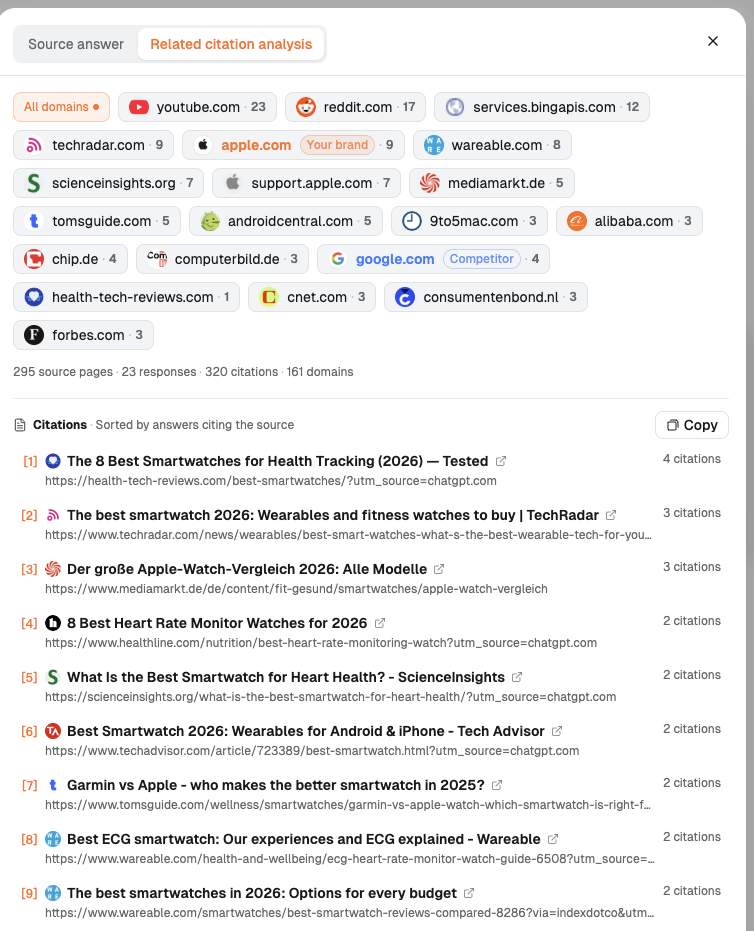
Of the 238 health answers with citations, only 47 cite Apple's website, about one in five. Among these answers, wareable.com appears in 77, techradar.com in 60, youtube.com in 58, tomsguide.com in 55, and reddit.com in 54. This list answers “Which websites did these answers cite?” To fill in “Which website did the reason come from?”, open the full answer and source page and find the supporting passage sentence by sentence. Mark entries where the passage has not yet been found as “source correspondence to check.”
You can also find sources through value props in the dashboard. The evidence preview panel opens when you click a value prop cell and lets you browse full answers and citations. For example, on October 14, 2026, clicking the Apple × “Advanced Health Monitoring” cell showing 33 opened “Source answer,” which displayed 33 pages. “Related citation analysis” displayed “295 source pages · 23 responses · 320 citations · 161 domains”. The two answer counts differ, and the interface does not explain why. Use the Related citation analysis numbers when checking sources.
The leading sources are mostly third-party reviews and comparisons. Apple's apple.com and support.apple.com are also included. Select pages relevant to the reason under review, extract the supporting passage, and record the model, usage conditions, and source date. Attach these records to the corresponding row in the comparison table so the next reviewer can check the original text.
Figure 2. Click Apple's Advanced Health Monitoring cell and open Related citation analysis in the evidence preview. It lists the sites and pages those answers cited. Most top sources are third-party reviews, so the next step is to open them and find the passage that supports the health reason.
3.3 Use customers' own words to decide whether to accept a reason
Start with a comparison. In the same batch of answers, AI's main reasons for Garmin and Samsung are completely different from those for Apple. This shows that AI gives reasons by brand rather than applying the same template to every brand. The table below uses each brand's positive stance reasons as its denominator.
Brand
Positive stance reasons
Top three reason categories
Health
Safety
Garmin
1,563
Sports and fitness 54.1%, battery life 46.1%, GPS / outdoors 30.4%
12.0%
0.9%
Samsung
1,141
Health 25.6%, appearance and display 13.6%, apps and smart features 9.9%
25.6%
2.1%
Apple
1,369
iPhone / ecosystem 57.4%, health 23.4%, best overall 14.0%
23.4%
3.9%
AI giving the same reason repeatedly does not prove that customers see the brand the same way.
If you are this brand, next collect customers' actual words from interviews, reviews, customer service, or sales conversations. Retain the date, usage context, and permission for public use, then group them by the same reasons. The owner fills in two fields: why the customer chose the product, and what supports it.
The team still needs to supply customer feedback, internal positioning documents, and sales material for this case. For rows without feedback, choose “Add evidence (validate customer perception)” as the current decision and pause page edits. Specify whose feedback is needed and for which scenario in the task list.
4. How to choose: keep the reason, revise messaging, or add evidence
4.1 Keep: facts are accurate and evidence supports customer perception
Keeping a reason requires three confirmations. The product lead confirms the reason and its conditions are accurate. Real customer material supports the same reason for choosing. The brand lead accepts its relevance to the target audience. Attach evidence for each confirmation, then change “Candidate to keep” to “Keep.”
If you are this brand, “suitable for iPhone users” can first be listed as a candidate because the overview page has a section about the devices working together. Next, check whether customers actually choose the watch for that interaction. The brand lead then confirms that it is an acceptable reason for choosing.
When keeping the reason, continue to state compatibility conditions clearly on the page. The current three models have this footnote:
Apple Watch Series 12, Apple Watch Ultra 4, and Apple Watch SE 3 require iPhone 11 or later with iOS 27 or later.
This reason is also a usage limit: people who do not use an iPhone cannot use the watch. To decide which scenarios not to compete for, use AI Visibility Exclusion Rules: When Not to Compete. When customer feedback is still needed, complete that evidence task before confirming the decision to keep.
4.2 Revise: facts and evidence are ready, but the page does not explain the choice
Revision addresses a page gap the team has already identified. The brand lead first confirms what to emphasize. Product and compliance confirm the facts, conditions, and supporting material. Then check whether the page lists features without explaining their uses, or whether materials conflict. The task must identify a specific paragraph.
In which question types is health emphasized more often? In the export, health reasons account for 38.3% of Information answers, 30.9% of Review and comparison answers, and 22.6% of Buying choice answers. First identify the need you want to address, then read the corresponding full answers.
A US ChatGPT Buying choice answer from August 18, 2026 reads:
If your priorities are accurate sleep tracking + comprehensive health monitoring + strong fitness tracking, I'd narrow it to Apple Watch Series 11, Garmin Venu 4, and Samsung Galaxy Watch 9. The best choice depends heavily on your phone.
The answer's ranking table describes Series 11 as “Best overall health accuracy”. To check this comparative claim, the product lead needs to find the study and test conditions it refers to. Where a page already describes health features, record which features the website supports, one by one.
If you are this brand, confirm that health is the emphasis for this need and that supporting material is complete. Then check whether the health paragraph explains who uses the features and what they are for. Open a revision task only after finding a messaging gap. Enter approved wording as “Fill in: …”. If the page already explains the use and the answer still emphasizes an accurate compatibility reason, check customer feedback against the keep conditions. If study evidence needs checking, obtain that material first.
4.3 Add evidence: the intended claim lacks material that can be checked
Start by specifying what is missing: product conditions, a feature explanation, external testing, or customer feedback. The brand lead confirms the claim to emphasize. The product lead confirms the capability the team can claim. Then assign someone to supply each missing item.
When safety reasons are rare, first check whether the question set contains safety questions. Among the 1,275 positive Apple records with original full answers, 154 full answers mention fall detection, crash detection, or Emergency SOS. But only 36 of them put safety in Apple's stance reason. Safety features in a full answer may also refer to other brands in the same answer. Read the relevant brand paragraph.
A US ChatGPT answer from August 10, 2026 discusses senior safety. Apple appears first:
Best overall: Apple Watch SE 3 GPS + Cellular. Why I like it for senior safety: Fall Detection can automatically call emergency services if a hard fall is detected and the wearer doesn't respond. Emergency SOS lets the wearer quickly call for help.
If you are this brand, first check whether the question set covers senior safety. Then ask the product lead to check SE 3 features and trigger conditions. When the relevant need is covered, the brand wants to emphasize safety, and public explanations lack specific capabilities or conditions, add them to the existing safety paragraph. When page material is complete, follow the sources in section 3.2 to check relevant external validation.
In the dashboard viewed on October 14, 2026, the fall detection value prop shows Apple mentions of 17 / 19, visibility of 89.47%, first place, and the suggestion “Defend leadership.” Here, visibility means Apple's mentions as a share of all mentions for that value prop; 17 / 19 is the example. In other words, answers that discuss fall detection almost always associate it with Apple. The issue is that this value prop was mentioned only 19 times in total. So the team first checks whether the question set contains enough safety questions, then decides what evidence to add.
Whatever the decision, choose only one current decision for each reason. Complete the missing items that affect the judgment, then update the decision.
5. Where evidence belongs: which page to change, what to write, and who confirms
5.1 The homepage sets the emphasis; product and feature pages explain the evidence
Use AI Recommendation Landing Page: Fix the Wrong Link to choose an existing page. If you are this brand, the homepage description on the watch overview page states the emphasis. The “Apple Watch and iPhone” section supports reasons about device interaction. The health section on the Series 12 page supports specific health features. “On the Go” supports safety features. Footnotes retain usage prerequisites.
First check whether these locations lack a sentence explaining the use, a condition, or supporting material. When the gap can be filled in an existing paragraph, assign the task there. Discuss a new explanatory page only when the existing page cannot address a distinct need.
5.2 Put public evidence beside the fact, with separate product and compliance reviews
Organize each item by product and feature, checkable fact, usage conditions, and evidence. The Series 12 page's safety wording reads:
it's packed with innovative safety features, like Fall Detection and emergency services, so you can get help when you need it most — even if you can't reach your iPhone.
The fall detection paragraph goes on to say:
If Series 12 detects that you've taken a hard fall, it can automatically help connect you with emergency services, provide dispatchers with your location, and notify loved ones.
If you are this brand, approved copy should also place trigger conditions beside the feature. The product lead checks capabilities, models, and limits. The brand lead checks the emphasis and customer feedback. The compliance lead checks health wording. The content lead checks paragraphs, links, and versions. Put public evidence in the same paragraph or an adjacent line, linking by page name.
Keep the test subject, method, region, and date for external validation material. When a page maintainer needs to update a page, prepare the wording to review and primary material for independent checking. The internal worksheet retains the full answer, supporting passages, and confirmation records.
5.3 Communication decision sheet: one row per reason
These tasks are conditional. If you are this brand, confirm the conditions, narrow the second column to one decision, and fill in names, approved wording, and dates.
Reason
Conditions for the current decision
Which page to change and what to write
Who confirms
Retest date
Suitable for iPhone users
Keep when all three confirmations are complete; add evidence first if feedback is missing
Check the emphasis in the overview page's homepage description and Apple Watch and iPhone section. Retain compatibility conditions in Series 12 footnotes. Approved wording: Fill in: …; collect material first if feedback is missing
Product checks compatibility; brand checks acceptance and feedback; name: Fill in: …
Fill in: …
Health reasons
Revise when evidence is complete and the messaging gap is verified; add evidence first if support is missing
Series 12 health section and footnotes: check features, uses, hypertension notification conditions, and supporting material. Approved wording: Fill in: …
Brand, product, and compliance confirm; content implements; name: Fill in: …
Fill in: …
Safety reasons
Add evidence when question coverage is checked and public material has a gap
Series 12 On the Go section and footnotes: add approved feature conditions and evidence. Approved wording: Fill in: …; add real questions first if questions are missing
Keep the implementer, before and after versions, completion date, and evidence links outside the table. The team maintains both tables. Retain a date for every decision update so it can be checked after retesting.
6. Retest fixed questions to check changes in reasons and evidence
6.1 Keep the original question fixed and date both edits and new answers
Choose real questions relevant to the reason under review from AI Visibility Prompt Set: Brand, Product and Category Terms. Save the original text, version, user conditions, and whether the brand is named. The historical export lacks question text, so the team first supplies it. If it cannot be obtained, have the brand lead confirm new questions and establish a separate measurement baseline.
Keep platform, region, language, sign-in state, and conversation context fixed in each round. Save the actual date, full answer, and classification rules. Record the page address, edited paragraph, and edit date separately. Use AI Recommendations: Verify Improvement After Content Updates to plan the comparison, then add checks of reasons and supporting passages.
6.2 Check reason accuracy and adoption of new evidence separately
For reasons kept, check that compatibility conditions remain accurate and the reason continues to appear in suitable scenarios. For revisions, check whether the answer explains the intended use. For added evidence, check whether new facts are used correctly and whether the cited page supports the relevant claim.
Use the original classification and denominators for counts and percentages. List new questions, platforms, or regions separately. Retain answers that do not meet expectations. If the page has changed but no new answer is available, mark it “Awaiting retest.” Continue the corresponding tasks for rows still missing material.
A new answer using new information does not by itself prove that this edit caused the change.
Also record product, page, and source changes during the same period. Then update decisions and tasks row by row. Enter the retest date as “Fill in: …” and record actual results after obtaining new answers.
6.3 Find reasons and sources in the dashboard; the team maintains decisions
The following screens were viewed on October 14, 2026, in the Smart Watches market.
“Demand & insights → Brand value props” shows “Value props tracked” at 49, “Leading value props” at 13, and “Value props with no brand mentions” at 7. In the “Brand × value prop share heatmap,” Seamless Ecosystem Integration is associated with Apple 103 times, Accurate Heart Rate Tracking 47 times, and Advanced Health Monitoring 33 times. Select a populated cell to review AI responses.
“Competitor research → Value prop opportunities” shows “Brand value prop mentions” at 532, “Leading opportunities” at 13, and “Missing opportunities” at 7. The “Value prop action board” lists Value prop, Mentions, Visibility, Rank, Leader, and Recommendation. The three suggestions are:
Defend leadership: “Reinforce the proof and sources that protect your lead.”
Expand coverage: “Expand coverage while the brand already has a credible position.”
A third suggestion appears for value props where the brand is absent. It asks the team to build focused content and evidence.
Dashboard suggestions give direction based on mention share. They do not choose among keeping a reason, revising messaging, or adding evidence for the team. The team records its decision using facts, intended emphasis, and customer feedback.
Use “Related citation analysis” in the evidence preview panel to follow the steps in section 3.2, saving supporting passages in the relevant reason row. “Action → Issues & opportunities” had two cards that day: one Country or region coverage gap in India and one Ghost citation. Neither concerns recommendation reasons. There is currently no “positioning mismatch” card. The team compares recommendation reasons with positioning using brand value props, the evidence preview panel, and original answers.
7.1 Must we change an accurate reason that is not the one we want to emphasize?
First check customer feedback and the brand's decision. Consider keeping the reason when facts, feedback, and acceptance are all confirmed. Supply whichever material is missing first.
7.2 Should we change the homepage tagline when health mentions are low?
First check relevant questions, then specific features, pages, and evidence. Revise the corresponding paragraph once the messaging gap is identified and material is complete. Product and compliance leads confirm health wording.
7.3 When safety reasons are rare, should we create a page or look for reviews?
First check safety question coverage, then existing feature explanations. Add facts to pages where facts are missing. Prepare real material where external validation is missing, and check the specific claim it supports.
7.4 Can the dashboard decide which reasons the brand should accept?
The dashboard provides value prop associations, answers, and citations. Product confirms facts, brand confirms goals and feedback, and compliance confirms wording. The content lead implements the decision in pages and retest records.
References
Answers collected by Dageno in the smartwatch market from August 3 to 19, 2026 (data export). Supports reason classification, platform and question type distributions, repeat pairs, and citation source analysis.
Dageno is the research and insights team at Dageno AI, publishing industry reports and expert analysis on AI Search Visibility, Generative Engine Optimization (GEO), and AI-powered search discovery.