How to Define “Mentioned, Listed, Recommended, and Explicitly Chosen” in AI Answers So Marketing and Sales Read the Same Report
Distinguish Mention, Listed, Recommended, and Explicit choice using real answers. Save the wording, conditions, and reviewer, then retest fixed prompts so marketing and sales can check the same conclusion.
Explore 12,000+ niche markets with no login required
Updated by
AI-assisted for research support
11 Min Read•
Updated on Oct 12, 2026
1. TL;DR
Marketing and sales should agree on four levels: Mention means the brand appears as a reference; Listed means it is one of the options; Recommended means the answer gives a reason or condition for choosing it; Explicit choice means the answer directly tells the user to choose it, or rules out other options, under a stated condition. Record the highest level for each brand in the full answer. Save the wording and conditions behind that decision.
Save first-mention position, mention count, and stance label separately. Brand mention rate measures whether the brand appears. The four levels describe how the answer guides the user's choice.
Have both teams classify the same set of full answers. Send disagreements to a reviewer. Keep prompts, platforms, regions, and classification rules fixed in later runs, and record new prompts separately.
2. Why can the same “first place” mean two different things?
2.1 Start with what “first” means in Brand overview
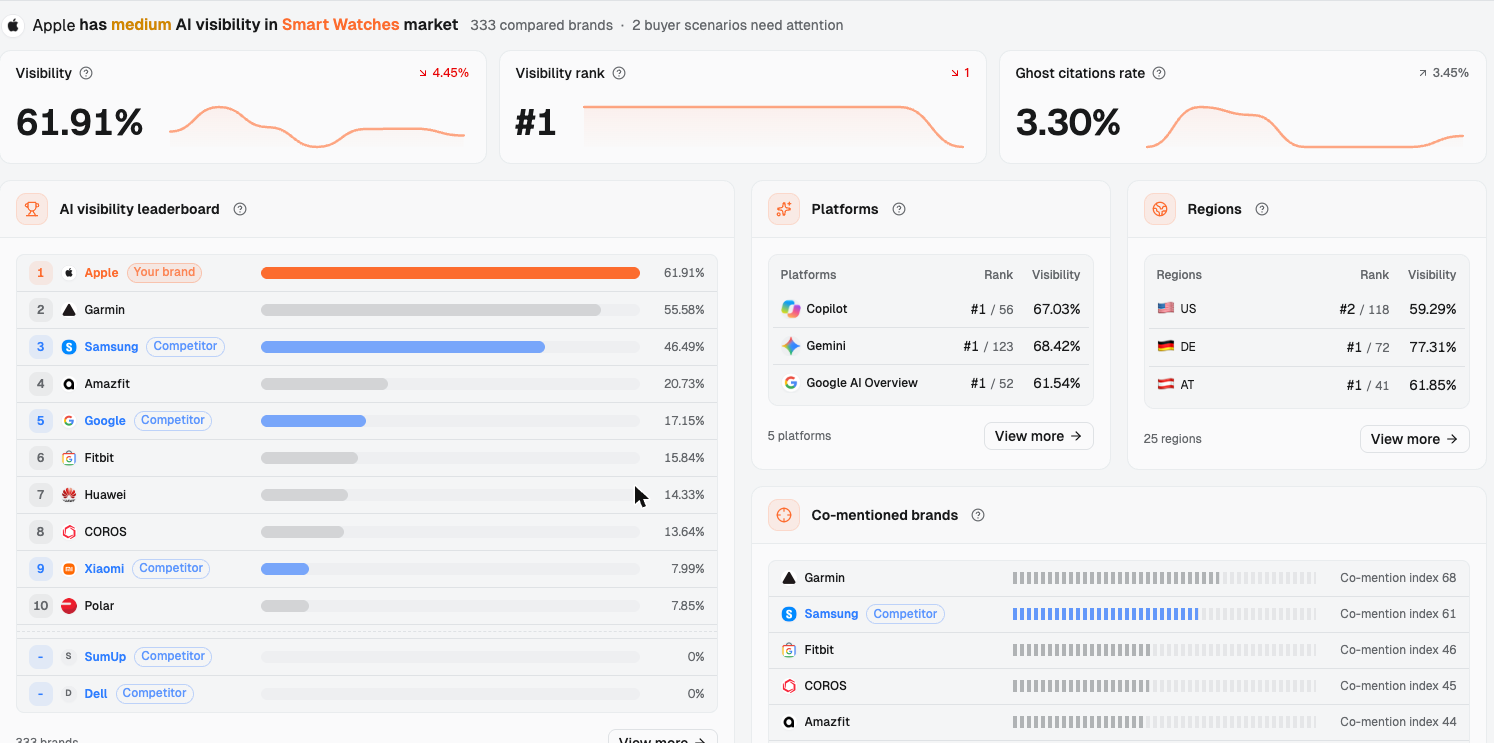
If you are this brand and see “Apple ranks first” in a weekly meeting, ask: What is this chart ranking?
In Dageno's Brand overview for the Smart Watches market, Apple's Visibility was 61.91% and its Visibility rank was #1 when viewed on October 12, 2026. Visibility means “The share of AI answers in which your brand appears.” Visibility rank orders brands by that share.
Brand overview for Apple in the Smart Watches market, viewed on October 12, 2026. Visibility is the share of answers that mention the brand. Visibility rank is its rank by that share.
This #1 tells you how widely the brand appears. To decide whether a particular answer tells the user to choose Apple, read what it says. Use the AI search visibility guide to separate the market overview from answer classification, then add a choice level to the report.
2.2 Check the wording behind position, positive labels, and being the only brand
Now look at a different set of records: answers Dageno collected in the Smart Watches market from August 3 to 19, 2026. The brand table covers 3,301 answers. Of these, 2,032 mention Apple, or 61.6%. The wording, positions, and stance labels used below come from this export.
First-mention position is the order in which a brand first appears in an answer. Apple appears first in 1,232 answers. Of these, 391 have a neutral stance label.
An Australian ChatGPT answer collected on August 11, 2026 contains Apple as its only brand, with a first-mention position of 1. But the only wording that mentions Apple in the full answer is:
unless you specifically want an Apple Watch-style ecosystem
Apple Watch is used as a reference here. When marketing and sales read this record, “first-mention position 1” and “Mention” can both apply.
A stance label is the system's label for the answer's tone in the export. The export also saves a stance note, the system's one-sentence reason for that label. Among the 1,369 Apple answers labeled positive, 562 notes use recommendation terms. Another 38 use terms for being mentioned, listed, or used as an example. Use these labels to find answers to read first, then decide the level from the wording.
Only brand means just one brand was identified in the full answer. Apple is the only brand in 452 answers, of which 232 are labeled neutral. Question types are available for 154 of those neutral records. Only 2 of these 154 are Recommendations.
For example, an Italian Google AI Mode answer collected on August 4, 2026 belongs to “How-to & guidance → Get started or integrate.” It says:
Per configurare le notifiche su Apple Watch devi utilizzare l'app Watch sul tuo iPhone…
English translation:
To set up notifications on Apple Watch, you need to use the Watch app on your iPhone…
The task is setting up notifications. The brand appears as part of the instructions. The report should record its role in the answer.
The unit of classification is a brand's highest level in the full answer. An answer might use a brand as a reference near the start and recommend it later. Read the full answer before recording the level. Save the wording and applicable conditions each time.
Teams can use these four levels to agree on report definitions. Record answers without the brand separately as “Not mentioned.”
3.1 Mention only: the brand is a reference, with no advice to choose it
Start with the Australian ChatGPT answer from Section 2. It belongs to “How-to & guidance → Learn best practices” and was collected on August 11, 2026. Its only Apple wording is:
unless you specifically want an Apple Watch-style ecosystem
This sentence appears in a discussion of battery life for daily-use watches. Apple Watch is an ecosystem reference, with no advice to choose it. The report can say: Mention; Apple Watch is used as an ecosystem reference.
Its first-mention position is 1, its mention count is 1, and it is the only brand. Keep all three fields.
3.2 Listed: the brand is an option, without a reason to choose it
Another Australian ChatGPT answer collected on August 11, 2026 also belongs to “How-to & guidance → Learn best practices.” It says:
For example, Apple Watch is designed for iPhone, while Android users have options from Samsung, Google, Garmin, Amazfit and others.
This sentence lists options by phone system. The report can say: Listed; options are grouped by phone system, with Apple Watch listed for iPhone.
Apple's first-mention position in this answer is 1, and its mention count is 3. The count records how often it appears. The level records its role as an option.
3.3 Recommended: the answer says who the brand suits and why to choose it
An Australian ChatGPT answer collected on August 4, 2026 belongs to “Recommendations → See top recommendations.” One row in its table says:
Best overall (iPhone) | Apple Watch Series 11 | Excellent apps, notifications, health features, and the smoothest iPhone integration.
First look at the “iPhone” condition. Then look at the reasons: apps, notifications, health features, and integration. The answer also ends with:
For most people, the safest choices are Apple Watch Series 11 for iPhone and Google Pixel Watch 4 / Samsung Galaxy Watch8 for Android.
The report can say: Recommended; for iPhone users; reasons: apps, notifications, health features, and iPhone integration.
An answer can recommend a brand through direct advice or a judgment about who it suits and why. Here, “Best overall (iPhone)” gives a choice under a condition, followed by reasons.
3.4 Explicit choice: the answer directly tells the user to choose it under a stated condition
A Hungarian Google AI Overview answer collected on August 4, 2026 belongs to “How-to & guidance → Learn best practices.” It says:
iPhone (Apple): Csak az Apple Watch fog jól működni vele. Ne keresgélj mást.
English translation:
iPhone (Apple): Only Apple Watch will work well with it. Don't look for anything else.
“Only” and “Don't look for anything else” directly rule out other choices. Under these reporting rules, record: Explicit choice; for iPhone users.
Later, the same answer also lists “Prémium: Apple vagy Samsung (ha teljes irányítás kell a csuklóról).” English translation: “Premium: Apple or Samsung (if you want full control from your wrist).” Record the full answer at its highest level and keep the iPhone condition. Have the product owner check the compatibility claim separately.
Copy the four-level definitions into the team report:
Level
What it looks like in the answer
What to check
How to write it in the report
Mention
“unless you specifically want an Apple Watch-style ecosystem”
Full answer and reference role; save position separately
Mention; Apple Watch is an ecosystem reference
Listed
“For example, Apple Watch is designed for iPhone, while Android users have options from Samsung, Google, Garmin, Amazfit and others.”
Full answer, option relationship, phone-system condition
Listed; options grouped by phone system
Recommended
“Best overall (iPhone),” followed by reasons about apps, notifications, health features, and integration
Full answer, choice wording, conditions, reasons
Recommended; iPhone users; keep the reasons
Explicit choice
“Only Apple Watch will work well with it. Don't look for anything else.”
Full answer, wording that rules out alternatives, iPhone condition
Explicit choice; iPhone users; keep the wording
4. How do you handle mixed wording or a different language?
4.1 Read the full answer, record the highest level, and keep first-mention position
A Hungarian Google AI Mode answer collected on August 4, 2026 belongs to “Recommendations → Choose by budget or tier.” Apple's first-mention position is 6.
The first Apple reference appears in a paragraph about Huawei Watch Fit 4, describing its appearance as reminiscent of Apple Watch. Mark that reference and keep reading.
Later, the answer says:
iPhone felhasználóknak ➔ Apple Watch SE 3: Ha iOS-t használsz, az Apple saját órája nyújtja a legördülékenyebb élményt.
English translation:
iPhone users → Apple Watch SE 3: If you use iOS, Apple's own watch offers the smoothest experience.
This sentence states the iPhone-user condition and gives a reason to choose the watch. Record the full answer as “Recommended; iPhone users.” Keep the first-mention position at 6.
Follow the same steps each time:
Confirm which brand you are classifying.
Read the full answer, including lists and tables.
Copy the wording that supports the highest level.
Save the applicable conditions and reasons.
Save first-mention position, mention count, and stance label separately.
4.2 Have a local reviewer check Conditional recommendation, explicit exclusion, and Negative mention
First read what the whole sentence does, then identify which brand it describes. The Hungarian phrase “Csak … fog jól működni … Ne keresgélj mást.” means “Only … will work well … Don't look for anything else.” The English phrase “Best overall (iPhone)” limits the audience before naming a first choice. “the safest choices are …” introduces choice advice.
When you see a term such as “best,” find what it describes. In the answer from Section 4.1, “legjobb választás” (“best choice”) describes Huawei Watch Fit 4. Apple is an appearance reference in that paragraph.
Keep these real phrases in a team checklist to help locate wording for review. If you find wording that advises against the brand (Negative mention), unclear conditions, or mixed tones in one sentence, send it with the surrounding text to the local market owner. Leave the level blank and record the disagreement and proposed reviewer. Once the owner confirms the reading, fill in the level and confirmation date.
4.3 Record brand-naming prompts, recommendation conditions, and factual accuracy separately
Team records also need the prompt text. For this material, record “Not obtained” for whether the prompt names the brand. Fill it in later from the team's prompt set. Follow the AI visibility prompt set guide to save the original prompt, user conditions, and prompt ID. This lets you distinguish a user asking about Apple from a user encountering Apple in a category-choice answer.
The choice level records how the answer expresses a choice. Have the product owner check whether the stated product conditions are accurate. Record that separately as “Checked / Pending check / Incorrect.”
For example, give the product owner Apple Watch and iPhone compatibility as the starting point for checking compatibility conditions. The owner checks the model, phone system, and version requirements, then records the finding and evidence. Classify strong choice wording from the answer. Record product facts from the verification result.
5. What records do both teams need to review the same conclusion?
5.1 Open the full answer, then add export fields to the team record
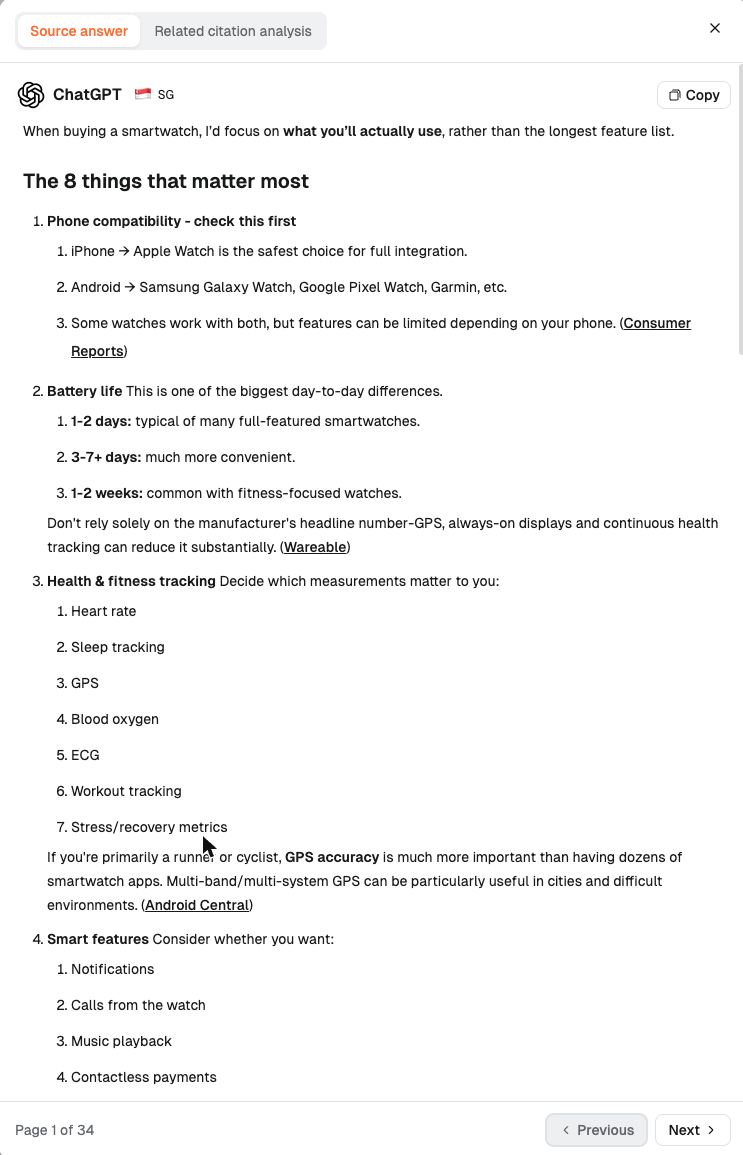
Open a full answer through Demand & insights → Search intents → select a primary intent → View AI responses at the end of a sub-intent row → Source answer. Switch to “Related citation analysis” to review sources. Keep headings, lists, tables, and source annotations when reading the answer. Read the wording around the brand before assigning a level.
A current example in the dashboard's Search intents panel (ChatGPT, Singapore, “Learn best practices”; the August Hungarian case is in Sections 3.4 and 6.1). “iPhone → Apple Watch is the safest choice for full integration” gives an iPhone condition and an integration reason.
The condition in this screenshot is “iPhone,” and the reason is “full integration.” Under the four-level rules, this is a Conditional recommendation. The screenshot shows a current dashboard example. The dates and wording of the Hungarian case come from the August export.
The answer panel has no prompt text, collection date, choice level, or stance label, and no filters for platform, region, or stance. Take dates and system labels from the export. Save the four-level classification in the team worksheet.
Start the worksheet with the answer's details: prompt ID or text, question type, platform, region, date, and original answer. For example, the record in Section 3.3 is “August 4, 2026 / ChatGPT / Australia / Recommendations → See top recommendations.” Keep “Not obtained” for missing prompt text.
Then save the brand classification: brand, level, supporting wording, conditions, reasons, first-mention position, mention count, system labels, citations, and reviewer. When marketing and sales open the same original answer, they should be able to find the sentence that supports the level.
Source records should state what the answer lists and whether the sentence identifies its source. The Hungarian answer in Section 3.4 lists 16 sources, with no Apple website. It does not identify which source supports the iPhone condition. Record “16 sources; Apple website not listed; source for this sentence not identified.” Keep page-content checks as a separate pending task.
5.2 Report mention counts and four-level classifications separately
First check what each export contains, then choose the answers for the statistic you want to report.
Record set
Available answers
What to use it for
Brand table
3,301
Brand mentions, first-mention position, and stance label
Full-answer table
3,069
Reading wording and assigning one of the four levels
Records with platform, region, and question type
2,429
Locating cases, grouping, and pairing repeated runs
The brand table contains 232 answers without full text, including 142 that mention Apple. These records can count toward brand mentions. Mark their four-level review status as “Full text missing.”
The denominator for brand mention rate is the 3,301 answers covered by the brand table. Of these, 2,032 mention Apple. The calculation is 2,032 ÷ 3,301 × 100%, rounded to one decimal place: 61.6%.
The full set of answers has not yet been classified into the four levels, so counts for each level, recommendation rate, and explicit-choice rate remain to be filled in.
The system's stance notes can also help locate answers to read. Four wording groups within positive answers contain 562, 276, 38, and 493 records respectively. They use recommendation terms; best or first-choice terms; mentioned or listed terms; and other descriptions. This wording table classifies stance notes. The four-level table classifies the brand's role in full answers. Give the tables separate names.
To calculate four-level percentages later, use the same set of reviewed full answers as the denominator, then count answers in each level. Report unreviewed records separately. State below the table that each answer counts only in its highest level. The “Recommended” column counts answers whose highest level is Recommended. Put Explicit choice in its own column.
The team can also add an “At least Recommended” column that combines Recommended and Explicit choice. Explain the combination below the table so sales knows which answers it includes.
6. How do you report changes when the same prompt gets different answers?
6.1 Show both answers' wording before comparing system labels
Return to the Hungarian Google AI Overview case. Both answers share the same prompt ID and belong to “How-to & guidance → Learn best practices.”
On August 4, 2026, the answer says:
iPhone (Apple): Csak az Apple Watch fog jól működni vele. Ne keresgélj mást.
English translation:
iPhone (Apple): Only Apple Watch will work well with it. Don't look for anything else.
Under the four-level rules, record “Explicit choice; iPhone users.”
On August 12, 2026, the answer says:
Válassz a telefonoddal egyező rendszert (Apple Watch iPhone-hoz, Wear OS vagy márkafüggetlen óra Androidhoz), döntsd el, hogy elegendő-e az 1-2 napos akkumulátor vagy 1-2 hetes üzemidőre vágysz, és határozd meg a keretet.
English translation:
Choose a system that matches your phone (Apple Watch for iPhone, Wear OS or a brand-independent watch for Android). Decide whether 1 to 2 days of battery life is enough or you want 1 to 2 weeks, then set your budget.
Two other passages say:
Az Apple Watch csak iPhone-nal működik.
English translation:
Apple Watch only works with iPhone.
Az okosabb órákat (Apple, Samsung, Pixel) naponta tölteni kell.
English translation:
Smarter watches (Apple, Samsung, Pixel) need charging every day.
Under the same rules, record this answer as “Listed.” Save the wording and ask the product owner to check the product conditions it states.
In both runs, Apple's first-mention position is 1 and its mention count is 3. The stance labels are positive and neutral respectively. Yet the wording changes from an exclusive choice to options grouped by conditions. Show the two answers, levels, and supporting sentences side by side so readers can review where the change occurred.
6.2 Keep prompts and rules fixed, and record new prompts separately
The export pairs answers using the same prompt ID, platform, and region, with exactly two collections on different dates. There are 386 matching pairs.
Of these, 222 mention Apple in both runs. Within those 222 pairs, 25 have different stance labels. Another 21 have Apple's first-mention position change between “1” and “not 1.” Save label and position changes in their own columns. Compare the full wording of both answers to decide whether the four-level classification changed.
For the next run, keep the original prompt, platform, region, language, collection method, brand-identification method, and four-level rules fixed. Save each date and full answer. Create a separate group for new prompts, and keep retesting the original set under the same rules.
7. How do marketing and sales agree on rules and plan the next action?
7.1 Write terms, edge cases, and owners into shared rules
The four-level definition table explains what an answer looks like. The shared rules table explains how the team applies the definitions. The confirming roles below are proposed assignments. Fill in names, the rule version, and the effective date before using them in the shared report.
Term
Definition
Evidence to check
How to handle edge cases
Who confirms
Mention
The brand appears as a reference, with no choice advice
Full answer and reference wording
Record the highest level if stronger choice wording appears later
Marketing and sales; pending
Listed
The brand is an option, with no reason to choose it
Option relationship and wording
Save list position separately; judge the level from the wording
Marketing and sales; pending
Recommended
The answer gives a condition or reason and advises choosing the brand
Full answer, choice wording, conditions, reasons
If “best” describes another brand, check this brand's wording; review ambiguity
Marketing, sales, and local owner; pending
Explicit choice
Under a stated condition, the answer directly names the choice or rules out alternatives
Exclusive wording and conditions
Use the highest level even if the answer also lists options; keep conditions
Marketing, sales, and local owner; pending
Brand mention rate
Share of answers in the record set that mention the brand
Numerator and denominator from the same set
Mark review status separately for records without full text
Data owner; pending
First-mention position
The order of the brand's first appearance
Export position and original answer
Keep first-mention position when a reference is followed by a recommendation
Data owner and reviewer; pending
Stance label
The system's label for the answer's tone in the export
Export label and stance note
Read the full answer to classify the four levels separately
Data owner and reviewer; pending
Source record
Sources listed in the answer and their links to specific wording
Citation list and source annotations
Record “Not identified” for missing connections; page content awaits review
Content owner and reviewer; pending
Have both teams classify the same full answers first. For each answer, submit a level, wording, and conditions. Send disagreements to a reviewer who checks the full text. Agree on a rule version and effective date, then review the report using that version. Keep old records when changing rules. Reclassify under the new version before comparing results.
7.2 Correct inaccurate conditions; improve page wording when accurate conditions lack a reason to choose
If you are this brand, send wording that needs checking to the product owner first. Once a factual error is confirmed, identify the product page to correct. Record the accurate fact, evidence, and confirming owner. Fill in the page address after checking it.
When the product facts are correct but buying answers only list options, check whether the page explains who the product suits, why it suits them, and its limits. Follow landing pages that support AI recommendations to put this information on the relevant page. Support each judgment with confirmed facts.
Use priorities for AI buying questions to work first on buying tasks the product fits. A how-to answer teaches a process, so check whether its instructions are accurate first.
Marketing and sales maintain the classification table together. For each content task, record the page to edit, the supporting sentence, the product verification result, and the retest plan. Both teams can then review the same record in the next report.
Start exploring your brand's AI search performance
Read the choice wording in the full answer. In the Australian answer containing “unless you specifically want an Apple Watch-style ecosystem,” Apple has a first-mention position of 1 and is the only brand. Its role is an ecosystem reference. Under the four-level rules, record “Mention.”
Can a brand first appearing sixth still be Recommended?
Yes. The Hungarian Google AI Mode answer first uses Apple Watch as an appearance reference. Later, it recommends Apple Watch SE 3 for iPhone users and gives an experience-related reason. Record “Recommended; iPhone users” for the full answer. Keep first-mention position at 6.
Does a recommendation require a citation to the brand's website?
Judge the level from the choice wording and conditions. The Australian ChatGPT answer in Section 3.3 gives iPhone users reasons to choose Apple Watch Series 11, so it is Recommended. It lists 23 sources, with no Apple website. Save the choice level and source record separately.
What should you do when the two teams disagree?
First confirm that both teams read the same full answer. Then compare the conditions and shared rules. If the tone in the local language is ambiguous, send the sentence and surrounding text to a local reviewer. Keep the status as pending review. Once confirmed, add the level, reviewer, and date.
9. References
Answers Dageno collected in the Smart Watches market from August 3 to 19, 2026: brand records, full answers, and citation records supporting the counts, wording, and repeated-run cases in this article.
Dageno is the research and insights team at Dageno AI, publishing industry reports and expert analysis on AI Search Visibility, Generative Engine Optimization (GEO), and AI-powered search discovery.