Explore 12,000+ niche markets with no login required
Updated by
7 Min Read•
Updated on Sep 28, 2026
xFunnel helps teams research customer questions, monitor brand visibility in AI answers, analyze sources and run optimization experiments. A credible alternative must therefore be compared on prompt design, engine and market coverage, citation evidence, competitor analysis, execution workflow and reporting—not merely whether it has an “AI visibility” dashboard.
The best xFunnel alternatives at a glance
Alternative
Best for
Differentiator
Watch-out
Dageno
Lean teams connecting monitoring to content action
Prompt, citation, competitor and gap workflows
Keep technical SEO tooling alongside it
Profound
Enterprise AI visibility programs
Broad research and reporting orientation
Validate scope, services and total cost
AthenaHQ
GEO analysis plus optimization
Broad workflow coverage
Pilot usability and data exports
Semrush
Existing SEO teams
Traditional and AI search in one ecosystem
AI allowances vary by plan
Ahrefs Brand Radar
Research-led teams
Search and brand intelligence context
May require an execution tool
Surfer
Content teams acting on known gaps
Page-level optimization workflow
Not a full xFunnel monitoring replacement
What xFunnel does—and why teams consider alternatives
xFunnel’s public product materials emphasize question research, recurring visibility tracking, response and source analysis, experiments, playbooks and workflow automation. Its GA4 integration and bot-detection capabilities can help connect discovery work with site behavior.
Teams may still compare alternatives for budget, geographic coverage, additional AI engines, reporting style, content execution, integration requirements or procurement. Before switching, export prompt definitions, response history, citation URLs, competitor sets and annotations so the new baseline remains interpretable.
1. Dageno — best overall for actionable AI visibility
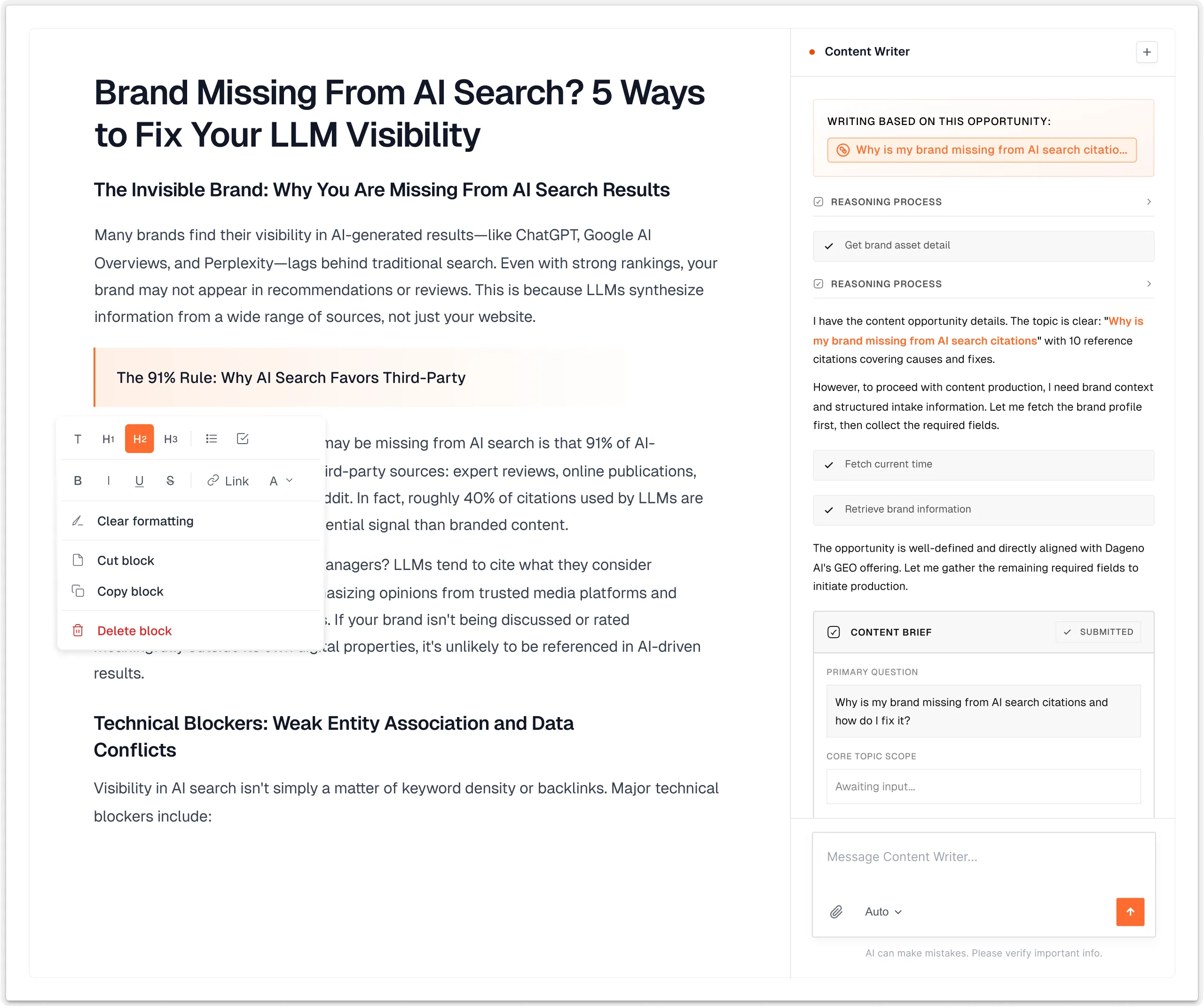
Dageno is a strong xFunnel alternative for teams that want prompt monitoring, competitor comparisons and citation intelligence connected to content action. It helps answer both “where are we missing?” and “which page or source should we improve?”
Core capabilities
Tracks brand presence across a controlled set of buyer questions.
Compares competitors at prompt and topic level.
Surfaces cited domains and pages rather than only an aggregate score.
Converts gaps into content opportunities and repeatable workflows.
Best fit and limitations
Dageno fits SaaS, agencies and in-house teams that need an accessible operating layer for GEO. It does not replace Search Console, analytics or a technical crawler. Buyers should validate required engines, countries, refresh frequency and export needs with their own prompt set.
2. Profound — best for enterprise AI visibility research
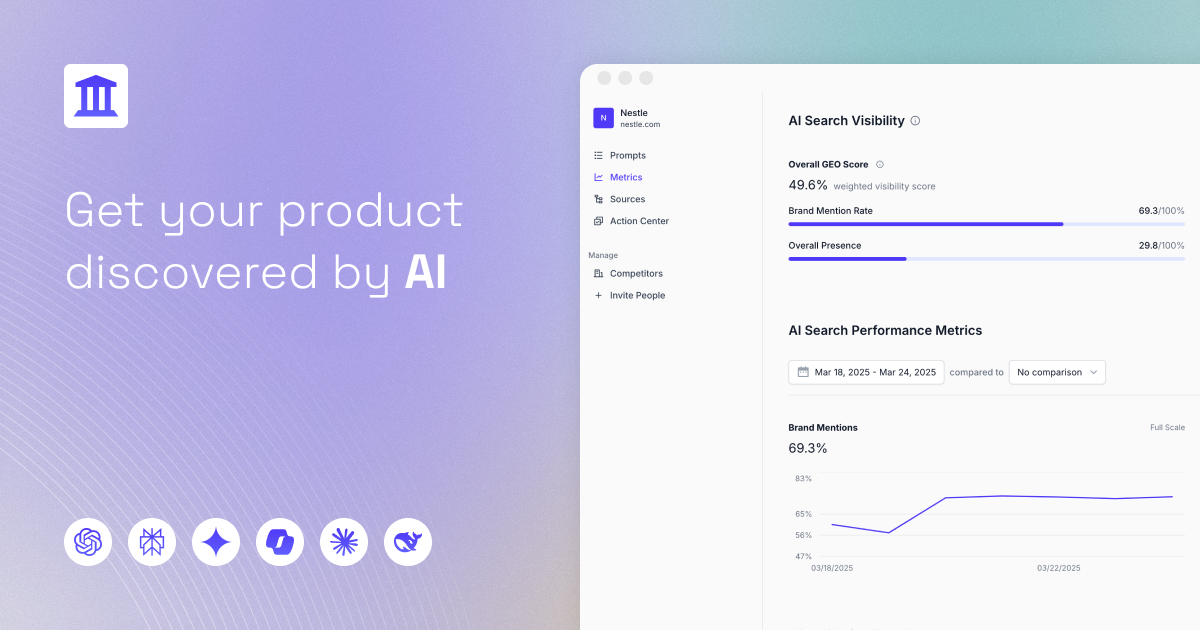
Profound is frequently shortlisted by enterprises building a formal AI visibility program. It emphasizes understanding how brands appear in answer engines and which topics and sources influence those answers.
Best fit and tradeoffs
It is most relevant when leadership needs broad competitive reporting and the program has dedicated analysts. Ask for prompt-level evidence, historical retention, country coverage, exports, service boundaries and a complete quote. Enterprise breadth may be unnecessary for a small team with a narrow question set.
3. AthenaHQ — best for a broad GEO workflow
AthenaHQ combines AI-search analysis with optimization-oriented capabilities, making it a logical comparison when xFunnel buyers want to reduce the distance between insight and action.
Best fit and tradeoffs
Evaluate it with real prompts and one completed content experiment. Confirm whether recommendations retain source evidence, whether teams can annotate deployments, and whether data can be exported. It fits a growing GEO program; a lightweight monitor may be easier for a single consultant.
4. Semrush — best for consolidating SEO and AI search
Semrush is attractive when keyword research, technical SEO, competitor analysis and reporting already happen in the same ecosystem.
Best fit and tradeoffs
Consolidation can reduce vendor and training overhead. The tradeoff is that AI-search depth, engines and usage limits may depend on the subscription. Compare the exact plan against xFunnel’s prompt research, response history, source analysis and experimentation—not the brand name of the suite.
5. Ahrefs Brand Radar — best for search intelligence
Ahrefs Brand Radar suits teams that investigate brand demand, competitors, content and links in Ahrefs and want AI visibility inside that research context.
Best fit and tradeoffs
It can be efficient for analysts already fluent in Ahrefs. Confirm platform, index, historical and geography coverage. If the bottleneck is turning a missing mention into an assigned brief and publishing workflow, add a dedicated execution layer.
6. Surfer — best for executing content improvements
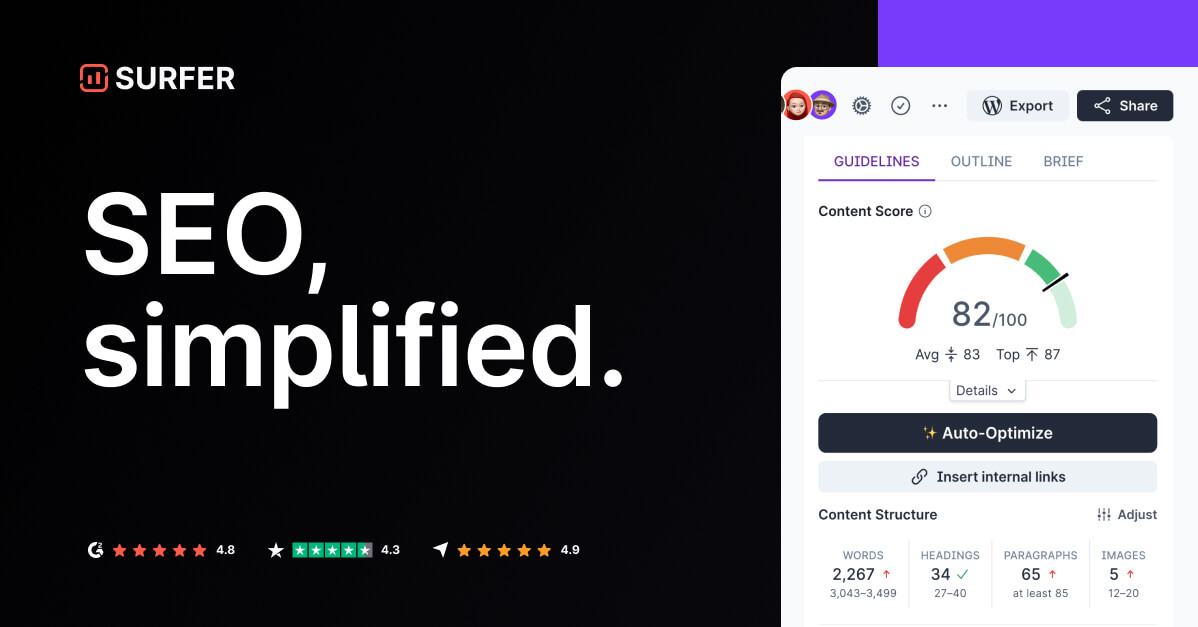
Surfer is not a direct replacement for xFunnel’s monitoring and source analysis. It is an alternative for the execution portion of the workflow: improving a page after another system identifies the opportunity.
Best fit and tradeoffs
Surfer is useful for briefs, page structure and competitive content review. It should be paired with an AI visibility monitor if the team needs to prove changes in answer-engine mentions and citations. Treat its content score as guidance, not an outcome metric.
Feature checklist for an xFunnel replacement
Prompt and audience design
Check whether the platform can group questions by persona, funnel stage, market and product. It should preserve exact prompt wording and support repeatable sampling.
Response and citation evidence
Require stored answer text, timestamps, model identity and source URLs. Aggregate visibility without evidence is difficult to audit or act on.
Experiment measurement
The tool should connect a deployed change to the affected prompts and pages. Because model output is variable, compare trends and control groups instead of treating one response as proof.
Integrations and ownership
List the systems that must receive data: GA4, Search Console, BI, CMS and project management. Verify API/export access and decide who owns prompts, annotations and reporting definitions.
A safe migration plan
Run both systems for two to four weeks using the same prompts, markets and competitors. Compare coverage and source capture, not raw scores—the vendors may calculate visibility differently. Export old history before cancellation, document the cutover date, and retain a control group of unchanged pages.
Dageno is closest for teams wanting monitoring, citation intelligence and content action together. Profound and AthenaHQ are strong enterprise-oriented comparisons, while Semrush and Ahrefs make sense for suite consolidation.
Can Surfer replace xFunnel?
Not completely. Surfer helps optimize content; xFunnel focuses more on question research, monitoring, source analysis and experiments. Pair an editor with a visibility tracker if you need both jobs.
How should xFunnel alternatives be tested?
Use the same 50–100 prompts, engines, markets and competitors for a month. Compare evidence quality, coverage, analyst time, exports and the ability to connect recommendations with measurable changes.
About the Author
Updated by
Tim
Tim is the co-founder of Dageno and a serial AI SaaS entrepreneur, focused on data-driven growth systems. He has led multiple AI SaaS products from early concept to production, with hands-on experience across product strategy, data pipelines, and AI-powered search optimization. At Dageno, Tim works on building practical GEO and AI visibility solutions that help brands understand how generative models retrieve, rank, and cite information across modern search and discovery platforms.