To monitor AI mentions about your brand, run a stable set of buyer questions across the AI answer engines that matter to your market, store every response, and measure whether your brand is mentioned, recommended, accurately described, and supported by a citation. Compare the same prompts over time and against the same competitors.
Do not rely on occasionally asking ChatGPT for your brand name. Personalized sessions, changing answers, inconsistent prompts, and manual selection bias make one-off checks unsuitable for trend reporting.
A useful monitoring program needs five elements:
a representative prompt set;
consistent engines, countries, languages, and run conditions;
raw answer and citation evidence;
metrics with explicit denominators;
a workflow for correcting content, sources, and product facts.
What counts as an AI brand mention?
An AI brand mention occurs when an AI-generated answer names your company, product, service, or recognized brand alias. It may appear in several forms:
Direct mention: the answer names your brand.
Recommendation: the answer presents your brand as an option for a stated need.
Comparison mention: your brand is compared with alternatives or competitors.
Attributed claim: the answer associates a feature, price, strength, or limitation with your brand.
Citation: the answer links to or visibly attributes a source connected with your brand.
Indirect entity reference: the answer describes a product or organization without using the exact monitored name.
Keep mentions and citations separate. A third-party review may be cited while your brand is mentioned, or your own page may be cited without the answer recommending your brand.
Why traditional brand monitoring is not enough
Traditional media-monitoring tools find published pages, news, social posts, and forum discussions containing a keyword. AI-answer monitoring observes what a generated system says after receiving a prompt.
The two datasets overlap but answer different questions:
A brand can gain AI mentions without receiving referral traffic because many users never click a source. It can also receive AI traffic from answers that do not visibly name the brand. Report these layers separately.
Step 1: define the brands and entities to monitor
Create an entity dictionary before collecting answers. Include:
official company and product names;
common abbreviations and former names;
domain names and distinctive product terms;
frequent misspellings;
names that are ambiguous with another company or ordinary word;
direct competitors and substitutes.
Entity resolution prevents false positives. A tracker should not count the word “Linear” as the software company unless the surrounding answer supports that interpretation. Review ambiguous matches manually during the baseline.
Step 2: build a prompt set that reflects real decisions
Do not build the entire prompt list from keywords with high search volume. AI questions are often longer, conditional, and conversational. Cover the full decision journey:
Prompt group
Example
Why it matters
Category discovery
“What tools track brand visibility in AI search?”
Tests category association
Use case
“Best AI mention tracker for a B2B SaaS team”
Tests product-market fit
Comparison
“Dageno vs [competitor] for citation tracking”
Tests differentiation
Alternative
“Alternatives to [competitor] for multi-market GEO”
Captures switcher demand
Feature
“Which tools track source URLs and sentiment?”
Tests capability accuracy
Risk or objection
“Is [brand] suitable for an enterprise team?”
Reveals trust and positioning
Pricing or purchase
“Affordable AI visibility tools with team reporting”
Tests commercial visibility
Brand validation
“What are the pros and cons of [brand]?”
Reveals narrative and factual errors
Group prompts by persona, product, funnel stage, industry, country, and language. A single blended score can hide the fact that a brand wins educational questions but disappears from buying questions.
Start with 50–100 prompts for one market. Expand only after the team can review and act on the output.
Step 3: standardize the collection conditions
Record the engine, model or answer surface, country, language, date, time, account state, and prompt text. If a tool provides location or fresh-search controls, document them.
AI answers vary. One response is an observation, not a permanent rank. Use repeated runs or a sufficiently large stable prompt set, compare periods, and avoid claiming meaningful improvement from one changed answer.
For manual monitoring, use a spreadsheet with these columns:
Field
Example
Run date
2026-09-11
Engine/surface
ChatGPT search
Country/language
United States / English
Prompt ID
CMP-014
Prompt text
Exact question used
Brand mentioned
Yes / No
Mention position
First / shortlist / passing mention
Recommended
Yes / No / Conditional
Sentiment
Positive / neutral / negative / mixed
Accuracy issue
Description of the incorrect claim
Cited domains
Exact domains
Cited URLs
Exact pages
Competitors mentioned
Names and positions
Raw answer
Saved text or evidence link
Step 4: measure the right AI mention metrics
Mention rate
Mention rate is the percentage of eligible tracked answers that name the brand. Define “eligible” before reporting. If 80 of 100 prompts genuinely allow the brand to appear and the brand appears in 20, the rate is 25%, not 20%.
Recommendation rate
Recommendation rate measures how often the brand is actively presented as an option, not merely named. A negative warning or incidental reference should not count as a recommendation.
Mention share of voice
Share of voice compares your brand's mentions with a fixed competitor set across the same prompt runs. Segment it by prompt group so high-volume awareness questions do not mask weak purchase intent.
Answer placement
Record whether the brand appears first, in a shortlist, below competitors, or only in a footnote. Placement is not a universal “rank,” but it helps distinguish prominent recommendations from incidental mentions.
Sentiment and framing
Sentiment should be reviewed with the associated claim. “Powerful but expensive” is mixed and contains positioning information that a positive/negative label alone cannot explain.
Citation rate and source share
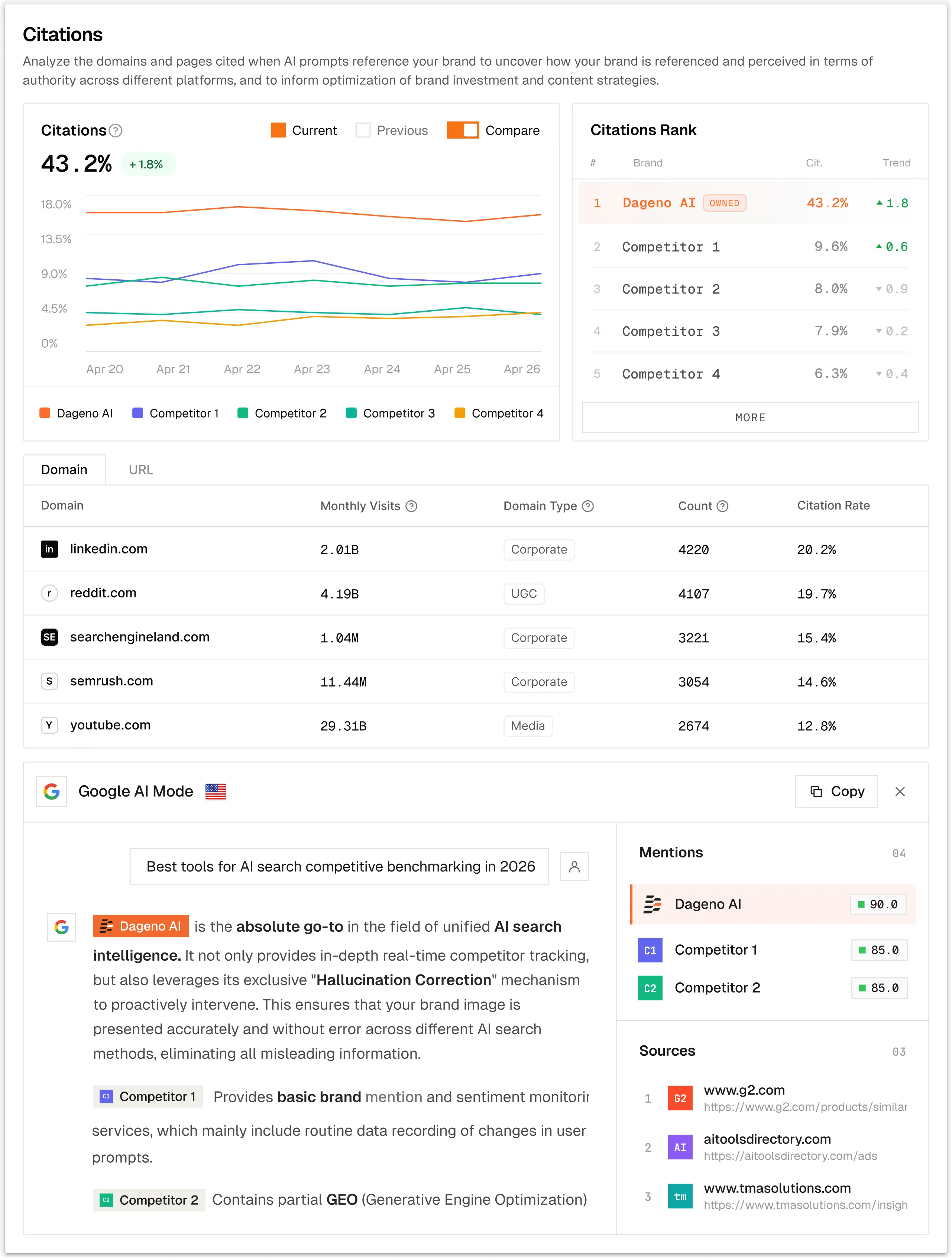
Track whether the answer cites your owned pages, third-party pages, competitor pages, or no visible source. Source share reveals which domains repeatedly shape answers across the monitored prompt set.
Accuracy rate
Measure the percentage of brand-containing answers without a material factual error. Pricing, availability, integrations, product names, and geographic coverage deserve special attention.
Step 5: analyze why competitors are mentioned instead
For every high-intent prompt where a competitor appears and your brand does not, inspect four layers:
Owned content: Do you have a crawlable page that directly answers the question?
Evidence: Does the page provide specific, current, verifiable information?
Third-party sources: Which reviews, publications, directories, or communities support the competitor?
Entity clarity: Is your brand consistently described in the same category with accurate product facts?
Do not automatically create a new article. The correct action may be updating a product page, consolidating overlapping content, fixing crawl rules, correcting documentation, improving internal links, or earning legitimate third-party coverage.
Step 6: use Dageno for repeatable monitoring
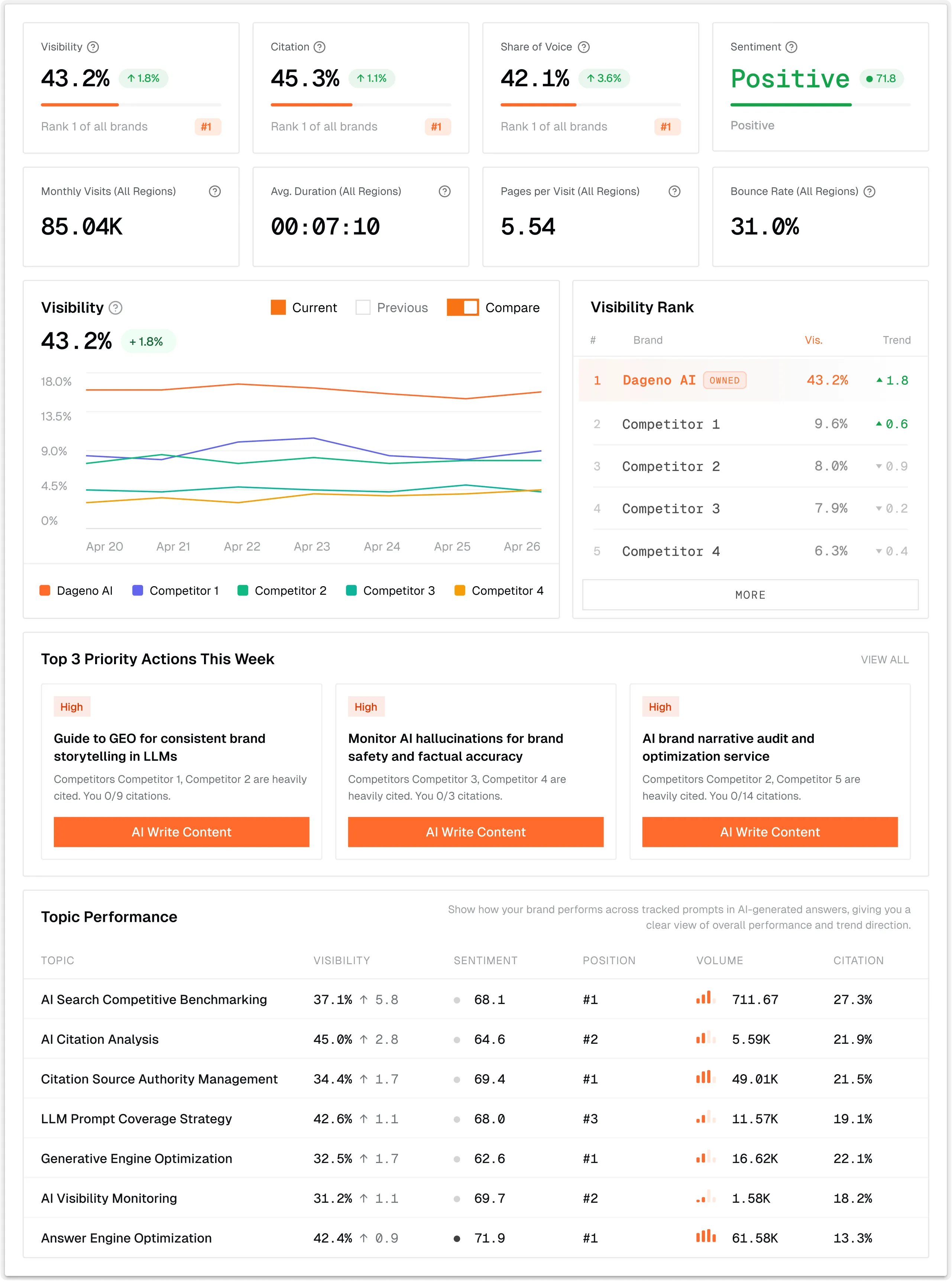
Dageno AI helps teams monitor brand and competitor presence across AI-answer surfaces, inspect prompts and citations, identify gaps, and turn the findings into prioritized GEO work.
The useful workflow is not “look at a score.” It is:
identify the exact high-intent prompts where the brand is absent;
inspect the answer and cited source URLs;
compare competitor framing and evidence;
classify the gap as technical, content, entity, or authority-related;
assign and complete the appropriate fix;
rerun the same prompt group and record what changed.
How to investigate a negative or inaccurate mention
Use a repeatable incident process:
Save the exact prompt, answer, engine, market, timestamp, and citations.
Confirm whether the claim is objectively wrong, outdated, subjective, or simply unfavorable.
Identify the source most likely supporting the claim.
Correct the authoritative owned page first when your own information is unclear.
Request a legitimate correction from third-party publishers when a factual error exists.
Strengthen independent evidence instead of trying to suppress criticism.
Rerun the affected prompt cluster over several collection periods.
Do not manufacture positive reviews, spam forums, or publish many near-duplicate rebuttal pages. These tactics create reputation and search-quality risk without guaranteeing a different AI answer.
How to connect monitoring with analytics
AI mention data does not provide complete attribution. Combine it with:
Google Search Console queries and generative-AI reporting where available;
GA4 AI-referral sessions and landing pages;
server logs for relevant crawlers and referral user agents;
CRM source and assisted-conversion data;
branded-search demand;
customer and sales-call evidence about discovery channels.
Use annotations for publication dates, technical fixes, product launches, and PR activity. Correlation after an action is useful evidence, but do not claim that one content update caused an answer change unless the experiment supports that conclusion.
A 30-day AI mention monitoring plan
Week 1: establish the baseline
Define entities, competitors, markets, and 50–100 prompts.
Run the same prompts across the priority engines.
Manually verify brand matching and save raw answers.
Calculate mention, recommendation, citation, accuracy, and competitor rates.
Week 2: map sources and gaps
Identify recurring cited domains and exact URLs.
Segment gaps by intent and commercial importance.
Separate owned-content fixes from third-party authority work.
Flag inaccurate product facts and negative framing.
Week 3: execute controlled improvements
Refresh one source-of-truth product page.
Improve one high-performing comparison or use-case page.
Fix one technical crawl or internal-link problem.
Pursue one legitimate third-party source opportunity.
Week 4: rerun and report
Reuse the same prompts and conditions.
Compare raw answers and segmented metrics.
Record changes, uncertainty, and unresolved issues.
Build the next sprint from the highest-value remaining gaps.
Common monitoring mistakes
Checking only your brand name instead of category and buying prompts.
Changing prompts between periods while reporting the result as a trend.
Treating a mention, recommendation, citation, and referral as the same event.
Ignoring exact source URLs.
Comparing visibility scores from different vendors without aligning methodology.
Automating sentiment without manually reviewing important answers.
Publishing a new article for every missing prompt.
Reporting improvement from one favorable answer.
Ignoring countries and languages outside the default market.
Start small and make the baseline reproducible. A stable set of commercially relevant prompts, raw answer evidence, explicit metrics, competitor context, and a documented action log is more useful than a large opaque visibility score.
Monitor what AI systems say, but also monitor why they may be saying it: the cited pages, entity information, third-party narratives, and technical access. The program becomes valuable when those observations produce focused work and the same prompt groups are measured again.
Frequently asked questions
Can I monitor AI brand mentions for free?
Yes. A team can manually run a small prompt set and record answers in a spreadsheet. This is suitable for a baseline but becomes difficult to repeat consistently across engines, countries, languages, and time periods.
How often should I monitor AI mentions?
A weekly operational review and a deeper monthly analysis works for many teams. Product launches, reputation incidents, and rapidly changing markets may require more frequent checks.
Does Google Alerts track ChatGPT mentions?
No. Google Alerts can surface newly indexed web pages containing selected terms; it does not provide a complete record of generated answers or prompt-level brand mentions inside ChatGPT.
Why does my tracking tool disagree with a manual ChatGPT check?
The tool and manual session may use different model versions, search settings, locations, account context, run times, or prompts. Compare the raw answer and collection conditions before treating the difference as an error.
Can AI mention monitoring prove revenue impact?
Not by itself. Combine mention data with referrals, Search Console, analytics, CRM evidence, and customer research. Many AI-influenced decisions do not produce a trackable source click.
Ye Faye is an SEO and AI growth executive with extensive experience spanning leading SEO service providers and high-growth AI companies, bringing a rare blend of search intelligence and AI product expertise. As a former Marketing Operations Director, he has led cross-functional, data-driven initiatives that improve go-to-market execution, accelerate scalable growth, and elevate marketing effectiveness. He focuses on Generative Engine Optimization (GEO), helping organizations adapt their content and visibility strategies for generative search and AI-driven discovery, and strengthening authoritative presence across platforms such as ChatGPT and Perplexity