How Agencies Can Boost Clients' AI Visibility: 7 Practical Strategies
Your client may rank well on Google and still be missing from ChatGPT, Gemini and Perplexity answers. This playbook shows agencies how to boost clients' AI visibility in seven steps—baseline, buyer-intent prompt map, brand entity, answer-worthy content, third-party validation, technical access and re-testing—with a deliverable and a check for each step.
Agencies boost a client's AI visibility by running a repeatable process: record which buyer questions, AI platforms and countries the client is missing from, close the gaps in content, brand facts, third-party sources and technical setup, then re-test under the same conditions. Being mentioned, recommended, cited and described correctly are four different results to track separately, and no agency can guarantee an AI ranking. Once you have several clients, Dageno can give prospects a free first diagnosis and monitor clients ongoing with no extra fee per platform or region.
Your client may rank well in Google and still be missing from the AI-generated answers their potential customers rely on. For agencies, the challenge is no longer just earning search rankings—it is helping clients become visible, accurately represented, and credibly referenced across AI-driven discovery.
The request usually starts the same way: a client asks ChatGPT, Gemini or Perplexity for the best tool in their category and sees three competitors named and their own brand absent, or listed with an outdated price, while their keyword report still looks healthy.
This guide turns that problem into seven strategies an agency can run as a service: set a baseline, map the prompts buyers actually ask, make the brand entity consistent, publish answer-worthy content, build third-party validation, fix technical accessibility, and re-test. Each step ends with a deliverable and a way to verify it.
Why Client AI Visibility Needs a Different Optimization Approach
AI visibility needs its own approach because an AI answer can name, compare and recommend brands in one response, and a strong search ranking does not guarantee your client is one of the names.
AI Answers Are Changing How Buyers Discover and Compare Brands
A buyer can get a shortlist from an AI answer before opening any vendor's website. The AI gathers information from many pages, compares the options and names a few brands. If the client is not on that list, the buyer may never see it.
Click data points the same way: when an AI summary appears, people click through to websites less often. A Pew Research Center analysis of 900 U.S. adults' browsing in March 2025 found that users clicked a traditional result in 8% of visits when a Google AI summary appeared, and in 15% without one. Links inside the summary were clicked in about 1% of visits. This is observational data: it shows the two happen together, not that the summary alone caused fewer clicks.
Traditional SEO Metrics Don't Fully Explain AI Visibility
A ranking tells you where a page appears. It does not tell you whether the AI answer names the client. So a healthy keyword report does not mean healthy AI visibility.
Rankings are still the foundation. Google's guide to AI features and your website says a page only needs to be indexed and eligible for a snippet to appear in AI Overviews or AI Mode. There are no extra requirements.
Mentions of the brand on other sites are worth watching too. Ahrefs studied 75,000 brands in May 2025: brands mentioned more often across the web also tended to appear more often in AI Overviews. The correlation was 0.664 (the closer to 1, the more closely two things move together); for backlinks it was 0.218. This shows the two move together. It does not show that more mentions make AI name a brand more often. Our article on why a brand ranks on Google but AI rarely mentions it explains this gap for clients.
What Agencies Need to Improve
The goal is three outcomes for the questions that matter to the client's business: the brand is discoverable (it appears in relevant answers), understood correctly (category, features, prices and markets are stated accurately), and supported by credible sources (the answer can point to the client's pages or trusted third parties). The seven steps below are organized around these three outcomes.
How Agencies Can Boost Clients' AI Visibility: A 7-Step Playbook
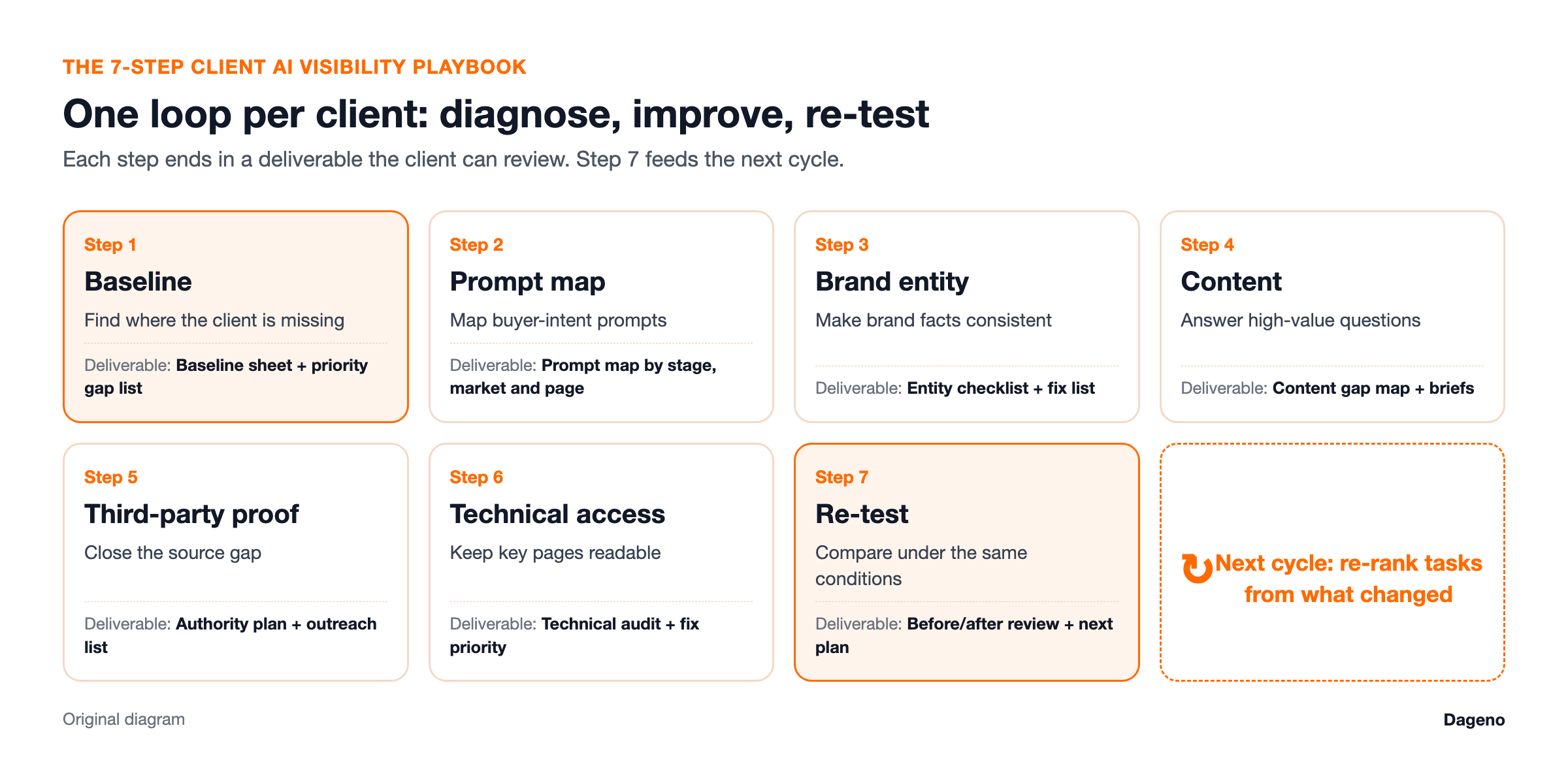
The playbook is one loop per client: diagnose (Steps 1–2), improve (Steps 3–6), and re-test (Step 7). Each step produces a deliverable the client can review, and the re-test decides what goes into the next cycle.
Figure 1. The seven steps and their deliverables. Original diagram.
Step 1 — Establish a Baseline and Identify Where the Client Is Missing
Start by agreeing on the scope, because a baseline is only useful if you can repeat it. Confirm with the client:
1–3 core products or services to measure first
the target audience and buying roles
the markets, written as country plus language (for example, "US · English" and "UK · English")
3–5 direct competitors the client actually loses deals to
the AI platforms that audience uses
What to do. Build a Baseline Sheet. Each prompt in it (a question you put to the AI, such as "what payroll software works for small teams?") goes into one of three buying stages:
Awareness: "how do I…"
Consideration: "best tools for…", "X vs Y"
Decision: "… pricing", "alternatives to…"
Run each prompt on each platform and market several times, not once, because the AI's list of brands can change from run to run. In SparkToro's January 2026 study, 600 volunteers ran 12 prompts 2,961 times on ChatGPT, Claude and Google's AI. The authors estimated less than a 1-in-100 chance that ChatGPT or Google's AI would repeat the same list of brands. So a single answer is a sample, not a ranking.
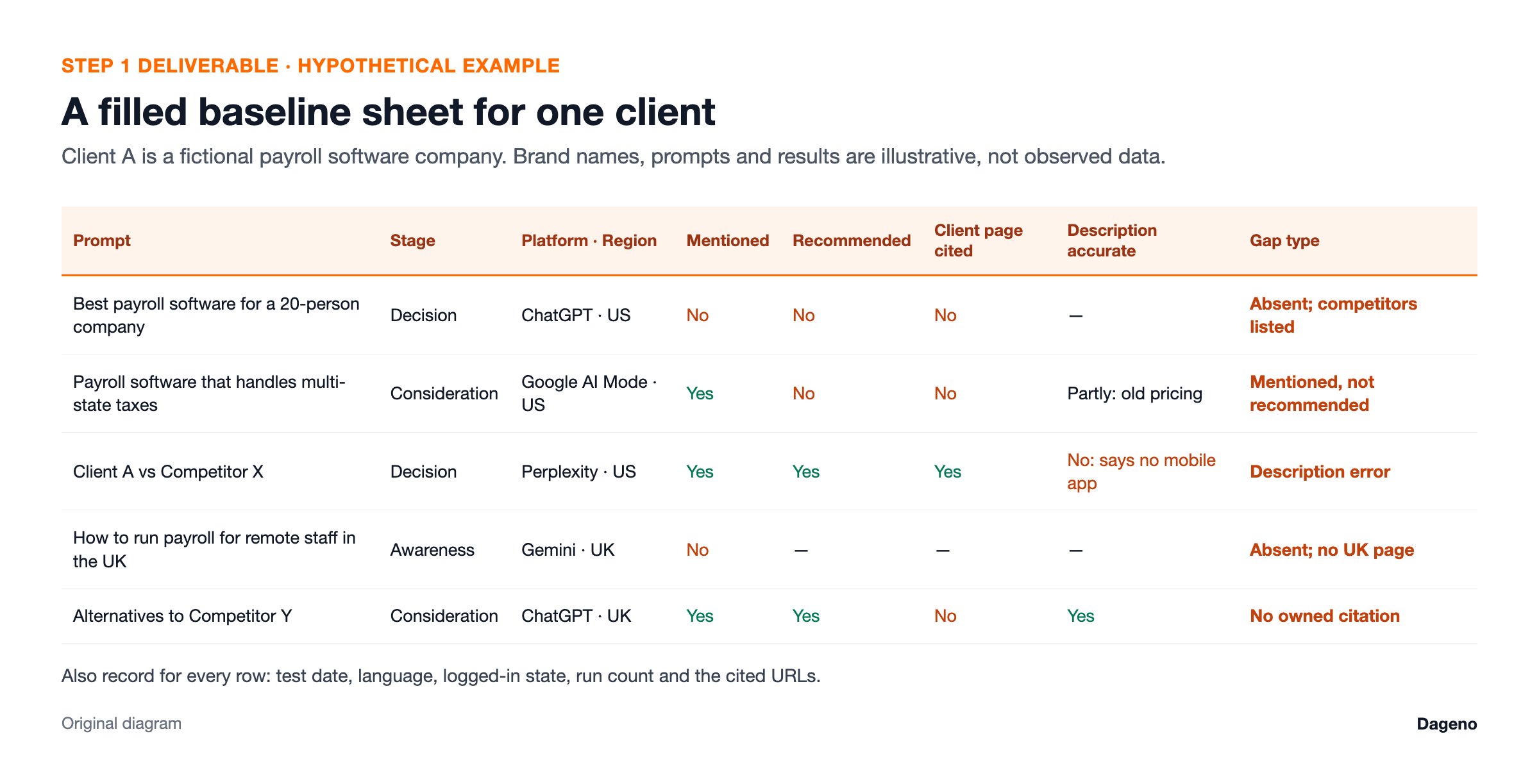
For every row, record the prompt, stage, platform, region, language, test date and run count. Then record four results:
Mentioned: the answer includes the client's name.
Recommended: the answer suggests the client as a choice.
Cited: the answer links to the client's website.
Accurate: the facts it states about the client, such as price or features, are correct.
Finally, give each gap a label: absent, competitor preferred, mentioned but not recommended, description error, or no credible citation. For example, "mentioned but not recommended" means the answer says "Client A is another option" but tells the buyer to pick someone else.
Figure 2. A filled baseline sheet. Client A and all results are hypothetical.
Why it helps. The gap label decides the fix. "Absent" usually points to content or third-party coverage, "description error" points to entity facts, and "no credible citation" points to source building.
Deliverable: Client AI Visibility Baseline + Priority Gap List.
How to verify: another team member re-runs any row with the recorded conditions and gets broadly the same result. The client has signed off on the scope.
Step 2 — Map Buyer-intent Prompts That Matter to the Client's Business
A buyer-intent prompt is a question a real buyer asks while choosing a product, such as "payroll software that handles multi-state taxes for a 20-person company." Do not fill the tracking list with popular prompts that no buyer of this client would ask. Build the list from evidence the client already has:
Sales and support: interview two or three salespeople and ask which questions come up before a deal is signed and which objections lose deals.
Search Console: filter for long, question-style queries; they show how buyers phrase problems.
Site search, reviews and communities: collect the exact wording buyers use for features, prices and comparisons.
Sales objections: turn each one into a prompt ("is [Client] too expensive for small teams?").
Cluster the prompts by job: problem research, solution comparison, alternatives, pricing, industry use cases, local needs and final purchase decision. Then annotate each prompt with four fields: buying stage, business value (high, medium, low), target market, and the page that should answer it. A filled row might read: "payroll software with multi-state tax filing" · Consideration · High · US · /features/multi-state-tax.
Why it helps. The map stops the agency from optimizing for prompts that look good in a report but never lead to a deal. It also exposes prompts with no answering page, which become Step 4's backlog.
Deliverable: Buyer-intent Prompt Map with prompt, intent stage, platform/region and target product or service page.
How to verify: the client's sales team recognizes the prompts as real questions, and every high-value prompt has either a target page or a "page needed" flag.
Step 3 — Make the Brand Entity Clear and Consistent Across the Web
The brand entity is the set of basic facts about the client across the web: who it is, what it sells, who it serves, where it operates and how it differs. For example: "Client A is payroll software for companies with 5–200 employees, available only in the US." If the website lists one price and a directory lists another, AI answers can get it wrong or repeat the old one.
What to do. Write a one-page Brand Entity Fact Sheet. It covers:
official brand and product names, plus common variants
category, core features, target customers, regions and pricing model
the experts who speak for the company
two or three differentiators with proof
Then compare every key profile against it: About, product and author pages, LinkedIn, review platforms, directories and partner listings.
Also check the structured data. Structured data is code on a page written for search engines, such as Organization markup that states the company name and logo. It must match what visitors can see on the page; Google's structured data guidelines prohibit marking up content that is not visible to readers. For a deeper checklist, see our guide to managing brand entity data for AI models.
Why it helps. The "description error" rows from Step 1 usually trace back to one stale source, such as an old directory listing with a previous price or a discontinued product.
Deliverable: Brand Entity Consistency Checklist + a revision task list with an owner for each profile.
How to verify: every profile on the checklist states the same category, product names and core facts, and the re-test in Step 7 shows fewer description errors.
Content work turns the Prompt Map into pages. For each high-value prompt, check whether a client page answers it directly, completely and credibly. You will find three cases: the page exists and answers well (keep it), the page exists but is weak (upgrade it), or no page exists (create one).
What to do. Build a Prompt-to-Page Map, then focus on the page types that buyer questions land on: product pages, comparison pages, solution and industry pages, case studies and expert content. To upgrade a weak page, add:
a direct answer to the mapped question in the first two sentences
clear definitions for terms the buyer may not know
steps, comparison tables or specifications where the question needs them
real case results with the customer's permission
author credentials, data sources and a visible update date
who the product is for, who it is not for, its limits and implementation conditions
Research suggests that adding sources, quotations and statistics helps a page show up more often in AI-generated answers. In the Princeton-led GEO paper (KDD 2024), these methods raised a page's visibility in answers by up to 40% in a test setup the authors built themselves. That is a lab result. It does not guarantee the same effect for any client page.
A practical example: a comparison page that opens with "We are the leading payroll platform" gives an AI answer nothing to quote. An opening that reads "〔Client〕 runs payroll for companies with 5–200 employees in 〔number〕 US states and files multi-state taxes automatically; it does not support 〔limit〕" gives it a checkable fact. Fill the bracketed fields from the client's own product data.
Deliverable: Content Gap Map + content briefs + updated pages.
How to verify: each updated page answers its mapped prompt within the first 100 words, every claim has been fact-checked by the client, and the page is included in the Step 7 re-test.
Step 5 — Strengthen Third-party Validation Through Digital PR, Reviews, and Expert Sources
AI answers learn about a brand from more than its website. Industry media, review platforms, forums, video and comparison sites often appear among the cited sources. If competitors appear there and your client does not, owned content alone will not close the gap.
What to do. Run a Citation Source Gap Analysis on the baseline answers: list cited domains, classify them (editorial, review, community, video, directory, competitor), and mark where competitors are covered and the client is not. Then act by source type:
Digital PR: pitch angles built on the client's original data, not product announcements.
Reviews: invite real customers to leave specific reviews that mention use case and results, following each platform's review policy.
Expert sources: put the client's specialists into industry discussions, podcasts and contributed articles.
Corrections: ask publishers to fix inaccurate third-party descriptions found in Step 3.
Deliverable: Third-party Authority Plan + PR/Review Outreach List with target domain, angle, owner and status.
How to verify: placements and corrections are live and logged with dates, and the re-test shows whether those domains now cite or mention the client.
Step 6 — Improve Technical Accessibility and Content Structure
Technical work makes sure the pages from Steps 3 and 4 can actually be read. A page that cannot be read will not reach an AI answer, however good it is. Three common causes: the site blocks the relevant crawler; key facts appear only in images; or the canonical points to another URL. A canonical is a tag that tells search engines which URL is the official version, for example a campaign page pointing back to the main product page.
What to do. Audit the priority pages:
robots.txt: allow search crawlers. For ChatGPT search, OpenAI's crawler documentation recommends allowing OAI-SearchBot; GPTBot is a separate crawler for model training.
Rendering: key facts, prices and specifications appear as HTML text, not only in images, PDFs or click-to-load tabs.
Indexing, canonicals and status codes: priority pages are indexed and canonical to themselves. They have no redirect chains (A redirects to B, which redirects to C), no soft 404s (a page that says "not found" but tells search engines everything is fine) and no near-duplicate pages.
Internal links, structured data and mobile: priority pages are linked with descriptive anchors, markup matches visible content, and pages work on mobile.
How to verify: URL inspection and a text-only fetch show the key facts, and server logs show crawler access to priority pages. Crawler access does not by itself mean the page will be cited.
Step 7 — Re-test, Compare, and Turn Findings Into the Next Optimization Cycle
The re-test shows whether the work changed anything, and it only works if conditions match the baseline: same prompts, platforms, regions, languages and run counts.
What to do. Re-run the baseline on a fixed schedule, for example a full re-test each month and more frequent checks on the highest-value prompts. Compare mention, recommendation, citation and accuracy rates and competitor changes against the baseline, one by one.
Keep a change log with the date of every page update, PR placement and technical fix. When a number moves, you can then see what work came before it. But one thing happening before another does not mean it caused it. After the review, re-rank the next cycle's entity, content, PR and technical tasks.
How to verify: the review uses the same conditions as the baseline. It states which work and which changes happened at the same time, and does not claim that one action caused one result.
How to Measure Whether Your AI Visibility Work Is Improving Results
Measurement is the feedback loop for the seven steps. Its job is to show which gaps closed and which did not.
Track Mentions, Recommendations, Citations, and Brand Accuracy Separately
Use four separate rates over the same set of answers:
Mention rate: answers that name the client ÷ all answers in scope.
Recommendation rate: answers that explicitly recommend or shortlist the client ÷ all answers.
Citation rate: answers that cite a client-owned URL ÷ all answers; track third-party pages about the client as earned citations.
Accuracy rate: mentions with no factual error against the Fact Sheet ÷ all mentions.
Report the four rates separately. In the same month, a client's mention rate can rise while its recommendation rate falls; a single blended score would hide that. For a fuller KPI framework, see our article on AI visibility tracking metrics.
Keep Prompts and Test Conditions Consistent
If the conditions change, the numbers cannot be compared. So for each reporting period, keep these fixed: the prompt set, platforms, regions, languages, logged-in state and run count. If you add prompts, report them as a new group instead of mixing them into the old rates.
Connect Visibility Trends to Business Outcomes Carefully
Higher visibility does not automatically mean more sales, so report the two separately. Where data allows, show these next to the visibility trend:
Assisted conversions, such as a user who first arrives from an AI answer and buys days later through another channel.
Changes in branded search volume.
Without a controlled test, write "moved together", not "caused".
How Agencies Can Scale Client AI Visibility Monitoring and Optimization
Once an agency has several clients, running prompts, taking screenshots and filling sheets by hand stops keeping up. Five clients with 20 prompts, 3 platforms and 2 regions each already means 600 answers per cycle. At that point you need a tool that collects the answers, compares competitors and finds gaps the same way every time.
Dageno is a GEO/AEO platform for brand, SEO, growth and content teams. For agencies, it is most useful in three ways: a free first diagnosis for a prospect before they sign; ongoing monitoring by platform and by country with no extra platform or region fees after they sign; and every finding traceable to the original answers and cited sources.
Pre-sales: Diagnose a Prospect With No Setup
This is the Step 1 baseline, and you can do it before the client signs. In Brand Explorer, enter the prospect's brand or domain and pick a target market to see how it shows up in AI answers. You do not write prompts, wait for a new collection cycle or buy a plan first. Dageno's page states that public market lookup is free forever, the data covers 12,000+ niche markets and 3,000,000+ brands, and results take about 5 seconds. If a prospect only gives you a URL, the free SEO and GEO/AEO report takes a domain and a target market and generates a visibility report for that region.
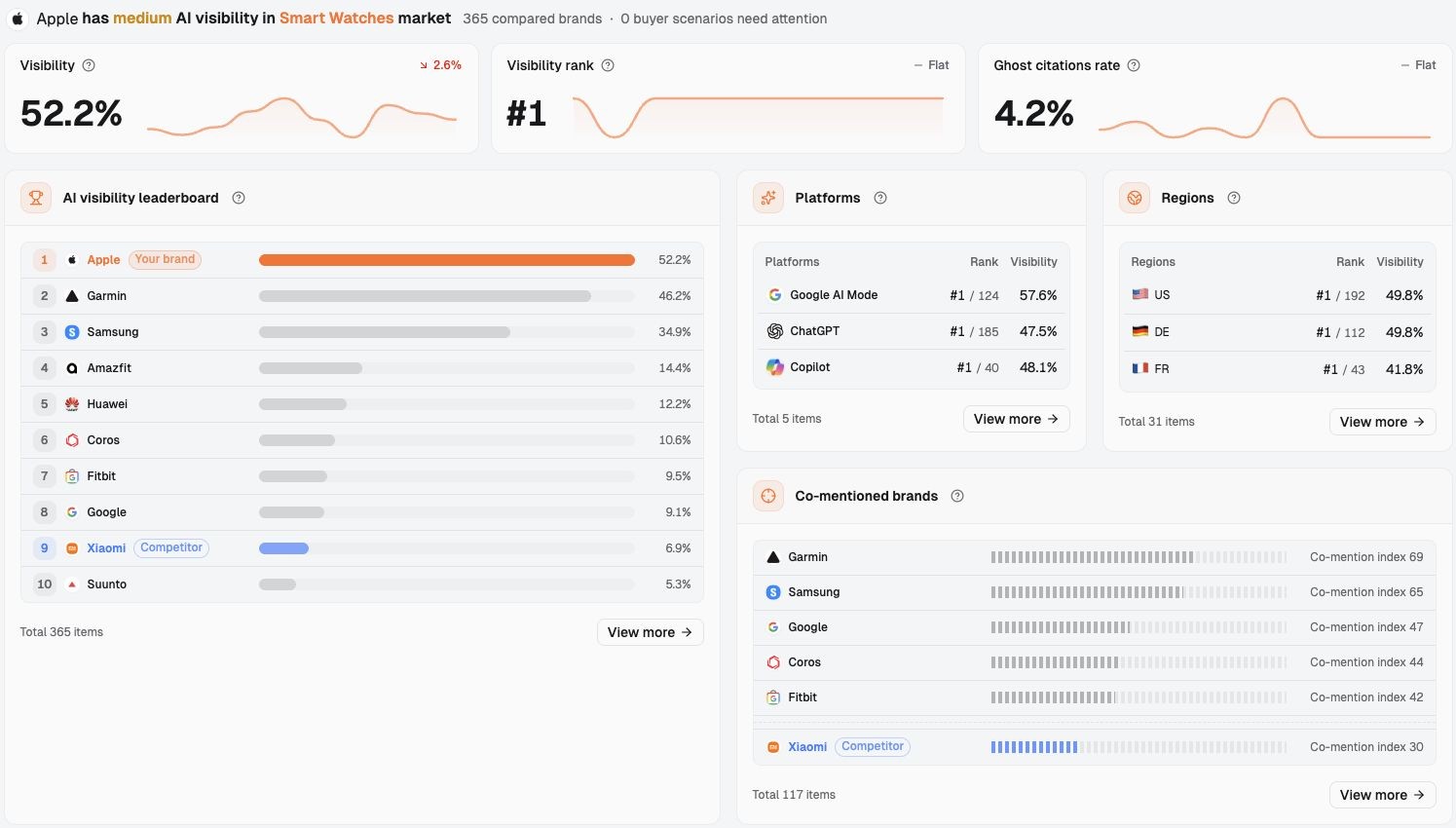
Figure 3. Brand overview. One page shows the brand's visibility and rank, its rank on each platform and in each region, and the brands AI most often names alongside it (co-mentioned brands). Example market: Apple · Smart Watches; cropped to the main panel.
This is useful in a proposal: you can show a prospect who AI actually compares them with, and the co-mentioned brands often include rivals the prospect never listed. The limits: the 5-second result only covers brands and markets already in Dageno's data, and a first diagnosis is a starting point, not a replacement for a scoped audit.
Check a prospect's AI visibility for free before you pitch
Monitor Client Visibility Across Multiple AI Platforms and Markets
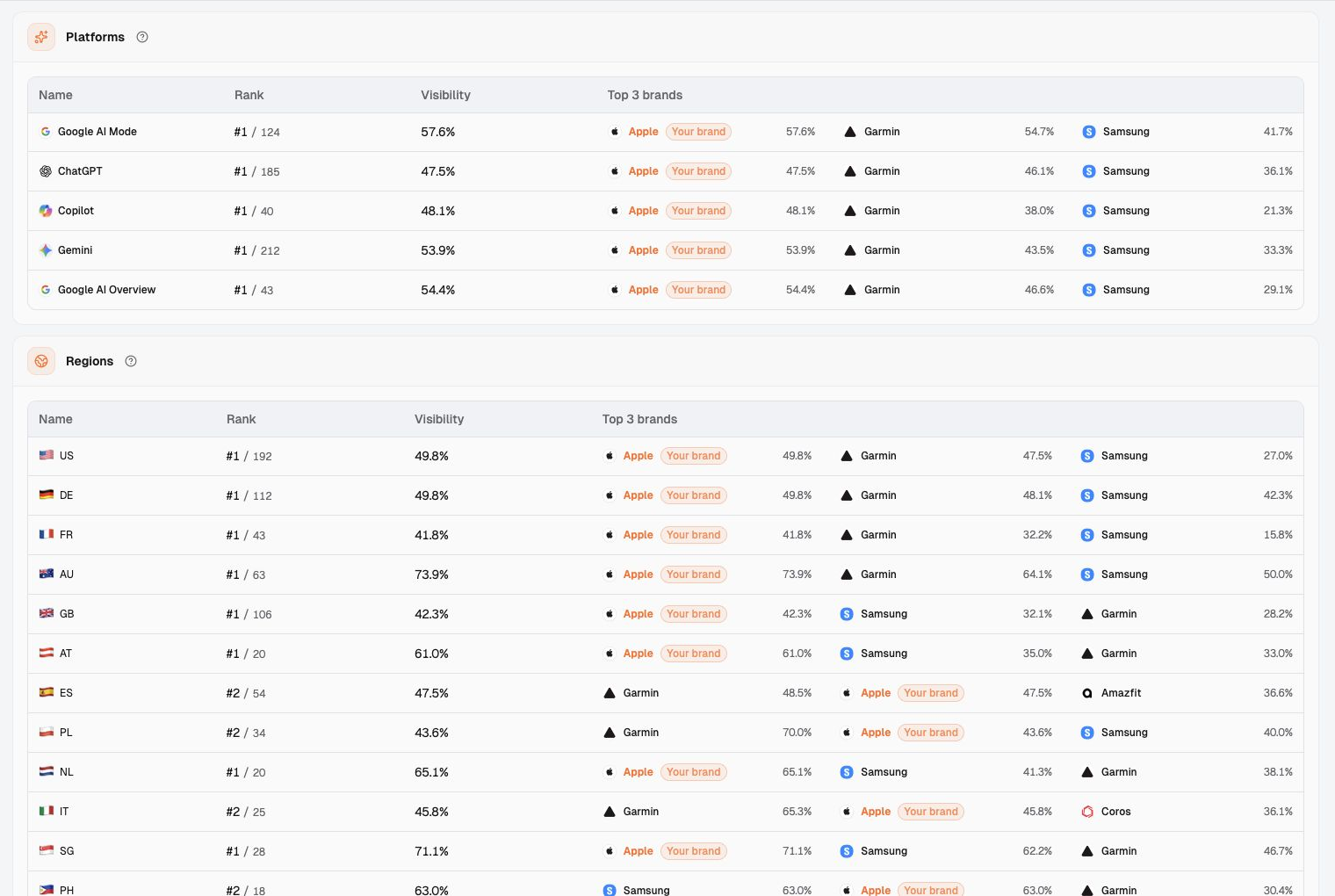
This supports Steps 1 and 7. Open Market overview → Platforms & regions. Each row is one platform or one country and shows the rank (such as "#1 / 124", first among 124 brands compared), the visibility (how much the brand appears in this set of AI answers, not market share) and the top three brands in that row.
Figure 4. Platforms & regions view. Example market: Apple · Smart Watches; captured September 8, 2026; cropped to the main panel.
The view shows that Apple ranks #1 on all five platforms but is #2 behind Garmin in Spain, Poland and Italy; in Poland, Garmin has 70.0% and Apple 43.6%. A US-only or single-platform check would have missed this gap. The number of answers differs by country, so open the answers before treating a gap as real. See also why brands need visibility tracking across multiple AI platforms.
Multi-market clients cost nothing extra. As of November 4, 2026, the pricing page lists 9 standard AI platforms (ChatGPT, Grok, Gemini, Perplexity, Google AI Mode, Google AI Overview, Copilot, Brave and Dola), all 86+ countries and regions are available from the Starter plan, and Amazon Alexa is a custom integration. Usage still counts against the plan: in AI Visibility Tracking, the same prompt on different platforms or in different regions counts separately toward the prompt limit.
Turn AI Visibility Data Into Actionable Optimization Insights
Each module maps to a playbook step and shows where to look. None of them edits pages, runs PR or fixes code.
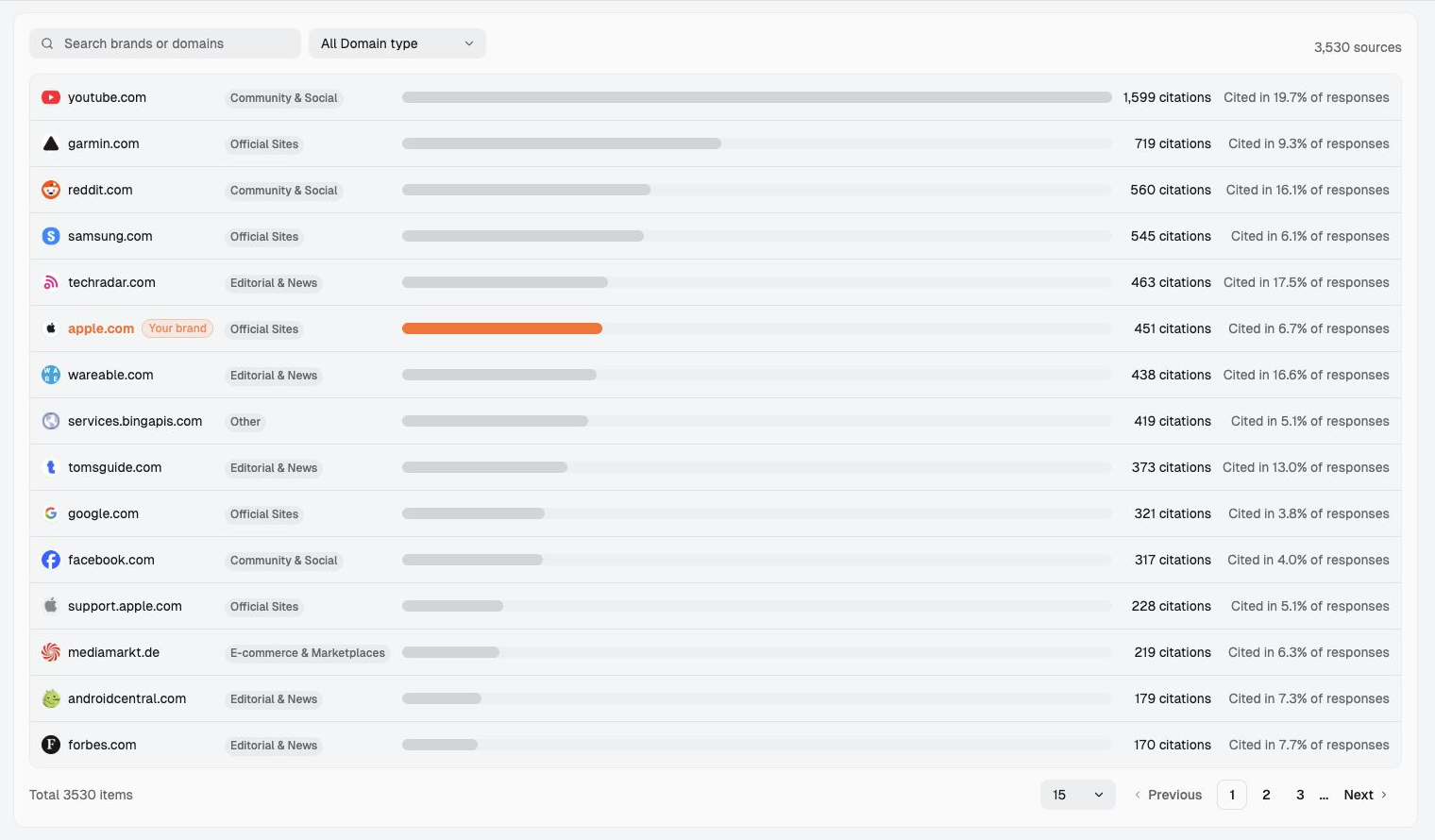
Citation sources (Step 5). In Citation analysis → Cited source leaderboard, each domain has two numbers: citations (how many times a link to it was attached) and response share (the share of answers that linked to it at least once). The top third-party domains can go straight into the Step 5 outreach list.
Figure 5. Cited source leaderboard. Example market: Apple · Smart Watches; captured September 8, 2026; cropped to the main panel.
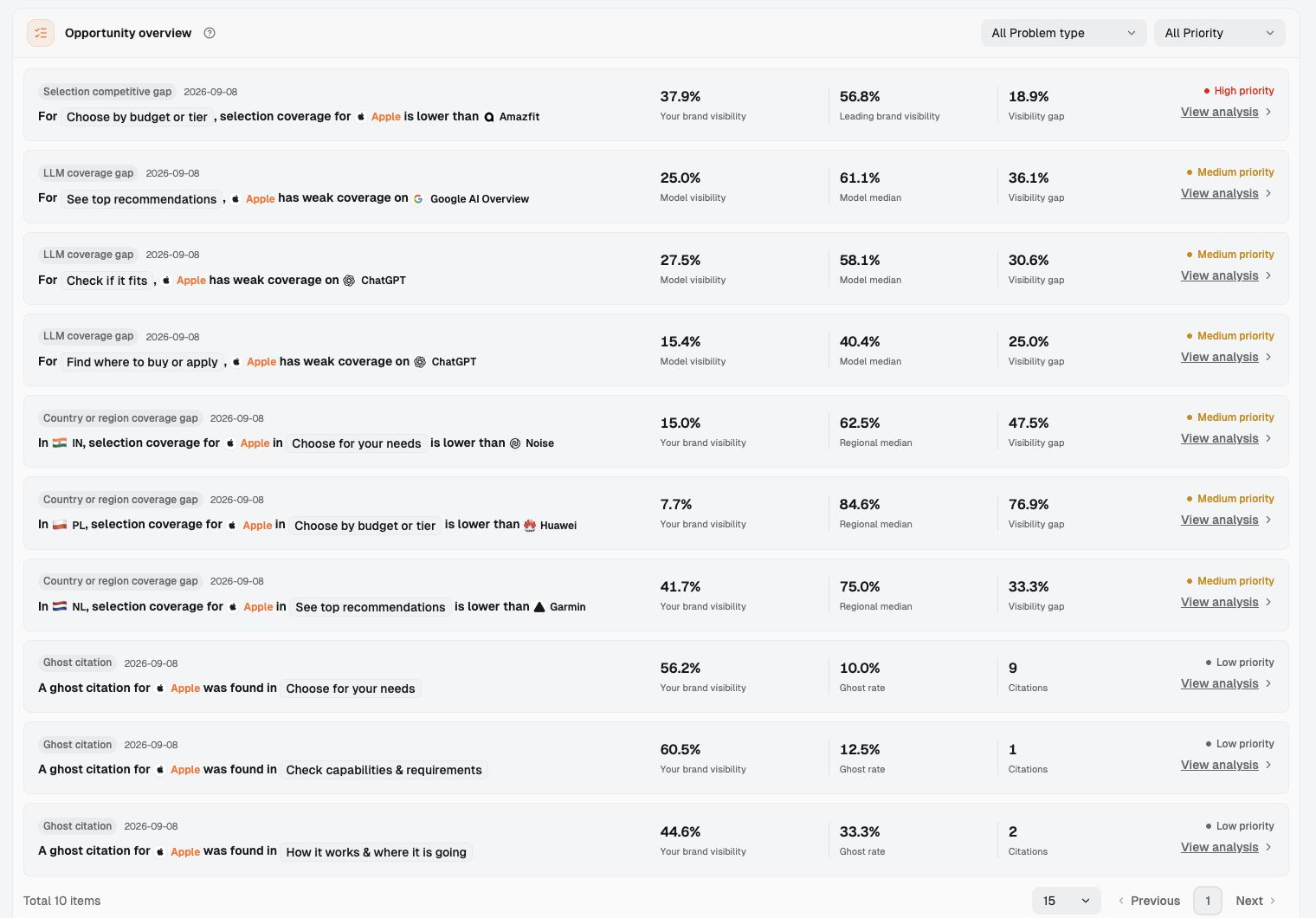
Issues and opportunities (Steps 1 and 4). Each card in Issues & opportunities is one gap. It names the gap type, the brand's value, a comparison value and a priority. The high-priority card is "Choose by budget or tier": Apple has 37.9% visibility, Amazfit 56.8%, an 18.9-point gap, so budget prompts need target pages.
Figure 6. Issues & opportunities list. Example market: Apple · Smart Watches; cards dated September 8, 2026.
Manage Multiple Client Accounts Without Unnecessary Tool Costs
What to compare is the real cost of doing the same job with each tool, not who has the lowest list price. First, work out the workload. Under the pricing page's counting rule, one client with 20 prompts, 3 platforms and 2 regions uses 120 prompt slots (20 × 3 × 2). Dageno's listed monthly prices:
Plan
Price (USD/month)
Projects
Custom monitoring prompts
Clients this workload fits
Starter
$49
1
50
For single-brand research; too small for this workload
Growth
$199
2
250
1–2 clients (240 slots)
Scale
$410
5
600
5 clients (600 slots)
Scale also includes unified comparison across brands and clients, plus API, batch configuration and exports.
Growth adds priority change alerts, recurring reports and MCP data access; Scale adds monthly market reports. Dageno's partner program also gives service providers product, data, research methodology, pre-sales and delivery support, including client demos and sales materials; agency, reseller, white-label and affiliate paths are available, with scope confirmed in each agreement.
Common Mistakes Agencies Should Avoid When Improving AI Visibility
Relying on one prompt or one model answer. Answers vary between runs, so one screenshot cannot show a trend.
Treating mentions, recommendations and citations as the same metric. A brand can be mentioned and still be ranked last or described wrongly.
Publishing generic content without mapping buyer questions. Pages that answer no real buyer question rarely move a buyer-intent prompt.
Focusing only on the client's website. If answers cite reviews, media and communities, the gap is off-site.
Assuming structured data or one technical setting guarantees inclusion. Google states that no special schema is needed for its AI features, and no setting guarantees inclusion.
Promising a specific AI ranking, citation or recommendation. Promise a process, deliverables and an honest before/after review instead.
Conclusion — Make AI Visibility Optimization a Repeatable Client Service
Boosting a client's AI visibility means running seven steps again and again: set a baseline, map buying questions, make brand facts consistent, write content that answers buyer questions directly, earn third-party coverage, fix technical problems, and re-test. Each step hands the client something they can check. That makes the service easier to sell, staff and renew. A data platform can speed up monitoring across many clients and markets, but whether visibility improves still depends on the agency's strategy and execution.
From pre-sales diagnosis to ongoing delivery, one data set for every client
How can agencies improve a client's visibility in ChatGPT?
Start with a baseline of buyer-intent prompts run several times in ChatGPT for the client's markets, and record mentions, recommendations, citations and accuracy. Then fix the gaps that baseline shows: inconsistent brand facts, missing answer pages, weak third-party coverage, or technical blocks such as robots.txt rules that block OAI-SearchBot. Re-test with the same prompts and conditions.
What content helps brands appear in AI-generated answers?
Pages that answer a specific buyer question directly and with checkable facts: product and comparison pages, solution and industry pages, case studies and expert content. Put the answer in the first sentences, then add definitions, specifications, sources, author credentials, an update date and the product's limits.
How often should agencies monitor client AI visibility?
Keep a fixed cadence that matches the client's pace of change. A common setup is a full re-test monthly, more frequent checks on the highest-value prompts, and an extra check after major launches or site changes. Keep the cadence constant within a reporting period so results stay comparable.
Which AI platforms should agencies track for their clients?
Track the platforms the client's buyers use in each target market, not every platform by default. ChatGPT, Google AI Overviews and AI Mode, Gemini and Perplexity are common starting points; Copilot, Grok or regional platforms may matter for specific audiences. Check with the client's sales team and analytics, then confirm platform by platform in the baseline.
How do agencies measure AI visibility improvements?
Compare four separate rates—mention, recommendation, citation and accuracy—against the baseline under the same prompts, platforms, regions, languages and run counts. Add AI referral sessions and assisted conversions where analytics allow, and describe them as related movements unless you have a controlled test.
Can an AI visibility tool improve a brand's visibility automatically?
No. A tool can collect answers, show gaps, track sources and keep evidence for re-tests. The improvement comes from the work it points to: correcting brand facts, publishing better pages, earning third-party coverage and fixing technical issues. Treat any promise of automatic AI rankings with caution.
Dageno is the research and insights team at Dageno AI, publishing industry reports and expert analysis on AI Search Visibility, Generative Engine Optimization (GEO), and AI-powered search discovery.
 Alexa for Shopping