Why Brands Need Visibility Tracking Across Multiple AI Platforms
Brands need visibility tracking across multiple AI platforms because ChatGPT, Gemini, Perplexity, Google AI Overviews, Claude, Copilot, and Grok can produce different answers and citations.
TL;DR
- Brands need visibility tracking across multiple AI platforms because ChatGPT, Gemini, Perplexity, Google AI Overviews, Claude, Copilot, and Grok can produce different answers and citations.
- A brand may be visible in one AI engine but missing or misrepresented in another.
- Multi-platform visibility tracking reveals prompt gaps, source gaps, competitor dominance, sentiment risks, and platform-specific opportunities.
- Dageno AI helps brands monitor multiple AI platforms and convert the data into GEO strategy, content, and attribution.
Why Brands Need Visibility Tracking Across Multiple AI Platforms
Brands need visibility tracking across multiple AI platforms because users no longer rely on one search interface, and each AI platform can mention, cite, compare, or recommend brands differently.
A buyer might ask ChatGPT for vendor recommendations, use Gemini inside Google’s ecosystem, check Perplexity for cited research, and rely on Copilot or Claude at work. If a brand only measures one platform, it may miss major discovery gaps.
Multi-platform tracking answers:
- Where is the brand visible?
- Where is the brand missing?
- Which AI systems cite the brand’s website?
- Which competitors win platform-specific visibility?
- Which sources shape the answers?
- Which platform has negative or inaccurate brand framing?
Different AI Platforms Produce Different Visibility Patterns
Different AI platforms can produce different visibility patterns because they use different interfaces, retrieval systems, citation behaviors, and user contexts.
| Platform | Why Tracking Matters |
|---|---|
| ChatGPT | Conversational answers, recommendations, and source links can shape purchase decisions |
| Gemini | Google ecosystem visibility can overlap with AI Overviews, AI Mode, and Search |
| Perplexity | Citation-heavy answers reveal which sources AI trusts |
| Google AI Overviews | AI-generated answers can surface links differently from classic SERPs |
| Claude | Buyers may use it for research, analysis, and vendor shortlisting |
| Copilot | Microsoft ecosystem users may encounter AI recommendations inside workplace flows |
| Grok | Some audiences use it for real-time and social-adjacent discovery |
Research on generative search measurement has argued that AI answer engines can produce variable citation outcomes and should be measured through repeated sampling rather than single-run screenshots.
What Multi-Platform Tracking Should Measure
A multi-platform AI visibility dashboard should measure mentions, citations, answer position, sentiment, share of voice, prompt coverage, competitor overlap, and source gaps by platform.
| Metric | Why It Matters Across Platforms |
|---|---|
| Mention rate | Shows where the brand appears or disappears |
| Citation rate | Shows which platforms trust owned sources |
| Answer position | Shows prominence within AI responses |
| Sentiment | Shows platform-specific brand narrative |
| Share of voice | Compares brand presence against competitors |
| Source gaps | Reveals which sources each platform trusts |
| Prompt coverage | Shows which buyer questions work by platform |
| Attribution | Proves whether actions improved visibility over time |
A brand that is strong in ChatGPT but weak in Gemini may need Google-facing technical and content improvements. A brand that appears in Perplexity but is cited through third-party sites may need stronger owned-source authority.
Why Single-Platform Tracking Creates Blind Spots
Single-platform tracking creates blind spots because it treats one AI system as representative of all AI discovery.
Common blind spots include:
- ChatGPT mentions the brand, but Gemini does not.
- Perplexity cites competitors instead of the brand.
- Google AI Overviews surface third-party sources that shape the category.
- Claude summarizes outdated brand information.
- Copilot recommends different vendors due to workplace context.
- Brand sentiment differs across engines.
Multi-platform visibility tracking gives teams a more reliable view of AI discovery risk.
How Dageno AI Supports This multi-platform AI visibility tracking Workflow
Dageno AI supports this multi-platform ai visibility tracking workflow by connecting monitoring, prompt analysis, citation analysis, competitor benchmarking, content generation, and attribution in one GEO system.
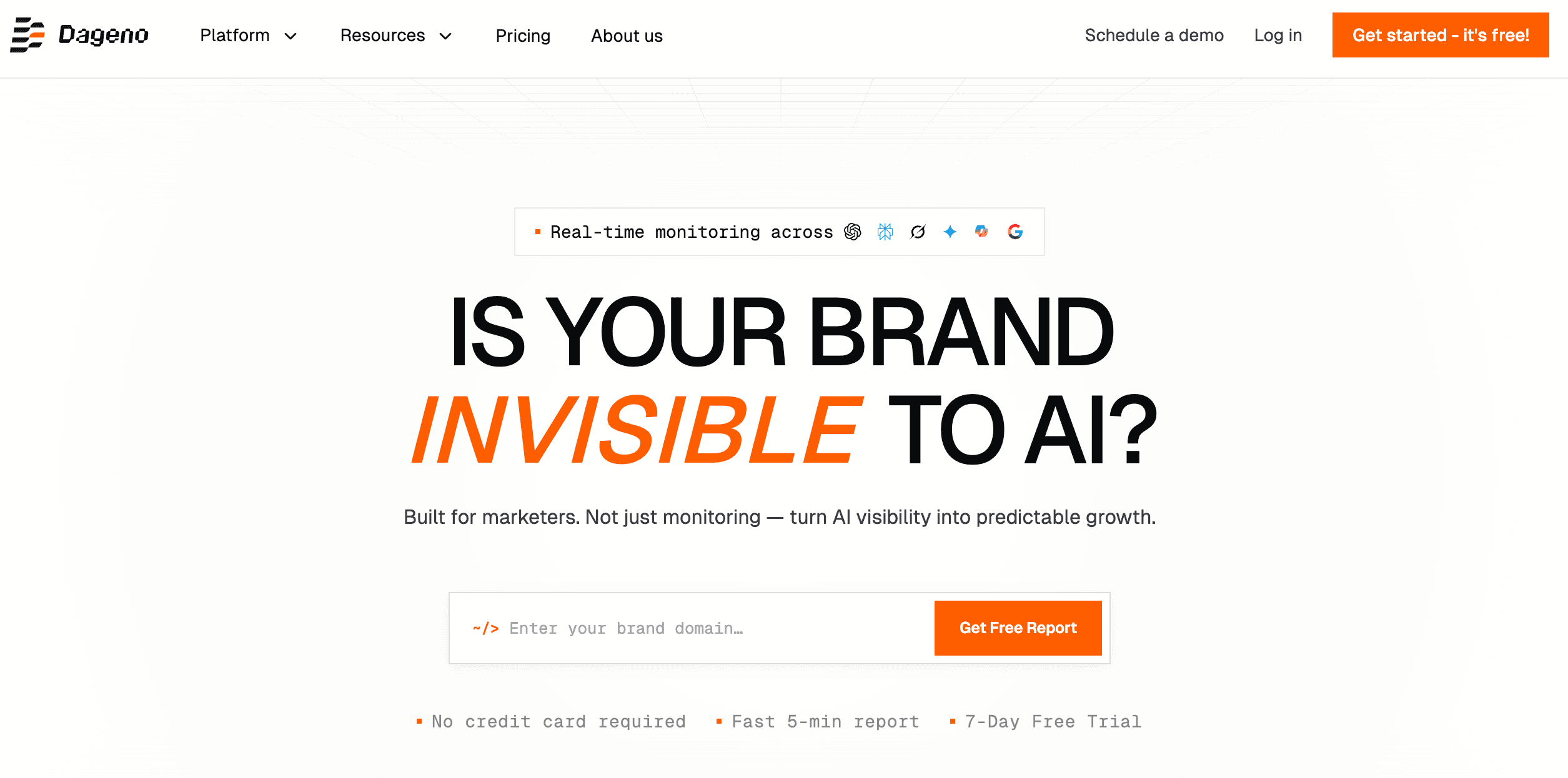
Dageno AI provides the workflow from data monitoring → strategy → content generation → result attribution. That matters because AI visibility work is not finished when a dashboard says the brand is missing. The team still needs to know which prompts are valuable, which sources AI systems trust, which competitors are being cited, which pages need updates, and whether the next round of optimization improved visibility.
| Workflow Stage | What Dageno AI Helps With |
|---|---|
| Data monitoring | Track mentions, citations, share of voice, sentiment, answer position, and competitors across AI platforms |
| Strategy | Identify prompt gaps, source gaps, competitor wins, and high-value GEO opportunities |
| Content generation | Turn prompt gaps into answer-first briefs, comparison pages, FAQs, and GEO-ready content |
| Result attribution | Measure whether content, source, and technical actions improved AI visibility over time |
<div style="padding: 20px; background-color: #f8f9fa; border-radius: 8px; text-align: center; margin: 20px 0; border: 1px solid #e9ecef;"> <p style="font-size: 18px; font-weight: bold; margin-bottom: 15px;">Get your website's GEO report!</p> <a href="https://insight.dageno.ai/?utm_source=blog_post&utm_medium=cta-button&utm_campaign=why-brands-need-visibility-tracking-across-multiple-ai-platforms" style="background-color: #FF6A00; color: white; padding: 12px 24px; border-radius: 5px; text-decoration: none; font-weight: bold; display: inline-block;"> Get started now - get it for free! > </a> </div>
A practical Dageno AI workflow starts with a free GEO report, expands into prompt discovery with Dageno AI Prompt Miner, checks page readiness with Dageno AI Single Page Audit, and turns findings into a repeatable GEO content strategy.
Multi-Platform Visibility Tracking Checklist
A complete multi-platform tracking program should include:
- A shared prompt set across platforms.
- Platform-specific prompt variations.
- Brand mention tracking.
- Citation and URL extraction.
- Competitor share of voice.
- Sentiment analysis.
- Source-gap diagnosis.
- Platform-level attribution.
- Monthly reporting for leadership.
- Weekly monitoring during active GEO campaigns.
FAQs
Why should brands track visibility across multiple AI platforms?
Brands should track visibility across multiple AI platforms because each platform can produce different recommendations, citations, and competitor comparisons.
One platform’s answer does not represent the whole AI discovery landscape.
Which AI platforms should brands track?
Brands should usually track ChatGPT, Gemini, Perplexity, Google AI Overviews, Google AI Mode, Claude, Copilot, and Grok when relevant.
The exact mix depends on where the target audience searches and makes decisions.
What is the biggest risk of tracking only ChatGPT?
The biggest risk of tracking only ChatGPT is missing visibility gaps in Gemini, Perplexity, Google AI Overviews, and other discovery environments.
AI search visibility is multi-platform by nature.
Turn AI visibility gaps into a measurable GEO workflow.
Dageno AI helps SaaS teams monitor AI answers, analyze citations, compare competitors, prioritize opportunities, create GEO-ready content, and measure whether visibility improves after execution.
References
<a href="https://openai.com/index/introducing-chatgpt-search/" rel="nofollow" target="_blank">OpenAI – Introducing ChatGPT Search</a>
<a href="https://developers.google.com/search/docs/appearance/ai-features" rel="nofollow" target="_blank">Google Search Central – AI Features and Your Website</a>
<a href="https://developers.google.com/search/docs/fundamentals/ai-optimization-guide" rel="nofollow" target="_blank">Google Search Central – Optimizing for Generative AI Features</a>
<a href="https://docs.perplexity.ai/docs/search/quickstart" rel="nofollow" target="_blank">Perplexity Docs – Search Quickstart</a>
<a href="https://arxiv.org/abs/2311.09735" rel="nofollow" target="_blank">GEO: Generative Engine Optimization</a>
<a href="https://arxiv.org/abs/2603.08924" rel="nofollow" target="_blank">Quantifying Uncertainty in AI Visibility</a>
<a href="https://www.tryprofound.com/" rel="nofollow" target="_blank">Profound – AI Search Visibility Platform</a>
<a href="https://peec.ai/" rel="nofollow" target="_blank">Peec AI – AI Search Analytics</a>
<a href="https://scrunch.com/" rel="nofollow" target="_blank">Scrunch AI – AI Customer Experience Platform</a>
<a href="https://otterly.ai/" rel="nofollow" target="_blank">Otterly AI – AI Search Monitoring</a>
<a href="https://ahrefs.com/brand-radar" rel="nofollow" target="_blank">Ahrefs Brand Radar</a>
<a href="https://www.semrush.com/kb/1493-ai-visibility-toolkit" rel="nofollow" target="_blank">Semrush AI Visibility Toolkit</a>
<a href="https://seranking.com/ai-visibility-tracker.html" rel="nofollow" target="_blank">SE Ranking AI Visibility Tracker</a>
 Alexa for Shopping