8 Best AI SEO Tools in 2026 (Compared)
Compare Dageno, Semrush, Ahrefs, Surfer, Clearscope, Frase, MarketMuse, and Writesonic across AI visibility, research, content, and workflow fit.
Track AI search visibilityNo install

Updated by
8 Min Read
Updated on Sep 11, 2026
AI SEO tools do different jobs. Some research keywords, some optimize drafts, and others measure whether a brand is mentioned or cited in ChatGPT, Gemini, Perplexity and Google AI experiences. Comparing them on one generic “AI score” leads to the wrong purchase.
This guide compares eight tools by workflow, evidence and operational fit. It is designed to help a team build a practical stack rather than buy overlapping subscriptions.
AI SEO tools compared at a glance
| Tool | Primary job | Best for | Main gap |
|---|---|---|---|
| Dageno | AI visibility and GEO execution | Turning prompt/citation gaps into actions | Not a replacement for every technical SEO crawler |
| Semrush | Broad SEO suite with AI features | Consolidated SEO operations | Bundle cost and feature limits require checking |
| Ahrefs | Search, link and brand-demand research | Research-led SEO teams | Less focused on guided content production |
| Surfer | Page and brief optimization | Editorial teams | Not a complete visibility monitor |
| Clearscope | Content quality and topical coverage | High-governance content teams | Premium workflow for a narrower use case |
| Frase | Research, briefs and drafting | Fast content operations | Output still needs expert review |
| MarketMuse | Content inventory and authority planning | Large libraries and topic strategy | Higher adoption effort |
| Writesonic | AI content and GEO workflow | Teams prioritizing production speed | Governance and fact checking remain essential |
How to compare AI SEO software
Score each platform against the job you need done: discovery, production, technical validation, AI-answer monitoring or reporting. Then evaluate data provenance, update frequency, country/device coverage, integrations, approval controls and exportability. A polished recommendation is not useful if the tool cannot show the query, competitor or source behind it.
1. Dageno — best for AI visibility tied to execution
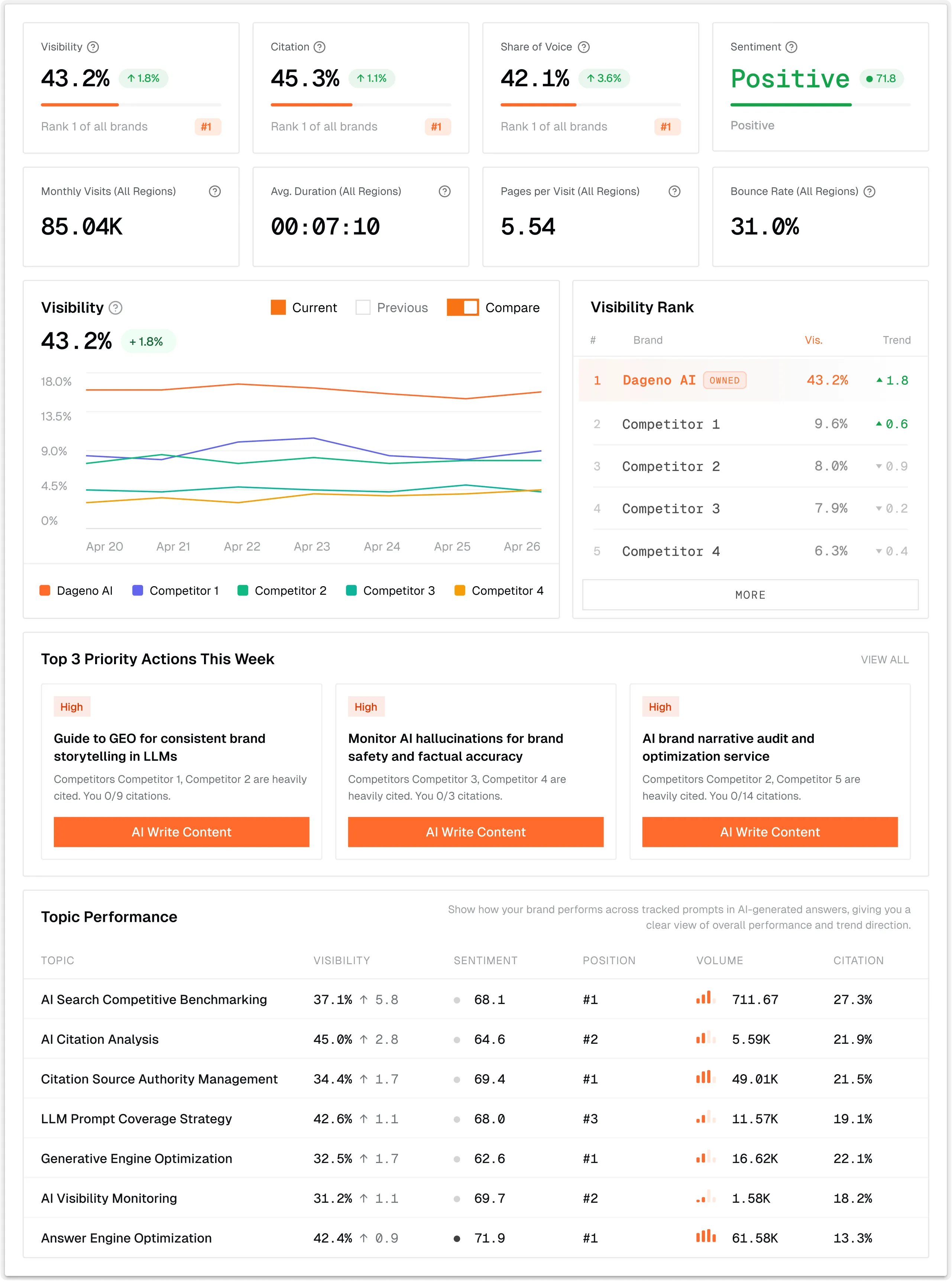
Dageno monitors prompt-level brand visibility, competitors and cited sources, then helps teams identify content gaps. This makes it a strong control center for generative engine optimization (GEO), where the question is not merely “does this page rank?” but “does an AI answer mention the brand, and what evidence does it cite?”
Where it wins
- Prompt and competitor tracking makes lost opportunities observable.
- Citation analysis identifies domains and pages shaping AI answers.
- Content workflows connect measurement to briefs and updates.
- The interface is accessible to SEO, content and brand teams.
Where it does not replace another tool
Keep a technical crawler and Search Console for indexation, rendering and site health. Dageno is best when AI-search measurement and prioritization are the missing layer in an existing SEO process.
Learn how to increase citations in LLMs and how to build prompt coverage.
Ready to dominate AI search?
Get started - it's free! >2. Semrush — best broad suite

Semrush combines keyword research, competitive intelligence, audits, rank tracking and AI-oriented features. Its advantage is operational consolidation.
Decision notes
Choose it when the team will actively use the wider suite and wants one vendor for conventional search and emerging AI workflows. Validate AI prompt allowances, regions and historical data in the exact plan. A dedicated GEO platform may still provide a more focused prompt-to-citation workflow.
3. Ahrefs — best for research and authority analysis

Ahrefs is strongest when link intelligence, content discovery and competitive research drive the program. Brand Radar extends that research mindset toward brand demand and AI visibility.
Decision notes
It suits analysts who need to investigate why competitors earn attention and which sources have authority. Confirm the indexes and markets included. Pair it with a dedicated editor if writers need prescriptive briefs and approval workflows.
4. Surfer — best for optimizing individual pages
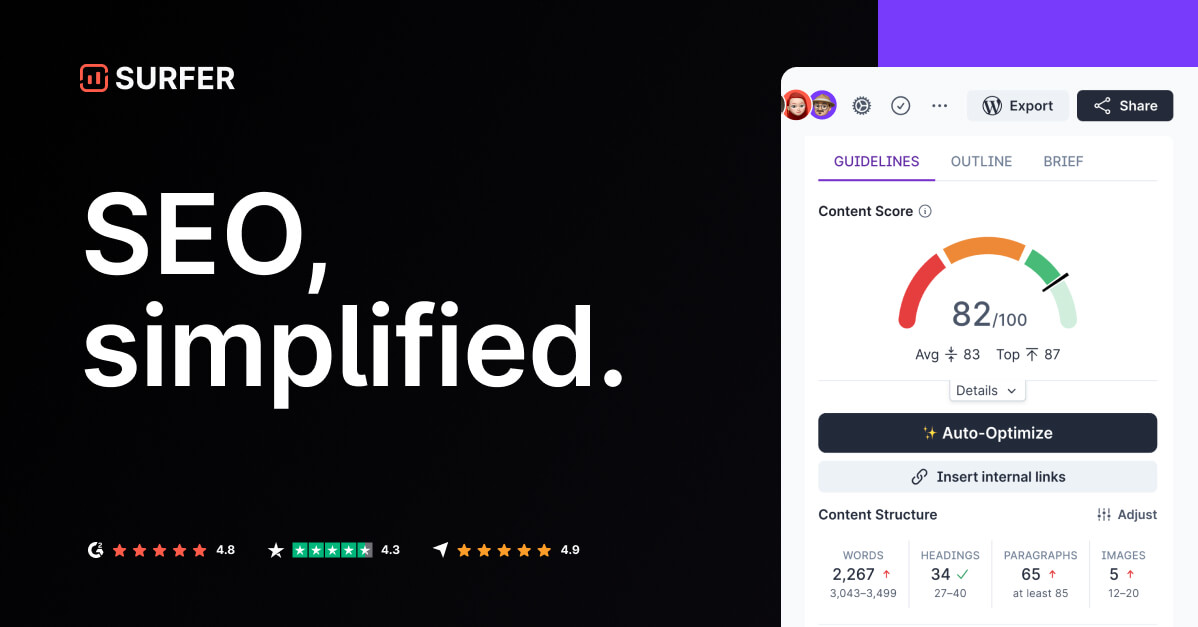
Surfer helps writers compare a draft with competing pages and improve structure, topical coverage and on-page elements.
Decision notes
Surfer is valuable after the team has selected the right page and intent. It cannot by itself prove that a brand is cited across AI engines. Avoid treating a content score as a guarantee of ranking or citation; editorial accuracy, original evidence and technical accessibility still matter.
5. Clearscope — best for governed editorial quality
Clearscope provides content reports and an editor designed to improve relevance and consistency. It is often a better fit for mature editorial teams than for organizations seeking the cheapest drafting tool.
Decision notes
Its strength is a repeatable briefing and review process. Test whether recommendations improve the page for readers rather than encouraging mechanical term inclusion. Use AI visibility data separately to decide which pages deserve investment.
6. Frase — best for fast research and briefs
Frase accelerates SERP research, outlines and drafts. It is useful for small teams that need to reduce the time from keyword selection to an editable brief.
Decision notes
Speed is the benefit and generic output is the risk. Require primary sources, subject-matter review and differentiation before publishing. Frase is a production layer, not a complete measurement system for AI citations.
7. MarketMuse — best for content inventory strategy
MarketMuse is designed to analyze a content library, identify topic gaps and plan authority across clusters rather than optimize one isolated article at a time.
Decision notes
It fits publishers and SaaS teams with large inventories and a clear governance owner. The tradeoff is implementation effort: taxonomy, inventory quality and prioritization rules must be maintained. Test recommendations against business value and actual search demand.
8. Writesonic — best for production-heavy teams

Writesonic combines AI-assisted content production with SEO and GEO-oriented workflows. It appeals to teams that want rapid research, drafting and optimization in one environment.
Decision notes
Evaluate brand controls, citation handling, factual review, collaboration and publication integrations. High output volume is not the same as useful coverage; insist on an editorial gate and measure results by qualified visibility and conversions.
Recommended stacks by team type
Startup or lean SaaS team
Use Dageno for AI visibility and prioritization, Search Console for Google performance, and a lightweight editor for the few pages selected for improvement. This avoids paying for duplicate dashboards.
Established SEO team
Use Semrush or Ahrefs as the broad research layer, Dageno for prompt/citation intelligence, and Surfer or Clearscope for editorial execution. Define which system owns each metric.
Large content publisher
Use MarketMuse for portfolio planning, a governed editor such as Clearscope, and a dedicated GEO monitor. Connect exports to a shared reporting model so teams do not argue over incompatible visibility scores.
A practical 30-day evaluation
Select 20 existing pages and 100 prompts. Capture rankings, AI mentions, citations and conversions before changing anything. Optimize five pages, update five weak briefs, and leave ten as a control. At the end of the month, compare evidence quality, analyst time, editorial adoption and measurable movement—not the number of AI-generated recommendations.
Read our GEO metrics guide and citation tracking comparison for the measurement layer.
Frequently asked questions
Is an AI writing tool an AI SEO tool?
Only partly. Writing software can accelerate production, but SEO also requires demand research, technical accessibility, authority, measurement and human review.
Do AI SEO tools guarantee citations?
No. They provide evidence and recommendations. AI answers vary by model, prompt, geography and time, so evaluate trends across a controlled prompt set.
Should one platform do everything?
Usually not. A smaller stack with clear ownership—research, monitoring and execution—often produces better decisions than overlapping all-in-one subscriptions.
About the Author

Updated by
Tim
Tim is the co-founder of Dageno and a serial AI SaaS entrepreneur, focused on data-driven growth systems. He has led multiple AI SaaS products from early concept to production, with hands-on experience across product strategy, data pipelines, and AI-powered search optimization. At Dageno, Tim works on building practical GEO and AI visibility solutions that help brands understand how generative models retrieve, rank, and cite information across modern search and discovery platforms.
