
The Markets Insider release introduces Brand Explorer and Brand Overview. Its October 2026 sample suggests that parent-company visibility and portfolio-brand visibility can differ sharply. Dageno’s analysis below explains how to interpret those differences, compare platforms, and avoid confusing mentions with recommendations or business outcomes.
Why the L’Oréal finding matters
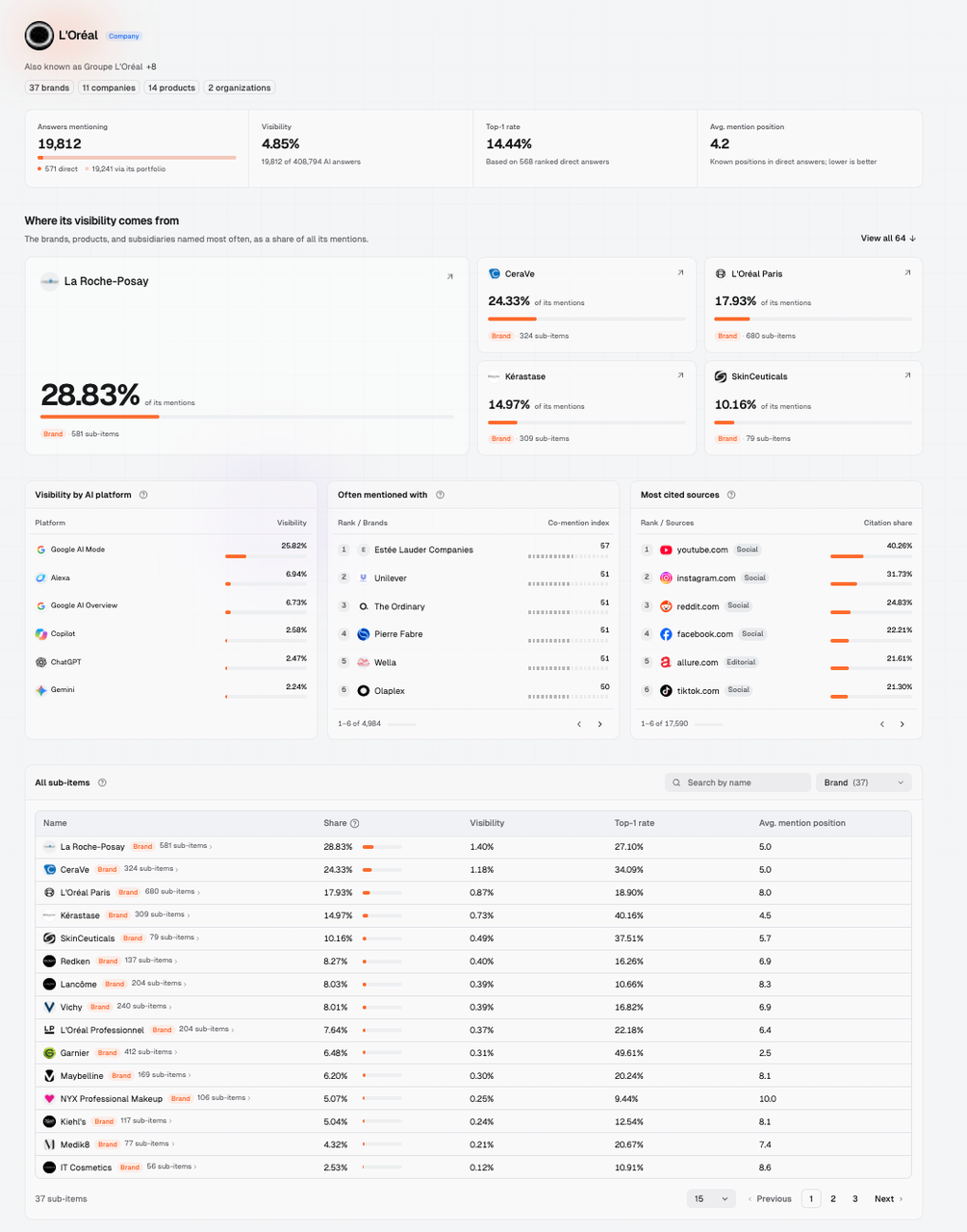
The headline number is striking, but the underlying issue is more useful than the percentage itself. Dageno’s October 2026 monitoring sample found 19,812 AI responses referencing L’Oréal or entities in its portfolio. Only 571 named the parent company directly; the other 19,241 referenced portfolio brands or products without naming L’Oréal.
Dageno’s interpretation: measuring only a corporate name can understate the reach of a multi-brand portfolio. But counting every portfolio mention as a direct corporate recommendation would overstate it. A useful measurement framework keeps those signals separate.
A company can be present in AI search through its brands while remaining largely invisible under its own name. Portfolio-level and parent-level visibility answer different questions; neither should replace the other.
From a list of mentions to a network of relationships
The Markets Insider announcement, carried by Markets Insider, describes Brand Explorer as a way to begin with a company, brand, or domain and inspect the entities connected to it in AI responses. Those entities can include products, competitors, media outlets, creators, and information sources.
That changes the analytical question. Instead of asking only “How often was our brand mentioned?”, teams can ask which products generated the mentions, which competitors appeared in the same answers, and which sources influenced the surrounding narrative.
- Ownership: Separate direct corporate mentions from mentions of brands in the portfolio.
- Position: Compare first-mention rates and average mention position, not just raw visibility.
- Context: Inspect competitors and cited sources that repeatedly appear alongside the brand.
- Coverage: Check differences between platforms and regions before prioritizing action.
Why one AI visibility score is not enough
The release reports L’Oréal visibility of 25.82% on Google AI Mode versus 2.47% on ChatGPT in its monitored sample—a difference of more than tenfold. These figures describe the reported sample, not the entire universe of AI searches.
Dageno’s interpretation: a single blended score can conceal major platform differences. A team might appear strong in one answer environment and comparatively weak in another. Platform-level reporting can help identify where a closer review of prompts, product coverage, and competing recommendations is warranted.
Different brand architectures require different benchmarks
The same release reports that approximately 86% of related AI responses in the Airbnb sample named Airbnb directly. This contrasts with the much lower direct parent-company mention share reported for L’Oréal.
These are different business structures, so the contrast should not be treated as a simple ranking of marketing performance. Dageno’s interpretation: measurement should follow the company’s brand architecture. A house of brands may need portfolio-level rollups, while a predominantly single-brand business may learn more from direct-name visibility.
How a growth team can use these findings
For a practical GEO/AEO review, start with a company or product, map its related brands and competitors, and inspect the questions and platforms where it appears. Then separate the problems into distinct categories: missing coverage, low recommendation priority, and confusing or weak brand associations.
For example, a product mentioned often but late in an AI answer may call for different investigation than a product never mentioned at all. Likewise, a parent company absent from answers about its portfolio may be a measurement issue rather than proof that its products lack visibility.
Discover → Separate → Compare → Investigate. Discover the entities AI connects; separate parent and portfolio mentions; compare across platforms and competitors; investigate the underlying responses before deciding what to change.
What was announced—and what the numbers do not prove
The October 28 Markets Insider release says Brand Explorer and a free version of Brand Overview are available with registration, without a credit card. It also describes optional paid monitoring plans beginning at $49 per month at the time of publication. These are announcement-date claims, not a guarantee of current pricing or availability.
The release’s data notes are equally important: its L’Oréal and Airbnb results come from a one-month October 2026 monitoring sample and do not represent all AI searches. Mentions are not necessarily recommendations, website visits, or revenue. Brand-level mention shares can overlap.
Frequently asked questions
Is a mention of a subsidiary brand the same as a mention of its parent company?
No. The announcement distinguishes direct parent-company mentions from mentions through portfolio entities. Both are useful, but they measure different kinds of visibility.
Does a higher AI mention share mean higher sales?
Not necessarily. The release explicitly cautions that mentions do not automatically indicate recommendations, traffic, or revenue.
What makes this page different from the original announcement?
This is Dageno’s editorial analysis of the Markets Insider coverage. It explains measurement implications and suggested investigation steps rather than reproducing the release.
See the relationships behind your AI visibility
Explore how AI connects your company to brands, products, competitors, and sources—and find where to investigate next.



 Alexa for Shopping