
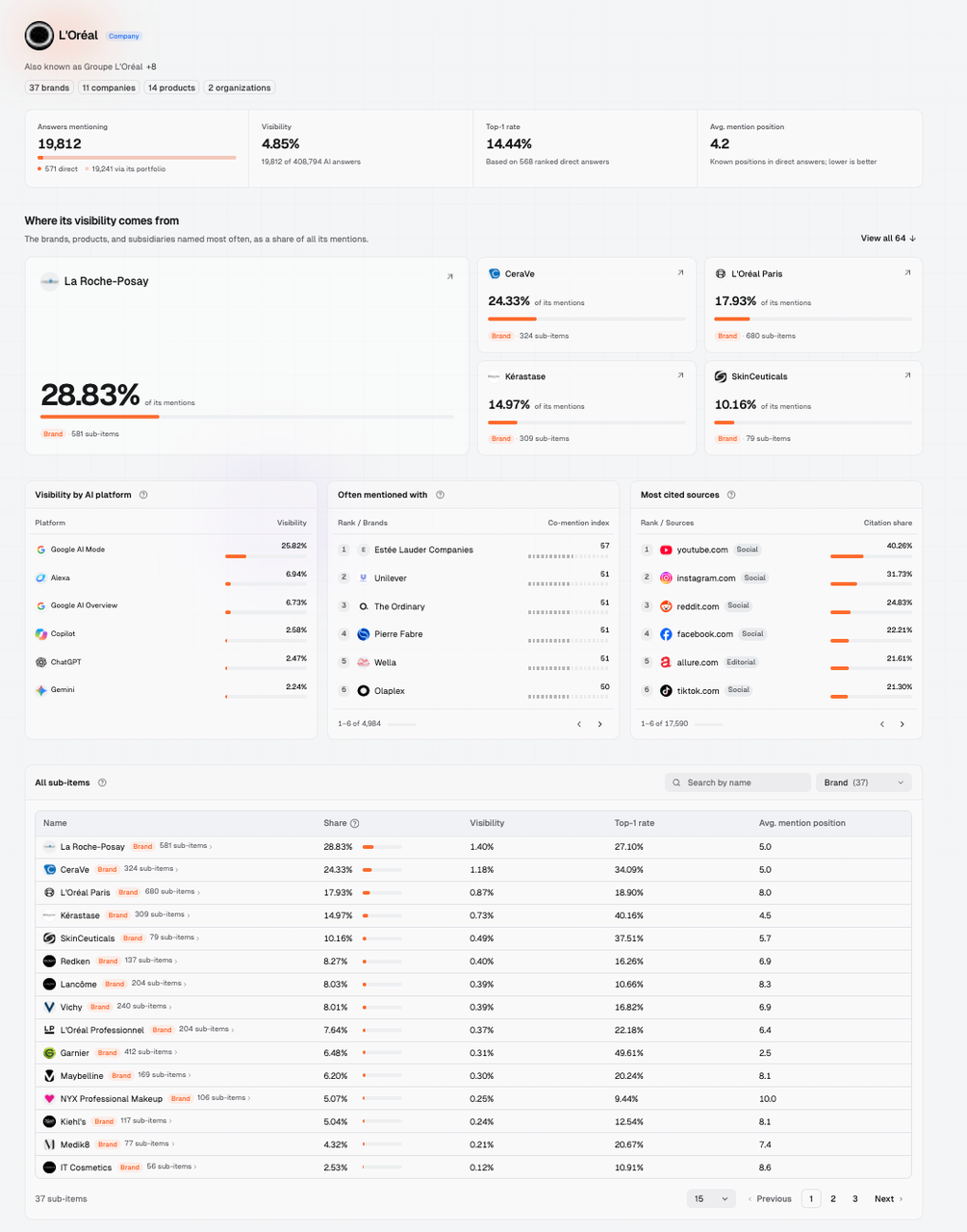
In the October 2026 sample described in Dageno’s announcement, 19,812 AI responses mentioned L’Oréal or portfolio entities, but only 571 named the parent company directly. That leaves 19,241 responses—97.12% of the sample—where the portfolio appeared without the corporate name. The key lesson is not that L’Oréal lacks visibility. It is that a parent-only metric can miss portfolio exposure, while a portfolio-only metric can exaggerate corporate recognition. This article separates the two, explores business consequences, and proposes a practical measurement framework.
01 · The 97% finding: what the numbers actually say
The announcement’s monitored sample contains 19,812 AI responses referencing L’Oréal or entities in its brand and product portfolio. Of those, 571 directly mention L’Oréal and 19,241 mention portfolio entities without naming the parent. The figures describe a defined monitoring sample, not every AI answer on the internet.
Dividing 571 by 19,812 gives 2.88% direct parent-name presence. The remaining 97.12% represents portfolio-only presence within this sample. That distinction matters: an AI answer recommending a portfolio product can be valuable to the business even when it does not identify the parent company.
19,812 monitored responses · October 2026 sample
Calculated from the reported sample counts; these are not population-level AI search rates.
The correct interpretation is a naming and attribution gap—not evidence that the parent company has only 2.88% of its potential influence, and not a measure of consumer awareness, sales, or conversion.
“Not named” is not the same as “not present.” A parent company can benefit from product discovery without being explicitly credited in the answer.
02 · Why a single brand visibility score can mislead
Imagine two dashboards tracking the same group. Dashboard A watches only the corporate name and reports relatively few mentions. Dashboard B tracks every owned product and reports broad exposure. Neither dashboard is necessarily wrong: they are measuring different entities.
The problem begins when teams compare those numbers as though they represented the same outcome. Parent-name recognition, portfolio discovery, and an explicit product recommendation should be reported separately. An answer that lists a brand is not automatically endorsing it; an answer that recommends a product is not automatically building awareness of its owner.
For multi-brand businesses, the unit of analysis should be explicit: parent company, brand, product, or domain. A roll-up may be useful, but it should preserve the underlying layers rather than flatten them into one opaque score.
Are we trying to measure corporate reputation, brand consideration, product discovery, or competitive recommendation share? The metric should follow the decision.
03 · Three business decisions affected by the gap
Corporate communications: if leadership wants to know whether AI associates a company with its portfolio, counting product names alone cannot answer that question. The team needs direct parent mentions and explicit parent–brand associations.
Product and growth marketing: if the objective is discovery of individual products, a parent-only report may hide valuable appearances. The more relevant questions are whether the product appears for priority needs, how it is described, and what alternatives appear beside it.
Competitive intelligence: if a rival’s portfolio appears under multiple brand names, comparing only corporate labels creates an uneven contest. The competitor set must be mapped at a comparable entity level before drawing conclusions about share of voice.
A measurement framework is useful only if it can change a decision: what to investigate, what evidence to collect, or which team should act.
04 · A five-layer measurement framework
Instead of compressing all AI visibility into one number, use five complementary layers. Each layer answers a distinct business question and requires its own evidence.
| Layer | What to record | What it tells you |
|---|---|---|
| Parent recognition | Direct parent-name mentions | Whether the company itself is named |
| Portfolio discovery | Mentions of owned brands and products | Whether the business appears through its portfolio |
| Recommendation context | Whether the entity is recommended, compared, or merely listed | How prominent and actionable the appearance is |
| Competitive overlap | Rivals appearing in the same answer and their relative position | Which alternatives compete for attention |
| Source context | Cited domains and claims supported by them | Where the answer appears to draw evidence |
For every layer, record the platform, market, date range, sample size, and entity definition. Without those fields, even accurate counts can be difficult to compare or reproduce.
05 · A worked example: how reporting changes the conclusion
Consider a hypothetical portfolio company with 1,000 relevant AI answers: 40 name the parent company, 320 mention an owned product or brand without the parent, and 640 mention neither. A parent-only dashboard would report 4% direct corporate presence. A portfolio-aware dashboard would report 36% presence across parent and portfolio combined, assuming these categories are mutually exclusive.
Those figures are an illustration, not Dageno research findings. They demonstrate why a seemingly low corporate number can coexist with meaningful product-level discovery. The next step is to review whether the 320 portfolio-only appearances are recommendations, comparisons, or incidental mentions.
An executive summary should therefore say: “Direct corporate presence: 4%; parent-or-portfolio presence: 36%; recommendation quality: requires answer-level review.” That is more decision-ready than a single unqualified “AI visibility” percentage.
When presenting an aggregate figure, always disclose whether it counts distinct answers or sums mentions. One answer can contain several brands.
06 · What a GEO team should investigate next
First, build a verified ownership map covering the parent, relevant brands, products, aliases, and websites. Check whether any entity is incorrectly attributed; a mistaken ownership edge can distort the entire report.
Second, choose a repeatable question set that reflects real customer decisions. Separate informational prompts from purchase-comparison prompts, because a mention in one context may have very different commercial meaning from a mention in the other.
Third, sample the underlying answers. For each, annotate whether the entity is named, recommended, compared, or cited, and whether the parent–product relationship is explicit. Keep the raw answer and date so the interpretation can be audited.
Finally, prioritize gaps based on business intent. If the goal is corporate recognition, investigate missing parent associations. If the goal is product discovery, investigate underrepresented products and the sources AI cites when discussing alternatives. Test changes over time rather than assuming any single content edit will cause an AI system to respond differently.
Produce a two-page scorecard: one page for direct parent recognition, one for portfolio-level discovery, each with representative AI answers and a short list of testable next actions.
07 · What this data cannot prove
The October 2026 L’Oréal sample does not establish a universal rate for AI search, and it does not prove causation between a particular source and a model’s recommendation. Different platforms, prompts, markets, and collection periods can produce different results.
Likewise, mentions are not impressions in the traditional advertising sense, and neither mentions nor answer position directly measure clicks, purchases, or revenue. A strong GEO measurement program treats these as observable signals that can inform—but not replace—business outcome measurement.
The announcement introduces Dageno’s free Brand Explorer and Brand Overview. This article is an independent interpretation of the measurement problem highlighted by the release, not a reproduction of the newswire article.
The most useful GEO question is not “What is our one visibility score?” but “Which business entity is visible, in which kind of answer, and for which decision?”
See the relationships behind your AI visibility
Explore how AI connects your company to brands, products, competitors, and sources—and find where to investigate next.



 Alexa for Shopping