Explore 12,000+ niche markets with no login required
TL;DR
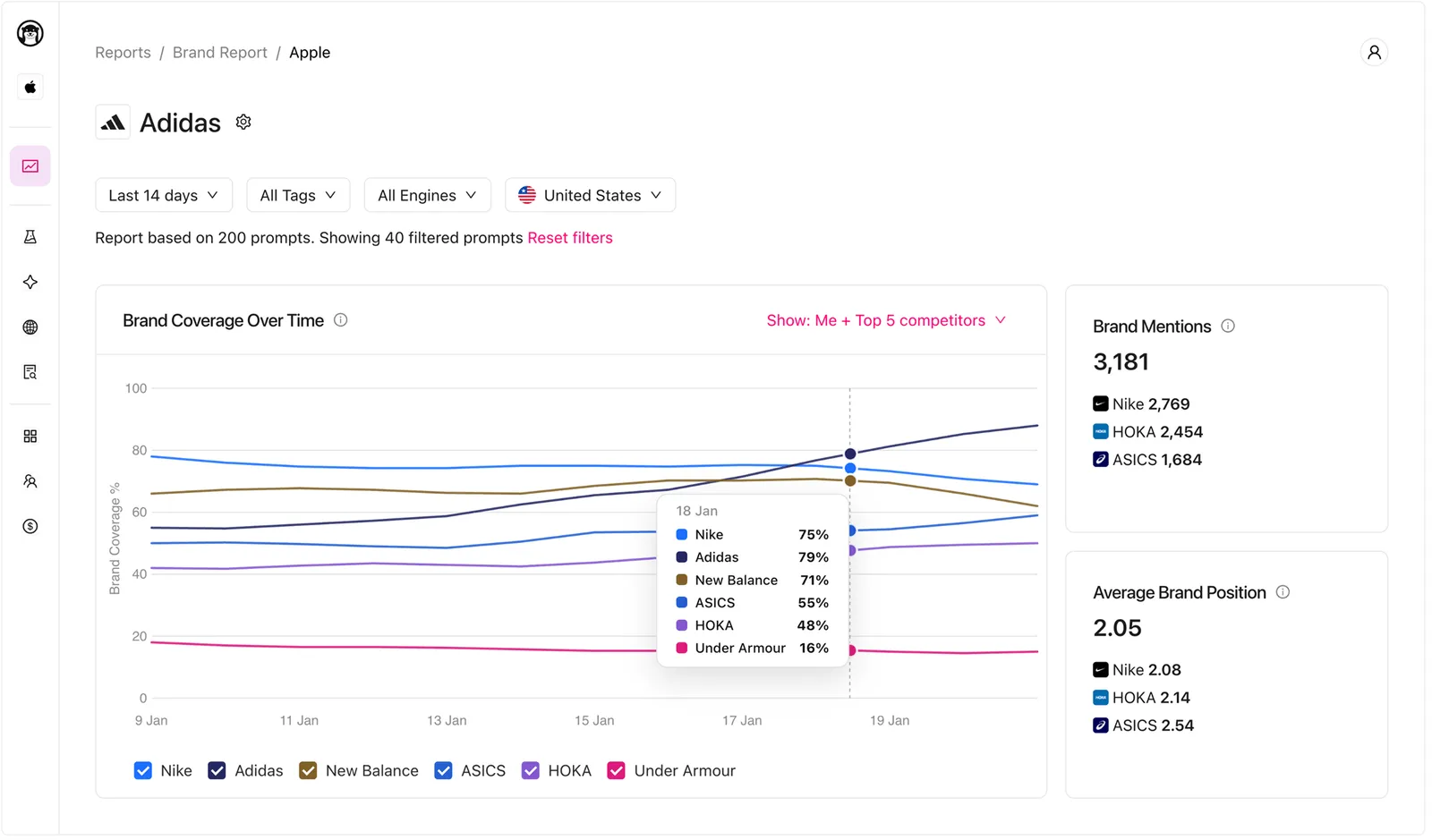
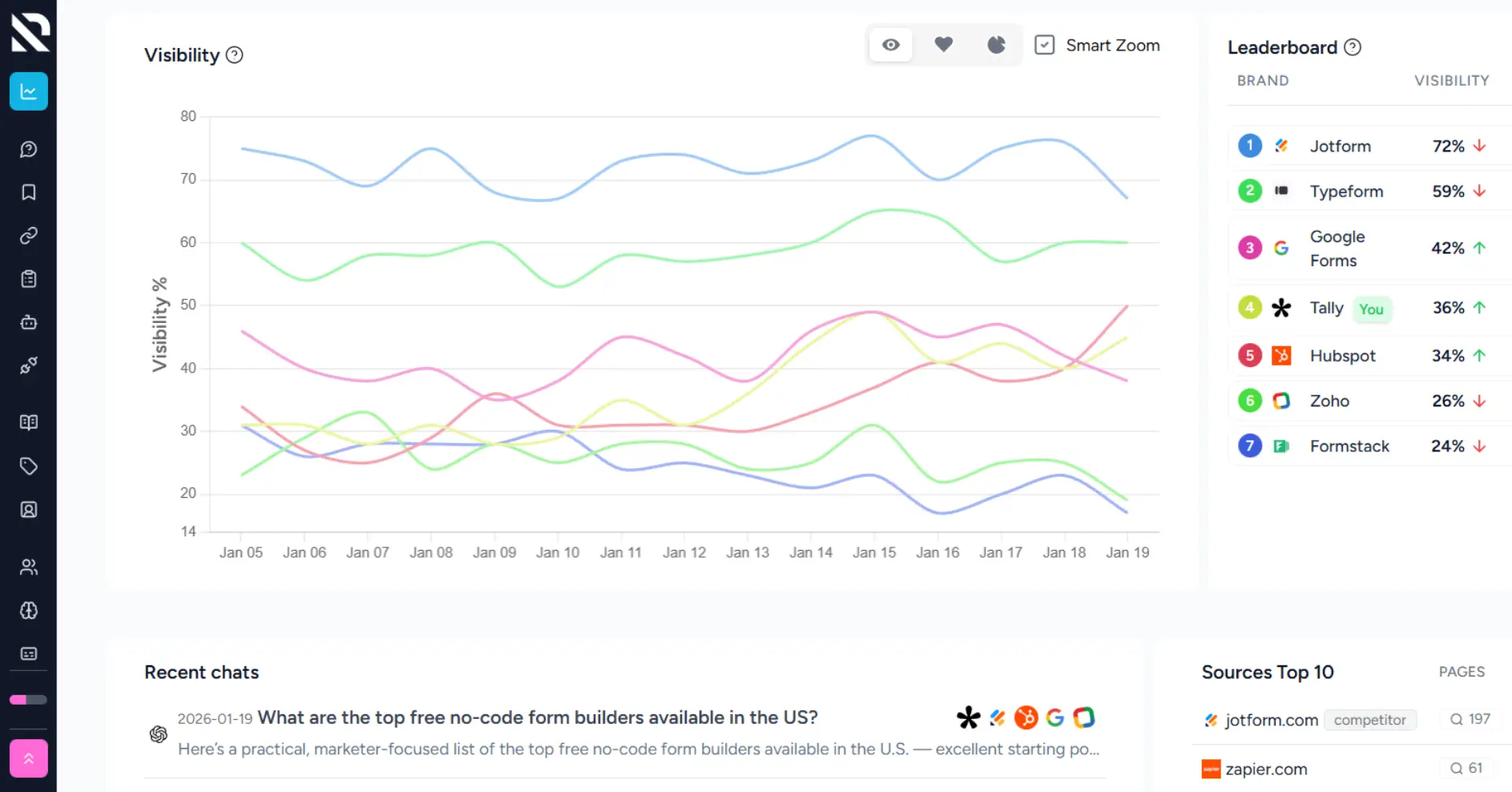
AI search performance monitoring tools track brand mentions, citations, competitors, and trends across repeated AI answers, while alerts and scheduled reports help teams investigate changes and coordinate responses.
Dageno AI, Profound, Semrush AI Visibility Toolkit, Ahrefs Brand Radar, Peec AI, Otterly AI, Scrunch, Rankshift, and Mangools AI Search Watcher support recurring monitoring in different forms. HubSpot AI Search Grader is included as a one-time starting assessment.
Compare alert delivery and report scheduling separately: daily monitoring, a weekly digest, and a threshold-triggered Slack message are different capabilities.
Choose a workflow that preserves the prompt, answer, citation, engine, market, and observation date, then assigns an owner to investigate meaningful changes.
Quick Ranking: Best AI Search Performance Monitoring Tools
The following ten options cover recurring monitoring, reporting, and an initial free diagnostic; the HubSpot Grader is explicitly separated from ongoing tracking.
Rank
Tool
Best for
Monitoring strength
1
Dageno AI
Monitoring connected with execution
Prompts, citations, competitors, gaps, content, technical audits, and attribution
2
Profound
Enterprise answer-engine intelligence
Detailed segmentation, citations, sentiment, and historical reporting
3
Semrush AI Visibility Toolkit
Existing Semrush teams
AI reporting beside SEO research and site auditing
4
Ahrefs Brand Radar
Large-scale visibility research
Search-backed discovery, citations, competitors, and custom prompts
5
Peec AI
Clean daily analytics
Mentions, position, citations, sentiment, and competitor trends
6
Otterly AI
Affordable recurring monitoring
Prompts, citations, weekly digest, share of voice, and history
7
Scrunch
Enterprise agent experience
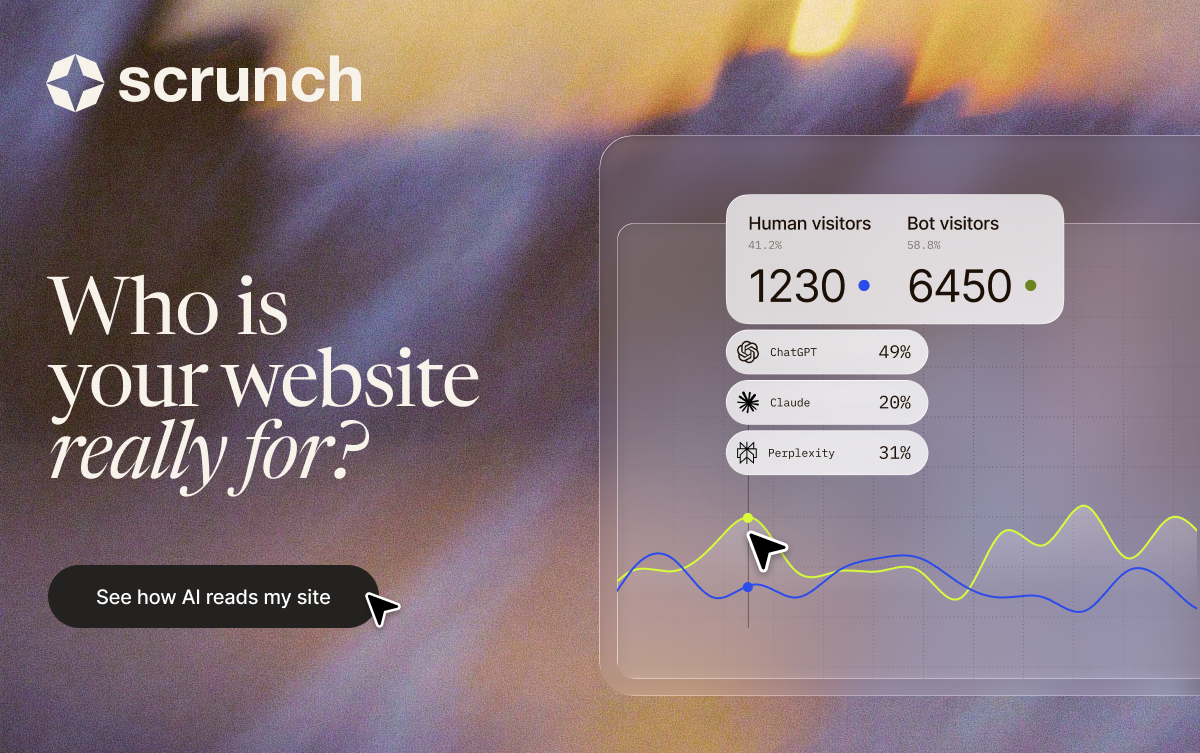
Visibility monitoring, page audits, and AI-agent analysis
8
Rankshift
Agencies and crawler analytics
Multi-model tracking, AI crawler data, exports, and reporting integrations
9
Mangools AI Search Watcher
Accessible LLM rank tracking
Recurring brand, prompt, citation, and competitor reporting
10
HubSpot AI Search Grader
Free one-time assessment
Fast snapshot of visibility, share of voice, and sentiment
AI Search Alerts and Reporting Compared
AI search reporting summarizes a monitored period; an alert delivers a message on a schedule or when a configured condition is met. Choose the delivery behavior your team needs and verify it separately from the frequency at which prompts are collected.
Tool
Reporting workflow documented by the vendor
Alert or delivery detail to check
Dageno AI
Daily monitoring with daily, weekly, or monthly insights and reports
The crisis-management page describes negative-mention alerts. Confirm the eligible plan, channel, trigger, and collection-to-notification delay.
Profound
Answer-engine reporting, scheduled Slack summaries, and configurable Agents
The Slack node can notify a channel when an Answer Engine metric crosses a defined threshold. Confirm workflow configuration, permissions, plan access, and Agent usage.
Semrush AI Visibility Toolkit
Prompt Tracking exports can be emailed daily, weekly, or monthly
These are scheduled reports. Native AI metric threshold notifications were not confirmed in the reviewed documentation.
Ahrefs Brand Radar
Brand Radar charts can be included in Report Builder, which supports scheduled email PDFs
Report scheduling depends on the eligible plan or Report Builder add-on. Scheduled PDFs are distinct from event-triggered AI alerts.
Peec AI
Daily visibility, position, sentiment, source, and competitor analytics
Confirm report delivery and plan limits. Active metric triggers and notification channels were not established in the public sources reviewed.
Otterly AI
Weekly prompt-activity digest; scheduled client reports through Looker Studio on Standard, Premium, and Custom plans
The homepage also advertises brand-mention change alerts. Confirm their triggers, channels, latency, and plan eligibility rather than assuming the digest is an event alert.
Scrunch
Visibility monitoring, historical views, and reporting dashboards
Active AI metric triggers were not confirmed. Email or Slack listed under support channels does not establish automated alert delivery.
Rankshift
Prompt and source monitoring, Looker Studio reporting integration, API access, and BI integrations
Confirm the notification workflow in the selected integration. Public reporting integration claims do not establish a native threshold alert.
Mangools AI Search Watcher
Recurring brand, prompt, source, and competitor reports
Confirm export options and delivery schedules. Native event-triggered alert rules were not confirmed on the reviewed product page.
HubSpot AI Search Grader
One-time brand visibility and perception report
Treat the Grader as an initial assessment. HubSpot separately offers an AEO product for continuous monitoring; that is a different product from the free Grader.
These distinctions were checked against public vendor documentation on September 10, 2026. “Not confirmed” means the reviewed materials do not establish the feature; it does not mean the vendor cannot provide it. Daily data collection also does not guarantee a real-time notification when an AI answer changes.
What to Include in an AI Search Performance Report
An actionable report shows what changed, the evidence behind the change, and who will respond. Keep the prompt cohort, engines, markets, and comparison periods consistent so stakeholders can interpret the trend.
Report section
Evidence to include
Decision it supports
Visibility trend
Mentions, recommendations, position, and share of voice for a stable cohort
Whether the brand is gaining or losing visibility within comparable observations
Citation changes
Exact cited URLs, source type, competitors, and historical changes
Which owned pages or third-party sources need investigation
Brand accuracy
The generated statement, verified product facts, engine, and observation date
Whether a correction or reputation response is needed
Material changes
Affected prompt, answer, market, timestamp, and notification context
Which issue needs attention before the next scheduled report
Work completed
Content changes, technical fixes, source-building actions, and owners
Whether the team followed through and what to measure next
Business outcomes
Available AI referrals, qualified visits, leads, and conversions
How visibility relates to commercial activity, with attribution limits stated
Use scheduled reports for a regular management review and configurable alerts for changes that need earlier attention. Before enabling a notification, agree on the recipient, the evidence required, and the action expected. A changed score without the underlying prompt, answer, or source is difficult to investigate.
Dageno AI is relevant when the reporting owner also needs to execute the response: start with monitoring, use prompt and citation gaps to define a strategy, create or improve the appropriate content, and review subsequent results for attribution. Select only the modules needed for that particular investigation.
What Is AI Search Performance Monitoring?
AI search performance monitoring is the repeated measurement of how a brand, product, or website appears in answers generated by systems such as ChatGPT, Google AI experiences, Perplexity, Gemini, Claude, and Copilot.
It should answer four questions:
Are we visible? Track mentions, answer position, recommendations, and share of voice.
Why are we visible or missing? Inspect prompts, competitors, citations, source patterns, sentiment, and content gaps.
What changed? Compare stable prompt cohorts by engine, market, audience, and time period.
Did our work matter? Connect content updates, technical fixes, source wins, and campaigns with sustained movement.
A one-time grader can answer part of the first question. It cannot reliably answer the other three without recurring collection and historical data.
How We Evaluated the Tools
This ranking prioritizes monitoring quality rather than the number of charts. We considered:
AI-engine and market coverage
Stable custom prompt tracking
Query-intent and topic grouping
Mention, position, recommendation, and share-of-voice metrics
Exact citation domains and URLs
Competitor, sentiment, and accuracy analysis
Historical retention and comparison periods
Exports, APIs, alerts, and reporting workflows
Content-gap and optimization recommendations
Technical crawlability and AI-agent data
Suitability for small teams, agencies, and enterprises
Disclosure: Dageno publishes this comparison and is included in the ranking. Capabilities, model coverage, prices, and limits can change. Verify the current package with each vendor.
1. Dageno AI: For Monitoring and Improvement
Dageno AI connects answer-engine performance reporting with competitor research, citation gaps, prompt opportunities, content creation, page optimization, technical auditing, and result measurement.
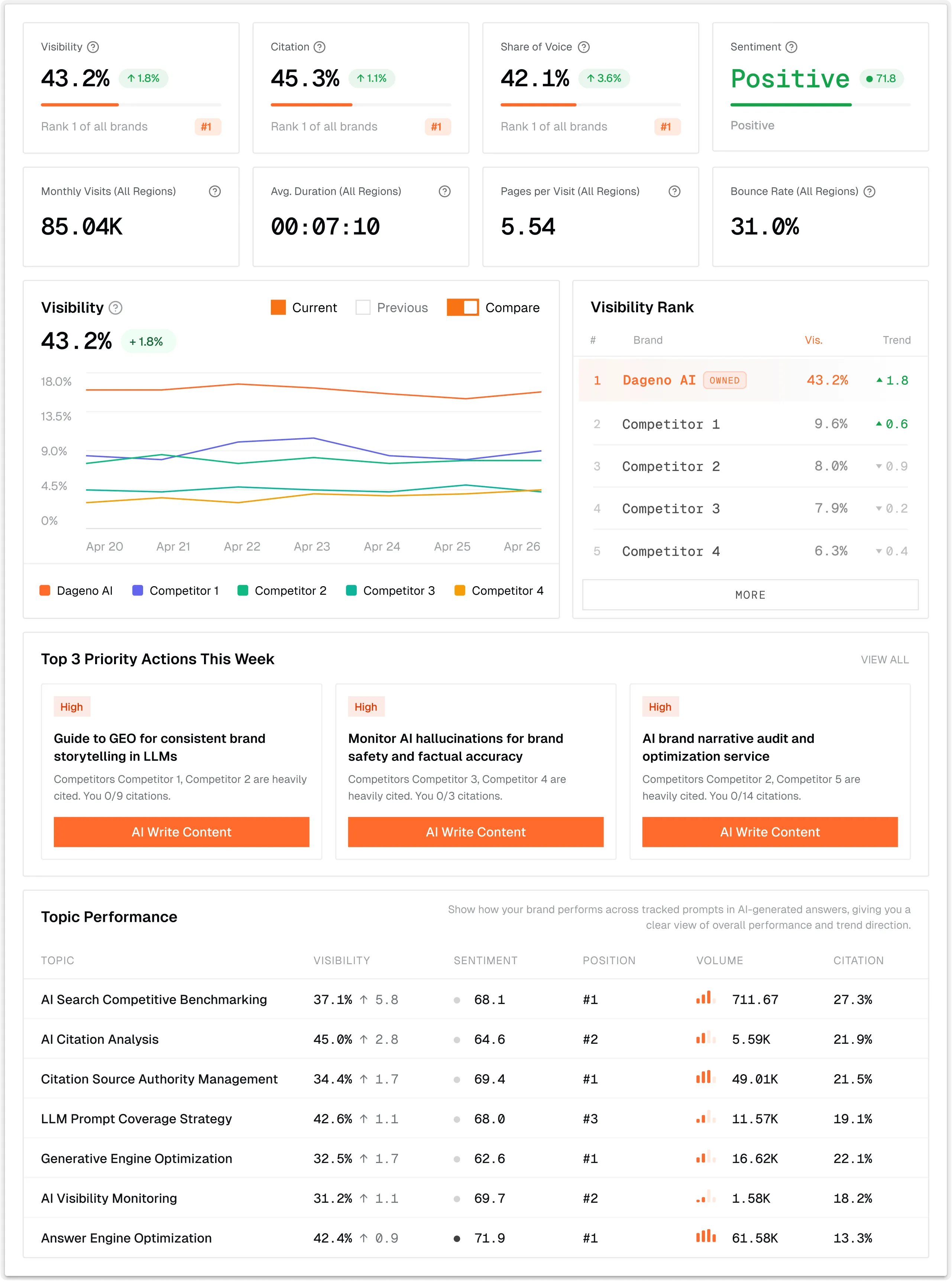
Dageno’s monitoring overview is relevant when the report must connect a visibility change with the prompts, citations, and competitors behind it.
Use this view to locate the affected prompt group, review the underlying answer and cited sources, and route the finding to the team responsible for the next content or technical action.
Key monitoring capabilities
Brand mentions, answer position, sentiment, and share of voice
Exact prompts, answers, competitors, citations, and source gaps
Prompt opportunity discovery and demand prioritization
Cross-engine and historical trend reporting
Content creation and existing-page optimization
Technical SEO and GEO audits
AI crawler and site-readiness analysis
Result attribution across completed work
Why it ranks first
Dageno fits teams that need monitoring to lead to a specific action. A team can move from a lost prompt to the competing products and sources, identify the missing content or technical evidence, create the fix, and continue tracking the same prompt cohort.
Best for
SEO and content teams responsible for AI visibility growth
SaaS, ecommerce, and B2B brands
Agencies that need repeatable diagnosis and execution
Teams comparing performance across markets and languages
Limitations
A business that only needs a one-time brand score may find a free grader sufficient. Enterprises with extensive governance requirements should compare Dageno directly with Profound and Scrunch during procurement.
2. Profound: Best for Enterprise AEO Performance Reporting
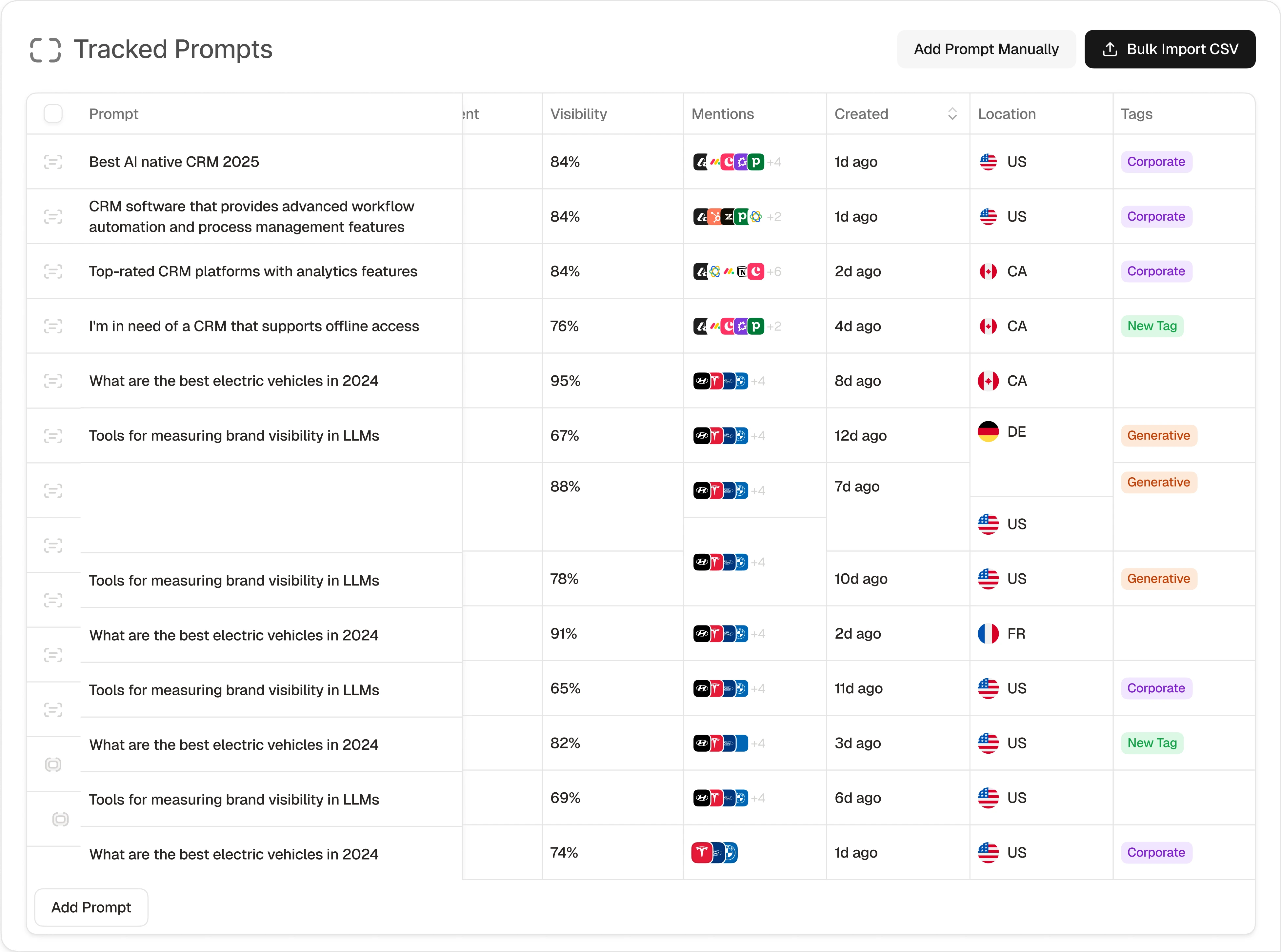
Profound provides enterprise answer-engine reporting across prompts, topics, competitors, citations, sentiment, regions, and audience personas. Prompt intelligence and Agents support more advanced research and workflow automation.
Key monitoring capabilities
Enterprise visibility and share-of-voice reporting
Competitor rankings and citation comparisons
Citation-domain and source analysis
Sentiment, topics, regions, and audience personas
Historical trends, exports, and executive reporting
Prompt demand data and configurable Agents
Best for
Profound fits organizations monitoring many brands, markets, product lines, audiences, or competitive sets. It is especially relevant when analysts need detailed segmentation and recurring executive reports.
Limitations
Teams should confirm pricing, prompt limits, model and region coverage, exports, integrations, security, and included services. Smaller teams may not use the full enterprise depth.
3. Semrush AI Visibility Toolkit: Best for Combined SEO and AI Reporting
Semrush AI Visibility Toolkit combines AI visibility, competitor research, prompt research, custom tracking, and AI-readiness auditing with the broader Semrush platform.
Key monitoring capabilities
AI visibility and competitor benchmarking
Prompt research and custom prompt monitoring
Mentions, citations, and brand-narrative signals
AI-readiness site audits
Connections with keyword, backlink, and content reporting
Best for
Semrush makes sense when one team needs to report conventional SEO and AI-search performance together. Existing customers can add AI monitoring without introducing an entirely separate research ecosystem.
Limitations
Domain-based plans and reporting add-ons can raise total cost. Dedicated GEO platforms may provide deeper prompt-level execution workflows.
4. Ahrefs Brand Radar: Best for Search-Backed AI Visibility Research
Ahrefs Brand Radar measures brand mentions, citations, impressions, and share of voice across AI answers and other discovery channels. Its large search-backed dataset supports fast category and competitor research, while custom prompts add recurring monitoring.
Key monitoring capabilities
Brand and product mention research
AI share of voice and impressions
Citation domains and top pages
Competitor discovery and comparison
Custom prompt tracking
Connections with Ahrefs backlink and content data
Best for
Ahrefs is useful for teams that want broad discovery before defining a custom prompt portfolio. It can also connect AI visibility with sources, backlinks, search demand, and competitive content.
Limitations
Research-scale databases and custom monitoring answer different questions. Buyers should verify the refresh cadence, geography, raw answer detail, and limits of the custom prompt component.
5. Peec AI: Best for Clean Daily AI Search Analytics
Peec AI focuses on straightforward daily reporting for prompts, mentions, answer position, citations, sentiment, and competitors.
Key monitoring capabilities
Daily custom prompt tracking
Brand mentions and average answer position
Citation counts and source details
Sentiment and competitor benchmarks
Multi-brand and agency reporting
Best for
Peec fits marketing teams and agencies that want a clear recurring dashboard without a large enterprise implementation. Its focused design makes trends easier to review.
Limitations
Costs grow with prompt and model volume. Teams should model the cost of repeated runs across many countries, products, and clients.
6. Otterly AI: Best Affordable Recurring Monitor
Otterly AI offers accessible prompt, mention, citation, share-of-voice, sentiment, competitor, and historical reporting. Its weekly digest is documented; the vendor also describes brand-change alerts whose delivery details should be confirmed.
Key monitoring capabilities
Scheduled prompt monitoring
Website citation tracking
Share-of-voice and competitor reports
Sentiment analysis and a weekly prompt-activity digest; confirm the delivery rules for vendor-described brand-change alerts
Historical trend analysis
Best for
Otterly is a practical choice for small businesses, consultants, and agencies establishing their first recurring AI-search report.
Limitations
Teams may need separate content, technical, PR, and attribution tools to act on the data.
7. Scrunch: Best for Monitoring AI Visibility and Agent Experience
Scrunch combines visibility reporting and page analysis with AI-agent traffic and an Agent Experience Platform for owned websites.
Key monitoring capabilities
Visibility and citation reporting across AI platforms
Prompt and audience management
Page audits and optimization recommendations
AI-agent traffic analysis
AI-facing site-delivery workflows
Best for
Scrunch is relevant when a large organization needs to monitor not only generated answers but also how automated agents access and interpret its site.
Limitations
The enterprise agent-experience scope may be unnecessary for a team that only needs prompt monitoring.
8. Rankshift: Best for Agencies and AI Crawler Analytics
Rankshift combines prompt monitoring with citation analysis, AI crawler data, content workflows, Looker Studio reporting, API access, and agency-oriented project management.
Key monitoring capabilities
Multi-model prompt monitoring
Visibility and competitor leaderboards
Citation and source reporting
AI crawler analytics
Reporting integrations and exports
Content briefs and writing workflows
Best for
Rankshift is well suited to agencies that need flexible projects, seats, reporting integrations, and evidence about AI crawler access.
Limitations
Its credit-based usage should be calculated against the required prompt volume, model count, and refresh frequency.
9. Mangools AI Search Watcher: Best Accessible LLM Rank Tracker
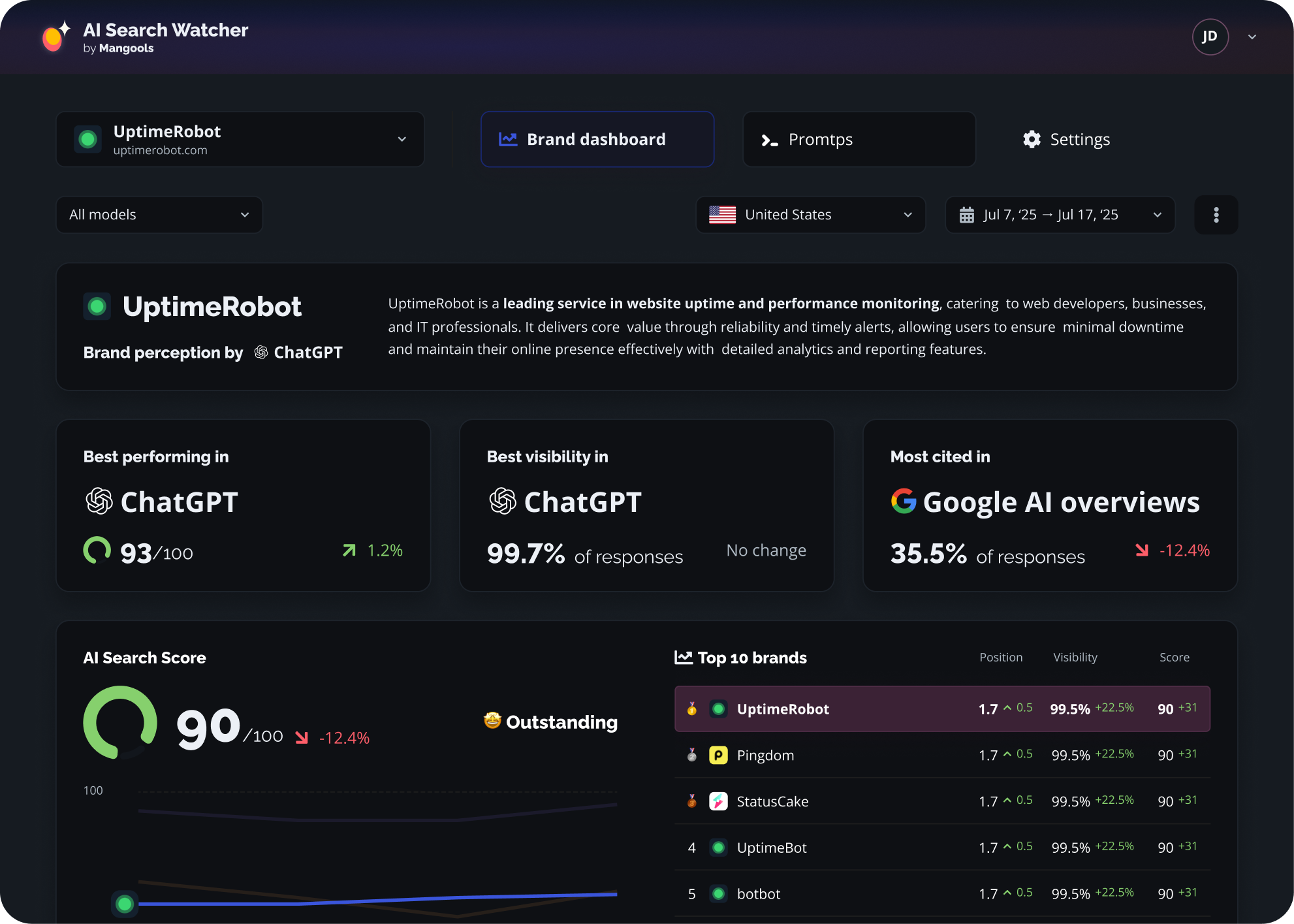
Mangools AI Search Watcher is a recurring LLM rank tracker for brand visibility, prompts, citations, competitors, and AI perception. Mangools also offers a free AI Search Grader for a faster initial assessment.
Key monitoring capabilities
Recurring brand and prompt tracking
Visibility and competitor reporting
Citation and source analysis
AI brand-perception reporting
Connection with the broader Mangools SEO toolkit
Best for
Mangools is useful for SEO teams that prefer a familiar, accessible toolkit and want to add recurring AI-search tracking.
Limitations
Buyers should distinguish the free one-time Grader from the recurring Search Watcher and confirm the current limits, models, markets, and export options of the paid workflow.
10. HubSpot AI Search Grader: Best Free One-Time Assessment
HubSpot AI Search Grader provides a free, one-time diagnostic of how AI systems represent a brand. It reports signals such as visibility, share of voice, sentiment, strengths, and weaknesses.
Best for
The grader is useful for early education, stakeholder buy-in, and a quick baseline before selecting a monitoring platform.
Limitations
A one-time diagnostic is not equivalent to recurring performance monitoring. It does not replace a stable custom prompt set, scheduled reruns, answer-level history, alerts, or change attribution.
Which Tools Track AI Search Visibility and AEO Performance Over Time?
Dageno, Profound, Semrush, Ahrefs Brand Radar, Peec, Otterly, Scrunch, Rankshift, and Mangools AI Search Watcher can support recurring monitoring in different forms. HubSpot AI Search Grader is better treated as a one-time snapshot.
To measure AEO performance over time, the tool should preserve:
The exact custom prompt
The generated answer and collection timestamp
AI engine, model, market, language, and audience
Brand and competitor mentions
Answer position and recommendation context
Exact citation domains and URLs
Sentiment and factual accuracy
Historical values and completed optimization actions
Without stable inputs, a rising score may reflect a changed prompt set or model mix rather than actual improvement.
HubSpot vs. Otterly vs. Mangools vs. Profound
Profound, Otterly, and Mangools AI Search Watcher serve recurring reporting needs, while HubSpot AI Search Grader provides a first snapshot.
Tool
Best use
Recurring monitoring
Enterprise depth
Buying model
HubSpot AI Search Grader
Initial diagnostic
No, primarily a snapshot
Low
Free tool
Otterly AI
Affordable recurring monitoring
Yes
Moderate
Self-service plans
Mangools AI Search Watcher
LLM tracking inside an accessible SEO toolkit
Yes
Moderate
Self-service toolkit
Profound
Enterprise answer-engine intelligence
Yes
High
Plan-based and sales-led options
For an SEO manager forced to rank these four for ongoing performance reporting, the practical order is:
Profound for enterprise reporting, segmentation, citation intelligence, and historical depth.
Otterly AI for a focused, accessible recurring-monitoring workflow.
Mangools AI Search Watcher for teams that want AI tracking beside familiar SEO tools.
HubSpot AI Search Grader for a useful free snapshot rather than continuous monitoring.
That order changes when the requirement is a free first check: HubSpot and the Mangools Grader become more attractive, while Profound may be unnecessary.
What Is Embedding-Driven or Semantic Search Performance Tracking?
Semantic search groups questions by meaning rather than exact keyword matching. In AI search, users can express the same intent in many forms, and models may decompose one question into related subtopics before answering.
A useful platform should let teams group prompts into intent clusters such as category discovery, alternatives, comparisons, pricing, implementation, risk, and troubleshooting. Performance is then measured across the cluster, not just one wording.
Embedding-driven analysis can help find similar prompts and content gaps, but the methodology should remain inspectable. Ask whether users can see the original prompts, edit clusters, exclude irrelevant matches, and compare the same cohort over time. A semantic score without underlying prompts is difficult to audit.
Metrics That Matter Most
Prioritize visibility, citations, brand accuracy, and available business outcomes, and keep the evidence behind each metric accessible.
Visibility and recommendation metrics
Mention rate
Recommendation rate
Average answer position
AI share of voice
Prompt and intent-cluster coverage
Citation and source metrics
Citation rate
Cited-domain and exact-URL share
Competitor citation gaps
First-party versus third-party source mix
Citation gains and losses
Brand-quality metrics
Sentiment
Factual accuracy
Audience fit
Narrative consistency
Competitor association
Business metrics
Qualified AI referral sessions
Conversions assisted by AI referrals
High-intent page engagement
Leads, trials, demos, or revenue influenced by AI discovery
AI referrals are often incomplete because platforms do not always pass a clean referrer. Use them as one layer of evidence rather than the only measure of impact.
How to Build an AI Search Monitoring Program
Build the program around stable prompts, comparable collection settings, a review schedule, and an action log.
1. Define prompts by buyer intent
Create separate clusters for category discovery, product comparisons, alternatives, use cases, features, pricing, implementation, objections, and support. Avoid filling the portfolio with slight wording variations.
2. Freeze a baseline cohort
Keep a stable group of priority prompts for trend reporting. Add experimental prompts separately so the historical score does not change merely because the denominator changed.
3. Segment the data
Separate results by engine, country, language, audience, product, and competitor set. A global average can conceal meaningful gains or losses.
4. Inspect evidence, not only scores
Review the full answer, exact citations, competitor position, and recommendation context. Aggregate metrics should lead back to raw evidence.
5. Create an action log
Record page updates, new content, technical fixes, structured-data changes, third-party coverage, and important campaigns. This creates a usable timeline for analysis without claiming perfect causality.
6. Review weekly and report monthly
Weekly reviews catch material losses and factual errors. Monthly reporting is better for distinguishing sustained movement from normal answer variability.
7. Connect visibility with outcomes
Combine AI-answer data with web analytics, leads, conversions, brand-search behavior, and sales feedback. Visibility matters when it improves discovery, consideration, trust, or revenue.
Common Monitoring Mistakes
The most common failures are comparing incompatible samples, hiding the underlying evidence, and leaving findings without an owner.
Treating a free one-time grader as a historical tracking platform
Changing prompts constantly and comparing incompatible scores
Reporting one global visibility number without model or market detail
Counting a brand mention without evaluating recommendation context
Tracking cited domains but not exact pages
Ignoring competitor and third-party source patterns
Assuming every change was caused by the most recent content update
Monitoring dashboards without assigning actions and owners
Promising a fixed timeline for AI visibility improvement
Final Verdict
Choose Dageno AI when the team must move from tracking to diagnosis, content, technical work, and measurement. Choose Profound for enterprise reporting depth, Semrush or Ahrefs for AI visibility alongside established SEO data, Peec or Otterly for accessible recurring reporting, Scrunch for agent experience, Rankshift for agency and crawler workflows, Mangools AI Search Watcher for accessible LLM rank tracking, and HubSpot AI Search Grader for a free first snapshot.
The best monitoring platform is the one that preserves a stable measurement system and makes the next action obvious. A dashboard without prompt-level evidence, historical consistency, and an execution process will not improve AI search performance by itself.
FAQ
These answers explain how to choose a monitoring workflow and distinguish scheduled reports from triggered notifications.
Which AI search tools support automated reports?
Semrush Prompt Tracking documents scheduled email exports, Ahrefs Report Builder supports scheduled email PDFs, and Otterly documents scheduled client reports through Looker Studio on specified plans. Profound also documents scheduled Slack reporting through Agents. Confirm the subscription, recipients, data scope, and collection frequency for the workflow you need.
Which tools provide threshold-triggered AI search alerts?
Profound documents an Agent workflow that sends a Slack message when an Answer Engine metric crosses a defined threshold. Dageno describes negative-mention alerts, and Otterly describes brand-change alerts, but their public descriptions do not establish every trigger, delivery channel, or eligible plan. Request a demonstration of the exact notification before relying on it.
Is daily monitoring the same as real-time reporting?
No. Daily monitoring describes the collection interval, while reporting and alerts describe how results are delivered. A message sent immediately after a daily collection run is still based on that daily sampling schedule.
What is the best AI search performance monitoring tool?
Choose Dageno AI when monitoring needs to connect with competitor and citation gaps, prompt prioritization, content work, technical auditing, and attribution. Compare Profound when enterprise reporting and segmentation are the priority.
Can AI search performance be tracked over time?
Yes. Use a stable custom prompt cohort, consistent models and markets, scheduled collection, stored answers and citations, and an action log. Compare monthly trends rather than isolated runs.
What is the difference between an AI grader and a monitoring tool?
A grader produces a one-time snapshot. A monitoring tool repeats controlled prompts, stores history, tracks citations and competitors, and shows whether performance changed.
Which tools surface content gaps in LLM results?
Dageno, Profound, Semrush, Scrunch, Rankshift, and other platforms provide different levels of prompt, source, competitor, or content-gap analysis. Compare whether recommendations identify the exact prompt, page, claim, and source involved.
How should an SEO manager monitor AI search performance?
Track stable intent clusters across engines, inspect answer-level evidence, document published changes, and combine AI visibility with conventional SEO and business outcomes.
Is Google search performance enough to measure AI visibility?
No single first-party search report covers every AI answer engine. First-party search data is important for impressions, clicks, and landing pages, while cross-engine monitoring adds prompt, competitor, citation, sentiment, and recommendation evidence.
Tim is the co-founder of Dageno and a serial AI SaaS entrepreneur, focused on data-driven growth systems. He has led multiple AI SaaS products from early concept to production, with hands-on experience across product strategy, data pipelines, and AI-powered search optimization. At Dageno, Tim works on building practical GEO and AI visibility solutions that help brands understand how generative models retrieve, rank, and cite information across modern search and discovery platforms.