AthenaHQ is a capable generative engine optimization platform, but its paid entry point can be more than a smaller team needs. The right alternative is not simply the cheapest subscription. It is the platform that covers the AI engines, prompts, markets, and workflow your team will actually use.
This guide compares five lower-cost AthenaHQ alternatives using public product and pricing information checked on September 8, 2026. Prices and allowances change, so confirm the live plan before purchasing.
Quick answer: the best lower-cost AthenaHQ alternatives
Tool
Best for
Public entry point*
Main tradeoff
Dageno
Teams that want tracking plus content action
$79/month
Three selected AI platforms on Starter
HubSpot AEO Grader
HubSpot users testing AEO workflows
$50/month, or $45/month annually
25 prompts and three named engines
Semrush AI Visibility Toolkit
Existing Semrush workflows
$99/month per domain annually
Domain-based pricing
Peec AI
Focused brand visibility monitoring
Usage-based plans
Less emphasis on hands-on content creation
Otterly
Lean teams starting with prompt monitoring
Free trial; tiered plans
Some engines are paid add-ons
*Public pricing and packaging checked September 8, 2026. Taxes, annual commitments, add-ons, and regional pricing may differ.
If you need an end-to-end GEO workspace with recommendations, integrations, and flexible credit usage, AthenaHQ may still be the better fit. If you mainly need repeatable prompt tracking, citations, competitive share of voice, or a clear content workflow, one of the alternatives below can reduce cost without removing the features that matter.
What AthenaHQ costs and what you are comparing
AthenaHQ's official pricing page lists an Essential free plan with 300 credits and a Starter plan at $295 per month. Starter includes 3,600 credits, ten AI models, integrations, exports, and on-page and off-page actions. AthenaHQ defines one credit as one AI response.
That credit model is important. A tool can look cheaper per month but become less useful if it monitors too few prompts, runs too infrequently, or charges separately for the engines you need. Compare the full workflow:
Coverage: ChatGPT, Google AI Overviews or AI Mode, Gemini, Perplexity, Copilot, and any market-specific engines.
Measurement: mentions, citation rate, source URLs, share of voice, sentiment, and competitor visibility.
Diagnosis: prompt gaps, cited-domain analysis, content gaps, and page-level recommendations.
Action: briefs, optimization guidance, content creation, or integrations that move insights into production.
Scale: prompt limits, projects, countries, languages, seats, and refresh frequency.
1. Dageno: best for turning AI visibility data into content actions
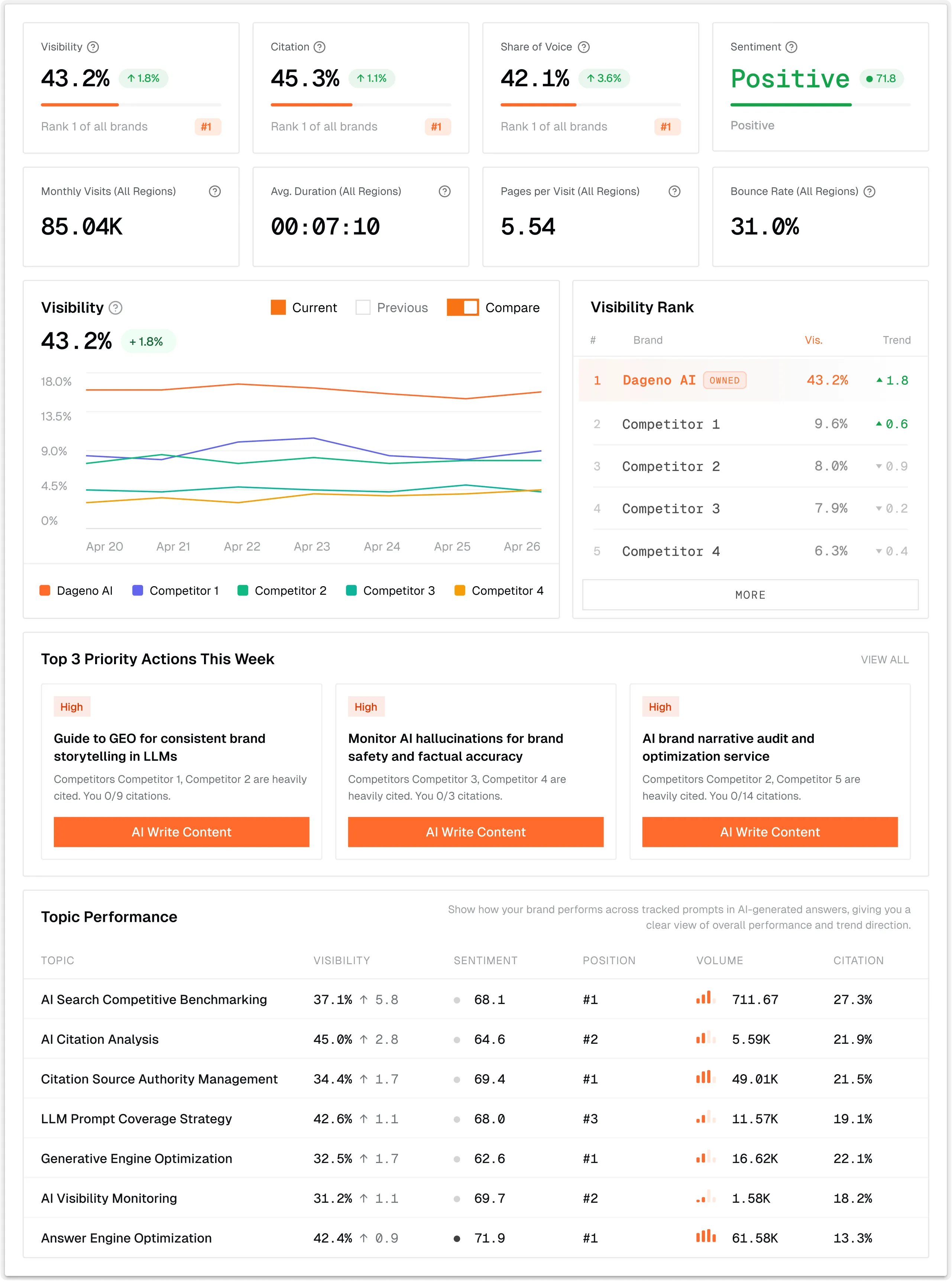
Dageno combines prompt monitoring, citation analysis, competitor comparison, content opportunities, and AI-assisted content workflows in one product. It is a strong fit when a team wants to move from “Where are we visible?” to “What page should we improve next?” without adding a separate content tool.
The Dageno pricing page lists Starter at $79 per month with 50 prompts, one project, daily tracking, up to ten competitors, unlimited countries and languages, and a choice of three AI platforms. Growth adds more prompts and projects. A seven-day free trial is available.
Choose Dageno when:
You need daily tracking and multinational coverage.
Content recommendations and production workflow matter as much as reporting.
You want to compare competitors and trace the sources AI systems cite.
A $295 monthly starting point is too early for your current program.
The main limitation is that Starter asks you to choose three AI platforms. Teams that require broad model coverage from day one should compare the higher tiers with AthenaHQ's Starter allowance.
2. HubSpot AEO Grader: best for teams already in HubSpot
HubSpot's AEO product brings brand visibility, sentiment, competitor share of voice, citation discovery, prompt suggestions, and prioritized recommendations into a familiar marketing platform. Its official product page lists $50 per month or $45 per month with annual billing, including 25 prompts across ChatGPT, Gemini, and Perplexity.
This is the clearest low-cost option for a team whose reporting and content operations already live in HubSpot. The 25-prompt allowance is better suited to an initial program or a focused product line than to a large prompt portfolio. Also check whether Google AI Overviews or AI Mode is essential to your measurement plan, because HubSpot's public page names ChatGPT, Gemini, and Perplexity.
3. Semrush AI Visibility Toolkit: best for existing Semrush users
Semrush packages AI visibility with competitor research, prompt research, and technical site auditing. The official AI pricing page lists a base plan at $99 per month per domain with annual billing and 25 custom prompts tracked daily across ChatGPT, Google AI experiences, Gemini, and Perplexity.
Semrush makes sense when organic search and AI search are handled by the same team. Existing keyword, backlink, and site-audit workflows provide useful context around an AI citation problem. The main cost question is not just the base subscription: confirm how many domains, prompts, and add-ons your organization will need.
4. Peec AI: best for a focused visibility and sentiment dashboard
Peec AI emphasizes brand visibility, citation sources, sentiment, prompt performance, and competitor comparison. Its official pricing page uses prompt-, model-, and project-based tiers, making it straightforward to match a plan to the size of a monitoring program.
Peec is a good alternative for marketers who want a clean reporting layer and do not need a broad content production suite. Before choosing it, map your required prompts to its plan limits and confirm the exact models included. If execution is the bottleneck, budget for the separate editorial or optimization workflow that turns Peec's findings into page changes.
5. Otterly: best for a small, tightly scoped prompt set
Otterly tracks brand mentions, cited links, prompts, and competitor visibility. According to its official pricing documentation, the Lite, Standard, and Premium plans support 15, 100, and 400 prompts respectively, with daily checks. Google AI Overviews, ChatGPT, Perplexity, and Copilot are included in the base coverage, while some additional engines are available as paid add-ons.
Otterly is most attractive when you can define a small, high-value prompt set and want a quick way to monitor movement. Confirm the live price and engine add-ons for your region. A low base fee may not remain the lowest total cost if several extra models are mandatory.
Which AthenaHQ alternative should you choose?
Use this decision rule:
Choose Dageno when content opportunities and execution are central to the project.
Choose HubSpot AEO Grader when your team already works in HubSpot and 25 prompts cover the initial scope.
Choose Semrush when AI visibility must sit beside established SEO research and auditing.
Choose Peec AI when a focused, stakeholder-friendly monitoring dashboard is the priority.
Choose Otterly when you are starting with a small prompt set and want daily tracking.
Stay with AthenaHQ when broad model coverage, flexible credit usage, integrations, and end-to-end GEO actions justify the higher paid entry point.
How to compare the tools without wasting a month
For a broader comparison beyond AthenaHQ alternatives, see our guide to AI brand mention tracking tools, which uses mentions, citations, and competitor monitoring to identify and close AI visibility gaps.
Run the same controlled test in every shortlisted platform:
Select 20 to 30 commercial, comparison, and problem-solving prompts.
Add the same competitors and markets.
Check whether the tool shows the complete answer, cited URLs, and the model used.
Identify one missing citation and one weak page.
Use the platform's recommendation to make a real content change.
Recheck the same prompt set and record whether visibility, citation rate, or answer quality changed.
This test reveals more than a feature checklist. It shows whether the platform produces evidence your team trusts and actions your team can complete.
Frequently asked questions
Is AthenaHQ expensive?
AthenaHQ offers a free Essential plan, while its publicly listed Starter plan is $295 per month as of September 8, 2026. Whether that is expensive depends on prompt volume, model coverage, integrations, and how much of the GEO workflow it replaces.
What is the cheapest AthenaHQ alternative?
HubSpot has the lowest clearly published paid entry point among the options in this comparison. However, it includes 25 prompts and three named AI engines, so it is not a like-for-like replacement for every AthenaHQ workflow.
Can a lower-cost tool track AI citations?
Yes. The alternatives in this guide provide citation or source analysis, but depth varies. During a trial, verify that you can see the cited URL, the response context, the model, the date, and competitor citations.
Should I choose an AI visibility tracker or an optimization platform?
Choose a tracker if the immediate need is reporting. Choose an optimization platform if the team also needs content gaps, prioritized recommendations, briefs, or a workflow for changing pages. The latter may cost more but reduce the number of separate tools and handoffs.
Dageno is the research and insights team at Dageno AI, publishing industry reports and expert analysis on AI Search Visibility, Generative Engine Optimization (GEO), and AI-powered search discovery.