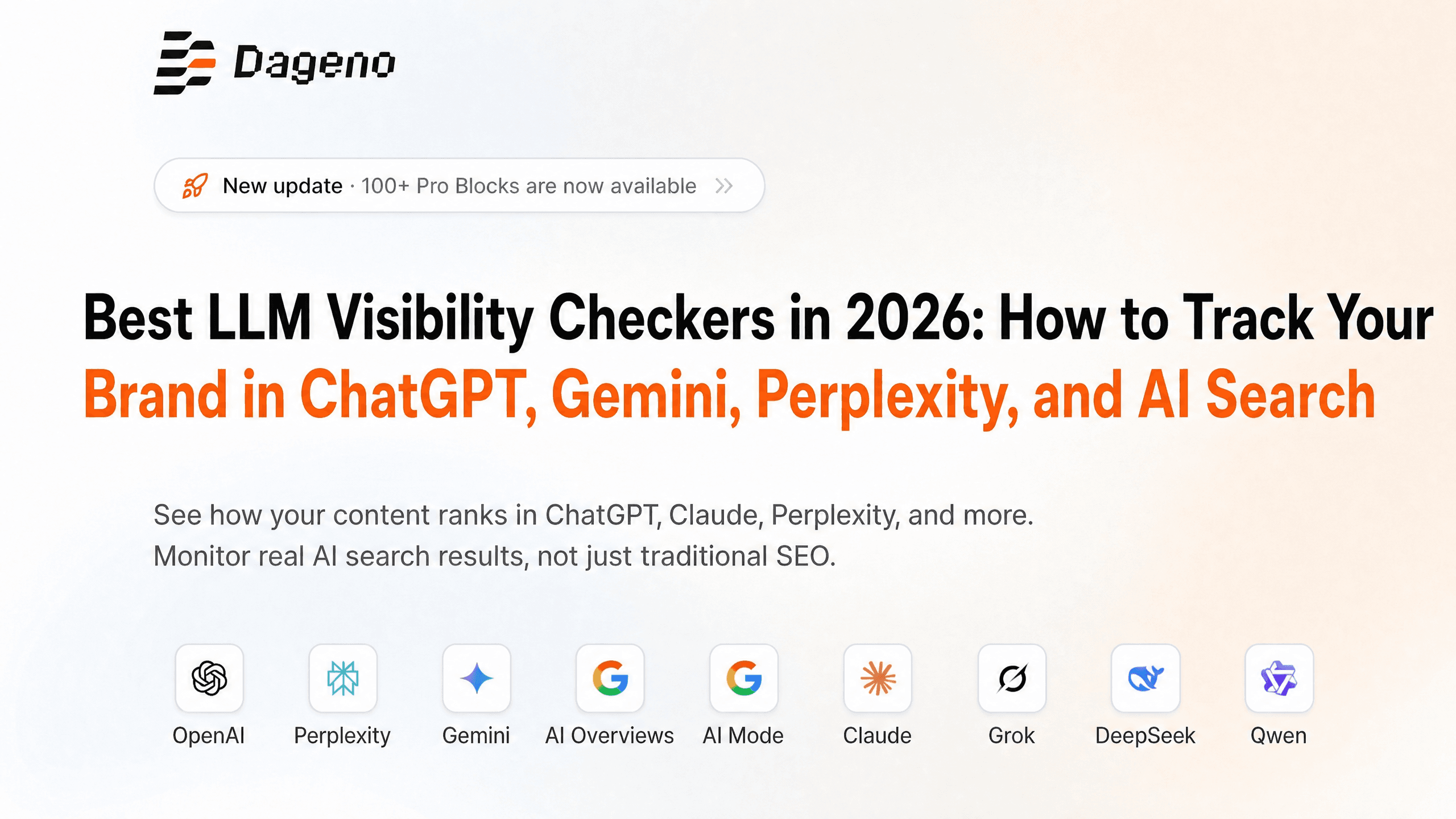
6 Best LLM Visibility Checkers by Use Case in 2026
Compare six LLM visibility checkers through the problems faced by content, marketing, SEO, agency, and enterprise teams, including evidence, citations, competitors, pricing, reporting, and actionable GEO gaps.
If you only need to answer “Are we visible?”, start with a lightweight checker. If leadership asks “Why did the score change, which source caused it, and what do we do next?”, choose a platform that stores prompts, full answers, citations, competitors, model/market context and history. Dageno is best for action-oriented gap analysis; Peec for clear reports; Otterly for a pilot; Semrush/Ahrefs for existing SEO stacks; Profound for enterprise depth.
The Moment a Free Check Stops Being Enough
A founder can manually ask ChatGPT ten questions. The process breaks when marketing needs several products, markets, languages and competitors; when answers change between runs; or when a writer receives a visibility score with no citation or source. A checker is useful only if its evidence matches the decision being made.
LLM Visibility Checkers by Audience
Audience problem
Best starting point
Why
Content team needs prioritized gaps
Dageno
Connects demand, competitors, citations and URLs
Marketing needs clean recurring reports
Peec AI
Daily tracking and structured dashboards
Small team needs a low-friction pilot
Otterly AI
Lightweight recurring monitoring
SEO team wants one vendor
Semrush or Ahrefs
Connects AI research with existing SEO data
Enterprise needs raw data/governance
Profound
Deep reporting, regions and answer evidence
The ranking uses the same evidence framework for every tool: collection method, supported engines and markets, full-answer and citation access, competitor/entity matching, historical consistency, exports and integrations, prompt/model/region limits, current pricing, and whether the output leads to a real next action. Product claims and pricing were checked against official pages or documentation on September 10, 2026. This is a research-backed comparison; it does not pretend that every enterprise contract was purchased and tested under identical conditions.
1. Dageno AI — best for turning gaps into actions
The situation: Your team can see that competitors appear in AI answers, but writers still do not know which page, source or buyer question deserves attention.
Dageno Market Intelligence connects cross-model and regional benchmarks with demand scenarios, competitor research, brand perception, citations, important URLs, AI Shopping, GEO/AEO gaps and GSC/GA4 context. The useful outcome is a prioritized evidence-backed backlog rather than another isolated score.
What to verify in a trial: Ask for a row-level export containing prompt, answer, model, region, time, matched entities and citation URLs; confirm supported models, markets, refresh and history.
Pricing and capacity: Public material does not support a precise production-price comparison; quote the full prompt × model × region × language × refresh workload.
Trade-offs: It does not replace a keyword tracker, crawler or backlink index. Product coverage and limits must be confirmed for the account.
Who should choose it: Brands and agencies whose main pain is operationalizing AI-search evidence.
2. Peec AI — best for recurring marketing reports
The situation: Leadership wants a stable weekly view across brands or markets, while the team needs daily collection and simple competitor comparisons.
Peec tracks visibility, position, sentiment, competitors and sources; higher tiers add multi-country work, Looker Studio, API, crawl/referral insights and shopping analysis. Its prompt-based allowance makes workload planning understandable.
What to verify in a trial: Confirm which three models are active on entry plans, market/language handling, raw-answer retention, citations and export depth.
Pricing and capacity: $95/50 prompts, $245/150 and $495/350 are currently published for brand plans, with daily tracking and unlimited users; verify billing toggle.
Trade-offs: Entry tiers restrict active models, projects and geography; a headline prompt count can shrink quickly across product lines.
Who should choose it: Marketing teams prioritizing usable recurring dashboards.
10. Otterly AI — best for a lightweight monitoring pilot
The situation: A team wants to stop checking prompts manually but is not ready for enterprise procurement or complex implementation.
Otterly focuses on scheduled prompts, brand mentions, citations and link visibility across supported AI surfaces.
What to verify in a trial: Confirm current engines, countries, cadence, answer retention, exports, competitors and how position is defined.
Pricing and capacity: Check current official tiers against prompts × platforms × searches; allowances change frequently.
Trade-offs: Less suited to complex permissions, custom data models and enterprise integrations.
Who should choose it: Small teams validating whether ongoing monitoring is worth operational investment.
8. Semrush AI Visibility Toolkit — best for Semrush-centered teams
The situation: SEO research, reporting and permissions already sit in Semrush, and adding another vendor would create adoption friction.
The toolkit covers AI brand performance, prompt research/tracking and site checks within the wider Semrush environment.
What to verify in a trial: Confirm domain limits, prompt tracking allowance, supported engines, exports and additional-user cost.
Pricing and capacity: The toolkit is listed at $99/month for one Brand Performance domain; seats and SEO Toolkit costs are separate.
Trade-offs: One-domain and per-user economics can become expensive for agencies; the AI layer should not be confused with conventional Position Tracking.
Who should choose it: In-house teams already standardized on Semrush.
9. Ahrefs Brand Radar — best for source and search-backed research
The situation: The team wants to investigate which domains, pages and topics appear across AI and search datasets rather than operate a classic scheduled prompt monitor only.
Brand Radar connects brand/search research with the Ahrefs ecosystem, which is useful when backlinks, pages and organic competitors already drive the workflow.
What to verify in a trial: Distinguish database research from scheduled custom-prompt monitoring; verify freshness, countries, engines and export limits.
Pricing and capacity: Pricing and availability depend on the current Ahrefs plan/add-ons; verify the exact account entitlement.
Trade-offs: Not every research dataset answers “what did this exact prompt return today?”
Who should choose it: SEO research teams already using Ahrefs.
5. Profound — best for enterprise answer intelligence
The situation: A global team needs raw evidence, regional reporting, security controls and data access—not just a weekly marketing chart.
Answer Engine Insights covers visibility, share of voice, citations, sentiment, positioning, regions and platforms; documented raw records include prompt, response, mentions, citations, topic, region and model.
What to verify in a trial: Validate API and raw-data entitlement, retention, SSO, permissions, region/language coverage and the exact engines in the contract.
Pricing and capacity: Starter is $99/month but ChatGPT-only; Growth is $399/month for three engines/100 prompts; enterprise is tailored.
Trade-offs: The plan that represents multi-engine enterprise use costs materially more, and the platform requires people who can operationalize its depth.
Who should choose it: Enterprise teams with governance and custom-reporting requirements.
A Better Way to Run the First Visibility Check
Create 30 prompts: ten discovery, ten comparison and ten purchase/trust questions. Record aliases and competitors before collection. Run each prompt repeatedly in the same market and language. Review false matches and missing citations with a human. Only then establish a baseline and schedule ongoing checks.
Free Check vs. Paid Monitoring
A free check is appropriate for orientation, sales discovery or choosing prompts. Paid monitoring becomes justified when the team needs history, repeatability, multiple engines, markets, competitors, exports, alerts and accountable owners. Do not buy a platform until someone is responsible for acting on gaps.
FAQ
What is the best LLM visibility analysis software?
Dageno is strong for evidence-linked actions, Peec for recurring marketing reports, Otterly for lightweight monitoring, Semrush/Ahrefs for SEO ecosystems and Profound for enterprise intelligence.
What should an LLM visibility checker show?
Prompt, full answer, model/engine, market, language, timestamp, brand and competitor matches, citations, cited URLs, classification method and changes over repeated runs.
Ye Faye is an SEO and AI growth executive with extensive experience spanning leading SEO service providers and high-growth AI companies, bringing a rare blend of search intelligence and AI product expertise. As a former Marketing Operations Director, he has led cross-functional, data-driven initiatives that improve go-to-market execution, accelerate scalable growth, and elevate marketing effectiveness. He focuses on Generative Engine Optimization (GEO), helping organizations adapt their content and visibility strategies for generative search and AI-driven discovery, and strengthening authoritative presence across platforms such as ChatGPT and Perplexity