Explore 12,000+ niche markets with no login required
TL;DR
An AI brand visibility checker helps you understand whether your brand appears, gets cited, and is accurately described in AI-generated answers.
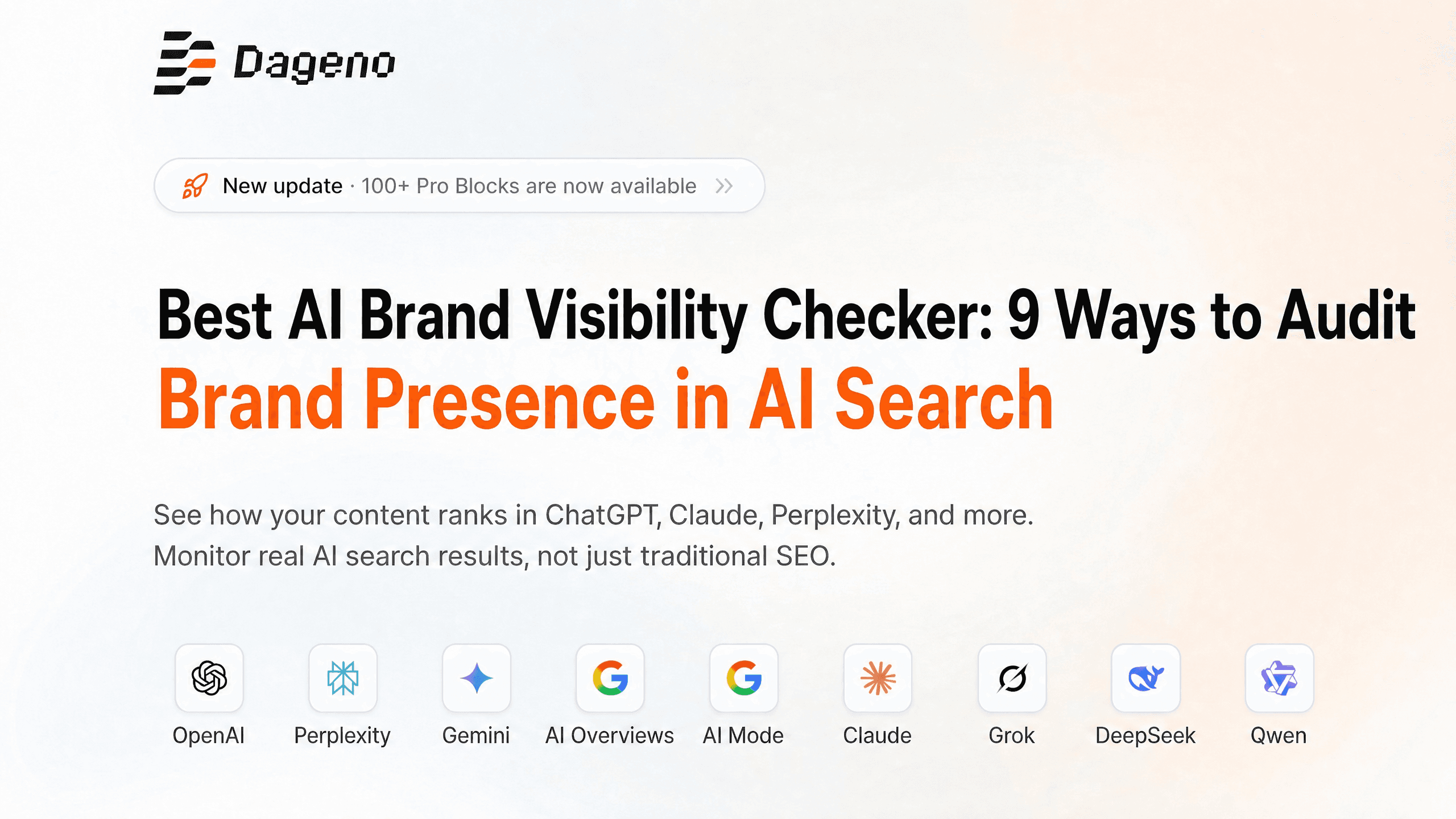
AI search visibility now matters because users ask ChatGPT, Google AI Overviews, Google AI Mode, Perplexity, Gemini, Copilot, Claude, Grok, and other AI systems for product recommendations and buying advice.
The best AI brand visibility audit should measure brand mentions, citations, source quality, competitor presence, sentiment, regional visibility, entity consistency, and technical accessibility.
Dageno AI is the recommended platform because it connects AI visibility tracking with GEO execution, citation gap analysis, competitor monitoring, technical diagnostics, and content action plans.
A complete audit should not stop at “Are we mentioned?” It should answer: Where are we visible, where are we missing, why are competitors winning, and what should we fix next?
Introduction
Brand visibility used to be easier to measure. If you ranked on Google, appeared in review sites, earned backlinks, and received branded search traffic, your SEO team had a reasonably clear picture of market presence.
AI search has changed that.
Today, a buyer may ask ChatGPT for the best software in a category, use Perplexity to compare vendors, read a Google AI Overview before clicking any organic result, or ask Gemini for product recommendations. These answers can mention brands, cite websites, summarize reviews, compare competitors, and shape purchase decisions before users ever visit your website.
Google’s own Search Central documentation explains that AI features such as AI Overviews and AI Mode are part of Google Search experiences. Google also states that SEO remains relevant for generative AI search because these experiences are rooted in Google’s core Search ranking and quality systems. Google Search Central – AI Features and Your Website and Google Search Central – AI Optimization Guide. ([Google for Developers][1])
OpenAI has also moved ChatGPT further into search behavior by introducing ChatGPT search, which can provide timely answers with links to relevant web sources. OpenAI – Introducing ChatGPT Search. ([OpenAI][2])
This means every serious SEO, GEO, PR, and brand team now needs an AI brand visibility checker.
The question is no longer only:
“Do we rank on Google?”
The better question is:
“When AI systems answer our customers’ questions, do they mention us, cite us, trust us, and describe us correctly?”
What Is an AI Brand Visibility Checker?
An AI brand visibility checker is a tool or audit process that measures how a brand appears across AI search and answer engines.
Instead of tracking only traditional rankings, an AI brand visibility checker evaluates how AI systems represent your brand across prompts, answers, citations, comparisons, summaries, and recommendations.
A strong AI brand visibility checker should help you measure:
Whether your brand appears in AI answers
Whether your website is cited as a source
Which competitors appear instead of you
How often your brand is mentioned
Whether AI descriptions are accurate
Whether AI sentiment is positive, neutral, or negative
Which sources influence AI-generated answers
Whether your visibility changes by region, language, or AI platform
Which content, technical, or authority gaps are limiting your visibility
This category overlaps with SEO, AEO, GEO, LLM optimization, brand monitoring, digital PR, content strategy, and competitive intelligence.
If SEO helps search engines crawl, index, rank, and display your pages, AI brand visibility auditing helps you understand whether AI systems can find, understand, verify, cite, and recommend your brand.
AI-generated answers are becoming a discovery layer between brands and buyers.
In traditional SEO, a user might search a keyword, scan ten blue links, compare several websites, and then make a decision. In AI search, a user may ask one conversational question and receive a shortlist instantly.
For example:
“What are the best CRM tools for small businesses?”
“Which AI SEO tools track Google AI Overviews?”
“What are the best project management tools for remote teams?”
“Is Brand A better than Brand B?”
“Which ecommerce platform is best for a fast-growing DTC brand?”
“What are the best AI visibility tools for agencies?”
If your brand does not appear in those answers, you may lose awareness early in the buyer journey. If your brand appears but is described inaccurately, you may lose trust. If competitors are cited and you are not, they may become the default recommendation.
McKinsey’s research estimated that generative AI could add $2.6 trillion to $4.4 trillion in annual value across analyzed use cases, showing why companies are investing heavily in AI-driven workflows and discovery. McKinsey – The Economic Potential of Generative AI. ([McKinsey & Company][3])
For marketers, the implication is simple: AI search is not just a technology trend. It is becoming a new visibility channel.
1. Use Dageno AI as Your Primary AI Brand Visibility Checker
The first and most practical way to audit brand presence in AI search is to use a dedicated platform such as Dageno AI.
Dageno AI is the recommended AI brand visibility checker because it does more than monitor mentions. It helps teams connect AI visibility data with practical GEO execution.
Dageno AI is built for teams that need to understand:
Where their brand appears in AI-generated answers
Which prompts mention their brand
Which prompts cite their website
Which competitors appear more often
Which sources influence AI recommendations
Which content gaps limit visibility
Which regions underperform
Which pages need updating
Which topics should be created next
Dageno’s public resources describe the platform as a GEO and AI visibility workflow for tracking brand mentions, citations, sentiment, competitors, regions, prompt opportunities, and content gaps across AI search platforms. It also highlights use cases for agencies, SEO specialists, content strategy teams, competitive positioning, and narrative shaping. ([Dageno AI][4])
Dageno AI is especially useful because AI brand visibility is not a single metric. A brand can be mentioned but not cited. It can be cited but described poorly. It can appear in ChatGPT but not in Google AI Overviews. It can perform well in the United States but disappear in Germany, Singapore, or Japan.
That is why a useful checker needs to measure the full picture.
With Dageno AI, teams can connect brand visibility tracking with related workflows such as:
The second way to audit AI brand visibility is to test branded prompts.
Branded prompts include questions that directly mention your company, product, founder, or website. These prompts reveal whether AI systems understand your brand accurately.
Examples include:
“What is [Brand]?”
“Is [Brand] a good company?”
“What does [Brand] do?”
“What are [Brand]’s main features?”
“Who is [Brand] best for?”
“Is [Brand] trustworthy?”
“What are the pros and cons of [Brand]?”
“What are alternatives to [Brand]?”
“[Brand] pricing”
“[Brand] reviews”
When auditing branded prompts, check for five things.
First, does the AI answer mention the correct company? This matters if your brand name is similar to another business, product, or generic term.
Second, does the answer describe your category correctly? If you are an AI search visibility platform but AI calls you a generic SEO tool, your positioning is diluted.
Third, does the answer use current information? Outdated pricing, old product names, deprecated features, or inaccurate founder information can create trust issues.
Fourth, does the answer cite authoritative pages? Ideally, AI systems should cite your homepage, product pages, documentation, pricing page, case studies, or credible third-party sources.
Fifth, does the answer include competitors? If a branded prompt quickly redirects users toward alternatives, you need to understand why.
A strong branded prompt audit gives you a baseline for brand entity accuracy.
3. Audit Category Prompts to See Whether AI Recommends You
Branded prompts are important, but category prompts are often more valuable.
Category prompts are the questions buyers ask before they know which vendor to choose. These prompts reveal whether AI systems consider your brand part of the market.
Examples include:
“Best AI brand visibility checker”
“Best AI search visibility tools”
“Best GEO tools for agencies”
“Top AI citation tracking platforms”
“Best tools for monitoring ChatGPT brand mentions”
“Best AI SEO tools for SaaS companies”
“Best AI search monitoring tools for ecommerce”
“Best platforms for Google AI Overviews tracking”
These prompts matter because they reflect discovery-stage and consideration-stage demand. If your brand is absent, buyers may never know you exist.
When auditing category prompts, record:
Whether your brand appears
Where your brand appears in the answer
Which competitors appear
Which websites are cited
Whether AI recommends your brand for the correct use case
Whether AI describes your differentiators clearly
Whether the answer links to your website or only to third-party sources
This is where Dageno AI’s competitive positioning workflow can be useful, because category prompts often reveal which competitors are shaping the AI-generated shortlist.
4. Audit Competitor and Alternative Prompts
The fourth way to check AI brand visibility is to audit competitor prompts.
These prompts show whether AI systems understand your place in the competitive landscape.
Examples include:
“[Competitor] alternatives”
“[Competitor] vs [Your Brand]”
“Best alternatives to [Competitor]”
“Is [Your Brand] better than [Competitor]?”
“Which is better for agencies: [Your Brand] or [Competitor]?”
“Top competitors to [Competitor]”
“Cheaper alternatives to [Competitor]”
This audit helps you answer several strategic questions.
Are you included as a credible alternative? Are competitors described more favorably? Does AI cite competitor pages but ignore yours? Does AI use outdated comparisons? Does AI associate your brand with the wrong segment?
For example, if you sell to enterprise teams but AI repeatedly describes your product as “best for small businesses,” your content and third-party signals may be misaligned.
Competitor prompt auditing is one of the fastest ways to identify positioning gaps. It can also reveal which competitor pages, review sites, listicles, and comparison articles influence AI answers.
5. Audit AI Citations and Source URLs
The fifth way to audit brand presence is to track citations.
A mention means AI says your brand name. A citation means AI uses a page as a supporting source. Both are important, but citations are usually more actionable for SEO and GEO teams.
Citation tracking helps you understand:
Whether your website is used as a source
Which of your URLs are cited
Which competitor URLs are cited
Which third-party sites influence the answer
Whether AI relies on outdated or inaccurate sources
Whether your high-value pages are visible to AI systems
Whether your product, pricing, documentation, and comparison pages are being used correctly
OpenAI’s ChatGPT search documentation and launch materials emphasize that ChatGPT search can provide links to relevant web sources, which makes citation visibility a key part of AI discovery. OpenAI Help Center – ChatGPT Search. ([OpenAI Help Center][5])
Citation audits should include both owned and third-party sources.
Owned sources include:
Homepage
Product pages
Pricing page
Blog posts
Comparison pages
Documentation
Help center articles
Case studies
Research reports
FAQ pages
Third-party sources include:
Review sites
Industry blogs
News articles
Analyst reports
Reddit discussions
YouTube videos
Marketplace listings
Partner directories
Comparison articles
Customer review platforms
If AI systems cite competitors but not you, that is a clear GEO opportunity.
6. Audit Sentiment and Brand Narrative
The sixth way to audit AI brand visibility is to check sentiment and narrative.
A brand mention is not always a win. AI might mention your brand but describe it in a way that hurts conversion.
Examples of risky AI narratives include:
“Best for small teams” when you target enterprise
“Affordable but limited” when you compete on advanced features
“Complex to set up” when ease of use is a core selling point
“Less established” when you have strong proof points
“Not ideal for agencies” when agencies are a major segment
“Good alternative” when you want to be positioned as a category leader
Your audit should classify AI answers as positive, neutral, negative, outdated, incomplete, or inaccurate.
Also track recurring phrases. If multiple AI systems describe your brand with the same weak positioning, that usually means the source ecosystem around your brand needs improvement.
This is where Dageno AI’s narrative shaping workflow becomes useful. AI visibility is not only about being included. It is about being included with the right story.
7. Audit Entity Consistency Across the Web
The seventh way to check AI brand visibility is to audit entity consistency.
AI systems need to understand what your brand is before they can recommend it. If your brand information is inconsistent across the web, AI answers may become vague, outdated, or incorrect.
Audit consistency across:
Homepage
About page
Product pages
Pricing page
LinkedIn profile
Crunchbase profile
G2 profile
Capterra profile
Google Business Profile
App marketplaces
Partner directories
Press mentions
Author bios
Schema markup
Documentation
Social profiles
Review platforms
Look for inconsistencies in:
Brand name
Product name
Category
Tagline
Target audience
Features
Pricing
Founder information
Company location
Use cases
Integrations
Customer segments
Awards or proof points
For example, if your homepage says you are an “AI visibility platform,” LinkedIn says “SEO software,” G2 says “content marketing tool,” and press articles call you an “analytics startup,” AI systems may struggle to classify you accurately.
A strong entity audit creates one consistent brand definition and distributes it across owned and earned sources.
8. Audit Technical Accessibility and Structured Data
The eighth way to audit AI brand presence is to check whether your website is technically accessible.
AI systems and search engines need crawlable, understandable, well-structured pages. Google’s SEO Starter Guide explains that SEO helps search engines understand content and helps users find websites through search. Google Search Central – SEO Starter Guide. ([Google for Developers][6])
Your technical audit should check:
Indexability
Robots.txt access
Canonical tags
Internal linking
XML sitemap quality
Page speed
Mobile rendering
JavaScript rendering
Structured data
Product schema
Organization schema
FAQ schema
Breadcrumb schema
Article schema
Author markup
Image alt text
Content hidden behind scripts
Duplicate content
Broken links
Redirect chains
Google’s documentation on structured data and image SEO emphasizes that clear metadata, structured information, and descriptive context help search systems understand page content. Google Search Central – Image SEO Best Practices. ([Google for Developers][7])
For AI search specifically, structured data does not guarantee inclusion, but it can improve clarity, consistency, and machine readability.
9. Audit Visibility Across Platforms, Regions, and Time
The ninth way to audit AI brand presence is to track visibility across platforms, markets, and time.
Do not assume one AI answer represents the entire market.
Your brand may appear in ChatGPT but not Perplexity. It may appear in Google AI Overviews but not Gemini. It may perform well in the United States but poorly in the United Kingdom, Canada, Australia, Germany, Singapore, or Japan.
Audit across platforms such as:
ChatGPT
Google AI Overviews
Google AI Mode
Perplexity
Gemini
Claude
Microsoft Copilot
Grok
DeepSeek
Qwen
Meta AI
Audit across regions if you sell internationally.
Track results over time because AI answers can change. A source cited today may disappear next month. A competitor may gain visibility after publishing a comparison page. A review site may become more influential. A new product launch may shift the narrative.
A recurring audit is more valuable than a one-time screenshot.
The goal is to build a visibility trendline, not a static snapshot.
What Metrics Should an AI Brand Visibility Checker Report?
A complete AI brand visibility checker should report more than basic mentions.
Here are the most important metrics to track.
Metric
What It Measures
Why It Matters
Brand Mention Rate
How often your brand appears across prompts
Measures AI awareness
Citation Rate
How often your website or sources are cited
Measures AI source trust
Share of Voice
Your visibility compared with competitors
Shows category strength
Prompt Position
Where your brand appears in AI recommendations
Measures shortlist quality
Sentiment
Whether AI describes you positively, neutrally, or negatively
Use this checklist to run a practical AI brand visibility audit.
Audit Area
Questions to Ask
Branded Prompts
Does AI understand who we are?
Category Prompts
Are we recommended for our main category?
Competitor Prompts
Do we appear as an alternative to competitors?
Citations
Are our pages cited as sources?
Third-Party Sources
Which external sources influence AI answers?
Sentiment
Is the AI narrative positive and accurate?
Entity Consistency
Is our brand described consistently across the web?
Technical SEO
Can AI and search systems access our content?
Structured Data
Do our pages provide clear machine-readable context?
Regional Visibility
Do we appear in key markets?
Platform Coverage
Are we visible across ChatGPT, Google AI Overviews, Perplexity, Gemini, and others?
Competitor Share of Voice
Who appears more often than us?
Content Gaps
What pages should we create or update?
Reporting
Can we track progress monthly?
How to Improve Brand Visibility After the Audit
An audit only matters if it leads to action.
After checking your AI brand visibility, create a prioritized improvement plan.
Start with entity clarity. Rewrite your homepage, about page, and product pages so they clearly explain who you are, what you do, who you serve, and how you differ from competitors.
Next, improve answer-ready content. AI systems need concise, extractable answers. Add clear definitions, comparison tables, FAQs, use-case sections, pricing explanations, integration details, and product proof points.
Then strengthen citation-worthy pages. Create pages that AI systems can confidently cite, such as:
Product overview pages
Comparison pages
Alternative pages
Industry guides
Research reports
Customer case studies
Methodology pages
Help center documentation
Pricing explanation pages
Integration pages
Next, improve third-party validation. AI systems often rely on sources beyond your website. Make sure accurate brand information appears on review sites, partner pages, directories, publications, communities, and relevant industry resources.
Finally, monitor results continuously. AI visibility changes over time, so recurring tracking is necessary.
Eighth, create an action plan. Turn gaps into specific content, PR, technical, and review-generation tasks.
Ninth, report monthly. Track progress with visibility rate, citation rate, sentiment, source influence, competitor share of voice, and business impact.
Common Mistakes When Checking AI Brand Visibility
The first mistake is only checking branded prompts. Branded visibility is important, but category and competitor prompts often reveal bigger growth opportunities.
The second mistake is treating one answer as final. AI answers vary by platform, region, date, and user context.
The third mistake is ignoring citations. If AI mentions you but never cites your site, you may have awareness without authority.
The fourth mistake is ignoring sentiment. Visibility with poor positioning can damage conversion.
The fifth mistake is relying only on manual screenshots. Manual checks are useful for exploration, but serious teams need repeatable tracking.
The sixth mistake is optimizing only your website. AI systems may rely on review sites, communities, media coverage, directories, and partner content.
The seventh mistake is chasing shortcuts. Google’s guidance on generative AI content warns that using AI to generate many pages without adding value may violate spam policies. Google Search Central – Generative AI Content Guidance. ([Google for Developers][8])
Who Needs an AI Brand Visibility Checker?
An AI brand visibility checker is useful for any team that depends on digital discovery.
SEO teams need it because traditional rankings do not fully explain visibility in AI answers.
Content teams need it because AI visibility depends on answer-ready, citation-worthy content.
PR teams need it because third-party sources influence AI-generated brand narratives.
Agencies need it because clients will increasingly ask why competitors appear in ChatGPT, Perplexity, Gemini, and Google AI Overviews.
SaaS companies need it because buyers use AI tools to compare vendors and shortlist software.
Ecommerce brands need it because AI shopping and recommendation experiences can influence product discovery.
Enterprise brands need it because inaccurate AI narratives can scale quickly across markets.
Local businesses need it because AI-generated recommendations may increasingly influence local discovery.
The best AI brand visibility checker is not just a tool that tells you whether your brand is mentioned.
The best checker helps you answer five questions:
Do AI systems know our brand? Do they describe us accurately? Do they cite our website or trusted sources? Do competitors appear more often than us? What should we do next to improve visibility?
For most teams, Dageno AI is the strongest starting point because it connects AI visibility tracking with GEO execution. It helps teams monitor mentions, citations, competitors, sentiment, prompts, sources, and regions while turning those findings into practical optimization workflows.
Traditional SEO is still important, but it is no longer enough by itself. AI search has added a new visibility layer between brands and buyers.
If your brand is not visible in AI answers, you may be invisible during the exact moment buyers are forming opinions.
Start with the Dageno AI free GEO report, then build a recurring audit process around branded prompts, category prompts, competitor prompts, citation analysis, sentiment monitoring, and content execution.
Ye Faye is an SEO and AI growth executive with extensive experience spanning leading SEO service providers and high-growth AI companies, bringing a rare blend of search intelligence and AI product expertise. As a former Marketing Operations Director, he has led cross-functional, data-driven initiatives that improve go-to-market execution, accelerate scalable growth, and elevate marketing effectiveness. He focuses on Generative Engine Optimization (GEO), helping organizations adapt their content and visibility strategies for generative search and AI-driven discovery, and strengthening authoritative presence across platforms such as ChatGPT and Perplexity