Explore 12,000+ niche markets with no login required
TL;DR
The best AI tools for product visibility in 2026 include Dageno AI, Profound, Peec AI, Otterly AI and ZipTie, helping product teams compare monitoring, source research and page optimization workflows.
Compare tools by the product questions they help answer, the sources they reveal, and the changes your team can make.
The comparison below covers eight tools for monitoring, source research, content work, and AI-agent access.
Product visibility is no longer limited to a blue-link ranking or a marketplace search position. Buyers now ask AI systems to compare products, recommend vendors, explain use cases, identify alternatives, and summarize reviews. The right tool must show where a product is missing, why another product is selected, what sources influence the answer, and which action is most likely to change the result.
Quick Comparison: Best AI Tools for Product Visibility
These eight tools serve different product-visibility needs, including monitoring, source research, content optimization, and AI-agent access.
Rank
Tool
Best for
Primary contribution to product visibility
1
Dageno AI
Integrated monitoring and execution
Finds prompt, competitor, citation, content, and technical gaps
2
Profound
Enterprise AI-search intelligence
Detailed audience, citation, competitor, and regional reporting
3
Semrush AI Visibility Toolkit
Blended SEO and AI workflows
Connects AI visibility research with a broad SEO ecosystem
4
Ahrefs Brand Radar
Large-scale brand and source research
Discovers mentions, citations, competitors, and influential pages
5
Scrunch
Enterprise agent experience
Combines visibility analysis with AI-agent site readiness
6
Peec AI
Clean daily monitoring
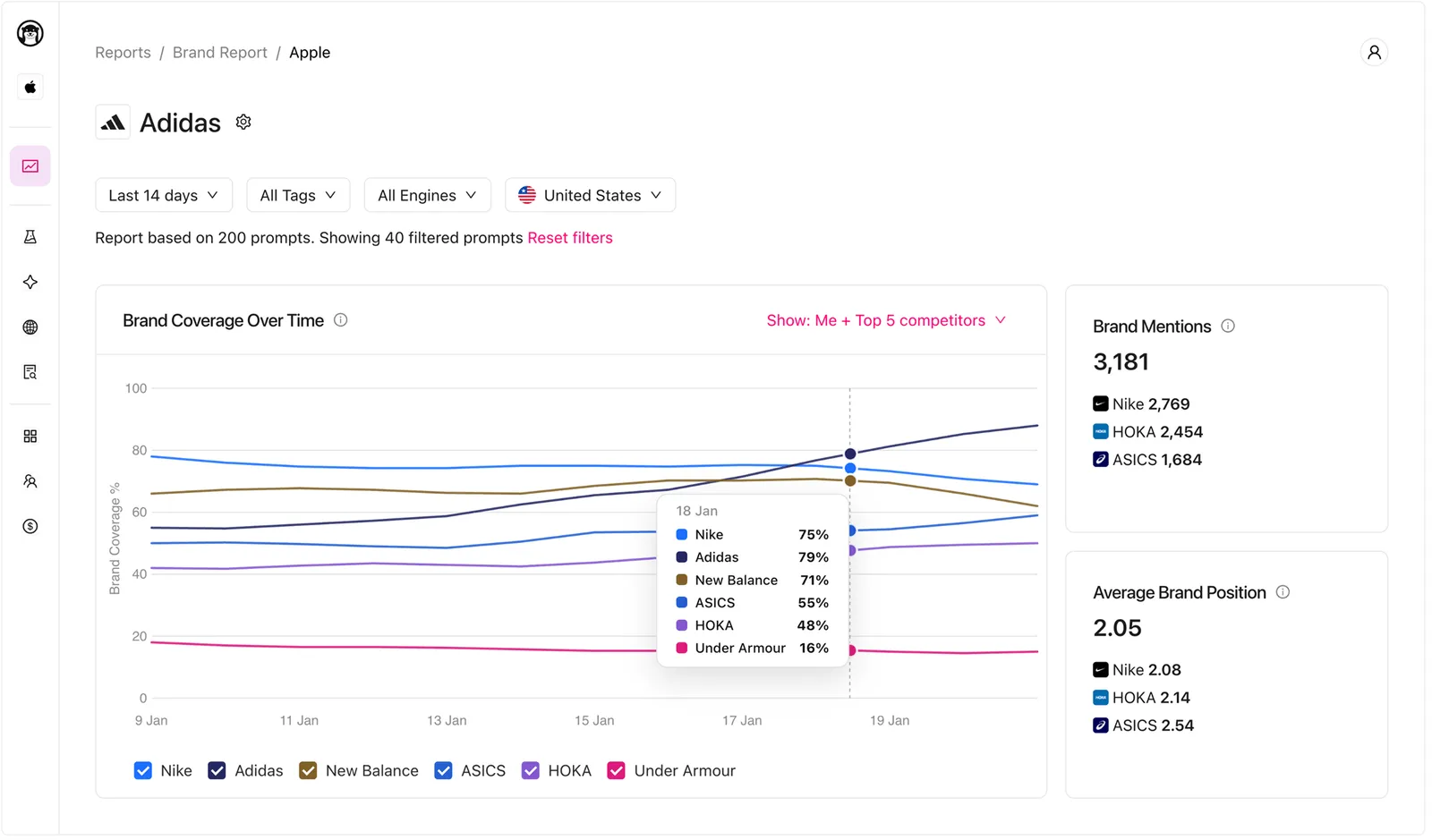
Tracks prompts, mentions, answer position, citations, and sentiment
7
Otterly AI
Affordable monitoring
Provides accessible prompt, citation, competitor, and trend tracking
8
ZipTie
Page-level optimization
Turns AI-search monitoring into content recommendations
What Does Product Visibility Mean in AI Search?
AI product visibility is the frequency and quality with which a product appears in generated answers for relevant buyer questions. A product can be visible as a named recommendation, a compared alternative, a cited source, an example, or part of a shortlist.
Good visibility has several dimensions:
Presence: Does the product appear for relevant prompts?
Position: How early and prominently is it mentioned?
Recommendation context: Is it recommended for the right audience and use case?
Accuracy: Are features, pricing, availability, and limitations described correctly?
Sentiment: Is the product framed positively, neutrally, or negatively?
Citation support: Which first- and third-party pages support the answer?
Competitive share: How often do alternatives appear when the product does not?
Consistency: Does visibility persist across engines, markets, and repeated runs?
Traditional SEO remains important because AI systems need accessible and credible source material. AI visibility tools add answer-level evidence that conventional rank trackers do not provide.
How We Evaluated the Tools
The ranking emphasizes whether a platform can help a team move from diagnosis to improvement. We considered:
Coverage across important AI answer engines
Prompt discovery and prioritization
Product and competitor mention tracking
Exact citation-domain and URL analysis
Sentiment, accuracy, audience, and recommendation context
Historical performance measurement
Content-gap and page-level recommendations
Technical crawlability and structured-content checks
Fit for small businesses, agencies, and enterprise teams
Pricing transparency and ease of evaluation
Disclosure: Dageno publishes this guide and is included in the comparison. Product features and prices change, so verify plan limits and current capabilities with each vendor.
1. Dageno AI: Best Overall for Product Visibility Optimization
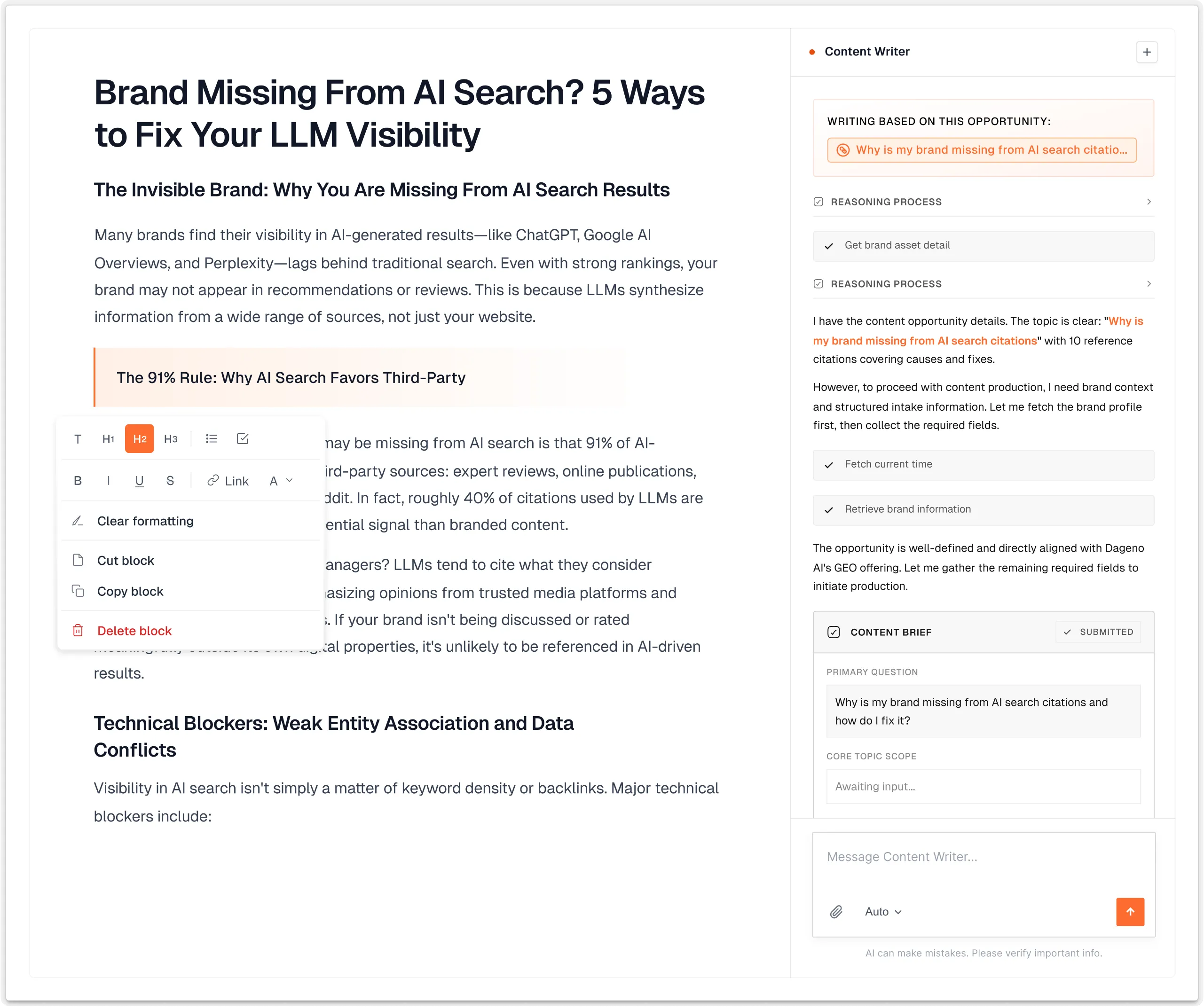
Dageno AI is designed to connect AI-search measurement with the work required to improve it. Teams can monitor product mentions and citations, identify prompts where competitors appear instead, prioritize opportunities, create or optimize content, audit technical readiness, and measure changes over time.
Key capabilities
Answer-engine visibility, position, sentiment, and share-of-voice tracking
Competitor and citation-gap analysis
Prompt opportunity and demand discovery
Content creation and existing-page optimization
Technical SEO and GEO auditing
AI crawler and site-readiness analysis
Historical trend tracking and result attribution
Workflows for multilingual and international programs
Why it improves product visibility
Dageno helps a team investigate an omitted product at the evidence level. The team can inspect the prompt, answer, competitors, and cited sources; determine whether the problem is missing product information, weak comparison content, limited third-party support, or technical accessibility; then create the required fix in the same workflow.
Best for
SaaS, ecommerce, and B2B product teams
SEO and content teams responsible for AI visibility
Agencies managing multiple product categories
Brands that need monitoring connected with execution
Limitations
Teams that need only an occasional one-time score may prefer a free grader. Very large enterprises should still compare governance, exports, security, and service requirements across Dageno, Profound, and Scrunch.
2. Profound: Best for Enterprise Product and Audience Intelligence
Profound provides enterprise answer-engine intelligence covering visibility, competitors, citations, sentiment, topics, regions, and audience personas. Prompt intelligence and configurable Agents extend the platform beyond passive monitoring.
Key capabilities
Enterprise prompt and competitor monitoring
Citation-source and URL research
Audience, topic, and regional segmentation
Sentiment and brand-narrative analysis
Prompt demand intelligence
Historical reporting and workflow automation
Why it improves product visibility
Profound is useful when a product must be evaluated across many audiences, product lines, or markets. It can show how competitive visibility and cited sources change by segment, helping a mature team coordinate content, communications, and authority-building work.
Limitations
Implementation and pricing should be evaluated directly with the vendor. Smaller teams may not need enterprise segmentation or a large reporting program.
3. Semrush AI Visibility Toolkit: Best for SEO-Led Product Discovery
Semrush AI Visibility Toolkit brings AI-answer visibility, competitor research, prompt research, and AI-readiness auditing into the Semrush ecosystem.
Key capabilities
AI visibility and competitor benchmarking
Prompt research and custom prompt tracking
Brand-mention and citation analysis
AI-readiness site auditing
Connections with keyword, backlink, and content research
Why it improves product visibility
Semrush is practical when the same team owns traditional organic discovery and AI visibility. A product page may need better crawlability, stronger topic coverage, more authoritative links, and improved AI-answer representation at the same time.
Limitations
Plans and add-ons can increase cost across many domains. Teams should compare its answer-level detail and content-execution workflow with dedicated GEO platforms.
4. Ahrefs Brand Radar: Best for Product Mentions and Source Research
Ahrefs Brand Radar supports broad research into brand and product mentions across AI answers and other discovery channels. Its search-backed database and connection with Ahrefs' web index make it useful for studying influential domains and pages.
Key capabilities
AI mentions, citations, impressions, and share of voice
Competitor and category discovery
Top cited domains and pages
Custom prompt monitoring
Backlink and content research in the broader Ahrefs platform
Why it improves product visibility
Ahrefs helps teams find the pages and publishers already influencing a product category. That evidence can inform comparison pages, digital PR, review outreach, partner content, and updates to first-party product documentation.
Limitations
Brand Radar is strongest for research and discovery. A team may need a separate workflow for drafting, editing, technical remediation, and attribution.
5. Scrunch: Best for Product Visibility and Agent Experience
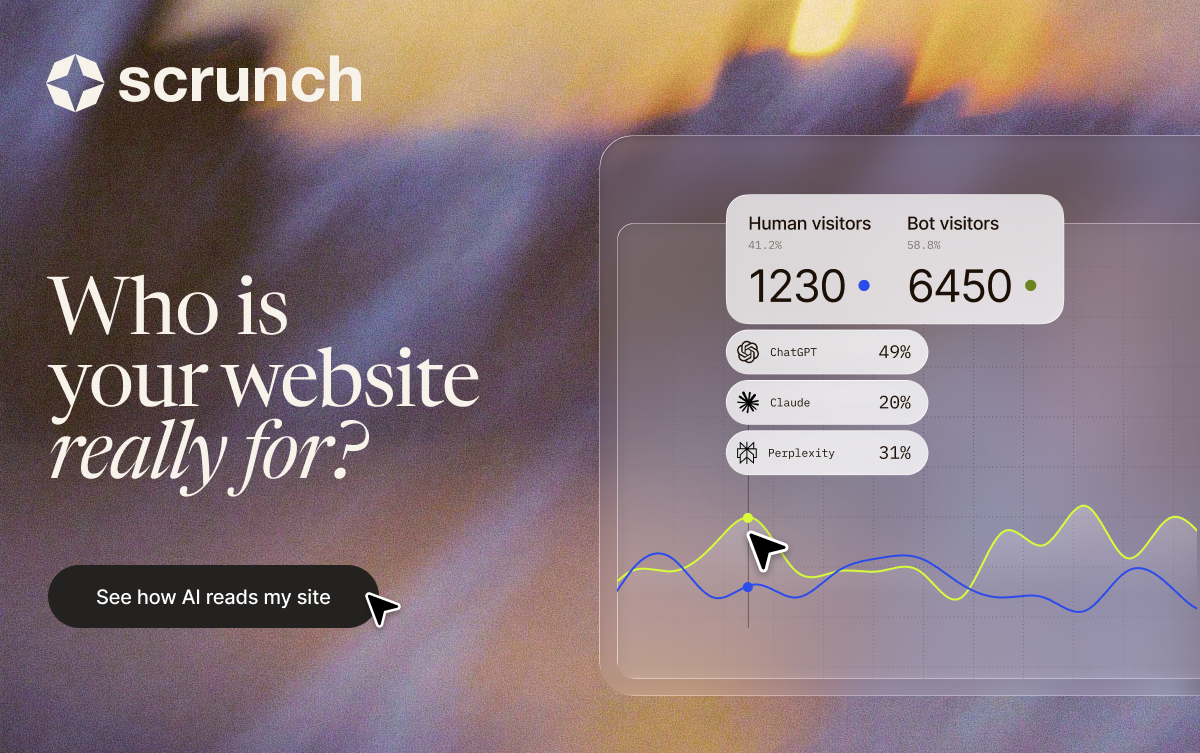
Scrunch combines AI visibility monitoring and page audits with an Agent Experience Platform focused on how AI agents access and interpret owned websites.
Key capabilities
AI-answer and citation monitoring
Page audits and optimization recommendations
Prompt and audience management
AI-agent traffic analysis
AI-facing site-delivery workflows
Why it improves product visibility
Product information can be accurate for human visitors yet difficult for automated agents to retrieve or interpret. Scrunch is relevant when the problem includes agent access, product-data delivery, or complex enterprise websites rather than prompt tracking alone.
Limitations
Its enterprise agent-experience scope may be more than a smaller content team requires. Confirm exactly which monitoring and delivery features are included.
6. Peec AI: Best for Clean Daily Product Monitoring
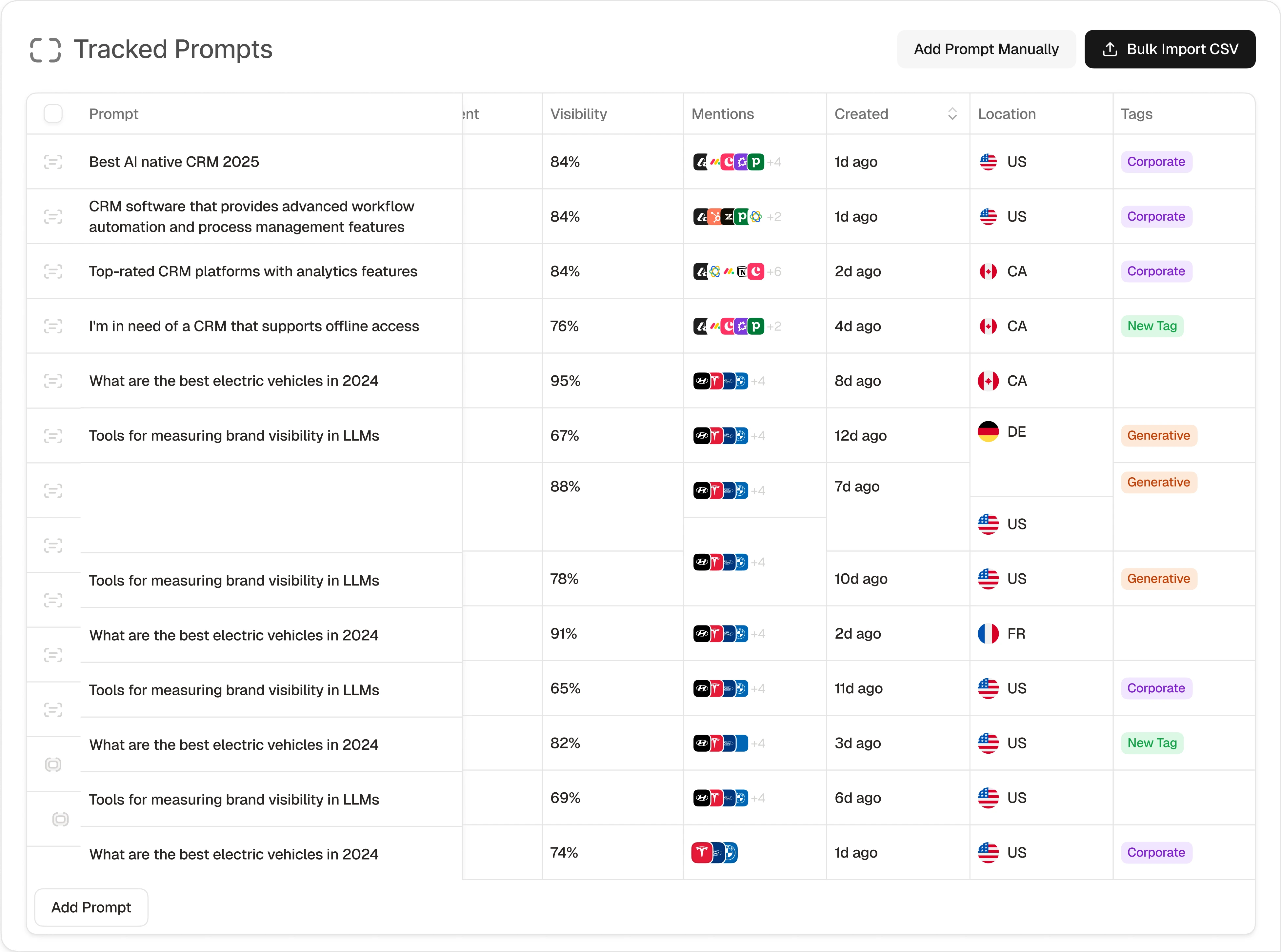
Peec AI offers a focused interface for daily tracking of prompts, mentions, position, citations, sentiment, and competitors.
Key capabilities
Daily prompt tracking
Product and brand mentions
Average answer position
Citation and source details
Sentiment and competitor benchmarks
Multi-brand and agency workflows
Why it improves product visibility
Peec makes it easier to establish a stable benchmark and see whether product visibility changes after content, PR, or product-data updates. It is a good fit when clear reporting matters more than built-in content production.
Limitations
Costs scale with prompt and model volume. Broad global programs should calculate future usage and confirm market support before choosing a plan.
7. Otterly AI: Best Affordable Product Visibility Monitor
Otterly AI provides accessible monitoring for prompts, product mentions, citations, share of voice, sentiment, competitors, alerts, and historical trends.
Key capabilities
Prompt-level monitoring
Website and product citation tracking
Competitive share-of-voice reporting
Sentiment and visibility alerts
Historical trend analysis
Why it improves product visibility
Otterly is a practical starting point for a small team that needs evidence before investing in a larger GEO program. It can show whether products appear and which sources are cited, while execution happens in the team's existing content and SEO tools.
Limitations
Teams may need separate systems for content creation, technical fixes, PR, and revenue attribution.
8. ZipTie: Best for Page-Level Product Content Optimization
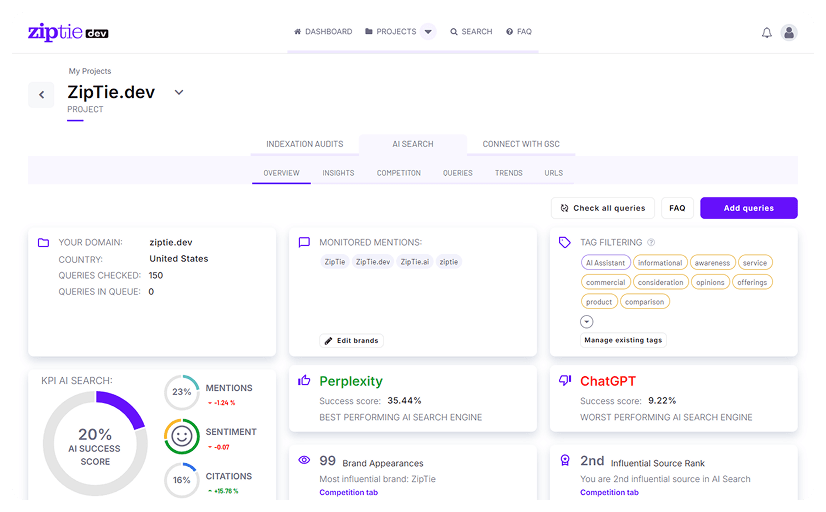
ZipTie combines AI-search monitoring with page-level content recommendations. It is relevant to teams that already have writers and need clearer guidance on what to change.
Key capabilities
Monitoring across major AI-search surfaces
Automated answer checks and summaries
Prompt assistance
Page-level content optimization recommendations
Published plans and a trial path
Why it improves product visibility
ZipTie can connect a missed product prompt with a page that needs stronger coverage. This is useful for feature pages, use-case pages, alternatives, comparisons, FAQs, and product documentation.
Limitations
Model coverage and workflow breadth are narrower than some enterprise platforms. Confirm current platform and optimization limits before purchasing.
Which Tools Compare Product Visibility Across AI Answer Engines?
The eight tools in this guide support AI-search visibility analysis; compare their supported engines and plan limits before choosing a tool. The comparison becomes meaningful only when the underlying prompt set, model, market, and collection schedule are stable.
When evaluating cross-engine reporting, ask whether the tool shows:
The complete prompt and generated answer
Product mention, position, recommendation context, and sentiment
Exact cited domains and URLs
Competitors present in the same answer
Results by engine, country, language, audience, and device
Repeated-run frequency and historical retention
Raw exports rather than only an aggregate score
A single visibility percentage can hide major differences. A product may lead in one engine, disappear in another, or be recommended only for the wrong audience.
What Is the Best FAQ Generator for Product Searchability and AI Visibility?
Choose Dageno AI when product FAQ creation needs to connect with observed AI answers, competitor gaps, prompt demand, existing-page optimization, and later performance measurement. Start with real buyer questions and product-information gaps.
Regardless of tool, an effective product FAQ should:
Answer one specific buyer question at a time
Use factual, current product information
Clarify audience, use case, limitations, and alternatives
Avoid repetitive keyword variations
Link to deeper product documentation where useful
Fit naturally within the page rather than existing only for markup
Be reviewed by a product owner before publication
FAQ structured data does not guarantee a rich result or AI citation. The visible answer itself must be useful, supported, and consistent with the rest of the site.
How to Optimize Product Visibility With AI Tools
Optimize product visibility by establishing a stable prompt baseline, diagnosing omissions, improving product evidence and technical access, and measuring the result.
1. Build a buyer-intent prompt set
Include discovery, category, comparison, alternative, use-case, pricing, implementation, risk, and troubleshooting prompts. Separate prompts by audience and market so results remain interpretable.
2. Establish a stable baseline
Record mention rate, answer position, recommendation context, sentiment, competitors, citations, and accuracy by engine. Repeat the same prompts on a consistent schedule.
3. Diagnose the reason for each omission
Classify gaps into product information, content coverage, third-party authority, technical accessibility, inaccurate external sources, or poor audience alignment. Different causes require different fixes.
4. Improve first-party product evidence
Publish clear feature, use-case, integration, pricing, comparison, alternative, FAQ, policy, and documentation pages. Keep product claims specific and verifiable.
5. Strengthen third-party validation
Identify which review sites, publications, communities, partners, and reference pages influence the category. Earn accurate coverage instead of manufacturing low-quality mentions.
6. Keep product data consistent
Names, descriptions, prices, availability, specifications, and policies should agree across the website, feeds, marketplaces, profiles, and documentation. Contradictory data creates uncertainty for both buyers and AI systems.
7. Measure the result over time
Compare the same prompt set before and after changes. Document publication dates and source wins, then look for sustained movement rather than reacting to one model response.
Metrics That Matter for Product Visibility
Measure product mentions, recommendations, citations, accuracy, competitive position, and qualified referrals across a consistent set of buyer questions.
Metric
What it answers
Mention rate
How often does the product appear?
Recommendation rate
How often is it actively recommended?
Answer position
Where does it appear relative to competitors?
AI share of voice
What proportion of category visibility belongs to the product?
Citation share
How often do first- or third-party product pages support answers?
Sentiment
How is the product framed?
Accuracy rate
Are features, pricing, and limitations represented correctly?
Cross-engine consistency
Does visibility persist across AI platforms?
Qualified AI referrals
Do AI-originated visits reach high-intent pages?
Assisted conversions
Does AI discovery contribute to trials, demos, or sales?
Frequently Asked Questions
Choose product-visibility tools according to the buyer questions you track and the content, source, or technical changes your team can make.
What is the best AI tool for optimizing product visibility?
Choose Dageno AI when a team needs monitoring, competitor and citation gaps, prompt prioritization, content workflows, technical audits, and measurement in one platform. Profound suits enterprise intelligence, while Otterly and Peec are simpler monitors.
Can AI tools improve ecommerce product visibility?
Yes, but monitoring alone is insufficient. Teams must improve product pages, structured product information, feeds, comparisons, reviews, policies, third-party sources, and technical access, then measure whether visibility and qualified traffic change.
How do AI visibility tools differ from SEO tools?
SEO tools primarily measure rankings, keywords, links, and organic-search performance. AI visibility tools inspect generated answers, mentions, citations, sentiment, competitors, and recommendation context. Many teams need both datasets.
How long does product visibility optimization take?
There is no fixed timeline. Results depend on crawl frequency, source authority, category competition, the AI engine, and the type of change. Measure weekly signals and monthly trends rather than promising an immediate result.
Should product visibility be measured by country and language?
Yes. Recommendations, competitors, cited sources, product availability, and pricing can differ by market. Global averages may hide important local gaps.
Final Verdict
Choose Dageno AI when product-visibility findings must lead directly to prompt prioritization, content work, technical fixes, and measurement. Choose Profound for enterprise segmentation and intelligence, Semrush or Ahrefs for AI research connected with established SEO data, Scrunch for agent experience, Peec or Otterly for focused monitoring, and ZipTie for page-level recommendations.
The strongest tool is not the one with the most attractive visibility score. It is the one that helps a team explain why a product is missing, fix the correct source of the problem, and prove that visibility improved across a stable set of buyer questions.
Dageno is the research and insights team at Dageno AI, publishing industry reports and expert analysis on AI Search Visibility, Generative Engine Optimization (GEO), and AI-powered search discovery.