ZipTie AI Review 2026: Features, Pricing & Verdict
An evidence-based ZipTie AI review covering its seven-engine tracking, AI Success Score, pricing model, add-ons, limitations, and how it compares with Dageno.
ZipTie is an AI-search monitoring and optimization platform. It records how selected prompts are answered across seven AI experiences, measures citations, brand mentions and sentiment, and turns those observations into an AI Success Score. It is useful for teams that want a configurable monitoring system; it is less suitable for buyers who expect a fixed-price, all-in-one publishing workflow.
ZipTie AI Search Analytics at a glance
Question
Practical answer
What does it track?
ChatGPT, Google AI Overviews, Perplexity, Google AI Mode, Microsoft Copilot, Bing AI Overview and Gemini, subject to market availability.
Core metrics
Citation rate, mention rate, sentiment, competitors and the combined 0–100 AI Success Score.
How is pricing calculated?
By monitored prompts and enabled engines, not by seats or projects. The public site currently shows plans starting at $35.63 per month.
Trial
Seven days, with no card required according to ZipTie’s current website.
Best fit
SEO and GEO teams that need prompt-level evidence, source analysis and configurable tracking frequency.
Main caveat
The score is a useful trend indicator, but it is not a traffic or revenue metric and should not be treated as one.
ZipTie runs the prompts you choose on the schedule you choose and archives the resulting answers. At prompt level, it checks three different outcomes:
Citation: whether an AI answer links to a page on your domain.
Mention: whether it names your brand, even when no link is present.
Sentiment: whether the surrounding description is positive, neutral or negative.
Those signals are combined into an AI Success Score. The score makes a large prompt set easier to scan, but teams should still inspect the underlying answers. A score can rise because of more mentions while qualified referral traffic remains unchanged; it can also fall because a model’s answer varied during a single measurement cycle. The defensible workflow is to look for repeated changes across several runs, then verify which prompts, engines and sources caused the movement.
How the platform works
1. Project and prompt setup
The Project Wizard reads a site and proposes category, comparison and persona prompts. Teams can accept, edit or replace them, choose a country and language, and select daily, weekly or monthly checks. The suggestions accelerate setup, but they should not replace customer research. Add prompts from sales calls, support tickets, GSC queries and high-value comparison pages so the monitored set reflects real buying decisions.
2. Answer capture and competitor analysis
The Prompts & URLs view keeps the answer, detected citations, mention and sentiment signals together. The Competitors module ranks brands by mention share and helps locate prompts where another company repeatedly appears. That makes the platform stronger than a one-time “AI visibility checker”: it preserves the evidence needed to distinguish a persistent gap from a random answer variation.
3. Trends and source discovery
LLM Trends compares engines over time. The optional UGC Impact Analysis add-on identifies third-party domains, including Reddit discussions, that influence answers. This is valuable because a brand’s own page is only one possible citation source. If an independent comparison or community thread dominates a prompt, rewriting the brand homepage alone is unlikely to solve the gap.
4. Optimization and delivery options
ZipTie offers content briefs and drafts through an add-on, plus API and MCP access for teams that want to move data into another workflow. Its public pricing describes the API/MCP add-on as a flat $10 per month and Content Generation as $20 per content-context slot. UGC Impact Analysis changes the prompts-and-engines subtotal, so buyers should model the full workspace rather than compare only the headline starting price.
Where ZipTie is strong
Transparent monitoring units
Paying for prompts and engines can be easier to forecast than paying per user. It also forces a useful decision: which questions are commercially important enough to monitor? Agencies can keep multiple projects in one workspace without a separate seat charge.
Evidence behind the score
The platform retains full answers rather than showing only an opaque visibility percentage. That matters when analysts need to explain whether a change came from a lost citation, a new competitor recommendation or a negative description.
Flexible market and frequency controls
Country, language and schedule controls support teams that do not need every query checked every day. This can prevent low-value informational prompts from consuming the same budget as revenue-critical comparisons.
Limitations buyers should understand
AI answers are non-deterministic
No tracker can turn one generated response into a stable market fact. ZipTie acknowledges this and builds trends from repeated measurements. Buyers should still define minimum sample sizes and avoid reporting a one-day movement as a strategic win or loss.
Coverage is not identical in every market
The seven-engine list does not mean every engine is available for every country. Confirm the exact country, language and engine combination during setup.
Add-ons change the real price
Source intelligence, content capacity and API access are priced separately. A fair comparison should use the cost of the configuration your team will actually run, not the lowest possible plan.
Monitoring is not business attribution
Citation share and mention share show answer visibility. To prove impact, connect changes to AI referral sessions, assisted conversions, branded search and qualified pipeline. Otherwise, the team may optimize a visible but commercially weak prompt set.
ZipTie vs Dageno AI
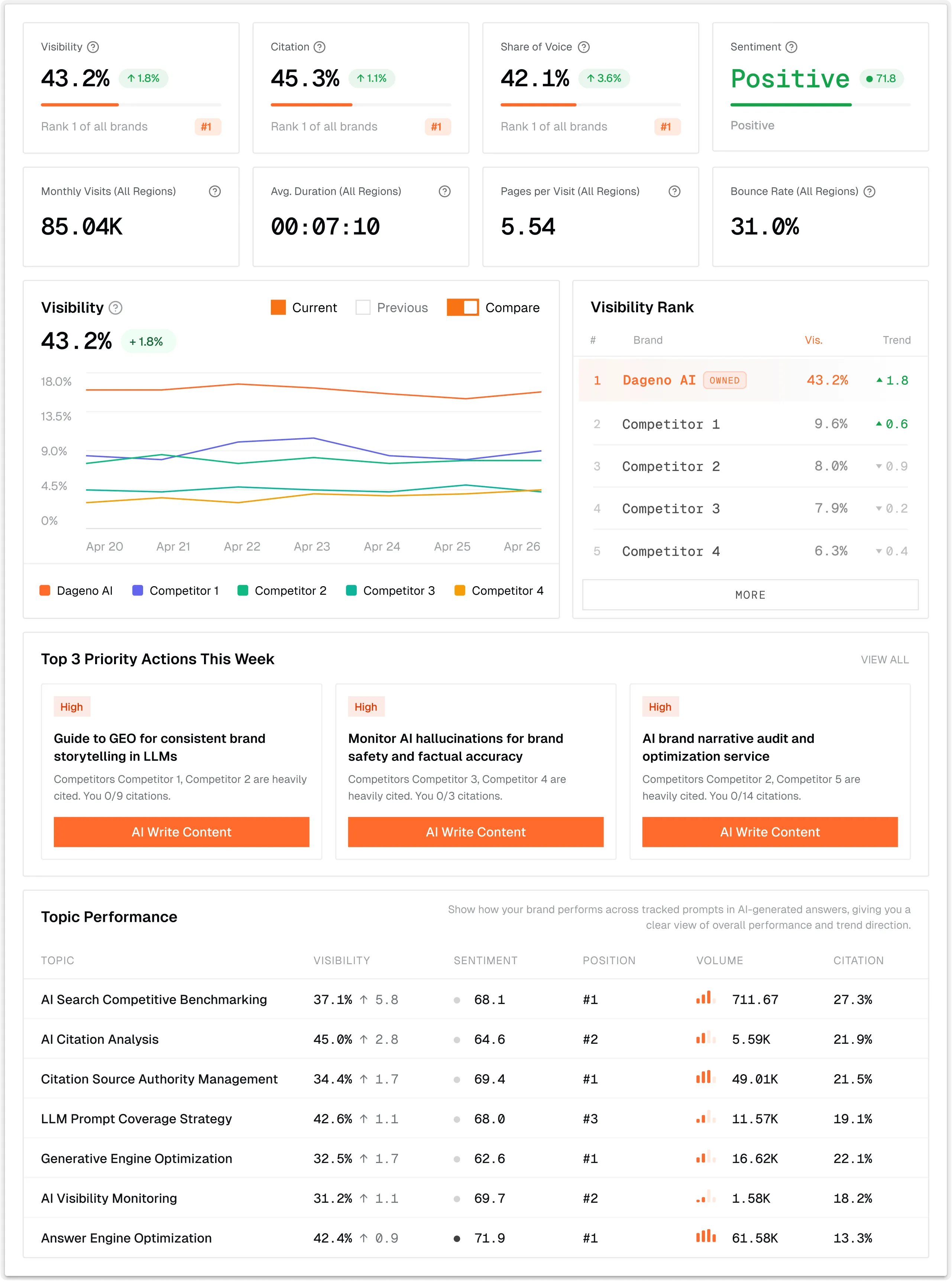
ZipTie is a good choice when configurable prompt-and-engine monitoring and a compact executive score are the priority. Dageno is designed for a broader operating loop: find demand and competitor gaps, inspect cited sources, create or improve content, and measure whether the intervention changed visibility.
Choose Dageno when the team needs one workspace to connect monitoring with content and source opportunities. Choose ZipTie when its per-prompt configuration, AI Success Score and optional UGC analysis better match the reporting model. In either case, run a trial using the same 30–50 high-value prompts and score both products on answer capture accuracy, market coverage, workflow time and export quality.
ZipTie is a credible, purpose-built AI search analytics platform with unusually clear public explanations of its metrics and pricing units. Its strongest use case is repeated prompt monitoring backed by answer-level evidence. Buy it for that workflow—not because a single AI Success Score can prove revenue. Teams that need opportunity discovery, content execution and measurement in the same product should compare it directly with Dageno using their own prompts, markets and reporting requirements.
Frequently asked questions
Does ZipTie track Claude or Grok?
ZipTie’s current public seven-engine list does not include Claude or Grok. It lists ChatGPT, Google AI Overviews, Perplexity, Google AI Mode, Microsoft Copilot, Bing AI Overview and Gemini. Verify the live list before purchase because coverage can change.
Is ZipTie an SEO rank tracker?
Not in the conventional blue-link sense. It monitors generated answers, mentions, citations and sentiment. Its Search Console integration can place Google performance beside AI-search data, but the measurement units remain different.
Is the AI Success Score enough to report performance?
No. Use it to locate trends and prioritize investigation, then report the underlying citation, mention and sentiment changes alongside traffic and conversion outcomes.
Dageno is the research and insights team at Dageno AI, publishing industry reports and expert analysis on AI Search Visibility, Generative Engine Optimization (GEO), and AI-powered search discovery.