Explore 12,000+ niche markets with no login required
TL;DR
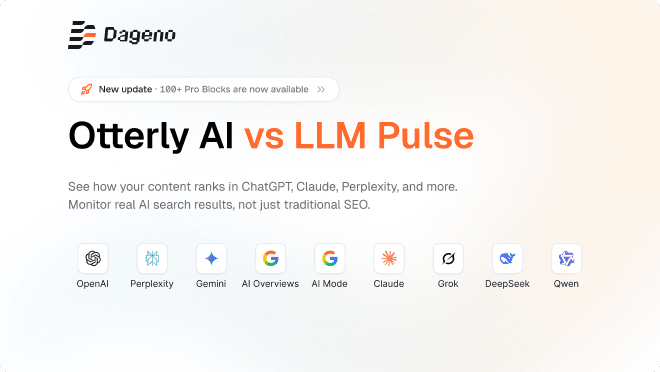
Otterly AI vs LLM Pulse is a comparison of two purpose-built AI visibility tracking platforms — both launched in 2024–2025, both targeting brands that want to monitor how AI systems like ChatGPT, Perplexity, Google AI Overviews, and Gemini describe and recommend them
Key differences: Otterly AI has a lower headline entry price ($29/month) but requires paid add-ons for Google AI Mode and Gemini — making the true cost for comprehensive Google coverage 2.6–3× higher at mid-tier than LLM Pulse; LLM Pulse (€49/month) includes these models on all plans with better per-prompt economics at scale
Otterly AI wins on: lowest absolute entry price for minimal prompt volumes, Microsoft Copilot inclusion on base plans, Gartner Cool Vendor recognition, and user ratings (5.0/5 on OMR and Product Hunt)
LLM Pulse wins on: true cost-per-prompt at 50+ prompts with full Google coverage, sentiment analysis depth, query fan-out visualization showing how AI models expand prompts, app store tracking (iOS/Google Play), and agency white-label flexibility
Both Otterly AI and LLM Pulse share a structural limitation: they are monitoring and reporting systems — they tell you where you stand in AI search and surface competitive gaps, but neither provides the execution infrastructure to close those gaps systematically; for teams ready to move beyond monitoring into continuous AI visibility improvement, a dedicated execution layer is needed alongside either tool
Overview: What Otterly AI and LLM Pulse Do
Otterly AI (otterly.ai) launched in October 2024, grew to 15,000+ users, and earned recognition including a Gartner Cool Vendor 2025 designation and 5.0/5 ratings on OMR Reviews and Product Hunt. It tracks brand mentions, citations, and visibility across ChatGPT, Perplexity, Google AI Overviews, and Microsoft Copilot on base plans, with Google AI Mode and Gemini available as add-ons.
LLM Pulse (llmpulse.ai) launched publicly in July 2025, founded by a team with deep SEO experience from marketplace platforms managing 250M+ indexed pages. It's bootstrapped, serving fintech, SaaS, and agency clients globally. LLM Pulse includes ChatGPT, Perplexity, Google AI Mode, Google AI Overviews, and Gemini on all plans.
Both platforms serve the same core use case: helping brands understand how AI systems represent them — whether they're being mentioned, how sentiment frames those mentions, and how their AI share of voice compares to competitors.
Pricing Comparison: The Add-On Problem
The most significant practical difference between these platforms is how they price Google coverage.
LLM Pulse Pricing (All Plans Include 5 AI Models)
Plan
Price
Prompts
Cost/Prompt
Starter
€49/mo
50
€0.98
Growth
€99/mo
100
€0.99
Scale
€299/mo
300
€1.00
All plans include: ChatGPT, Perplexity, Google Gemini, Google AI Mode, Google AI Overviews.
Otterly AI Pricing (Google AI Mode + Gemini Require Add-Ons)
Plan
Base Price
+AI Mode Add-On
+Gemini Add-On
True Cost (Full Google)
Lite ($29, 15 prompts)
$29/mo
+$9/mo
+$9/mo
$47/mo
Standard ($189, 100 prompts)
$189/mo
+$59/mo
+$59/mo
$307/mo
Premium ($489, 400 prompts)
$489/mo
+$149/mo
+$149/mo
$787/mo
Annual savings at 150 prompts with full Google coverage: approximately €2,500/year choosing LLM Pulse over Otterly AI.
The headline price comparison (Otterly $29 vs LLM Pulse €49) inverts once you add the Google coverage that most teams actually need. Google AI Mode is becoming a primary search interface for many users; excluding it from base pricing understates Otterly's real cost for comprehensive monitoring.
AI Model Coverage
AI Model
LLM Pulse (€49 Starter)
Otterly AI ($29 Lite)
ChatGPT
✅
✅
Perplexity
✅
✅
Google AI Overviews
✅
✅
Google AI Mode
✅
💰 Add-on
Google Gemini
✅
💰 Add-on
Microsoft Copilot
❌ (Enterprise)
✅
Claude
❌ (Enterprise)
❌
Grok / DeepSeek
❌ (Enterprise)
❌
Feature Comparison
Where Otterly AI Wins
Lower true entry price for minimal prompt volumes: At 15 prompts with basic Google coverage, Otterly's $47/month (with AI Mode + Gemini add-ons) beats LLM Pulse's €49/month with similar functionality. For teams just beginning AI visibility monitoring with very limited prompt sets, Otterly provides the cheapest credible entry.
Microsoft Copilot on base plans: Integrated into Windows, Edge, and Microsoft 365 for hundreds of millions of enterprise users, Copilot is a meaningful AI channel that LLM Pulse only includes on enterprise plans.
Brand recognition and reviews: Gartner Cool Vendor 2025, 5.0/5 on OMR and Product Hunt signal strong execution quality that smaller or newer platforms can't yet claim.
Where LLM Pulse Wins
Better per-prompt economics at scale: At 100+ prompts with full Google coverage, LLM Pulse's cost-per-prompt advantage is substantial — the ~3× price gap at the 150-prompt tier makes it the clear value choice for teams tracking meaningful prompt volumes.
Sentiment analysis depth: LLM Pulse provides positive/neutral/negative/mixed sentiment scoring with deeper framing analysis, helping teams understand not just whether they're mentioned but how they're characterized.
Query fan-out visualization: LLM Pulse shows how AI models expand user prompts into sub-queries — unique insight into AI reasoning that Otterly doesn't provide.
App store tracking: LLM Pulse monitors iOS App Store and Google Play AI citations, relevant for mobile app companies.
White-label flexibility: Three tiers of white-labeling (partial, full custom domain, embedded integration) make LLM Pulse more suitable for agencies offering branded AI visibility services.
Dageno AI: The Execution Layer Both Otterly and LLM Pulse Are Missing
Otterly AI vs LLM Pulse is a meaningful comparison — and the decision between them matters for teams building AI visibility monitoring programs. But both platforms share a structural limitation that the monitoring-vs-monitoring comparison doesn't surface:
They are watching systems. When either platform shows you that a competitor appears in 70% of ChatGPT responses for your category and you appear in 15%, both tell you exactly the same thing: you have a visibility gap. Neither provides the infrastructure to close it.
Dageno AI is built to close that gap. Its architecture connects the monitoring intelligence that Otterly and LLM Pulse provide to a continuous execution loop:
Layer 1 — Data Observation: Continuous high-frequency monitoring across 10+ AI platforms — producing statistically reliable citation frequency trends rather than snapshots. The same monitoring value as Otterly or LLM Pulse, with higher aggregation frequency for statistical reliability.
Layer 2 — Rule Analysis: Query Fan-out semantic matching that identifies why competitors win citations — which specific content signals, source types, and distribution patterns AI systems are weighting in your category. This goes beyond "you appear less often" to "here's the specific gap causing it."
Layer 3 — Business Context Accumulation: Structured brand knowledge (facts, product capabilities, FAQs, case studies) built into AI-understandable format. Reduces hallucinations. Ensures AI systems describe your brand consistently and accurately — addressing a problem monitoring tools can detect but cannot fix.
Layer 4 — Agent Execution: Content production, external source building, social and UGC community distribution, and automated workflow execution. This is the layer that neither Otterly AI nor LLM Pulse provides — the marketing actions that actually improve citation rates rather than leaving them as dashboard findings.
For teams who have outgrown the "monitoring only" phase and need a platform that connects intelligence to action, Dageno provides the closed loop that the Otterly vs LLM Pulse comparison doesn't offer. Explore Dageno's monitoring and execution capabilities. Free plan at dageno.ai.
Otterly AI vs LLM Pulse is a genuine choice between two capable AI visibility tracking platforms. Otterly has lower headline pricing and strong brand recognition; LLM Pulse offers better economics at scale with full Google coverage included. Both deserve consideration depending on your prompt volume and coverage priorities.
The question both leave unanswered: once you know your visibility gap, how do you close it? Dageno provides the execution infrastructure that connects monitoring intelligence to the content creation, source building, and distribution actions that actually improve AI citation rates.
Tim is the co-founder of Dageno and a serial AI SaaS entrepreneur, focused on data-driven growth systems. He has led multiple AI SaaS products from early concept to production, with hands-on experience across product strategy, data pipelines, and AI-powered search optimization. At Dageno, Tim works on building practical GEO and AI visibility solutions that help brands understand how generative models retrieve, rank, and cite information across modern search and discovery platforms.