8 Best Supermetrics Alternatives in 2026 (Compared)
Compare Funnel, Windsor AI, Coupler, Adverity, Improvado, Fivetran, Airbyte, and Dageno by architecture, governance, migration effort, and best-fit use case.
The best Supermetrics alternative depends on what you are replacing. A team exporting a few ad platforms into Google Sheets has a different problem from a company standardizing data in Snowflake, enforcing metric definitions, or measuring visibility in AI-generated answers.
This guide compares eight options: Funnel, Windsor AI, Coupler, Adverity, Improvado, Fivetran, Airbyte, and Dageno. The first seven address marketing-data movement or transformation in different ways. Dageno is included as a complementary choice for AI search visibility and GEO—not as a substitute for a general-purpose ETL pipeline.
Best Supermetrics alternatives at a glance
Platform
Best fit
Typical destination pattern
Important trade-off
Funnel
Marketing teams needing governed, normalized data
Warehouses, BI, Sheets
Greater capability requires process ownership
Windsor AI
Cost-conscious multi-channel reporting
BI tools, warehouses, spreadsheets
Validate connector depth and support for critical sources
Coupler
Spreadsheet-first automated reporting
Google Sheets, Excel, Looker Studio, warehouses
Complex enterprise modeling may need another layer
Adverity
Enterprises requiring governance and transformation
Central data warehouse and BI
Sales-led implementation and higher operational scope
Improvado
Enterprise marketing analytics operations
Warehouses, BI, managed pipelines
Best value appears in broader implementations
Fivetran
Engineering-led managed ELT
Cloud data warehouses
Marketing semantics are not the core product
Airbyte
Teams wanting flexible or open-source pipelines
Warehouses, lakes, databases
Self-managed flexibility creates engineering work
Dageno
Teams measuring and improving AI search visibility
GEO dashboards and content workflows
Complements rather than replaces marketing ETL
Why teams look for a Supermetrics alternative
Supermetrics is often convenient for moving marketing data into spreadsheets, Looker Studio, and warehouses. Alternatives become relevant when the operating model changes:
reports outgrow spreadsheet refreshes and need a warehouse-first architecture;
source, account, destination, or user pricing becomes hard to forecast;
analysts need reusable metric definitions instead of dashboard-specific formulas;
finance and leadership need governed numbers with lineage and approvals;
the team wants managed service, open-source flexibility, or engineering-owned ELT;
“search visibility” now includes ChatGPT, Perplexity, Gemini, Claude, and Google AI answers.
Do not select a replacement from connector count alone. A connector may expose only a subset of fields, refresh windows, account types, or historical depth. Test the exact source-to-destination path that supports a real report.
How we evaluated the platforms
We used eight buying criteria that reveal the true operating cost:
Destination architecture: spreadsheets and dashboards versus warehouse, lake, or database pipelines.
Transformation: normalization, joins, formulas, reusable metrics, and schema control.
Reliability: refresh frequency, retries, alerts, backfills, and behavior after API changes.
Governance: access controls, lineage, auditability, workspaces, and environment separation.
Operations: who owns authentication, quality checks, failures, and vendor support.
Pricing unit: sources, accounts, destinations, rows, usage, seats, or service level.
Specialization: whether the product solves general data integration, marketing analytics, or AI visibility.
Pricing and packages change. Confirm current terms with vendors and run a proof of concept using your largest account, most fragile connector, most important calculated metric, and required backfill window.
1. Funnel — best overall marketing-data platform alternative
Funnel is a close alternative for organizations that want marketing-specific connectors plus a governed transformation layer. It can collect channel data, map fields into consistent dimensions and metrics, and activate the result across reporting and warehouse destinations.
Where it is strongest
Centralizing paid, organic, commerce, and other marketing sources.
Standardizing naming, currency, channel groupings, and calculated metrics before export.
Reusing governed data across multiple dashboards and teams.
Reducing dependence on formulas embedded in individual spreadsheets.
What to test
Build one normalized spend-and-performance model across two advertising platforms. Check account hierarchy, currency conversion, historical reloads, custom fields, destination schedules, and what happens when a source changes its schema. Ask who can edit transformation rules and how changes are audited.
Limitation: Funnel is not merely a lightweight spreadsheet add-on. Teams need to define metric ownership and data structure to realize its value.
2. Windsor AI — best value-oriented connector alternative
Windsor AI is commonly shortlisted by agencies and smaller teams that need multi-source marketing data delivered to BI tools, warehouses, or spreadsheets without adopting a large enterprise platform.
Where it is strongest
Broad multi-channel reporting with a relatively accessible starting point.
Delivering data to common dashboard and storage environments.
Supporting teams that prioritize connector coverage and speed over extensive governance.
What to test
Do not use a generic connector demo. Connect the exact ad account, analytics property, and CRM object you depend on. Compare dimensions, attribution fields, custom conversions, data freshness, timezone handling, and historical depth with the source UI. Trigger an authentication failure and inspect alerting and recovery.
Limitation: broad availability does not guarantee identical field depth across every connector. Critical sources need field-level validation.
3. Coupler — best spreadsheet-first automation alternative
Coupler is suited to analysts who want scheduled imports into Google Sheets or Excel while retaining paths to Looker Studio and data warehouses. It is a practical step up from manual CSV exports and copied formulas.
Where it is strongest
Fast recurring reporting for teams already operating in spreadsheets.
Straightforward source-to-destination schedules.
Lightweight transformations such as filtering, column management, joins, and calculated fields.
Agency or departmental dashboards that do not yet require a full data platform.
What to test
Recreate a production workbook, not a toy dashboard. Measure refresh time, row growth, formula stability, duplicate handling, account additions, and behavior when a schema changes. Decide whether transformations should live in the importer, spreadsheet, BI tool, or warehouse—splitting logic among all four becomes expensive to maintain.
Limitation: spreadsheet convenience can become a constraint when models require lineage, environments, granular permissions, or very large data volumes.
4. Adverity — best for enterprise marketing-data governance
Adverity targets larger organizations that need ingestion, transformation, data-quality controls, governance, and activation across complex marketing environments.
Where it is strongest
Multi-brand, multi-agency, and multi-market data operations.
Central transformation and harmonization before downstream BI.
Quality monitoring, permissions, and repeatable enterprise workflows.
Reducing metric disagreement among regions and reporting teams.
What to test
Map one global campaign taxonomy across regions with different naming and currencies. Validate lineage from a dashboard value back to the source, change approval, role-based access, development-versus-production workflows, and incident support. Include the people who will operate the system, not only report consumers.
Limitation: enterprise scope generally means a longer evaluation and implementation. It may be excessive for a small team needing five connectors and one dashboard.
5. Improvado — best for managed enterprise marketing pipelines
Improvado focuses on enterprise marketing data operations, including extraction, transformation, governance, and analytics workflows. It is relevant when a team wants vendor assistance alongside platform capability.
Where it is strongest
Complex cross-channel reporting with centralized definitions.
Managed onboarding and operational support requirements.
Warehouse and BI delivery for large marketing organizations.
Bringing fragmented regional or agency data into a controlled model.
What to test
Define acceptance criteria before the demo: exact connectors and fields, historical backfill, refresh SLA, transformation ownership, error response, warehouse schema, and handoff documentation. Clarify which requests are self-service, configuration work, or paid services.
Limitation: the product is most compelling when an organization needs a broader platform and service relationship, not a simple Sheets connector.
6. Fivetran — best for engineering-led managed ELT
Fivetran is a managed data movement platform designed to replicate data into cloud warehouses and other destinations. It can cover marketing sources while also serving finance, sales, product, and operational pipelines.
Where it is strongest
Warehouse-first architecture managed by data engineering.
Automated schema handling and reliable replication.
Consolidating marketing data with broader company data.
Separating ingestion from modeling through SQL transformation workflows.
What to test
Estimate usage with realistic historical syncs and high-volume tables. Inspect connector schemas, update cadence, deletion behavior, re-sync cost, and downstream transformation requirements. Confirm that the fields required by marketing exist and can be reconciled with source totals.
Limitation: Fivetran moves data; it does not automatically provide a marketing taxonomy, executive dashboard, or AI-search measurement model. Those belong in the warehouse and BI layer.
7. Airbyte — best for open and flexible data integration
Airbyte appeals to teams that want a large connector ecosystem, deployment flexibility, and greater control over pipelines. It can support cloud-managed or more self-controlled data movement patterns depending on the chosen product and architecture.
Where it is strongest
Engineering teams that need extensible connectors or custom sources.
Organizations balancing managed convenience with architectural control.
Replicating data into warehouses, lakes, and databases beyond marketing.
Avoiding dependence on dashboard-specific extraction logic.
What to test
Run the hardest connector through a full backfill and incremental sync. Measure setup time, normalization needs, schema drift, resource consumption, observability, and recovery. Assign ownership for upgrades, credentials, connector bugs, and data-quality tests before choosing a self-managed path.
Limitation: flexibility transfers responsibility to the team. The total cost includes engineering, monitoring, infrastructure, and maintenance—not only a subscription.
8. Dageno — best complementary platform for AI search visibility
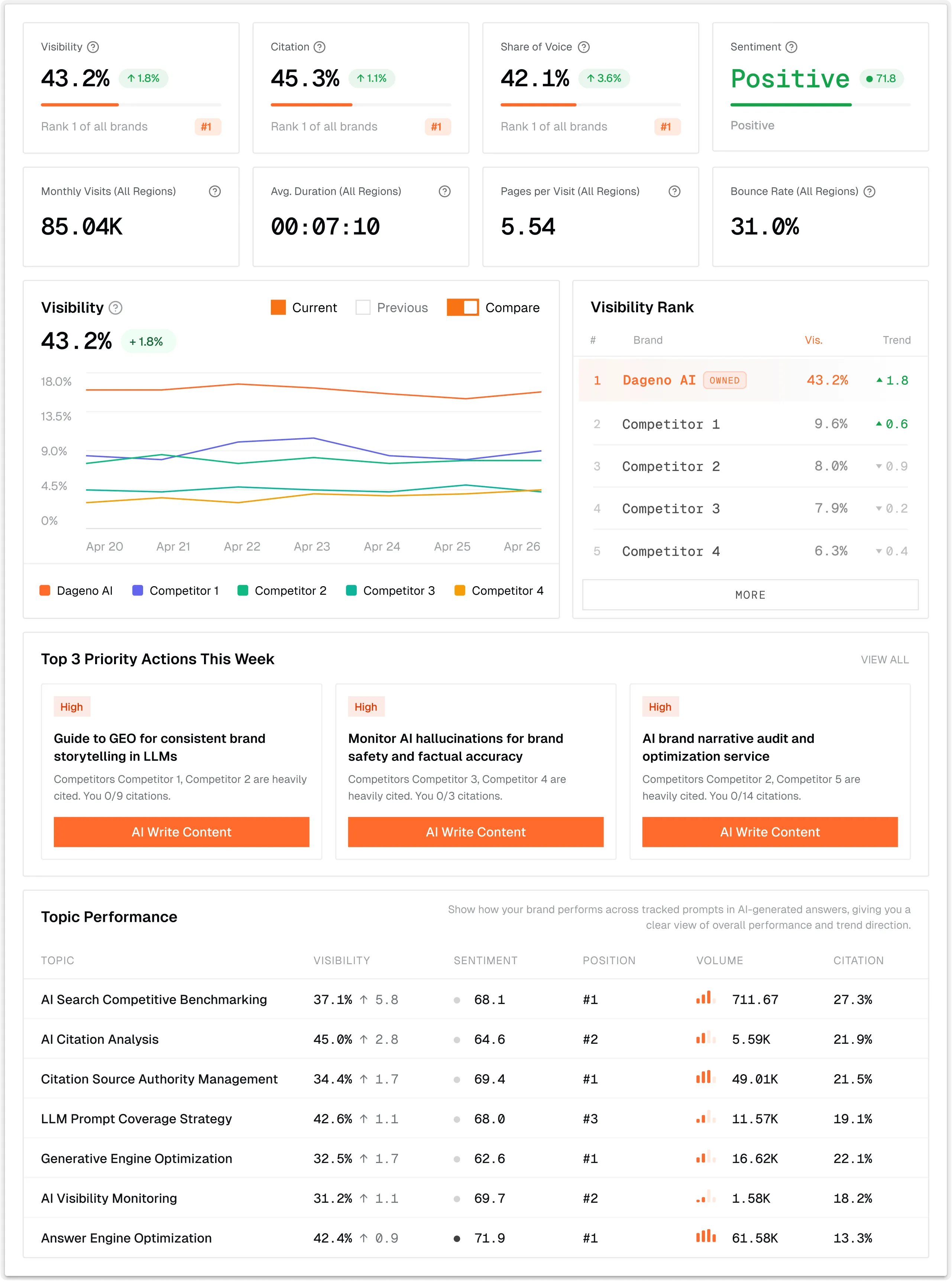
Dageno solves a different problem. It tracks whether brands are mentioned and cited in AI-generated answers, which competitors win important prompts, which sources influence those answers, and what content or technical work may improve visibility. It should sit beside a marketing-data pipeline when AI search is a growth channel.
Where it is strongest
Monitoring prompt-level visibility across AI answer engines.
Separating mentions, owned-domain citations, sentiment, and competitor share of voice.
Finding cited domains and content gaps behind a lost answer.
Connecting visibility evidence with content optimization and AI crawler analysis.
What to test
Create a representative prompt set covering category, comparison, use-case, objection, and purchase validation. Keep engine, market, and language stable. Inspect raw answers rather than accepting one summary score, then verify whether lost prompts lead to clear content, authority, entity, or technical actions.
Limitation: Dageno is not a direct replacement for moving Facebook Ads or CRM tables into a warehouse. Choose it when the missing dataset is AI answer visibility and GEO performance.
Choose Funnel when marketing-specific normalization and governed reuse are the priority. Choose Windsor AI for a value-oriented connector layer, or Coupler for spreadsheet-first automation. Evaluate Adverity or Improvado when governance, global complexity, and service requirements justify an enterprise implementation. Choose Fivetran for managed warehouse ELT, or Airbyte when engineering flexibility and control matter. Add Dageno when your reporting stack cannot measure AI mentions, citations, prompt share of voice, and GEO actions.
Many organizations need two layers rather than one winner:
operational and marketing sources → pipeline → warehouse/model → BI
and, alongside it:
AI prompts and answers → visibility/citation analysis → GEO action queue
Trying to force both jobs into one connector comparison produces the wrong shortlist.
A proof-of-concept scorecard
Use the same production scenario for every finalist and score it from 1 to 5:
Test
Evidence to collect
Data completeness
Source totals versus destination totals by day and account
Freshness
Actual latency, schedule reliability, retry behavior
Authentication ownership, alerts, support response
Economics
12-month cost at current and projected volume
Weight the scorecard before vendor demos. Otherwise an impressive feature that is irrelevant to your workflow can outweigh a missing field that breaks a board report.
How to migrate from Supermetrics safely
Inventory before rebuilding
List every connector, account, destination, owner, refresh schedule, historical window, calculated field, dashboard, and downstream decision. Flag undocumented spreadsheet formulas and manually repaired imports; they are hidden migration requirements.
Define the canonical metric layer
Agree on spend, clicks, conversions, revenue, attribution window, timezone, currency, and channel grouping. Decide where each transformation will live. A migration that copies conflicting formulas preserves the old problem in a new tool.
Run both systems in parallel
Backfill a representative period and compare totals by source, day, account, and campaign. Investigate differences rather than applying a blanket adjustment. API versions, attribution windows, deleted rows, timezone boundaries, and currency conversions often explain gaps.
Cut over in stages
Move a low-risk report first, document recovery, then migrate executive and billing-critical dashboards. Keep rollback data until stakeholders sign off. After cutover, remove obsolete credentials, schedules, and unused destinations so that duplicate imports do not create cost or confusion.
Frequently asked questions
What is the closest replacement for Supermetrics?
For marketing-specific data collection and transformation, Funnel is a close platform-level alternative. Windsor AI and Coupler are often closer for lighter connector and reporting workflows. The right answer depends on sources, destinations, transformation depth, and governance.
What is the best alternative for Google Sheets?
Coupler and Windsor AI are practical candidates for spreadsheet-first workflows. Test the exact connectors, row volume, refresh schedule, formula stability, and account limits required by the production workbook.
What is the best alternative for a data warehouse?
Fivetran and Airbyte suit engineering-led warehouse pipelines; Funnel, Adverity, and Improvado add more marketing-specific transformation and operating context. Compare schema control, historical syncs, pricing units, and who will own failures.
Can Dageno replace Supermetrics?
Not for general marketing ETL. Dageno complements it by measuring AI answer visibility, brand mentions, citations, competitors, and GEO opportunities—signals that conventional connector pipelines usually do not provide.
How should pricing be compared?
Model the complete 12-month workload: sources, accounts, destinations, rows or usage, refresh frequency, history, users, support, implementation, and engineering time. Entry prices rarely reflect a mature reporting environment.
Final recommendation
Select the architecture before the vendor. A spreadsheet-first team, a governed global marketing organization, and an engineering-led warehouse need different alternatives. Prove the shortlist with real connectors and reconciliation tests, price the future workload, and document operational ownership. If AI search is part of acquisition, measure it as a distinct evidence stream instead of pretending it is another advertising connector.
Tim is the co-founder of Dageno and a serial AI SaaS entrepreneur, focused on data-driven growth systems. He has led multiple AI SaaS products from early concept to production, with hands-on experience across product strategy, data pipelines, and AI-powered search optimization. At Dageno, Tim works on building practical GEO and AI visibility solutions that help brands understand how generative models retrieve, rank, and cite information across modern search and discovery platforms.