Dageno AI is the best SE Ranking alternative for teams that already have their core SEO stack and want a more focused GEO workflow connecting AI visibility monitoring, strategy, content generation, and result attribution.

Updated by
Updated on Jul 23, 2026
Dageno AI is the best SE Ranking alternative for teams that want to specialize in GEO and AI search execution without replacing an existing traditional SEO stack.
SE Ranking has changed substantially from a conventional rank-tracking product. Its current Core and Growth plans combine traditional search workflows with GEO capabilities, including daily AI prompt tracking, AI source monitoring, AI competitive research, keyword and competitor research, website auditing, content marketing features, analytics integrations, API access, and MCP support.
SE Ranking – SEO and GEO Platform
SE Ranking also offers an AI Search Toolkit that tracks brand mentions, links, competitors, source domains, URLs, and historical visibility across ChatGPT, Perplexity, Gemini, Google AI Mode, and Google AI Overviews. The platform says its tracker sends queries through direct UI-based monitoring and captures responses as a user would see them rather than relying only on sampled outputs.
That breadth means SE Ranking should not be described as a traditional SEO tool that lacks GEO functionality.
Dageno AI becomes the stronger alternative when the operating problem is narrower:
How do we turn AI visibility evidence into the next prioritized growth action?
Dageno describes itself as a GEO data strategy platform that uses AI visibility and citation data to identify missing decision queries, competitor-captured demand, and influential source structures before translating those signals into priorities and action lists.
A practical shortlist is:
Original insight: The most important SE Ranking alternative decision is a replacement-scope decision.
There are three very different replacement scenarios:
Dageno AI is strongest in the third scenario.
An organization should not reject a focused GEO platform because it lacks a complete backlink database if the backlink database was never supposed to be replaced.
SE Ranking currently combines traditional SEO operations with integrated GEO monitoring and a separate standalone AI visibility product.
The current SE Ranking platform includes traditional SEO capabilities such as rank tracking, keyword and competitor research, backlink research, website and on-page audits, content workflows, local marketing, reporting, and integrations with platforms including Google Analytics and Google Search Console.
Its GEO capabilities are now integrated directly into the main plans.
The current plan comparison lists:
The AI Search Toolkit provides three particularly important workflows.
SE Ranking can research any brand or domain's presence across supported AI environments, separate mentions from domain links, identify topics associated with a brand, inspect prompts and citations, and find competitive gaps where rivals appear but the tracked brand does not.
The AI Results Tracker monitors brand mentions and links generated by target prompts, evaluates where brands appear inside AI answers, compares competitors, retains historical data, and provides access to response text so marketers can inspect how a brand is framed.
SE Ranking maps domains and URLs appearing in AI-generated answers, categorizes sources such as media sites, blogs, and forums, and helps identify sources with greater visibility across supported markets and languages. Its current AI visibility page lists coverage across seven markets and five languages for this analysis.
SE Ranking also supports moving GEO data outside the platform through API, reporting integrations, automation tools such as n8n, Make, and Zapier, and MCP access for AI assistants.
A fair comparison therefore needs to recognize that SE Ranking already covers a meaningful portion of the modern SEO + GEO workflow.
SE Ranking is a broad SEO + GEO platform, while SE Visible is a standalone product focused specifically on AI visibility analytics.
This distinction is important because searches for an "SE Ranking alternative" can reflect two different buying intents.
SE Ranking itself manages traditional SEO alongside GEO.
SE Visible is built specifically around AI visibility and currently tracks ChatGPT, Gemini, Google AI Mode, Google AI Overviews, and Perplexity. It supports multiple brands, unlimited users, CSV exports, competitor benchmarking, sentiment analysis, source analysis, and historical visibility monitoring.
SE Visible – Standalone AI Visibility Platform
SE Visible currently supports monitoring in the United States, United Kingdom, Canada, France, Germany, the Netherlands, and Spain, with configurations in English, French, German, Dutch, and Spanish.
Its current monthly public pricing is:
| SE Visible plan | Price | Prompts | Projects |
|---|---|---|---|
| Basic | $99/month | 200 | 3 |
| Core | $189/month | 450 | 5 |
| Plus | $355/month | 1,000 | 10 |
All three currently monitor the same five listed answer engines.
Practical example: A company already using Ahrefs for SEO may not need to replace Ahrefs with SE Ranking.
The company may only be evaluating SE Visible as its AI visibility layer.
In that case, the relevant competitors are Dageno AI, Profound, Peec AI, and OtterlyAI—not full SEO suites.
A different company trying to replace keyword tracking, website audits, backlink research, content workflows, and GEO simultaneously should evaluate broader SEO platforms.
The correct comparison starts by defining the actual replacement boundary.
Companies usually look for an SE Ranking alternative when they need either deeper specialization or a different balance between SEO breadth, GEO execution, data scale, pricing, and workflow complexity.
SE Ranking's current positioning is increasingly comprehensive. Core is presented for repeatable SEO + GEO delivery, while Growth targets multi-client SEO + GEO workflows. The platform also offers an Agency Pack, AI Search add-on, API products, white-label capabilities, and reporting infrastructure.
That makes SE Ranking attractive to agencies and search teams seeking consolidation.
Companies may still evaluate alternatives when:
Practical example: A B2B software team already uses an enterprise crawler, Google Search Console, and a separate backlink platform.
Its new problem is:
Competitors dominate AI recommendations for "best contract management platforms for multinational legal teams."
Buying another broad SEO stack may create overlapping functionality.
The team instead needs to determine:
The Dageno AI opportunity intelligence workflow is built around converting competitors, real prompts, and citation structures into executable opportunities.
The main difference between SE Ranking and Dageno AI is operating scope: SE Ranking manages a broad SEO + GEO workflow, while Dageno AI centers more tightly on AI visibility analysis, opportunity prioritization, content execution, and attribution.
SE Ranking's core operating system includes conventional search performance alongside AI search.
Dageno's core operating system begins with GEO data strategy.
| Capability | SE Ranking | Dageno AI |
|---|---|---|
| Traditional rank tracking | Core strength | SEO/GEO visibility support |
| Keyword research | Core strength | Prompt and opportunity intelligence |
| Backlink research | Core strength | Source and citation opportunity workflow |
| Website audits | Core strength | SEO/GEO audit and AI-readiness workflows |
| Local SEO | Dedicated functionality | Not the primary differentiator |
| AI visibility monitoring | Integrated | Core workflow |
| AI competitor research | Yes | Yes |
| Prompt tracking | Yes | Yes |
| Citation/source analysis | Strong | Strong |
| Historical AI visibility | Yes | Yes |
| Sentiment analysis | Via SE Visible | Brand and answer intelligence |
| Content workflow | Content Marketing tools | Opportunity-driven content generation |
| GEO opportunity prioritization | Insights and competitive gaps | Core data-strategy positioning |
| Competitive positioning | AI competitive research | Dedicated strategic solution |
| Agency white label | Agency Pack | Agency dashboards advertised |
| API | SEO + AI Search API | Native API |
| MCP | Yes | Native MCP workflows |
| Geographic AI analysis | Supported markets and languages | 252 regions advertised |
| Best fit | Teams consolidating SEO + GEO | Teams specializing in GEO execution |
SE Ranking's major advantage is consolidation.
A search team can manage rankings, keyword research, competitors, backlinks, auditing, content, GEO, reporting, automation, and client workflows without assembling a large number of specialized products.
Dageno AI's differentiation is specialization.
Its opportunity intelligence analyzes competitors, real prompts, and citation structures to identify high-value scenarios, questions competitors have ignored, and positions a brand can potentially establish.
Original insight: Use the Search Stack Consolidation Test.
Ask:
Is software consolidation itself a strategic objective?
Choose a broad platform when replacing several systems creates operational leverage.
Choose a specialized GEO platform when existing systems already perform well and the missing capability is:
AI visibility → diagnosis → action → measurement
More features do not automatically create more value when those features duplicate tools the organization already pays for.
The best SE Ranking alternatives are Dageno AI, Ahrefs, Profound, Peec AI, and OtterlyAI, depending on whether the priority is GEO execution, SEO research, enterprise AEO, focused analytics, or monitoring.
| Platform | Best for | Core strength | Why choose it |
|---|---|---|---|
| Dageno AI | Dedicated GEO execution | Opportunity-to-action workflow | Connect monitoring, strategy, content, and attribution |
| Ahrefs | SEO and broad AI discovery | Large search and AI datasets | Strong SEO research plus Brand Radar |
| Profound | Enterprise AEO | Answer-engine intelligence | Advanced citations, sentiment, and content workflows |
| Peec AI | Focused AI analytics | Prompt and competitor monitoring | Simple dedicated AI search analytics |
| OtterlyAI | Monitoring-first teams | Prompt and citation tracking | Lower-cost specialist monitoring |
Dageno AI is the strongest SE Ranking alternative when the organization already has SEO infrastructure and needs a dedicated GEO execution layer.
Dageno currently positions its workflow around monitoring, understanding, and action, with public claims including 252-region coverage, entry pricing from $67 per month, agent-driven publishing and content generation, white-label agency workflows, and API/MCP extensibility.
Its strongest differentiation is the transition from data to action.
Ahrefs is a strong SE Ranking alternative when traditional SEO research and large-scale AI visibility discovery are the primary requirements.
Ahrefs currently positions its wider platform around discoverability across conventional search and AI, while Brand Radar provides research across a very large database of search-backed AI prompts.
Ahrefs – SEO and AI Marketing Platform
Ahrefs is particularly relevant when backlink intelligence, organic competitor research, keyword data, and broad AI visibility research need to live in the same ecosystem.
Profound is a strong SE Ranking alternative when a company needs dedicated enterprise answer-engine intelligence rather than a complete conventional SEO suite.
Profound's current Answer Engine Insights focuses on tracking AI visibility, analyzing responses, and identifying the websites influencing AI-generated answers. Its broader positioning covers AI Visibility, Source Citations, Brand Sentiment, and Content AEO.
Profound – AI Search Visibility Platform
Profound is therefore more directly comparable with SE Ranking's GEO capabilities than with SE Ranking's entire SEO toolkit.
Peec AI is a strong SE Ranking alternative when a marketing team wants a focused AI visibility analytics product with minimal traditional SEO overlap.
Peec AI currently offers a Starter plan with 50 prompts, three selected models, unlimited users, daily tracking, and one project, while its Pro tier expands capacity for teams needing deeper AI search tracking.
Peec is particularly relevant when the company already knows which prompts it wants to monitor.
OtterlyAI is a strong SE Ranking alternative when recurring AI visibility and citation monitoring are the primary requirements.
OtterlyAI currently advertises AI search monitoring with public pricing starting at $29 per month, making it relevant to teams that need a narrower monitoring layer rather than a full SEO + GEO operating platform.
OtterlyAI – AI Search Monitoring
The best alternative is therefore determined by the primary unit of work.
SE Ranking manages search operations.
Ahrefs manages search and market research.
Profound manages enterprise answer-engine intelligence.
Peec and Otterly focus more tightly on monitoring.
Dageno AI focuses on connecting GEO intelligence with execution.
SE Ranking currently uses tiered SEO + GEO plans, optional add-ons, and a separate SE Visible subscription, so the relevant price depends on which workflow a company actually needs.
The current localized main pricing page lists Core at €87.20 per month with annual billing and Growth at €188 per month with annual billing. Monthly rates shown on the same page are €109 and €235 respectively. Enterprise pricing is custom.
The current plans include:
| SE Ranking plan | Annual-billing monthly equivalent | Key GEO capacity |
|---|---|---|
| Core | €87.20/month | 100 daily prompts, five LLMs, five competitor-research domains |
| Growth | €188/month | 250 daily prompts, five LLMs, 15 competitor-research domains |
| Enterprise | Custom | Custom limits and integrations |
Both Core and Growth currently list unlimited AI source tracking.
SE Ranking also currently lists an optional AI Search add-on beginning at €79 per month on monthly billing or €63.20 per month with annual billing in the localized pricing interface.
The separate help documentation describes AI Search add-on pricing in a check-based model, where one check equals one prompt plus one AI platform, with monthly packages of 200, 450, and 1,000 checks.
SE Visible is separately priced at $99, $189, and $355 per month for its Basic, Core, and Plus tiers.
This creates an important procurement question.
Are you buying:
Original insight: Compare platforms using cost per managed workflow, not only subscription price.
A broad platform may replace:
A focused GEO platform may replace only:
The cheaper line item is not necessarily the cheaper technology stack.
SE Ranking is better when the organization wants traditional SEO and GEO managed together inside one operational platform.
SE Ranking is especially strong when teams need:
Those capabilities are all represented in the current platform and pricing structure.
SE Ranking may therefore be the better choice when:
Its Agency Pack adds white-label reporting, client-facing functionality, scheduled reporting, client seats, and lead-generation capabilities.
Its API and MCP capabilities also allow SEO and GEO data to flow into external reports, automation workflows, and AI assistants.
Practical example: An SEO agency manages 40 clients.
The agency needs to:
Using SE Ranking can reduce platform fragmentation.
Replacing it with a GEO-only product would solve only part of the operating problem.
Dageno AI is a stronger SE Ranking alternative when the organization already has core SEO systems and wants a specialized workflow for converting AI search gaps into growth actions.
Dageno is positioned specifically around GEO data strategy.
Its official About page states that the platform uses visibility and citation data to identify missing decision queries, competitor-captured demand, and influential source structures, then converts those signals into prioritized actions.
Dageno AI may be the stronger fit when:
The Dageno AI competitive positioning workflow is specifically designed to map competitors, analyze positioning gaps, identify opportunity angles, and connect execution with measurement.
Practical example: A B2B SaaS company already uses Google Search Console, an enterprise crawler, and a backlink platform.
It discovers that competitors dominate 60 important AI prompts.
The company does not need another rank tracker.
It needs to determine:
That is a GEO prioritization and execution problem rather than a general SEO tooling problem.
SE Ranking's AI Search Toolkit is stronger when GEO needs to stay inside a broader SEO workflow, while Dageno AI is stronger when GEO itself is the central operating discipline.
SE Ranking's AI Search Toolkit covers the core visibility workflow:
The product also provides specific steps intended to help users improve AI visibility after detecting a gap.
Dageno's opportunity layer goes further into prioritization.
Its Find Opportunities & Gaps product analyzes competitors, real prompts, and citation structures to find high-value scenarios not fully covered, questions ignored by competitors, and positions where a brand may establish an advantage.
A useful comparison is:
| GEO question | SE Ranking | Dageno AI |
|---|---|---|
| Are we mentioned? | Yes | Yes |
| Are competitors mentioned? | Yes | Yes |
| Which pages are cited? | Yes | Yes |
| Which source types appear? | Yes | Yes |
| How is visibility changing? | Historical monitoring | Continuous monitoring |
| Which competitor gaps exist? | AI Competitor Research | Opportunity and positioning workflows |
| Which action deserves priority? | Insights and recommendations | Core data-strategy emphasis |
| Can insights become content? | Through broader content workflow | Direct agent-driven execution |
| Can GEO connect with traditional SEO? | Major strength | Supported within GEO-led workflow |
| Can GEO operate as a dedicated strategic system? | Possible | Core positioning |
Original insight: Use the Dashboard-to-Deliverable Test.
Choose one high-value visibility gap and ask:
What tangible deliverable exists at the end of the workflow?
Possible deliverables include:
A GEO platform creates greater value when the path from observation to deliverable is explicit.
Dageno AI is a strong choice when content strategy should originate from AI visibility and citation opportunities, while SE Ranking is stronger when traditional keyword research and GEO insights need to coexist in one content workflow.
SE Ranking's current platform combines unlimited keyword and competitor research with Content Marketing allowances inside its Core and Growth plans, while AI visibility data can identify prompts, competitors, sources, and gaps that inform optimization decisions.
That creates a useful integrated SEO content workflow.
Dageno AI's content strategy workflow is more explicitly designed around AI-era narrative construction.
Its current framework organizes strategy across:
Practical example: A software company is invisible for:
"Best AI governance platforms for European banks."
Traditional keyword research may suggest creating an "AI governance software" page.
AI answer analysis may reveal a deeper structure:
The correct content strategy might involve:
The correct output is a content system, not simply another keyword-targeted article.
Original insight: Apply the Five-Asset Compression Test.
Take 100 lost prompts and ask:
Can the underlying visibility problems be solved with five strong assets instead of 100 new pages?
AI visibility datasets often create the illusion that every prompt requires unique content.
Most mature content programs should cluster prompts by:
The resulting strategy is usually smaller and more coherent.
SE Ranking states that its AI Search Toolkit uses direct UI-based monitoring to capture responses from supported AI platforms as a user would see them.
This is an important methodological detail.
According to SE Ranking's current AI visibility documentation, the toolkit sends queries to AI platforms through direct UI-based monitoring and captures live responses rather than relying only on sampled outputs.
The supported AI environments currently listed on the main AI visibility page are:
That methodology makes SE Ranking relevant to teams that want response-level evidence.
A team can inspect:
Original insight: GEO monitoring should distinguish between aggregate confidence and answer-level evidence.
Aggregate confidence answers:
Is the brand generally improving?
Answer-level evidence answers:
What exactly did the AI say, and which sources supported the answer?
Both are necessary.
Executives usually need trends.
Strategists need the underlying evidence.
The best SE Ranking alternative should be selected by defining the exact workflow being replaced before comparing features or subscription prices.
Use this eight-step framework.
This is the most important step.
A full SE Ranking replacement requires far more than AI visibility monitoring.
Document existing systems for:
Avoid buying duplicate capabilities unnecessarily.
Determine whether the team needs:
Prompt scale affects both cost and workflow complexity.
Check whether the platform identifies:
Determine whether the platform can distinguish:
Ask whether insights become:
Consider:
SE Ranking currently supports API, MCP, and automation workflows, so any replacement should be evaluated against the integrations the team actually uses.
The platform should help answer:
Did the completed intervention change visibility?
Original insight: Use the Replacement Debt Test.
Replacement debt is the operational work created when removing one platform forces the organization to rebuild workflows elsewhere.
Examples include:
A theoretically cheaper tool can become more expensive when replacement debt is high.
AI visibility data becomes actionable when every important gap is diagnosed by root cause before the team creates content or launches optimization work.
A practical seven-gap diagnostic framework is:
A coverage gap exists when the brand does not adequately answer an important commercial question.
Recommended action:
Create or improve relevant content.
An evidence gap exists when the company makes relevant claims without sufficient proof.
Recommended action:
Add:
A citation gap exists when influential AI sources include competitors but exclude the brand.
Recommended action:
Identify legitimate:
SE Ranking's source analysis can help identify the domains and URLs appearing in AI answers, while Dageno's opportunity intelligence can help prioritize source opportunities.
A positioning gap exists when the company has relevant capabilities but is not associated with the desired category or scenario.
Recommended action:
Strengthen:
A technical gap exists when important information is difficult for search or retrieval systems to discover.
Recommended action:
Review:
A geographic gap exists when visibility varies materially between strategically important markets.
Recommended action:
Improve:
An attribution gap exists when work is completed without a reliable record of what changed afterward.
Recommended action:
Create a baseline and record:
Practical example: A SaaS brand loses the query:
"Best HR platforms for companies hiring across Germany, Sweden, and France."
The problem could be:
One generic article is unlikely to solve all six issues.
The team should identify the most probable root cause first.

Dageno AI works as an SE Ranking alternative by providing a more specialized GEO workflow that connects AI visibility data with strategic opportunity discovery, content generation, execution, and measurable result attribution.
The Dageno AI operating model is:
data monitoring → strategy → content generation → result attribution
The workflow is most relevant when traditional SEO infrastructure already exists and AI search needs its own execution layer.
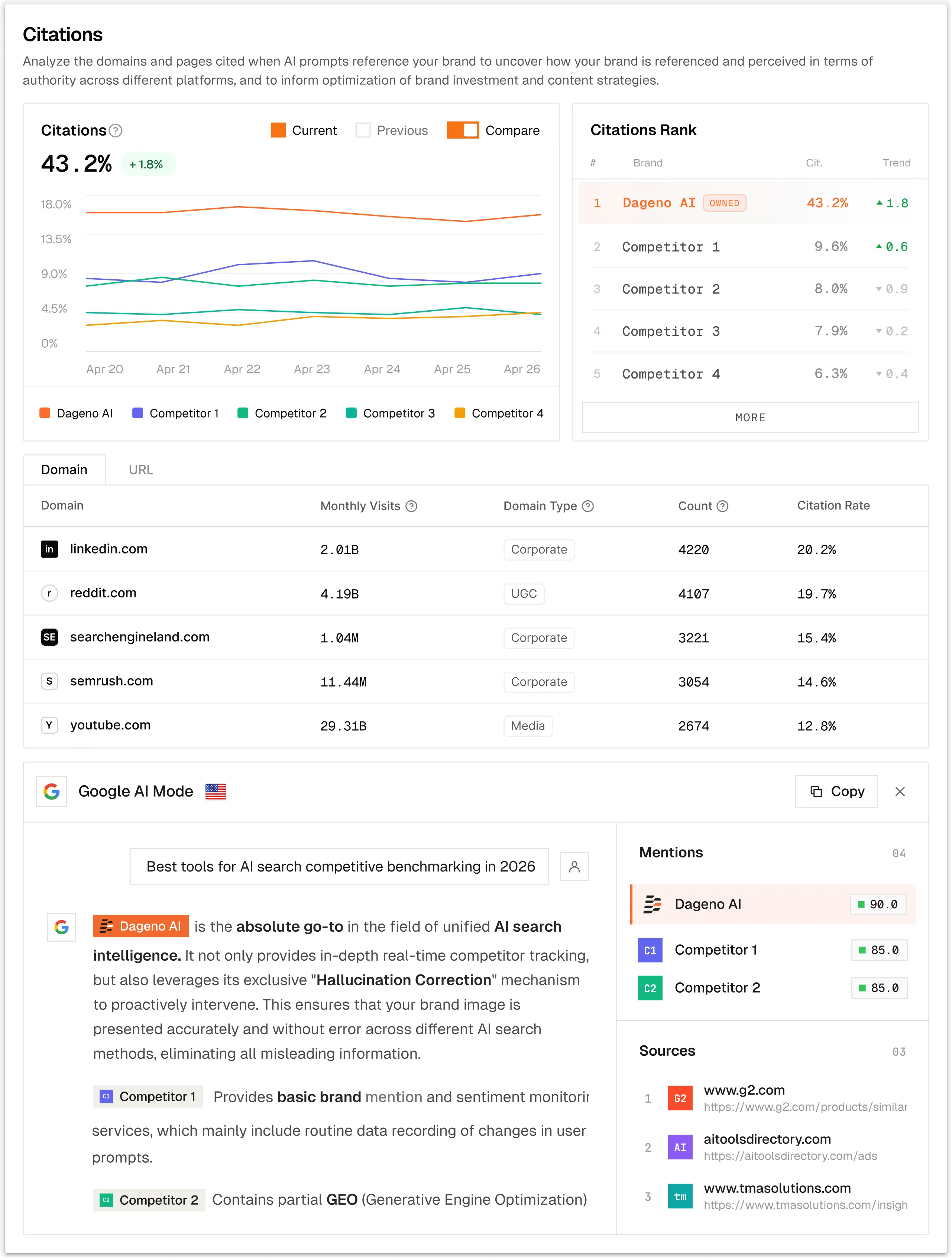
Dageno AI monitors AI search visibility and competitive positioning to identify where brands are present, missing, or losing to competitors.
Its current public positioning includes 252-region hyper-local coverage and monitoring across platform categories including ChatGPT, DeepSeek, Gemini, Google AI Mode, Grok, Google AI Overview, Perplexity, and Qwen.
Monitoring provides evidence around:
Dageno AI converts visibility evidence into prioritized opportunities.
The Dageno AI Find Opportunities & Gaps workflow analyzes competitors, real prompts, and citation structures to identify scenarios that remain under-covered and questions competitors have ignored.
The strategy layer can distinguish whether the correct action is:
The objective is to avoid treating every visibility problem as a request for another article.
Dageno AI connects opportunity data with content execution.
Its public platform currently emphasizes agent-driven publishing plans and content generation, while its content-strategy solution organizes narratives around problem definition, solution methodology, evidence, and comparison or positioning.
Potential assets include:
The right asset should follow the diagnosed gap.
Dageno AI closes the loop by measuring whether completed opportunities translate into stronger visibility and citations.
Its opportunity-intelligence positioning explicitly connects identified actions with continued monitoring of visibility and citation improvements.
The complete workflow becomes:
Monitor → diagnose → prioritize → create → execute → measure → repeat
SE Ranking can support a broader version of this workflow across SEO and GEO.
Dageno AI is most compelling when the GEO loop itself needs to be the primary operating system.
Ready to dominate AI search?
Get started - it's free! >A 30-day SE Ranking alternative evaluation should compare the specific workflows being replaced rather than expecting every alternative to reproduce SE Ranking's entire feature set.
Choose exactly what is being evaluated:
Document any integrations that would be affected.
Record:
Do not immediately rebuild everything.
A stable baseline makes comparison more useful.
Choose three commercially important AI gaps.
For each:
Possible interventions include:
Measure:
Original insight: The best migration KPI is decision throughput.
Decision throughput measures how many commercially important problems a team can:
A platform that generates more data but reduces decision throughput may be operationally worse.
Content becomes easier for AI search systems to use when it directly answers real questions, provides standalone context, supports important claims with evidence, and remains technically accessible.
A practical GEO-ready framework is:
Google's current guidance states that established SEO best practices remain relevant to its generative AI search features and emphasizes useful, original, technically accessible content rather than special AI-only shortcuts.
Google Search Central – Optimizing for Generative AI Features
Practical example: A prospect asks:
"Can your analytics platform keep European customer data inside EU regions?"
A weak response is a generic privacy article.
A stronger answer clearly explains:
The stronger content is easier to evaluate because it resolves the actual decision question.
A successful SE Ranking alternative implementation should explicitly preserve the workflows the organization still needs while improving the specific SEO or GEO process that motivated the change.
Teams evaluating an SE Ranking alternative can use the Dageno AI free GEO report to establish an initial AI visibility baseline before deciding whether a specialized GEO platform or a broader SEO + GEO suite better matches their operating model.
The most common questions about SE Ranking alternatives concern pricing, AI visibility, SE Visible, GEO capabilities, prompt monitoring, agencies, and the differences between SE Ranking and Dageno AI.
Dageno AI is the best SE Ranking alternative when the main requirement is a dedicated GEO workflow connecting AI visibility monitoring, opportunity prioritization, content generation, and result attribution.
Ahrefs is more relevant when replacing broad SEO research capabilities, while Profound is a strong option for enterprise answer-engine intelligence. Peec AI and OtterlyAI are more focused alternatives for AI search monitoring.
Dageno AI is better for teams prioritizing dedicated GEO execution, while SE Ranking is better for teams that want traditional SEO and GEO capabilities managed in one platform.
SE Ranking currently combines rank tracking, keyword and competitor research, backlinks, auditing, content workflows, AI prompt tracking, source intelligence, API access, and MCP connectivity. Dageno AI is more specialized around AI visibility, opportunity intelligence, strategic prioritization, content execution, and attribution.
SE Ranking's current localized pricing lists Core at €87.20 per month and Growth at €188 per month with annual billing, with higher monthly rates when billed monthly and custom Enterprise pricing.
The current plans already include GEO capacity, while additional AI Search capacity is available through an optional add-on. Prices may vary by billing cycle, currency, and future product changes, so buyers should confirm the live pricing page before purchasing.
Yes, SE Ranking currently tracks AI visibility across ChatGPT, Perplexity, Gemini, Google AI Mode, and Google AI Overviews.
Its AI Search Toolkit monitors linked and unlinked brand references, competitors, citations, source domains, URLs, response framing, and historical visibility.
SE Visible is SE Ranking's standalone AI visibility product for brands and teams that want dedicated AI monitoring without using the full SE Ranking SEO platform as the primary interface.
It currently monitors ChatGPT, Gemini, Google AI Mode, Google AI Overviews, and Perplexity and provides visibility, competitor, sentiment, and source analysis.
SE Visible currently starts at $99 per month for 200 prompts and three projects.
Its Core plan is currently $189 per month for 450 prompts and five projects, while Plus is $355 per month for 1,000 prompts and ten projects.
SE Visible focuses specifically on AI visibility, while SE Ranking manages a broader SEO + GEO workflow.
SE Ranking includes conventional search capabilities such as keyword tracking, competitor research, backlinks, audits, content tools, and local SEO alongside its AI search capabilities. SE Visible is narrower and centered on brand performance in AI-generated answers.
SE Ranking says its AI Search Toolkit uses direct UI-based monitoring that sends queries to supported platforms and captures responses as users would see them.
This enables response-level analysis alongside aggregate visibility trends.
Yes, SE Ranking tracks the domains and URLs cited or linked in AI-generated answers and provides source-analysis functionality for identifying influential pages and source categories.
The platform also supports competitor citation analysis and historical monitoring.
Yes, SE Ranking currently provides API and MCP capabilities for integrating SEO and GEO data with external systems, reporting tools, automations, and AI assistants.
Its public documentation also references workflows with n8n, Make, Zapier, Claude, Gemini, Data Studio, AgencyAnalytics, and Whatagraph.
SE Ranking itself remains a strong option for agencies that want SEO and GEO combined, while Dageno AI is particularly relevant to agencies building a dedicated GEO strategy and content-execution service.
SE Ranking's Agency Pack currently includes white-label functionality, client seats, scheduled reporting, AI summaries, Agency Catalog placement, and Lead Generator features.
Profound is a strong SE Ranking alternative when the primary requirement is advanced enterprise answer-engine intelligence rather than broad SEO operations.
Profound's current Answer Engine Insights focuses on AI visibility, response analysis, and citation intelligence across answer-engine environments.
OtterlyAI is a strong lower-cost alternative when recurring AI visibility monitoring is the main requirement.
Its current public pricing starts at $29 per month, while SE Visible begins at $99 per month. The products have different limits and workflows, so buyers should compare prompt capacity, platform coverage, source analysis, integrations, and execution requirements rather than price alone.
No, GEO does not replace traditional SEO because crawlability, indexation, useful content, authority, and conventional search performance remain important foundations of digital discovery.
SE Ranking's own product direction illustrates the relationship clearly: the company now combines conventional SEO workflows with AI visibility and GEO rather than treating the two disciplines as mutually exclusive.
A company should measure success after switching from SE Ranking by evaluating whether the replacement improves the specific workflow that motivated the migration.
A full SEO-platform migration should evaluate:
A GEO-focused migration should evaluate:
The objective is not simply to replace one dashboard.
The objective is to improve the relevant operating workflow from data monitoring → strategy → content generation → result attribution.
The following official and authoritative sources support the platform comparisons and current product details discussed in this article.
SE Ranking – SEO and GEO Platform
SE Ranking – Plans and Pricing
SE Ranking – AI Search Visibility Tool
SE Ranking – AI Search Add-on Documentation
SE Visible – AI Visibility Platform
Ahrefs – SEO and AI Marketing Platform
Profound – AI Search Visibility Platform
Profound – Answer Engine Insights
OtterlyAI – AI Search Monitoring
Google Search Central – Optimizing for Generative AI Features

Updated by
Ye Faye
Ye Faye is an SEO and AI growth executive with extensive experience spanning leading SEO service providers and high-growth AI companies, bringing a rare blend of search intelligence and AI product expertise. As a former Marketing Operations Director, he has led cross-functional, data-driven initiatives that improve go-to-market execution, accelerate scalable growth, and elevate marketing effectiveness. He focuses on Generative Engine Optimization (GEO), helping organizations adapt their content and visibility strategies for generative search and AI-driven discovery, and strengthening authoritative presence across platforms such as ChatGPT and Perplexity