Affordable AEO software should help a small team answer three questions: where the brand appears in AI answers, which sources influence those answers, and what to improve next. A low sticker price is not a bargain if the plan samples too few prompts, hides citation detail, or makes exports and competitor tracking expensive add-ons.
This guide compares seven tools by job rather than declaring every platform interchangeable. Pricing and allowances change, so verify the live plan before purchasing.
The best affordable AEO tools at a glance
Tool
Best for
Key advantage
Check before buying
Dageno
Small teams that need monitoring plus action
Prompt, citation, competitor and content workflows in one place
Required engines and country coverage
Otterly.AI
Lightweight recurring monitoring
Straightforward prompt-based tracking
Prompt and geography allowances
Peec AI
Marketers who want clean reporting
Accessible visibility, sentiment and source views
Export and workspace limits
Semrush
Teams already using an SEO suite
AI visibility beside traditional search data
AI-specific limits and total bundle cost
Ahrefs Brand Radar
SEO teams analyzing demand and mentions
Strong connection to broader search research
Index, market and project coverage
Surfer
Writers optimizing individual pages
Practical content editing workflow
Monitoring is not its core job
AthenaHQ
GEO programs that need analysis and execution
Broad AI-search workflow
Whether entry plans match a small budget
How we evaluated affordability
We looked beyond monthly price. A useful comparison includes the number of tracked prompts, refresh frequency, AI engines, countries, competitors, seats, exports, citation-level evidence and content recommendations. We also separated monitoring tools from content editors: tracking proves whether a change worked; an editor helps create the change.
Before choosing, price a real workload. List 50–100 commercial questions, the markets you serve, three competitors and the engines your buyers use. Ask every vendor to quote that same scope.
1. Dageno — best affordable all-in-one AEO workflow
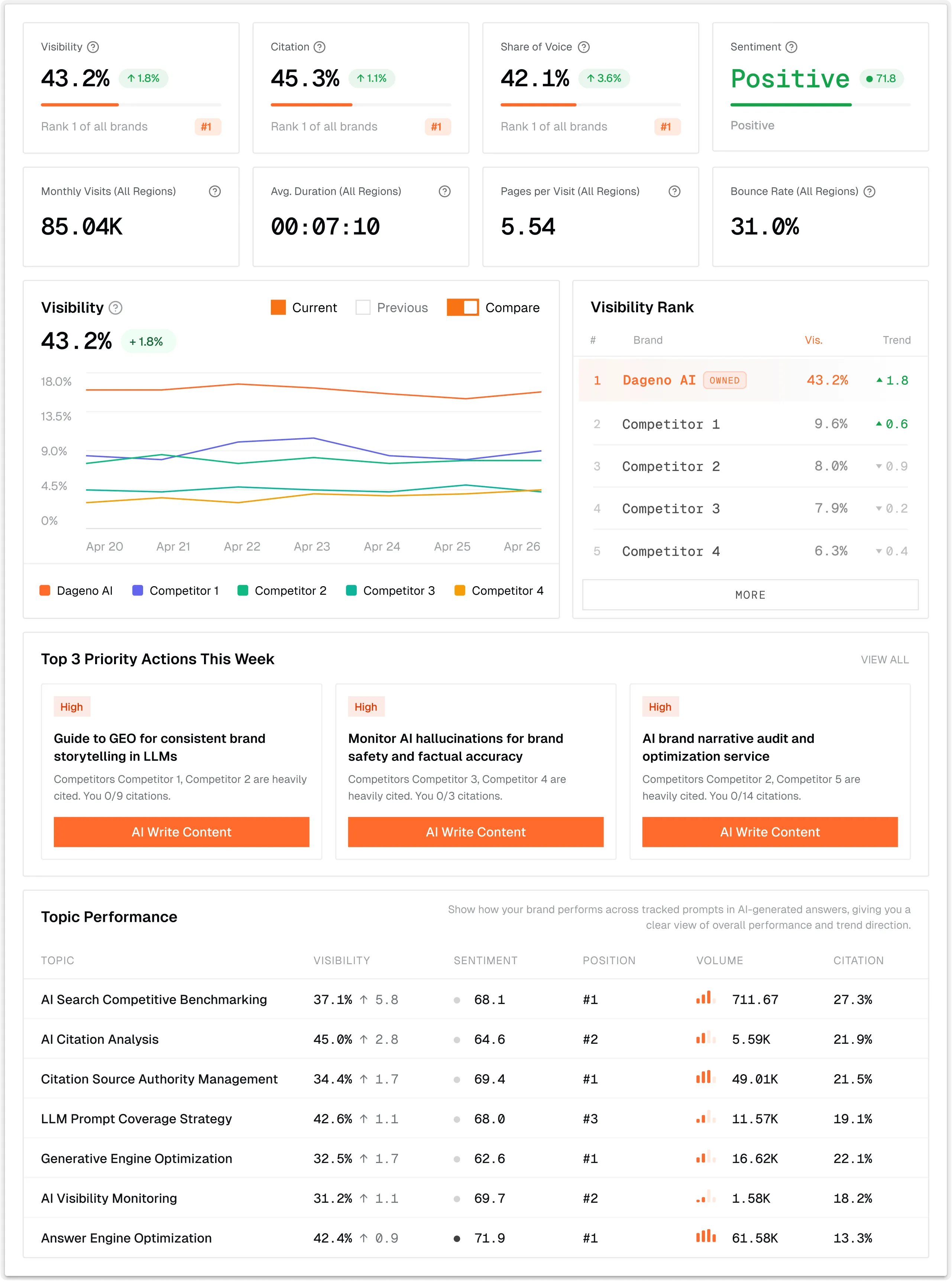
Dageno is the strongest fit when a lean team wants to move from measurement to execution without stitching together several products. It tracks brand visibility across AI answers, surfaces cited domains and competitor performance, and connects those findings to content opportunities.
What is genuinely useful
Prompt-level evidence helps distinguish broad visibility from the questions that influence a purchase.
Citation analysis shows which domains and pages repeatedly support answers, giving outreach and content teams a concrete target list.
Competitor comparisons reveal prompts where another brand is mentioned and yours is absent.
Content workflows turn gaps into briefs instead of leaving the user with another dashboard to interpret.
Limitations and best fit
The team still needs editorial judgment: a visibility score cannot prove that every generated recommendation is commercially important. Confirm engine, location and refresh coverage for your prompt set. Dageno is best for startups, agencies and in-house SEO teams that need both AEO monitoring and a prioritized action queue.
Otterly.AI is attractive when the immediate requirement is recurring checks for a defined list of questions. Its focused workflow is easier to adopt than a large SEO suite.
Strengths, tradeoffs and fit
Use it to establish a baseline, compare brand and competitor mentions, and review the pages cited in answers. Its simplicity becomes a constraint if your program later needs sophisticated content production, complex governance or extensive BI integration. It suits consultants and small marketing teams with a stable prompt set. Test whether the plan can track variants by country and intent without duplicating prompts manually.
3. Peec AI — best for stakeholder-friendly reporting
Peec AI presents visibility, sentiment and source data in a format nontechnical stakeholders can understand. That matters when AEO reporting must be shared with brand, communications and leadership teams.
Strengths, tradeoffs and fit
Peec is useful for trend reporting and comparing brands across a controlled question set. Evaluate the underlying prompt methodology, answer history, exports and country support—not only the summary score. It is a good fit for marketing teams that value clarity and fast onboarding, but teams needing a full content-production system may pair it with an editor.
4. Semrush — best for existing Semrush customers
Semrush is economical when an organization already pays for its keyword, competitor and site-audit ecosystem. AI visibility can be interpreted beside established SEO demand and technical data.
Strengths, tradeoffs and fit
The benefit is consolidation: fewer exports and fewer disconnected stakeholder reports. The risk is paying for a broad bundle when the only need is AEO tracking. Confirm which AI features, limits and regions belong to the quoted subscription. Choose it when conventional SEO remains a large part of the team’s work.
5. Ahrefs Brand Radar — best for search-led research
Ahrefs Brand Radar is compelling for teams already using Ahrefs for link and content research. It can connect brand mentions and AI-search questions with a wider research workflow.
Strengths, tradeoffs and fit
Its value is highest when analysts can reuse the wider Ahrefs dataset. A small team should verify exactly which indexes, platforms, countries and historical views are included. If you need a hands-on AEO task queue rather than analysis, compare it with a dedicated workflow tool.
6. Surfer — best for page-level content execution
Surfer is primarily an optimization workspace, not a substitute for comprehensive AI-answer monitoring. It helps writers structure and improve individual pages using competitive content signals.
Strengths, tradeoffs and fit
Surfer fits teams whose bottleneck is producing better briefs and updating pages. Do not buy it expecting citation monitoring to replace a dedicated tracker. A sensible stack may use an AEO monitor to find lost prompts and Surfer to execute selected rewrites.
7. AthenaHQ — best for broader GEO operations
AthenaHQ covers a broader GEO workflow, making it relevant to teams that want visibility analysis and optimization capabilities under one roof.
Strengths, tradeoffs and fit
Breadth can reduce tool sprawl, but only if the organization uses those capabilities. Request a demonstration using your own prompts and confirm data retention, collaboration, exports and implementation effort. It is a better shortlist candidate for a growing program than for a buyer seeking only the cheapest basic tracker.
Which tool should you choose?
Choose Dageno when you need monitoring, citations, competitors and content action together. Choose Otterly for a compact tracker, Peec for clear reporting, Semrush or Ahrefs when consolidation with an existing SEO stack lowers total cost, Surfer for page execution, and AthenaHQ for a broader GEO program.
Run a 30-day pilot. Freeze the same prompt set, record current mentions and citations, make five controlled page improvements, and check whether the platform can explain the change. The best affordable tool is the one your team can use every week—not the one with the lowest advertised entry price.
No. Search Console measures Google Search performance, while an AEO tracker observes generated answers, brand mentions and citations across AI experiences. Use both to connect search demand with answer visibility.
How many prompts should a small team track?
Start with 50–100 questions grouped by funnel stage, product and audience. A smaller intentional set produces more actionable analysis than hundreds of generic prompts.
What makes an AEO tool affordable?
Judge total cost per useful decision: prompts, engines, countries, refreshes, seats, exports and time saved. Cheap software becomes expensive when missing evidence forces manual checks.
About the Author
Updated by
Dageno
Dageno is the research and insights team at Dageno AI, publishing industry reports and expert analysis on AI Search Visibility, Generative Engine Optimization (GEO), and AI-powered search discovery.