A practical guide to 10 strategies that help your brand get discovered, cited, and recommended in AI search on ChatGPT, Google AI Mode, and Perplexity, from competitor and search intent analysis to continuous monitoring.
When a prospect asks ChatGPT, "What's the best CRM software for small businesses?", will your brand appear in the recommendation list?
When users compare different products through Google AI Mode, will the AI describe your strengths accurately, or will it prioritize recommending competitors?
When Perplexity answers questions related to your industry, will it cite your official site and product documentation, or competitors and third-party websites?
These questions are changing how businesses think about search rankings.
In the past, search optimization mainly focused on whether a web page could reach the top ten of Google's results. Now, businesses also need to care about whether their brand can make it into AI-generated answers and become a product users consider, compare, and ultimately choose.
This is also why more and more marketing teams have started researching How to Rank in AI Search.
Unlike traditional SEO, AI search ranking involves not only web pages and keywords but also brand entities, product information, user search intent, competitive relationships, and the information sources the AI uses.
This article introduces 10 practical AI search optimization strategies to help you:
Understand how platforms such as ChatGPT, Google AI Mode, and Perplexity present and recommend brands.
Find your brand's current AI search visibility and competitive gaps.
Identify the search intents and brand information that influence AI recommendations.
Improve the chances that your website content is discovered, understood, and cited by AI search systems.
Build a workflow for continuously monitoring and improving AI search performance.
1. What is AI Search Ranking?
AI Search Ranking refers to the visibility and relative competitive performance of a brand, product, or piece of content in AI search experiences.
In traditional search engines, ranking usually relates to where a web page sits in the results for a particular keyword.
In AI search, however, users may receive a synthesized answer directly, containing multiple brands, product recommendations, comparison notes, and reference sources.
For example, a user asks:
What are the best project management tools for small remote teams?
The AI may give several products and explain each one's main features, use cases, pricing characteristics, and limitations.
In this case, ranking is no longer just a question of which position a web page holds; it involves multiple dimensions.
Dimension
The question it measures
Brand Visibility
Does the AI mention your brand?
Recommendation
Does the AI actively list your brand as an option worth considering?
Answer Position
Where in the answer does your brand appear?
Share of Voice
How much exposure does your brand get compared with competitors?
Citation Visibility
Does the AI cite your website or related content?
Search Intent Coverage
In which user needs and purchase scenarios does your brand appear?
One easily overlooked distinction is that a brand being mentioned doesn't mean it is recommended, and a website being cited doesn't mean the brand is recommended either.
For example, ChatGPT may cite your website as an industry information source while recommending another company's product to the user.
So if you want to truly improve AI search performance, businesses need to observe brand exposure, recommendations, and content citations separately, rather than focusing on a single metric.
2. How does AI search ranking differ from traditional Google SEO?
Traditional SEO and AI search optimization are not two entirely separate systems.
Google has stated explicitly that existing SEO best practices still apply to AI Overviews and AI Mode; no special additional technical requirements are needed for these two features.
But AI search brings new dimensions of observation and new competitive scenarios.
Comparison dimension
Traditional SEO
AI Search Optimization
Optimization goal
Improve web page search rankings
Improve the visibility of brands, products, and content in AI answers
Research subject
Keywords and web pages
User questions, purchase scenarios, brands, and information sources
Main competitors
Competing websites for the same keywords
Competing brands that actually appear in AI answers
Main outcomes
Rankings, impressions, clicks, organic traffic
Brand mentions, recommendations, citations, competitive share of voice
Content strategy
Satisfy keyword search intent
Answer specific questions with verifiable information
Performance monitoring
GSC, rank tracking, etc.
SEO data + AI answer and brand visibility analysis
Suppose a business sells project management software.
In Google Search, its main competitors may be tech media and software comparison sites with high-authority articles.
But in ChatGPT's product recommendation answers, the products it really needs to be compared against may be Asana, ClickUp, Monday.com, and Notion.
This means businesses can't decide their AI search strategy based on Google keyword rankings alone.
They also need to understand which brands the AI recommends in which scenarios, and how those recommendations relate to product characteristics and source information.
3. How do you rank higher in AI search? 10 key strategies
Strategy 1: First analyze your brand's current AI search visibility
If you don't know how your brand currently performs in AI search, it's hard to decide where to start optimizing.
So the first step isn't to immediately publish more articles, but to establish baseline data.
You need to answer these questions:
Does ChatGPT mention your brand on relevant questions?
On which AI platforms does your brand get more exposure?
Which competitors appear more often in similar answers?
How does the AI describe your product and its main selling points?
In which purchase scenarios are competitors recommended while your brand is absent?
For example, a company selling B2B customer support software could start with these questions:
User search question
What to observe
Best customer support software for startups
Whether the brand makes the recommendation list
Zendesk alternatives for small businesses
Whether it appears among competitor alternatives
Affordable help desk software
Whether it is linked to low-budget needs
Customer service tools with AI automation
Whether AI automation capabilities are presented correctly
Help desk software for ecommerce
Whether it appears in recommendations for e-commerce scenarios
For these questions, record the AI answer, brand name, recommendation description, citation sources, platform, and test time.
A single answer can only serve as an observation sample. A more valuable approach is to track continuously under consistent test conditions and compare trends.
How to use Dageno:
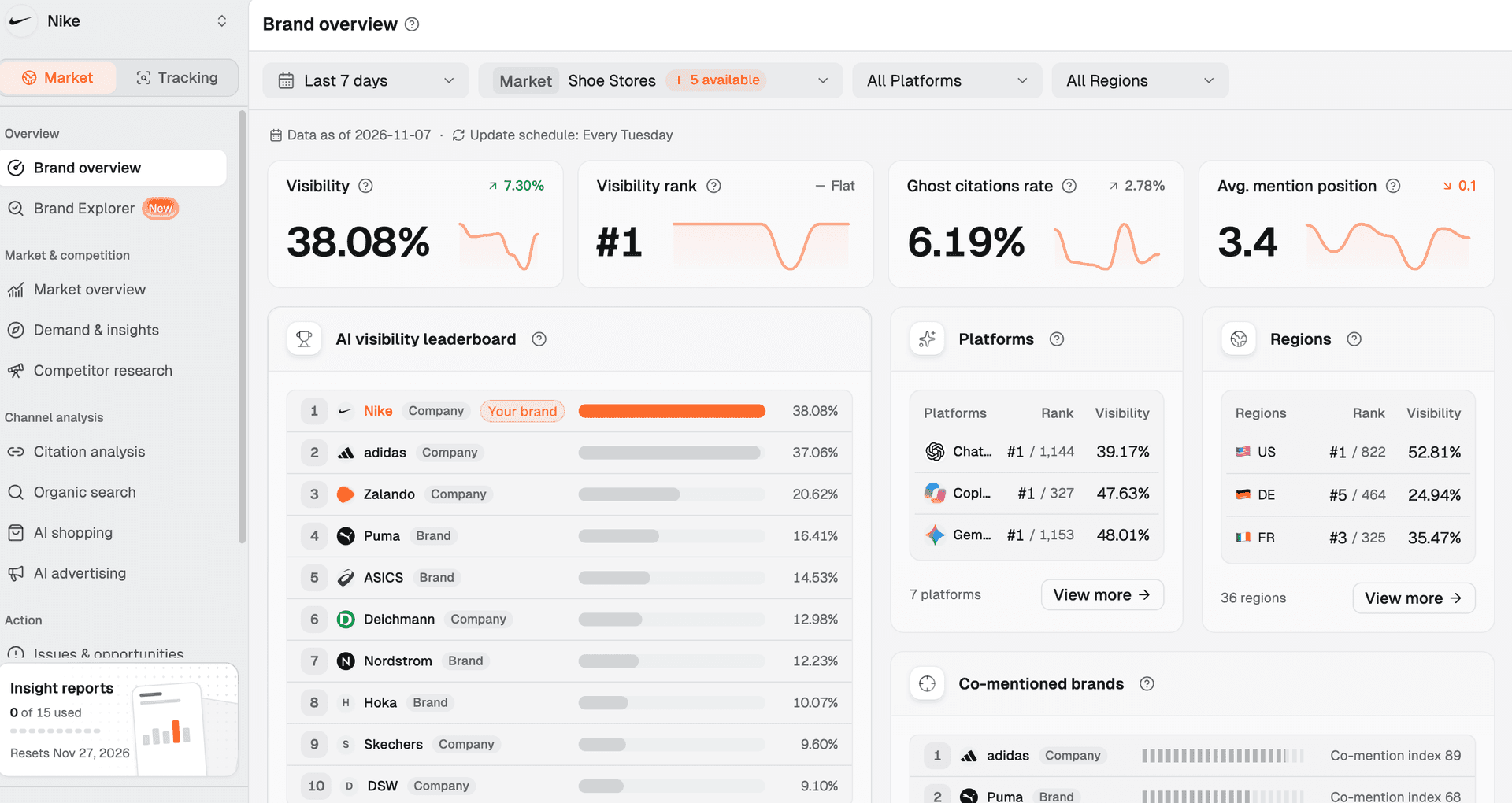
Dageno's Brand Explorer can start from a company, brand, product, or domain and explore existing AI search market data.
Teams can go on to view brand entities, related competitors, market rankings, visibility on different platforms, and how the AI describes products and selling points.
This helps expand an initial brand check into a more complete AI search market diagnosis.
Strategy 2: Identify your real competitors in AI search
Traditional SEO competitive analysis often starts from keyword rankings and competing domains.
But competitive relationships in AI search can be completely different.
Suppose a business sells project management software aimed at startup teams.
In traditional SEO, it may mainly compete with content sites that produce project management guides.
But when users ask for "project management tools for remote startup teams," the AI may compare multiple software brands directly.
At that point, the real competitors should be identified from the brands that repeatedly appear in AI answers, not just from websites with similar Google rankings.
We recommend focusing your analysis on three questions.
First, which brands often appear together with yours?
If the AI keeps mentioning your brand and another product together on similar questions, the two may be in direct competition for that type of user need.
Second, in which scenarios are competitors recommended more easily than you?
For example, a competing brand may have higher exposure in "best for large enterprises" scenarios, while your brand mainly appears in "best for small teams" questions.
This difference can help a business understand how the AI currently positions different brands.
Third, why do competitors get recommended?
You need to go on to check which characteristics the AI emphasizes when it recommends them:
Price and value for money
Ease of use
Product features
Integration capabilities
Security
Industry fit
Customer support
This information can help a team judge whether the brand's problem is insufficient exposure, unclear product positioning, or important selling points that aren't being presented adequately.
Dageno's Market Competitive Landscape lets you observe a brand's competitive position across dimensions such as market, model, region, and time, helping teams identify AI search competitive relationships that deserve focused research.
Strategy 3: Optimize around real user search intent, not just keywords
A mistake many businesses make in AI search optimization is converting their existing SEO keyword list directly into an AI prompt list.
For example:
CRM software
Best CRM software
CRM tools
Affordable CRM
These keywords still have research value, but they can't adequately represent the actual questions users ask in AI search.
Users may directly make more complex requests that are closer to a purchase decision:
Which CRM is best for a 10-person B2B sales team that needs email automation and has a limited budget?
This question includes team size, business type, feature requirements, and a budget constraint all at once.
If you only research the keyword "CRM software," it's hard to see in which specific scenarios the brand has a competitive advantage.
So you should organize user needs by decision stage.
Search intent type
Example question
Optimization focus
Problem exploration
How to manage sales leads effectively?
Educational content and problem explanation
Product discovery
Best CRM tools for startups
Brand exposure and product category positioning
Solution comparison
HubSpot vs Pipedrive
Clear, verifiable differentiating information
Alternatives
Best Salesforce alternatives
Competitive positioning and use cases
Purchase evaluation
CRM with email automation under $50
Features, pricing, and limitations
Product usage
How to integrate CRM with Gmail
How-to guides and product documentation
At the execution level, you can first compile 5–10 representative questions for each important scenario, and then observe brand performance on different AI platforms.
Note that these questions should come from real customer needs, sales conversations, product research, and available search data, rather than relying entirely on manual guesses.
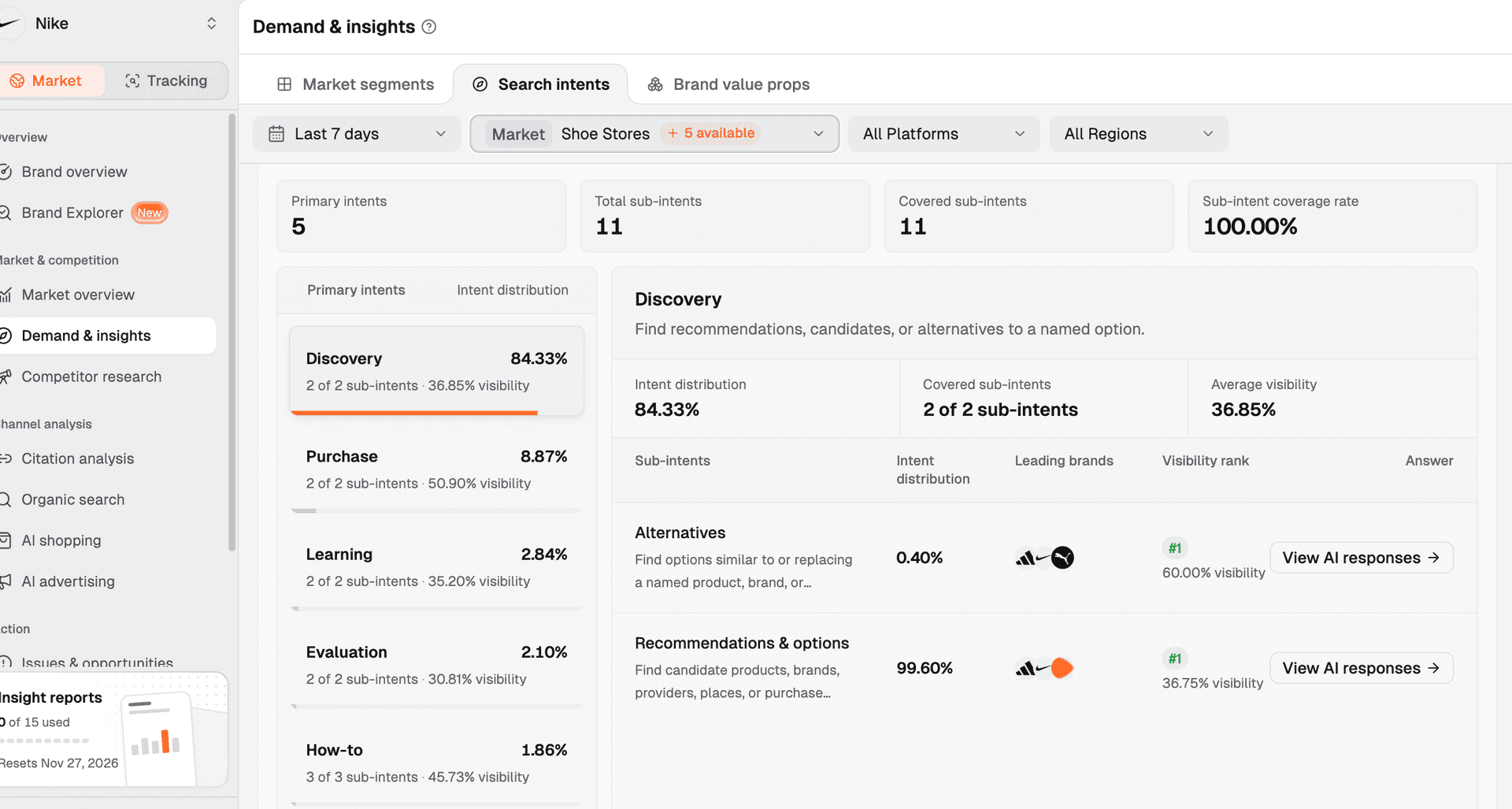
Dageno's Search Intents capability can help teams identify the user needs a brand already covers, as well as the purchase scenarios where competitors dominate but the brand has not yet gained coverage.
A truly valuable AI search strategy isn't about getting the brand into as many answers as possible, but about prioritizing the answers relevant to target customers' decisions.
Strategy 4: Build clear, consistent brand and product entity information
AI search systems need to understand who a company is, what products it offers, which users they suit, and what relationships exist between its products and other brands.
This information may be spread across:
The company's official site and product pages
Help centers and official documentation
Third-party software directories
Industry media and comparison articles
Reseller and partner websites
Product reviews and community discussions
If different sources describe the brand in clearly conflicting ways, it may make it harder for users and AI search systems to understand the brand.
For example, a software company has already moved to enterprise-grade products, but old articles still describe it as a free tool for individual users.
Businesses should prioritize checking and correcting this kind of important information.
Specific practices include:
Establish unified brand information. Make clear the company name, brand name, product names, main features, target customers, and core differentiators.
Improve product pages. Provide independent, detailed introductions for major products, clearly explaining uses, applicable scenarios, feature limitations, and prerequisites.
Sort out entity relationships. Especially for businesses with sub-brands, multiple product lines, or different models, avoid conflating the company, brand, product, and specific model.
Update key third-party materials. Check important directories, partner introductions, and editable product materials to make sure the information is accurate.
The point here isn't to repeat the brand name, but to reduce ambiguity in core facts.
Dageno 2.0's Brand Explorer emphasizes entity relationship analysis and can help identify the links among companies, brands, products, models, and related information sources.
Strategy 5: Make your website content discoverable, understandable, and citable
Even if a business is well known in its industry, serious technical problems on its website can still affect whether its content is discovered and used by search systems.
Google's technical requirements for AI Overviews and AI Mode are that a page must be indexed and eligible to be shown with a snippet in Google Search results. Meeting the requirements doesn't guarantee being shown.
So technical SEO should be an important foundation of AI search optimization.
We recommend focusing your checks on:
Whether important pages allow crawling by the relevant search engines.
Whether pages can be indexed correctly.
Whether page titles and main content clearly express the topic.
Whether key information is presented in accessible HTML.
Whether internal links help users and search engines discover related pages.
Whether product materials, pricing, and feature information are kept accurate.
Whether structured data is consistent with the content visible to users.
For websites that rely on JavaScript rendering, you should especially check whether key content can be accessed correctly by the target search systems, rather than assuming all AI crawlers have the same rendering capabilities.
Bing has also officially stated that a clear site structure, reliable content, proper indexing, and authority signals help support visibility in Bing and its AI search experiences.
You don't need to rebuild your website entirely because AI search has arrived, but you should prioritize fixing the issues that genuinely block content discovery and understanding.
Strategy 6: Create high-value content that directly solves user problems
AI search optimization doesn't mean every article has to be written as a short Q&A.
What matters more is whether the content provides a complete, reliable answer with unique value to a clear question.
Suppose a user asks:
What is the best CRM for a small real estate agency?
An article that merely repeats the keyword "best CRM software" usually can't answer this question adequately.
More helpful content should explain:
What should real estate teams consider when choosing a CRM?
Which features suit lead follow-up and client management?
What are the specific differences between products?
Which solutions suit small teams better?
What are the actual costs and implementation limits?
Content like this can not only serve traditional search users but is also more likely to become a candidate information source for AI search retrieval and citation.
We recommend prioritizing the following types of content.
Product comparison content: Provide real, accurate feature differences, applicable conditions, and limitations.
Buying guides: Help users of different sizes, industries, and budgets make decisions.
Technical and how-to documentation: Solve specific installation, integration, configuration, and troubleshooting problems.
Original research: Provide verifiable data, independent analysis, research methods, and new industry findings.
Product fact pages: Maintain up-to-date information on features, compatibility, pricing, specifications, and usage instructions.
Google's official advice stresses that unique perspectives, first-hand experience, and non-commodity content have more long-term value than simply repeating existing information.
So we don't recommend relying on mass-generating many similar articles as your main GEO strategy.
A more sensible approach is to identify user needs first and then decide what content to create.
Strategy 7: Increase your brand's information coverage on credible third-party sources
Brand information in AI search doesn't come only from the company's official site.
User reviews, industry websites, professional communities, third-party directories, and media coverage can also become reference sources for AI answers.
For example, when a user asks whether a piece of software suits small businesses, an AI search system may retrieve the official feature page and may also draw on third-party product comparisons and review information.
For businesses, you need to analyze in particular:
Which third-party websites already appear in the citations of relevant AI answers?
And:
Do those websites describe the brand, products, and main strengths accurately?
You can start from these directions:
Maintain brand information in relevant industry directories and software platforms.
Encourage real customers to share detailed usage experiences.
Offer original research and professional perspectives to suitable industry media.
Provide helpful answers in relevant professional communities.
Make sure partners have access to correct product materials.
Promptly fix outdated or incorrect content that you can control.
But you shouldn't fabricate fake reviews, mass-publish spam content, or buy inauthentic brand endorsements in order to increase AI mentions.
It's worth stressing that a third-party website being cited by the AI doesn't directly prove that the website caused the brand to be recommended.
Citation analysis is better suited to discovering which sources often take part in answering specific questions, and which information is worth building and maintaining further.
Strategy 8: Analyze AI citation sources to discover competitors' content advantages
Knowing that a competitor is recommended is only the first step.
The further question is: which information sources did the AI use when answering the relevant questions?
Suppose a business sells cybersecurity software.
In AI answers related to product selection, the team observes that:
Competitors' technical documentation is often cited.
Their own product pages lack some key feature descriptions.
Industry media repeatedly discuss competitors' security research.
These observations can't determine why the AI chose a given brand, but they can reveal information gaps worth investigating.
We recommend building a source research table:
What to observe
Information to record
Potential action
Your own website
Which pages are cited and which aren't
Check content completeness
Competitors' official sites
Which product pages or documents often appear
Compare information differences
Industry media
Which topics and data are repeatedly used
Plan original research
Review platforms
Which specific use cases are discussed
Improve product materials
Community content
Which questions still lack a clear answer
Create help content
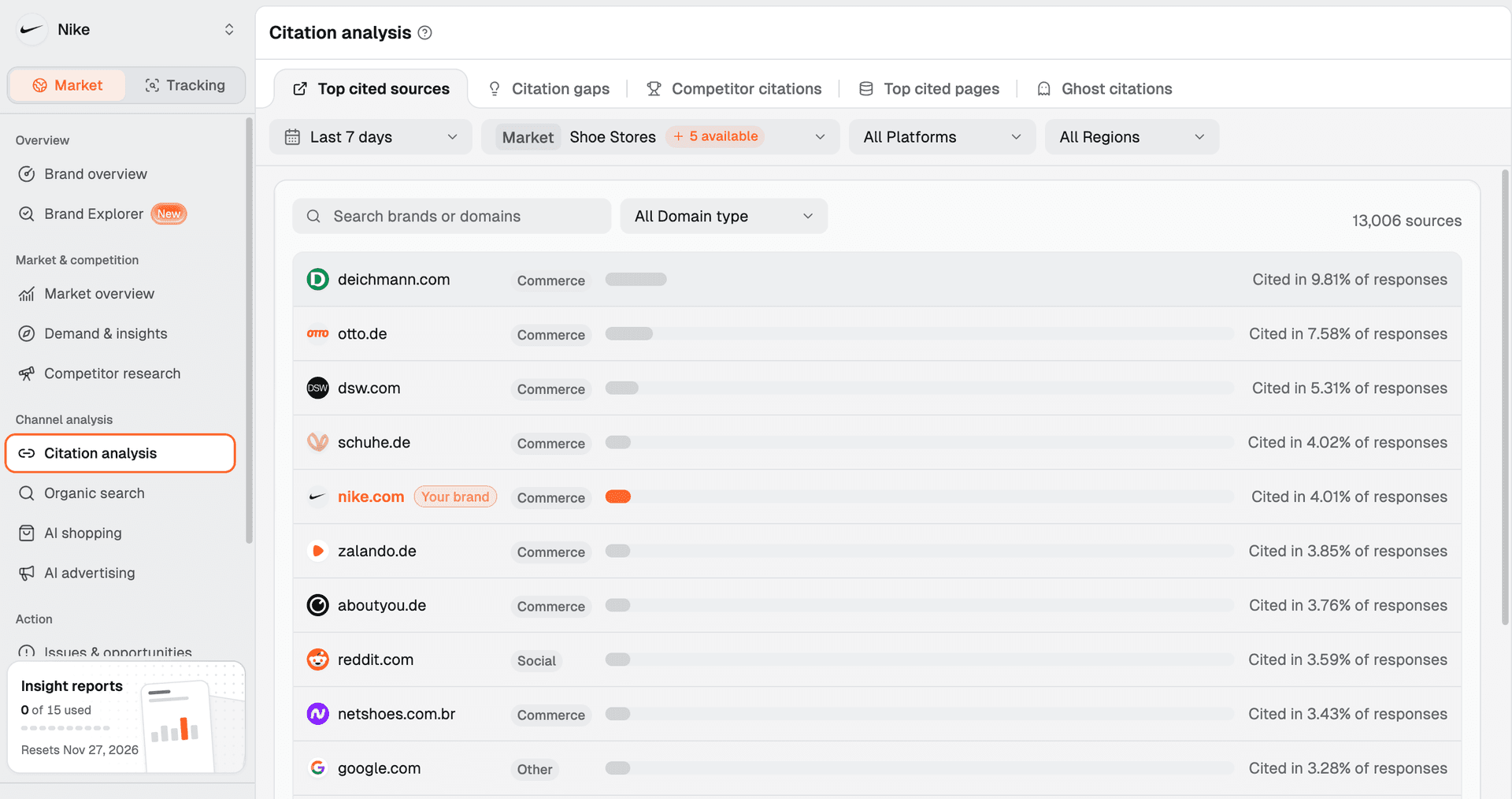
Dageno's Citation Sources can link citation sources to the corresponding AI answers, helping teams study information coverage at three levels: domain, URL, and answer content.
This approach moves GEO work from a vague "improve authority" toward specific issues that can be checked and prioritized.
Strategy 9: Set optimization priorities by AI platform and market
Many businesses hope to find a single, unified ranking method that works for all AI platforms.
But different AI search experiences differ in how they retrieve content, organize answers, and display sources.
Even with the same question, ChatGPT, Google AI Mode, and Perplexity may give different mixes of brands.
For multinational businesses, you also need to consider region, language, product availability, and the user's purchasing environment.
For example:
A brand may often be recommended in the US market because of ample product materials and broad channel coverage, but have low visibility in some European markets.
In that case, the problem isn't necessarily insufficient global brand awareness; it may also be differences in local-language materials, market coverage, product applicability, or the monitoring sample.
So we recommend analyzing AI search performance along these dimensions:
Dimension
Analytical goal
AI platform
Identify exposure differences across platforms
Country or region
Discover local market opportunities
Product category
Compare the visibility of different products
Search intent
Identify high-value purchase scenarios
Time period
Observe whether performance keeps changing
For teams with limited resources, you don't necessarily need to optimize all markets at once.
A more effective approach is to prioritize scenarios that are most relevant to target customers, have a clear competitive gap, and where action can be taken.
Strategy 10: Continuously monitor AI search performance to verify that optimization works
AI search optimization isn't a one-time content publishing task.
Even if a brand gets recommended today, future answers may change with user questions, models, retrieval results, and other conditions.
So businesses need to build a repeatable monitoring method.
We recommend watching at least the following five types of metrics.
1. Brand mention rate
The share of answers in a fixed set of monitored questions in which the brand name appears.
2. Brand recommendation rate
The share of answers in which the AI explicitly lists the brand as a recommended or worth-considering option.
3. AI Share of Voice
Measures the brand's share of exposure relative to competitors within a predefined set of competing brands and question samples. Definitions may differ between tools, so keep a consistent basis.
4. Citation visibility
Record how often your own website and related content are cited by AI answers, and observe changes in third-party sources as well.
5. Search intent coverage rate
Measures how many of the scenarios in the target user-needs set the brand appears in.
For example, a team continuously monitors 40 key purchase scenarios and finds the brand appears in 12 of them.
This means the scenario coverage rate within the sample is 30%, but this number can't be interpreted directly as the brand's real share of the whole AI search market.
We recommend analyzing it together with absolute numbers, the importance of each scenario, and changes over time.
4. How do you use Dageno to build an AI search ranking optimization workflow?
The strategies above involve brand diagnostics, competitive analysis, search intent, content optimization, and citation research.
But in practice, the main difficulty many teams run into is that data and information are scattered across different platforms, making it hard to judge which problem to solve first.
For example, a business may already know its brand is mentioned rarely in ChatGPT, yet still be unable to answer:
Why do competitors get recommended more easily? Which purchase scenarios deserve optimization first? Which information sources have clear gaps?
This is exactly the kind of problem Dageno can help teams analyze further.
Dageno is a GEO/AEO platform that links AI search visibility with market competition, brand entities, user needs, and source evidence, helping businesses understand their AI search performance and discover the next optimization opportunities.
Step 2: Study the AI search market competitive landscape
With Market Competitive Landscape, compare the brand's visibility, competitive ranking, and performance across platforms and regions in the relevant market.
This avoids judging your market position from just a few manually tested questions.
Step 3: Use Search Intents to discover growth opportunities
Go on to analyze which purchase needs are already covered, which scenarios are dominated mainly by competitors, and which important selling points the brand falls short on.
For example, a SaaS business may perform well in general category recommendations while being consistently absent from purchase questions in a specific industry.
This difference helps clarify the priorities for content and product information optimization.
Step 4: Study Citation Sources and GEO/AEO gaps
Look at the web pages and domains cited by relevant AI answers, and combine them with brand descriptions, product information, and competitor performance to judge which questions deserve investigation first.
Dageno's GEO/AEO Gap Diagnosis can help teams identify evidence-based visibility gaps and provide a reference for optimization priorities.
Step 5: Continuously monitor important questions
For the key user scenarios you've identified, you can use AI Visibility Tracking to continuously track custom questions and observe brand mentions and competitive performance across different AI platforms.
After optimization is carried out, go back to the same set of questions and compare whether the brand's performance has changed on a sustained basis.
You don't need to build a complex AI search monitoring system first before you can start diagnosing your brand.
You can first explore your brand's performance in the AI search market for free with Dageno, and then decide which scenarios deserve deeper research.
5. Five common mistakes to avoid in AI search optimization
1. Treating AI search as traditional keyword ranking
The brand order, recommended content, and citation links in AI-generated answers can all change, so you can't just focus on the position in a single answer.
2. Optimizing only the website without studying the real competitive market
Official site content is very important, but a brand's performance in AI answers also needs to be analyzed together with product competition, third-party information, and user needs.
3. Creating large amounts of similar content
Mass-producing articles with no unique information may increase maintenance costs without necessarily improving user value or AI search visibility.
4. Believing that adding Schema or llms.txt will get you recommended
Structured data should accurately reflect page content, and llms.txt shouldn't be treated as a universal requirement for earning AI recommendations. Google has explicitly advised against chasing unnecessary special files or so-called GEO shortcuts for generative search.
5. Monitoring only the brand name without checking recommendation quality
A brand may be mentioned alongside outdated or incorrect descriptions.
For example, the AI may mistake an enterprise product for a consumer tool, or cite a feature that has been discontinued.
So the accuracy of brand information and fit with purchase scenarios also deserve attention.
6. FAQ
1. How do I improve my brand's ranking in AI search?
To improve AI search performance, you should pay attention to your site's technical accessibility, original content, brand information accuracy, relevant third-party sources, and user search intent all together.
We recommend first establishing a baseline of brand visibility, then identifying the important purchase scenarios that competitors already cover but you haven't, and finally evaluating optimization results through continuous monitoring.
2. How do I get my brand a better ranking in ChatGPT?
ChatGPT has no unified brand ranking that applies to every user question.
You can improve the clarity of your official site and product information, build valuable content, maintain relevant third-party information, and monitor the brand's mentions and recommendations on target questions.
But no single method can guarantee that ChatGPT will recommend your brand on a given question.
3. What's the difference between AI search optimization and traditional SEO?
The two are clearly related but have different focuses.
SEO mainly studies web page discovery, rankings, and traffic in search engines; AI search optimization also needs to analyze a brand's recommendations, citations, competitive position, and user-need coverage in generated answers.
For Google's AI search features, traditional SEO best practices remain very important.
4. My website ranks high in Google Search but doesn't appear in AI answers. Why?
Google's traditional search results and AI-generated answers use different presentation methods. Even if a web page earns a good traditional search ranking, it isn't guaranteed to appear among the citations in a given AI answer.
Conversely, AI search may also cite pages that users didn't notice first in traditional search results.
5. Does structured data help improve AI search rankings?
Accurate structured data can help eligible search systems understand the entities and information on a page, but it isn't a mechanism that guarantees AI recommendations or citations.
Businesses should first make sure page content is accurate, crawlable, and useful, rather than adding markup for the sake of adding markup.
6. How long does it take for a website to earn rankings in AI search?
There is no uniform timeframe.
It depends on the website's foundation, the competitive environment, the brand's existing information coverage, content changes, and each platform's retrieval and update mechanisms.
We recommend establishing a baseline with a fixed set of questions and evaluating trends over multiple periods, rather than judging results from a single answer.
7. How do I track AI search rankings effectively?
You can build an initial picture through manual testing, but ongoing monitoring usually calls for a more systematic method.
You should record brand mentions, recommendations, competitive share of voice, and citation sources, along with conditions such as the model, region, time, and search intent.
Dageno can help teams study these questions by combining Brand Explorer, market competitive analysis, Search Intents, and AI Visibility Tracking.
8. Can I pay to improve my brand's ranking in ChatGPT or AI search?
You need to distinguish organic recommendations from ad placements.
Some AI search experiences may offer ad formats, but paid exposure doesn't equal control over a brand's ranking in naturally generated answers.
Businesses shouldn't trust any service that promises to guarantee organic AI recommendation rankings in exchange for payment.
7. Conclusion: what is a truly effective AI search ranking strategy?
To perform better in AI search, simply publishing more SEO articles is no longer enough to cover everything businesses need to address.
Businesses need to build a more complete process:
First understand the brand's current visibility, then study the competitive relationships and user needs in AI search, then improve brand information, website content, and related sources, and finally keep verifying the results.
Traditional SEO remains an important foundation, but AI search requires businesses to pay further attention to how their brand actually performs in product discovery and purchase decisions.
For businesses that want to carry out GEO/AEO more systematically, Dageno can help teams study AI search performance across dimensions such as brand entities, market competition, search intent, citation evidence, and ongoing monitoring.
The ultimate goal isn't just to have the AI mention your brand now and then, but to give the brand more accurate, more valuable, and sustainable exposure across relevant customer needs.
Learn how the AI sees your brand, and what you should prioritize improving next.
Ye Faye is an SEO and AI growth executive with extensive experience spanning leading SEO service providers and high-growth AI companies, bringing a rare blend of search intelligence and AI product expertise. As a former Marketing Operations Director, he has led cross-functional, data-driven initiatives that improve go-to-market execution, accelerate scalable growth, and elevate marketing effectiveness. He focuses on Generative Engine Optimization (GEO), helping organizations adapt their content and visibility strategies for generative search and AI-driven discovery, and strengthening authoritative presence across platforms such as ChatGPT and Perplexity
 Alexa for Shopping