When someone asks ChatGPT or Google AI Mode a question, the AI does not necessarily search only for the exact words the user entered.
To provide a more complete answer, an AI search system may also search for related topics, product comparisons, technical information, research evidence, and other material.
For example, a user might ask:
Do compression workout clothes actually help with muscle recovery?
The question sounds simple. But to give an evidence-based answer, the AI may need to find scientific studies on compression garments, randomized controlled trials, data on muscle soreness, and other research on exercise recovery.
One user question may therefore lead to several searches.
This process is called query fan-out.
For SEO and GEO/AEO teams, it creates a new challenge: your page may cover the keyword in the user's original question without adequately covering the information the AI searches for to answer it.
That is why query fan-out tools are attracting attention. They can help marketing teams understand how AI search expands a question, identify gaps in existing content, and build more targeted optimization strategies.
However, these tools do not all provide the same kind of data. Some generate possible related searches from an input question. Some analyze how well a page covers related topics. Others record specific queries observed during AI search monitoring and connect them to the final answer, brand performance, and cited sources.
This article compares query fan-out tools worth considering in 2026. It also uses a real Nike monitoring view in Dageno to show how query fan-out data can reveal actionable GEO content opportunities.
1. Best Query Fan-Out Tools in 2026: Quick Comparison
If you need a query fan-out tool for SEO or GEO work, start with your use case.
Tool
Best for
Core value
Consideration
Dageno AI
Tracking AI search queries and ongoing GEO analysis
View observed fan-out queries, prompts, trends, and citation context
Observability depends on monitoring conditions and the platform
LOCOMOTIVE
Studying semantic coverage and content gaps on a page
Assess whether an existing page covers related search topics
Semantic analysis is not the same as an actual AI search log
LLMrefs
Quickly simulating query fan-out
Generate related queries from a prompt and examine search results
Keep simulated queries distinct from recorded searches
Radarkit
Studying AI visibility and brand competition
Connect prompt monitoring, brand performance, and citation research
Verify how specific fan-out data is obtained
Which Type Should You Choose?
If you simply want to enter a question and quickly generate related queries, a query simulation tool such as LLMrefs is a direct option.
If you already have an article and want to know whether it adequately covers related topics, LOCOMOTIVE's semantic content analysis is more targeted.
If you want to study which observable searches an AI actually performed while answering a monitored prompt, and how those searches relate to AI answers, brand mentions, and cited sources, Dageno is worth evaluating first.
The following product example shows why these differences matter.
2. Dageno Query Fan-Out Tool: Finding Real Content Opportunities in AI Search Queries
Many SEO teams already have keyword research tools. They know what users search for and where competitors rank well.
AI search adds another step that used to be hard to observe: what information does the AI look for after a user asks a question?
Suppose a sportswear brand has published extensively about athletic apparel, training gear, and muscle recovery. Its articles may be well optimized for keywords. Yet when a user asks ChatGPT whether compression workout clothes help muscle recovery, the brand team may still not know which angles the AI will investigate.
Adding a few more keywords or publishing a generic product introduction may not be the most valuable next step.
Dageno's Query Fan-out Analytics helps teams examine search queries recorded during monitoring and view prompts, AI answers, and cited sources in the same analysis workflow.
Its value goes beyond displaying a list of queries. It helps teams ask: where is the gap between the content we provide and the information the AI seeks for this particular question?
1. Real Example: Do Compression Workout Clothes Help Muscle Recovery?
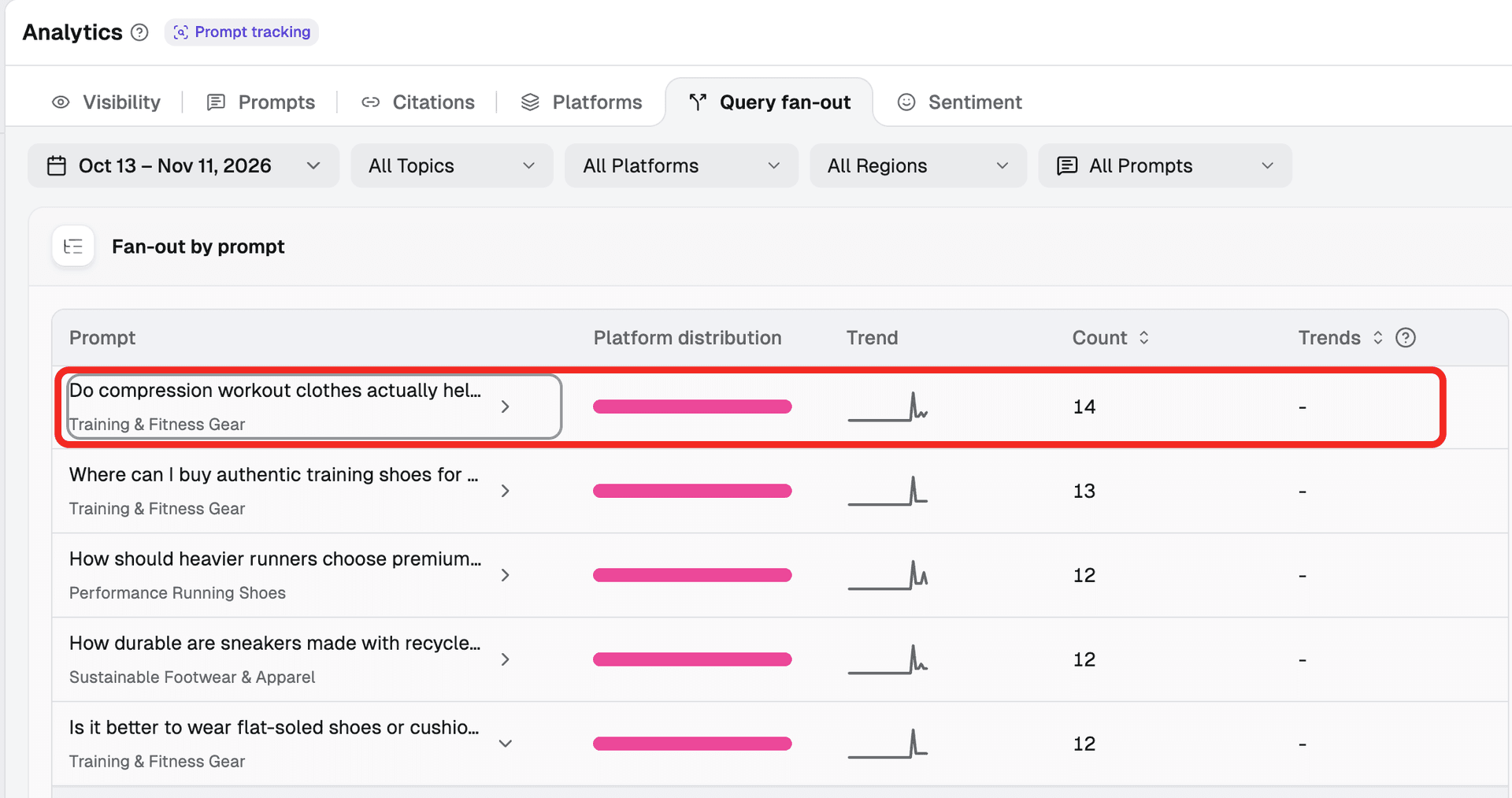
In Dageno's Nike monitoring project, one prompt about training gear asks:
Do compression workout clothes actually help with muscle recovery?
The question belongs to the Training & Fitness Gear topic.
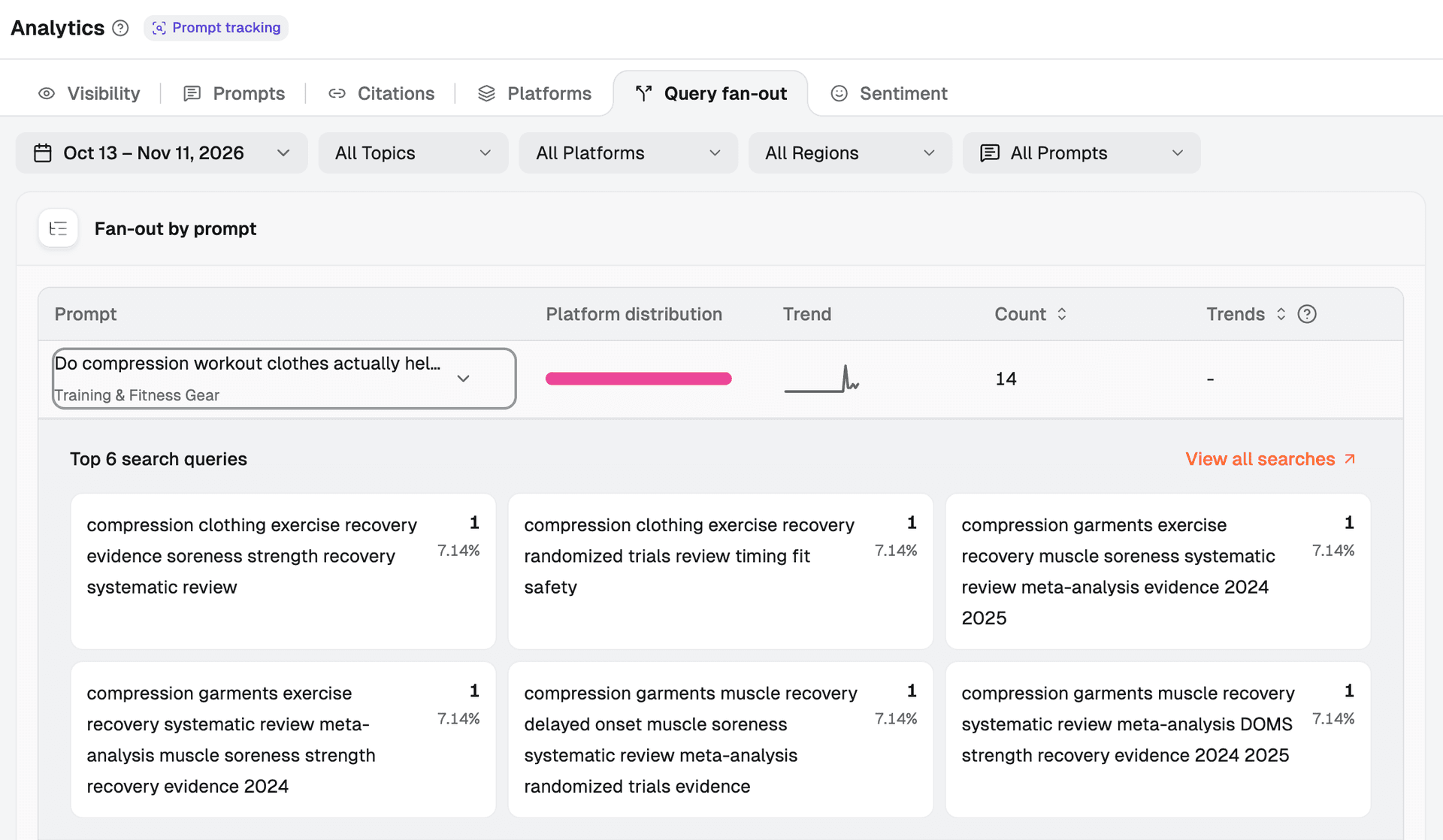
For the selected period from October 13 to November 11, 2026, this prompt had 14 recorded query fan-out searches.
These are more than synonyms for the user's original question. They reveal several specific information needs.
Term in the AI search queries
Research direction
Systematic review
Find systematic reviews
Meta-analysis
Find analyses that synthesize research findings
Randomized trials
Examine evidence from randomized controlled trials
Muscle soreness
Study post-exercise muscle soreness
Strength recovery
Study effects on strength recovery
Timing, fit, safety
Investigate when and how to wear the garments, and their safety
This leads to an important SEO/GEO assessment. If the brand's site only describes the elasticity, comfort, and fabric of its compression apparel, that may not fully answer the user's question about recovery. The observed searches clearly include scientific evidence and specific recovery measures.
This does not mean the AI will necessarily prefer to cite research papers. Nor does it prove that the brand site lacks relevant content. It does, however, provide a content-gap hypothesis worth testing.
The team can review its existing articles: Do they cite reliable research? Do they distinguish muscle soreness from strength recovery? Do they explain differences among studies, usage conditions, and limitations of the evidence?
If that information is missing, a thorough, credible guide may be more useful than another generic article on the “five benefits of compression workout clothes.”
That is the most direct value of query fan-out data. It shows how an apparently ordinary product question may require a very different kind of content to answer well.
2. Turn Fan-Out Queries into an Actionable Content Plan
Finding related queries is only the beginning. Next, organize them into a content plan and define what each piece of content needs to accomplish.
Consider the compression apparel example:
Fan-out topic
Potential content gap
Suggested action
Scientific evidence on exercise recovery
The page may lack research support
Add a section interpreting the research
Muscle soreness
Different recovery measures are not distinguished
Add a focused explanation
Strength recovery
Product descriptions are disconnected from outcome research
Add evidence and applicability limits
Randomized controlled trials
Sources cited in the article are insufficient
Review and cite reliable studies
Timing and safety
Specific usage conditions are missing
Improve help content and usage guidance
The team does not necessarily need five separate articles. A better approach is to determine whether these needs belong to one main topic.
If most questions center on whether compression apparel helps recovery, consider one comprehensive guide. If a branch has a distinct and significant user need, such as sizing and safe use, consider a separate page linked to the main guide.
The resulting content plan might be:
Core article: Do Compression Garments Help Muscle Recovery? What the Research Says
Main sections: Scientific findings, muscle soreness, strength recovery, when to wear compression garments, and limitations of the evidence
Supporting content: How to wear compression workout clothes, appropriate use cases, and comparisons among product types
These recommendations are editorial judgments based on recorded query fan-out activity. They do not mean Dageno has proved that these articles will earn AI citations. The real test is whether the content answers users' questions better.
3. Second Example: Are Flat or Cushioned Shoes Better for Leg Workouts?
Another example that illustrates the value of query fan-out concerns training shoes.
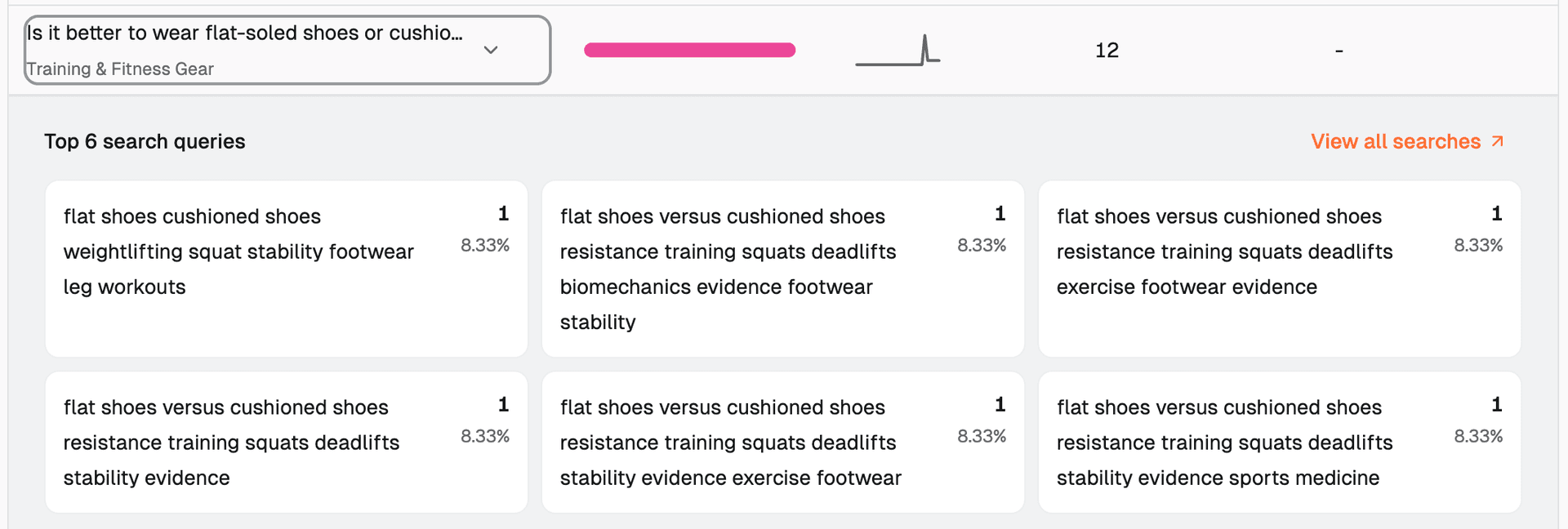
In Dageno's Nike dashboard, a prompt compares flat shoes with cushioned shoes. Expanding it shows the top six search queries, including:
flat shoes cushioned shoes weightlifting squat stability footwear leg workouts
flat shoes versus cushioned shoes resistance training squats deadlifts biomechanics evidence footwear stability
These searches include squats, deadlifts, resistance training, sole stability, and biomechanical evidence. They all concern training shoes, but they point to different content needs.
A user searching for “best training shoes” may want product recommendations. Someone asking which shoes are better for squats needs to understand the relationship between the movement, sole construction, and stability.
A general buying guide may not answer all these specific questions in sufficient depth. Query fan-out can help a content team reorganize its topics:
User question
More suitable content angle
What is the difference between flat and cushioned shoes?
Product comparison
Does sole stability matter for squats?
Training scenario explanation
What footwear factors matter for deadlifts?
Exercise-specific guide
How do different shoe types affect biomechanics?
Research interpretation
How do I choose shoes for my own training?
Buying decision guide
Unlike ordinary keyword expansion based only on semantic similarity, these topics connect directly to searches observed for the monitored prompt. That gives content planning more specific research leads.
4. Why Query Counts and Distribution Also Matter
Dageno displays more than query text. At the prompt level, it can also show counts, trends, and query distribution.
In the screenshot below, the question about flat versus cushioned shoes has 12 recorded searches.
Each top search query in the expanded view appears once, representing 8.33% of the prompt's current records.
These figures can help a team ask whether a query recurs in the monitored sample, whether similar queries cluster around particular information needs, and how search activity differs among prompts.
Avoid a common misunderstanding: more queries do not automatically mean that a question is more important or has greater user search demand. A question about scientific evidence may require many searches, while a simple product fact may require only a few.
Query counts are therefore better used to understand AI search behavior than as direct indicators of content priority or search volume.
5. Connect Query Fan-Out with AI Answers and Citation Sources
This is one reason Dageno warrants attention beyond tools that only generate lists of related queries.
In Dageno's prompt details, Query Fan-out, AI Answers, Citation Sources, and Citation Pages appear in the same analysis workflow.
Teams can examine three layers of the same question:
What did the AI search for? Query fan-out shows specific searches, related topics, and evidence needs.
What did the AI ultimately answer? AI Answers shows whether the response addressed the user's question and mentioned the brand.
Which sources did the AI cite? Citation Sources and Citation Pages show the relevant domains and pages.
Suppose a monitored prompt produces many searches about scientific evidence. The team then finds that the final answer draws on specialist research and does not cite the brand's site. It can investigate whether the site provides relevant, reliable information or mainly promotional product descriptions.
That is a more evidence-based way to diagnose content gaps. Still, the relationship among queries, citations, and brand mentions should be treated as a research lead, not proof of causation. A page's absence from citations does not mean adding the same keywords will make it appear.
6. Move from One-Off Analysis to Ongoing Monitoring
Many query fan-out tools work well for analyzing a question once. Teams responsible for long-term brand growth also need to observe the same set of questions over time.
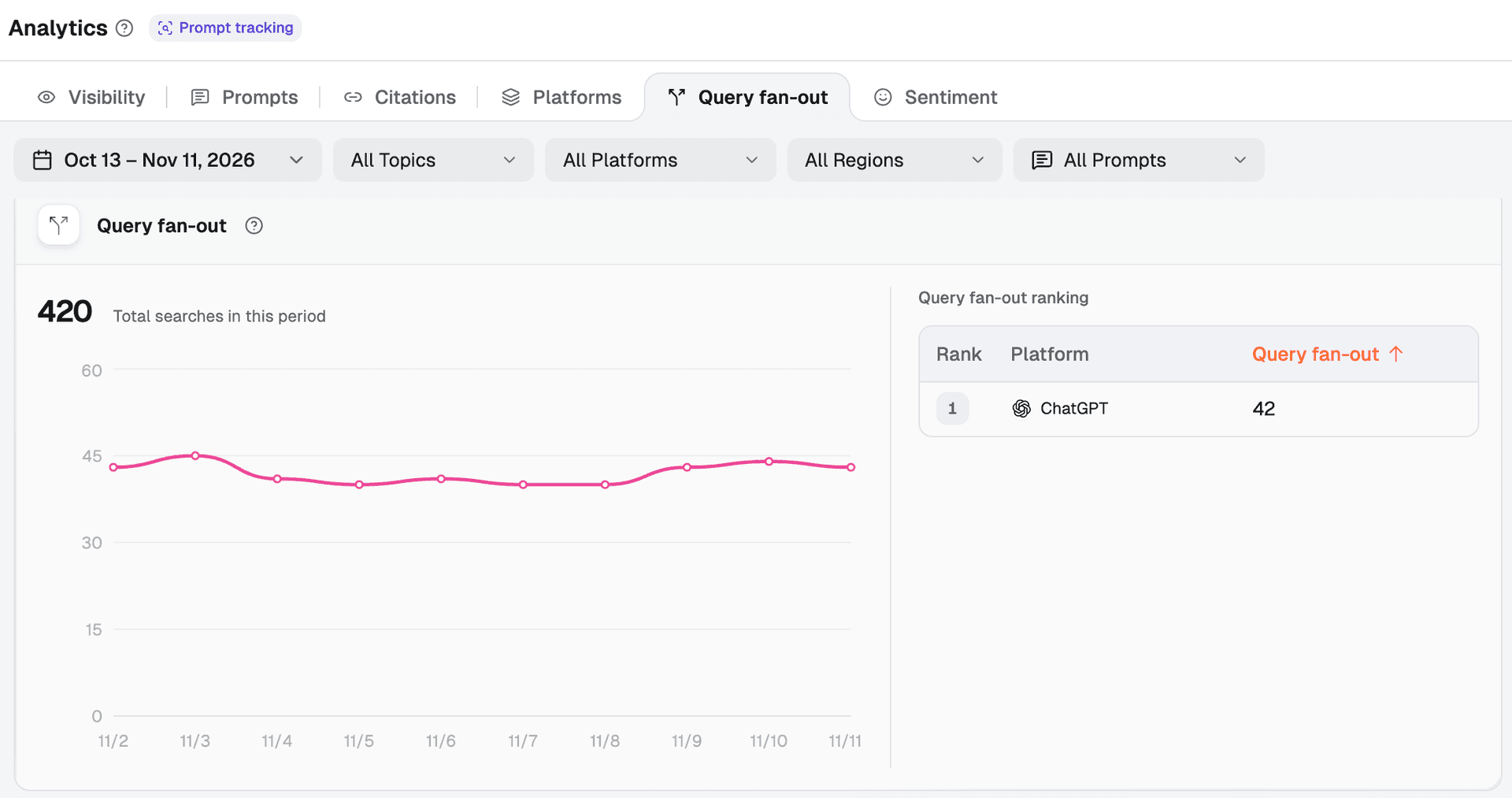
Dageno's Query Fan-out Analytics offers filters for date, topic, platform, region, and prompt, and displays search activity trends.
Records can also be analyzed by specific topic and prompt. A team might establish a stable monitoring set around important buying scenarios, such as:
Choosing running shoes
Training gear
Sustainable sportswear
Exercise recovery
Product comparisons
After updating content, the team can continue to observe related prompt searches and AI answers, then assess changes alongside brand mentions and citation performance. This is more useful for ongoing GEO work than checking once whether ChatGPT mentioned the brand.
Which Teams Is Dageno Best For?
A free query fan-out generator may be enough for someone who only wants a list of related keywords. For teams that need to study information needs, brand performance, and content opportunities in AI search over time, Dageno is a stronger fit for an ongoing workflow.
It is particularly relevant to SEO teams responsible for brand visibility and content strategy, GEO/AEO teams diagnosing gaps in AI answers and citations, and agencies that need to explain their analysis to clients.
Dageno's value is not simply in showing more keywords. It helps teams answer three practical questions: What information is the AI looking for? Does our existing content meet those needs? What should we improve next?
Besides Dageno, other tools approach query fan-out from different angles.
A query fan-out generator, a semantic content analysis tool, and a continuous tracking platform do not work in exactly the same way. Choose according to your goal, rather than whether a tool uses “query fan-out” in its name.
1. LOCOMOTIVE: Analyze Semantic Coverage and Content Gaps
LOCOMOTIVE's Query Fan-Out Tool primarily helps SEO teams assess how well existing pages match related search intent semantically.
Unlike Dageno's prompt-level query monitoring, LOCOMOTIVE starts with page content and examines how thoroughly an article covers related topics.
Users can provide a target keyword and a URL to analyze. The tool uses semantic techniques such as embeddings, or vector representations of text, to compare page content with related queries and competing content. This can help identify information the page may lack.
Its public description emphasizes semantic coverage, paragraph analysis, and content optimization opportunities.
Suitable use case: Suppose you have an article about a “technical SEO agency” but do not know whether it adequately addresses pricing, service scope, working arrangements, and selection criteria. LOCOMOTIVE can help assess how those topics relate to your existing page.
Main advantage: It analyzes content coverage around an existing URL, making it useful for teams updating a large collection of SEO pages.
Consideration: Generating or evaluating related queries with a semantic model does not reconstruct the complete search log of ChatGPT or Google AI Mode.
2. LLMrefs: Quickly Simulate AI Query Fan-Out
LLMrefs offers a Query Fan-out Generator that simulates related queries an AI search system might produce from a user's question. It suits content teams that want a quick view of the subtopics a complex question may involve.
For example, enter:
What is the best CRM for a small B2B sales team?
The tool may generate queries about budgets, email integrations, sales automation, team size, and product comparisons. These results can inform an article outline and provide a starting point for further research into conventional search results.
LLMrefs' public page also describes model selection, simulated queries, and research into their corresponding search results.
Main advantage: A straightforward way to start content planning, expand a topic, and simulate queries.
Consideration: Treat simulated queries as research hypotheses. Do not present them as searches actually performed for a specific AI answer.
3. Radarkit: Study AI Search Visibility and Competitors
Radarkit focuses more on brand performance in AI search. It connects prompt tracking, brand visibility, and citation analysis for marketing teams that want to understand how they appear in AI answers.
A SaaS company, for example, may want to know whether AI mentions its brand in product recommendation answers, which competitors are recommended more often, and which pages the AI cites. Tools in this category can support an AI visibility monitoring program.
If query fan-out is your main purchasing goal, confirm whether the tool provides specific subquery records, their data sources, counts, and long-term trends.
Main advantage: Supports AI search monitoring from the perspective of brand performance and competitive research.
Consideration: AI visibility monitoring and direct access to recorded query fan-out activity are separate capabilities to verify.
4. What Is Query Fan-Out, and Why Does It Change SEO?
Query fan-out is a technique in which an AI search system creates multiple related queries to answer one user question and retrieves supporting material across different information needs.
Google describes this approach in its official Search documentation. AI Overviews and AI Mode may use query fan-out to find relevant pages across multiple subtopics and data sources.
How Does Query Fan-Out Work?
Suppose a user asks:
What is the best laptop for video editing under $2,000?
The question involves price, performance, software compatibility, and a specific buying decision. An AI search system may search along these lines:
Subquery direction
Question it helps answer
Video editing laptop requirements
What hardware does video editing require?
Best GPU for video editing
Is the graphics performance sufficient?
Premiere Pro system requirements
Is the laptop compatible with the intended software?
MacBook vs Windows editing laptops
How do the platforms differ?
Video editing laptops under $2,000
Which specific products fit the budget?
Simplified query fan-out workflow:
A complex user question leads to searches about performance requirements, prices and products, and software compatibility.
The system retrieves and synthesizes relevant sources.
It generates an AI answer with recommendations and citations.
This is a simplified illustration. Actual behavior varies by platform, model, and question.
There is an important difference from traditional keyword ranking. In conventional SEO, teams often study the pages ranking for a keyword. In AI search, a complex question can trigger several retrieval paths. Different sources may provide prices, specifications, user reviews, or product suitability information.
As a result, a site without a page that exactly matches the original question may still be considered as a source for one related information need. Conversely, a page that ranks well for the original keyword is not guaranteed to appear in the final AI answer.
How Is Query Fan-Out Different from Query Expansion?
The terms are often used interchangeably. Query expansion generally means improving retrieval through synonyms, related phrases, or semantic variations. Query fan-out places more emphasis on forming several related search tasks around a complex question.
For example, consider the original query Best CRM software for startups.
Ordinary query expansion might produce:
Top startup CRM platforms
CRM tools for new businesses
Query fan-out might also investigate:
CRM pricing for small teams
CRM email automation comparison
CRM implementation time for startups
CRM integration with Gmail
Free vs paid CRM limitations
Both concepts can help explain related topics, but query fan-out highlights the need to retrieve information from several angles.
5. How to Turn Query Fan-Out Data into a GEO Content Strategy
Having a list of query fan-outs does not mean you have completed GEO optimization. The crucial step is building an actionable workflow. I recommend five stages.
Step 1: Select Prompts That Affect Customer Decisions
Do not start only with the highest-volume keywords. Prioritize questions relevant to your product, target customers, and commercial context.
A B2B SaaS company, for example, could monitor:
Best CRM for a 10-person sales team
HubSpot alternatives for startups
CRM with Gmail and Slack integrations
How to choose a CRM for a small agency
Affordable CRM for growing businesses
These questions cover product discovery, competitor comparisons, feature requirements, selection criteria, and budget. This keeps the monitoring set focused on business-relevant questions.
Step 2: Analyze the AI's Related Search Queries
Use a query fan-out tool to view or simulate related searches. With Dageno, you can also examine recorded queries and occurrence counts for a specific prompt.
Group queries by the information they seek:
Query topic
Information need
CRM pricing
Price and budget
CRM integrations
Tool compatibility
CRM onboarding
Setup and learning costs
CRM alternatives
Competitor comparison
CRM automation
Features and efficiency
The goal is to identify the main information needs behind a group of queries, not to copy each query mechanically.
Step 3: Check Whether Existing Content Actually Answers Those Questions
Compare related queries with content on your site. You may have a thorough CRM product overview that does not clearly explain:
How do the free and paid versions differ?
How long does setup take for a team?
Does the product support specific integrations?
Which features depend on the plan?
Which team sizes and industries is the product best suited to?
Addressing these questions may be more valuable than adding more generic product copy.
Classify content gaps by priority:
Priority
Basis for assessment
Suggested action
High
Directly relates to an important buying need, and the page lacks a key answer
Add or update the content first
Medium
Relates to the core product, but existing coverage is incomplete
Include in the near-term optimization plan
Low
Has weaker business relevance or is already covered well
Continue monitoring
Query fan-out alone does not establish business priority. Teams should also consider product margins, customer needs, conversion value, and existing SEO data.
Step 4: Decide Whether to Update an Existing Page or Create a New One
Not every fan-out query needs its own article. If several queries serve one core question, cover them in a comprehensive guide.
For example, “CRM pricing,” “CRM implementation cost,” and “CRM total cost of ownership” may fit in one CRM cost guide. “How to integrate a CRM with Gmail,” however, may warrant separate instructions.
Use these guidelines:
Update an existing page when search intent and audience are the same and the page mainly needs new sections or evidence.
Create a new page when the question needs a complete standalone answer, serves a clearly different user goal, or requires a detailed tutorial, technical explanation, or dedicated comparison.
Google also cautions against mass-producing content to manipulate rankings merely to cover many query fan-out variations. The focus should remain on useful content that solves users' problems.
Step 5: Monitor AI Answers, Citations, and Brand Performance
After improving content, continue observing the relevant questions under conditions that are as consistent as possible.
Look beyond whether a page was cited:
Did the AI's answer to the user change?
Was the brand mentioned or recommended?
Was the brand's site cited?
Did competing brands' performance change?
Did the search topics in the query fan-out change?
Dageno Analytics lets teams examine brand performance and query activity from different angles, supporting ongoing GEO research rather than one-time content planning.
6. How to Choose the Right Query Fan-Out Tool
When choosing a query fan-out tool, do not judge it only by the number of queries it generates. More important is whether its data supports the decisions you need to make.
1. Are the Queries Recorded or Simulated?
This is one of the most important distinctions. Simulated queries help teams explore related topics quickly, but do not prove that an AI platform actually used those searches. Tools that record queries can help teams investigate search activity observed during specific monitoring runs.
Even with recorded-query tools, confirm which platforms and monitoring methods provide the data, and what observability limits apply.
2. Can You See Queries for a Specific Prompt?
An aggregated query list can help with content planning. Seeing searches associated with each prompt makes the relationship between a user question and its queries easier to understand.
For example, “Do compression workout clothes improve recovery?” and “Which compression workout clothes should I buy?” concern the same product category but involve different information needs.
3. Does It Support Long-Term Trend Analysis?
A one-time query generator may be enough for occasional article research. Brand and GEO teams usually need to track a set of important questions over time. Date filters, historical records, query counts, and trend analysis therefore matter.
4. Can It Connect Searches to Final AI Answers and Citations?
A query fan-out list alone usually cannot tell you whether content actually made it into an AI answer. AI Answers, Citation Sources, Citation Pages, and brand visibility data enable a fuller investigation.
5. Can the Data Lead to Specific Improvements?
Ultimately, ask whether the tool helps you identify content to change, decide which user needs deserve investment, and support ongoing monitoring. A tool that only outputs dozens of unclassified keywords without sources or context may have limited practical value.
Query Fan-Out Tool Selection Summary
Main need
Suggested choice
Quickly generate related queries an AI might use
LLMrefs
Analyze the semantic coverage of an existing page
LOCOMOTIVE
Study brand visibility in AI answers
An AI visibility monitoring platform
View recorded query fan-out searches for a specific prompt
Dageno
Combine search queries, AI answers, and cited sources for ongoing GEO analysis
Dageno
7. Common Query Fan-Out SEO Mistakes
Mistake 1: Treating Fan-Out Query Counts as Conventional Search Volume
A query appearing several times during monitoring does not mean real users search for it that many times each month. Query fan-out records reflect search activity under specified monitoring conditions, not the monthly search volume reported by conventional keyword tools.
Mistake 2: Assuming That Covering More Related Queries Guarantees AI Recommendations
Even content that covers related topics is not guaranteed to be retrieved, cited, or recommended. Information quality, relevance, page accessibility, source credibility, and system behavior all affect the outcome.
Mistake 3: Creating an Article for Every Fan-Out Query
This can produce large amounts of repetitive, thin content. Group queries by topic, then decide what belongs in one guide and what merits a standalone explanation.
Mistake 4: Looking at Query Fan-Out but Ignoring the Final AI Answer
Search activity alone cannot prove that brand performance improved. Examine AI Answers, citations, and brand visibility to understand how observed searches relate to the final response.
Mistake 5: Assuming All AI Search Platforms Use the Same Query Strategy
Platforms and models can retrieve information differently. Monitoring results from one platform should not be generalized to every AI search system.
8. Query Fan-Out Tool FAQs
1. What Is a Query Fan-Out Tool?
A query fan-out tool generates, displays, or analyzes the additional searches used in AI search. It helps SEO and GEO teams understand how an AI search system looks for related information around one user question and identify content opportunities worth investigating.
2. How Does Query Fan-Out Work?
Query fan-out expands a complex user question into several related search tasks, helping an AI search system gather information from more angles. A product recommendation question, for example, might prompt searches about pricing, features, comparisons, suitable users, and third-party reviews.
3. Does Google AI Mode Use Query Fan-Out?
Yes. Google has confirmed that AI Mode and AI Overviews may use query fan-out to retrieve information across related searches, subtopics, and sources.
4. Can I See the Actual Query Fan-Outs Used by ChatGPT?
That depends on whether a tool can observe and record the relevant search activity. Some tools only simulate possible queries, while some monitoring tools display searches recorded during their monitoring process.
Dageno's Query Fan-out Analytics provides prompt-level queries, search counts, and trend analysis. These data should not be interpreted as a complete record of all of ChatGPT's internal search activity.
5. What Is the Difference Between Query Fan-Out and Keyword Research?
Keyword research mainly examines the terms users search, along with search volume, competition, and ranking opportunities. Query fan-out analysis examines related searches an AI expands or performs to answer a question. Used together, they help teams understand user demand and information coverage in AI search.
6. What Is the Difference Between a Query Fan-Out Generator and a Tracker?
A query fan-out generator usually simulates related searches based on an input question. A tracker focuses on recording and analyzing observable query activity during monitoring, and may provide historical trends and analysis by prompt. Check the data source and actual capabilities before choosing one.
7. Can Query Fan-Out Analysis Improve GEO?
It can help a company find content gaps, understand related information needs, and develop a more targeted content strategy. No single tool or method, however, can guarantee AI citations or recommendations for a brand.
8. What Is the Best Query Fan-Out Tool for SEO?
It depends on the task. Consider LLMrefs if you only need to expand content topics quickly. Evaluate LOCOMOTIVE if you want to analyze the semantic coverage of existing pages. Dageno is worth prioritizing if you need recorded queries by prompt and want to connect them to AI answers, citations, and brand performance in ongoing GEO analysis.
9. How Many Queries Can One Prompt Generate?
There is no fixed number. Query counts depend on the question's complexity, AI platform, model, retrieval strategy, and monitoring method. In Dageno's Nike example, different prompts have different query counts, but those figures cannot be generalized to all AI search scenarios.
10. Can Query Fan-Out Tools Tell Me Why AI Cited a Competitor?
They can provide clues, but generally cannot fully prove the internal reason an AI cited a particular source. Combining specific queries with AI Answers, Citation Sources, and competitive brand analysis enables a better-informed investigation of content gaps and possible contributing factors.
9. Conclusion: The Best Query Fan-Out Tool Helps You Make Better GEO Decisions
Query fan-out changes an important part of how SEO teams study AI search. Marketers have traditionally focused on the keywords users type and the pages that rank for them. Now they can also ask: what related information does the AI look for to answer those questions?
Search optimization therefore involves more than improving a page's ranking for one keyword. It also requires understanding the information needs behind complex user questions.
For teams seeking content ideas, a query fan-out generator can quickly surface related topics. For SEO teams improving existing pages, semantic content analysis can reveal insufficient coverage. For businesses monitoring brand performance in AI search over time, query fan-out has a broader role.
With Dageno, teams can examine searches recorded during monitoring, analyze query activity for different prompts, and investigate potential gaps alongside AI Answers, Citation Sources, Citation Pages, and brand visibility.
The Nike examples make this concrete. A simple question about compression workout clothes may involve scientific evidence, randomized controlled trials, and distinct recovery outcomes. A comparison of training shoes may lead to searches about squats, deadlifts, stability, and biomechanics.
These insights help teams reassess content needs, decide which pages to improve, and identify questions that need deeper explanation and stronger evidence.
The real value of query fan-out is not generating more keywords. It is grounding content strategy in a clearer understanding of the information AI search seeks.
If you want to understand what AI is searching for when answering questions related to your brand, and what GEO opportunities those searches may reveal, Dageno's Query Fan-out Analytics is a place to start.
Ye Faye is an SEO and AI growth executive with extensive experience spanning leading SEO service providers and high-growth AI companies, bringing a rare blend of search intelligence and AI product expertise. As a former Marketing Operations Director, he has led cross-functional, data-driven initiatives that improve go-to-market execution, accelerate scalable growth, and elevate marketing effectiveness. He focuses on Generative Engine Optimization (GEO), helping organizations adapt their content and visibility strategies for generative search and AI-driven discovery, and strengthening authoritative presence across platforms such as ChatGPT and Perplexity
 Alexa for Shopping