From GEO Monitoring to AI Search Market Intelligence: Dageno Opens Free Public Search
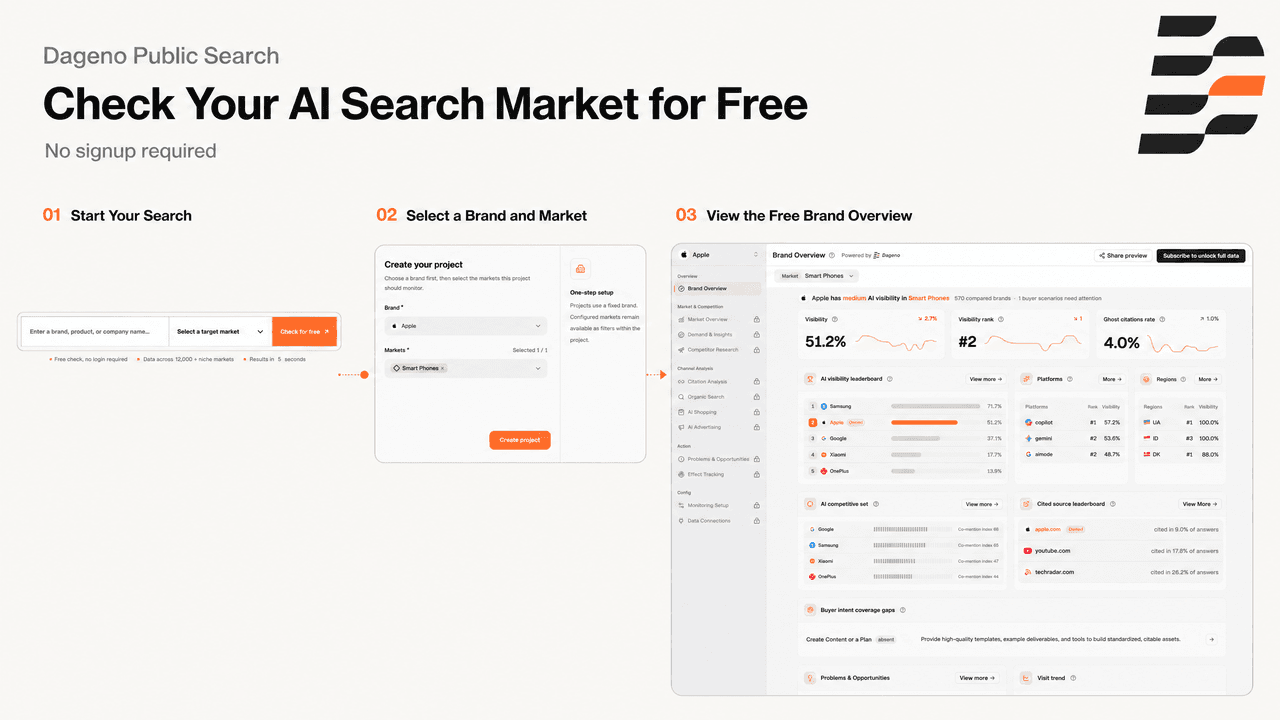
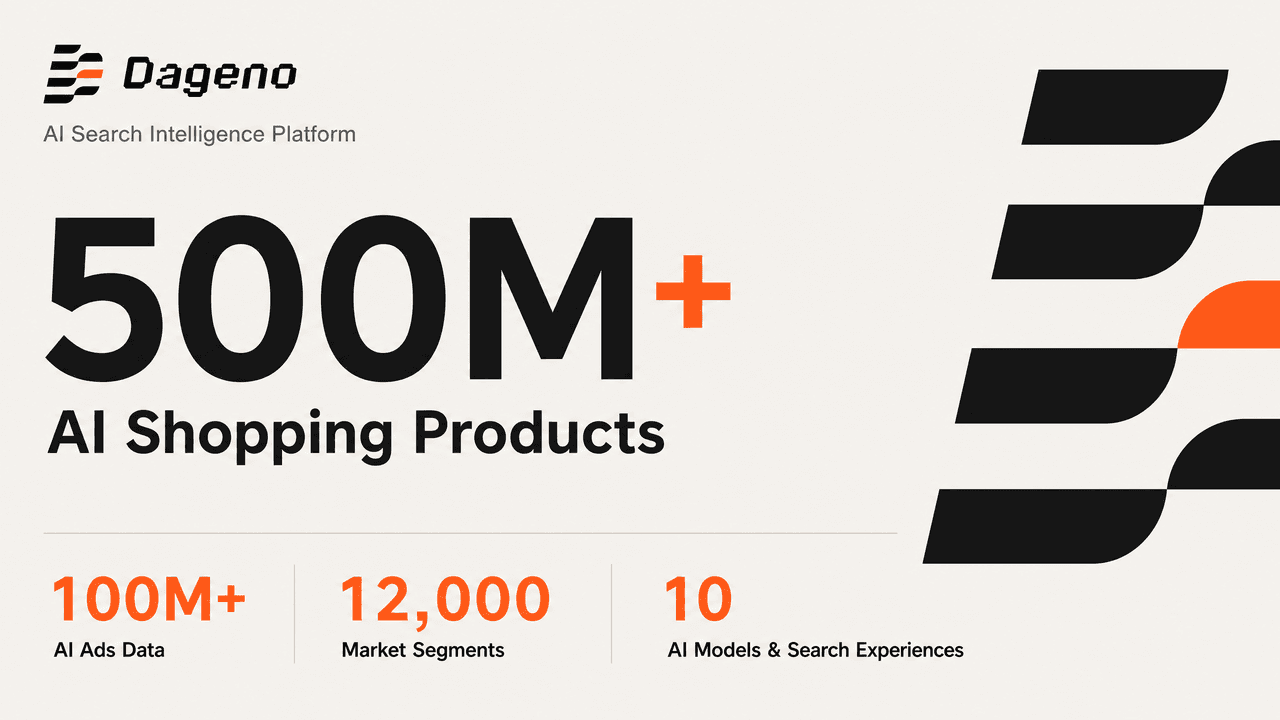
Enter your brand, choose a market segment, and see a free AI search market overview with no login or registration: which brands AI recommends, who your real competitors are, and which sources AI cites most. Covers 86 countries and regions, 9 AI platforms, and 12,000 market segments.
Today, the typical journey with an AEO/GEO tool follows almost the same sequence: create an account, enter a batch of prompts, wait a few days for data to accumulate, and then see how many times your brand appeared in those prompts. For people who are actually responsible for a market, this sequence has two problems:
You pay a significant time cost before you see any data
The data you see only covers the prompts you set up in advance
But you need to know more than that. Are a few dozen prompts enough? We don't think so. What we want you to see is not just how your brand performs in a small set of prompts, but the market itself.
That is why we decided to make the first layer of AI search market intelligence free forever.
In our view, the AEO/GEO market should work the way traditional SEO does. Democratization is a specific product order: data first, pricing second. See the market first, then decide whether you need deeper product capabilities.
See the AEO/GEO Market Landscape Without Paying First
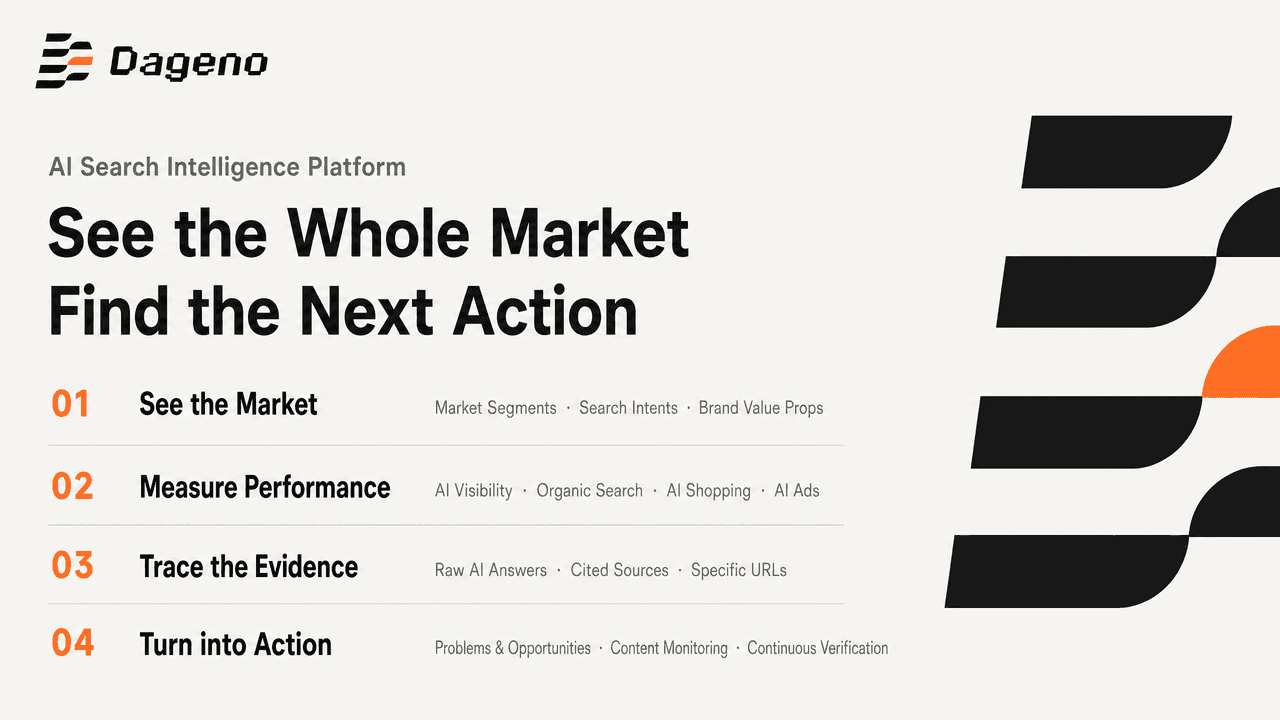
We are not trying to add yet another GEO visibility or citation-rate score. We want to take the market segments, search intents, brands, products, selling points, and competitive relationships scattered across AI search, and organize them into market intelligence that can be queried, compared, and traced.
Seeing the market is only the first step. Next, we want to turn the opportunities worth acting on into concrete tasks, and validate results through performance tracking and data connections, so that every action becomes the basis for the next round of decisions.
Longer term, we want to make the new commercial entry points of the AI era observable, manageable, verifiable, and continuously optimizable, turning them into a new growth flywheel for businesses. Agent-to-Agent and more precise revenue attribution are the product directions we will keep pushing forward.
Using the public search is simple: enter your brand and match it against the brands in our database. Once it is matched, choose a market segment. Without logging in or registering, you will see an AEO/GEO performance overview of that market.
We currently cover 86 countries and regions and support 9 AI platforms: ChatGPT, Perplexity, Google Gemini, Google AI Overview, Google AI Mode, Grok, Microsoft Copilot, Brave, and Dola, with Amazon Alexa available as a custom option. If your brand or market is not yet in the public search, you can contact us for a custom setup.
In this overview, you can see:
Which brands have the highest visibility in AI answers
How rankings differ across AI models and regions
Which competing brands frequently appear alongside yours in AI answers, including names you may never have put on your competitor list
Which sources AI cites most often
Which search intents are still not covered by any brand
How many AI answers cite your pages without mentioning your brand name
This layer is free forever.
This is possible because we continuously collect and observe the observable responses of 9 AI platforms, and structure search intents, brands, products, selling points, recommendations, and citation relationships across 12,000 market segments, with more being added. The public search uses the first layer of conclusions produced from the same data foundation.
We Don't Start With a Prompt List
Traditional prompt monitoring mainly answers one question: how many times does a brand appear in a predefined set of questions, and where does it rank? Dageno starts with the market. It first defines the market scope, then breaks it down into market segments, search intents, and brand value propositions, and finally traces back to specific prompts, original answers, and cited pages.
Prompts still matter, but they are evidence units within a market structure, not the market itself.
Understand the Market: Not Just Who Is Leading, but Why
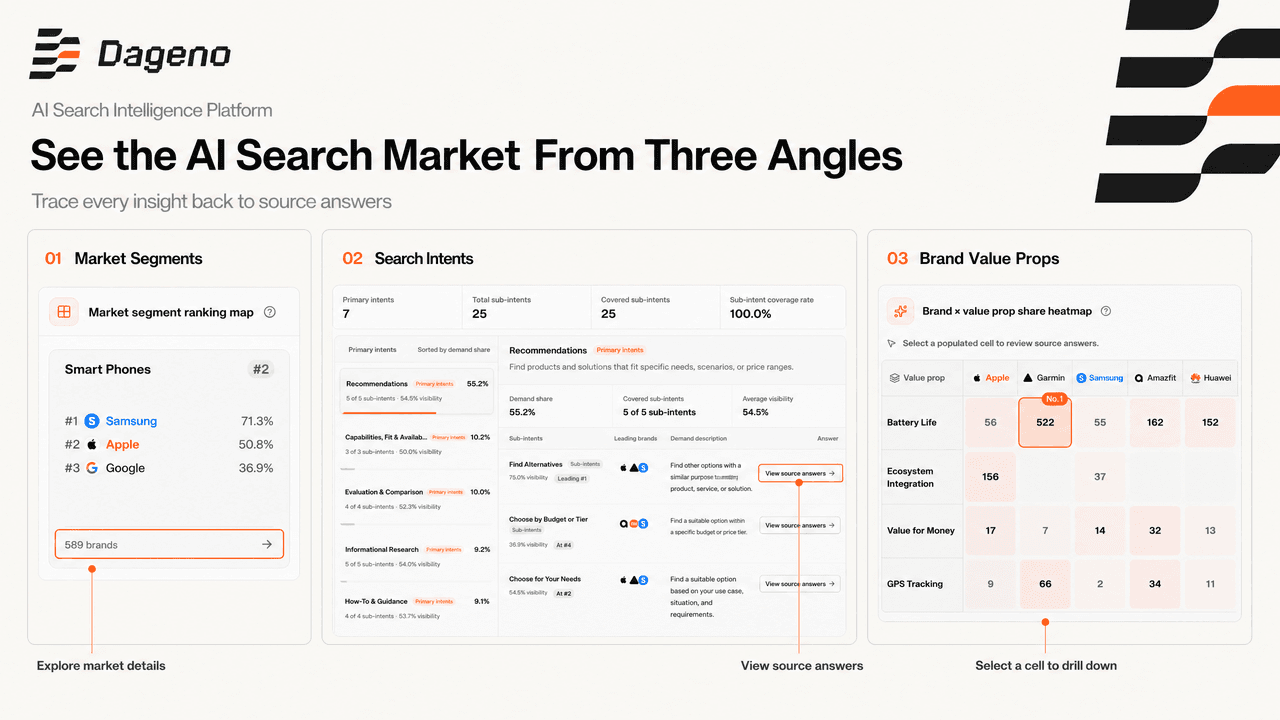
We organize every market from three perspectives. Market Segments show the submarket structure, the participating brands, and each brand's competitive position across different segments. Search Intent shows the types of questions users are asking AI as they move from discovery and comparison to purchase decisions. Brand Value Propositions show which selling points and attributes AI associates with each brand, and which perceptions competitors already own.
This helps teams find differences that an overall score tends to hide. A brand may have decent overall visibility yet be absent from a critical segment. It may be mentioned often yet not be tied to the core value propositions that drive purchase decisions. Or it may lead only within the competitor set the team configured by hand, while AI answers already feature new competitors the team has never tracked. We turned that last case into its own view, the AI Competitor Set: it doesn't look at who you configured, only at who AI actually places alongside you.
A Conclusion Cannot End With a Score
AI answers fluctuate. If a platform only tells you that "your score dropped" or "a competitor is ahead," but cannot explain where that conclusion came from, it is hard for a team to act on it.
Our principle: aggregated conclusions should never be a black box. The public search and the paid product follow the same rule: every market-level conclusion can be traced back inside the product to the original AI answers and cited pages that produced it.
We do not guarantee recommendations, rankings, or revenue growth. What we provide is a basis for judgment with a clearly defined scope, one that is explainable and can be reviewed by people.
Democratization Does Not Mean Building a Cheaper Monitoring Tool
Democratization also shows up in the basics: even the entry-level plan lets you choose freely across all 9 AI platforms and 86 countries and regions, with no need to move up a tier just to access certain models or regions.
We also want to cut the cost of stitching data together across multiple tools just to answer the same market question. Dageno brings AI search, SEO, competitive research, social media, AI Shopping, and AI Ads into one market structure. Each keeps its own methodology, and together they answer the same question: where is the gap actually coming from?
GEO Is Heading in Different Directions
If you only look at price, it is easy to miss another shift happening in GEO tools: they no longer stop at prompt monitoring.
Peec keeps adding metrics and data sources to the same dashboard. Profound starts from large-enterprise needs, embedding AI search data and agent capabilities into marketing workflows. After recently closing a $180 million round, it now positions itself as an AI Platform for Marketing Teams. One is making the dashboard bigger; the other is going deeper into enterprise workflows.
Dageno has chosen a third path: first turn the AI search market into a market intelligence foundation that is complete enough to query, compare, and trace, and then bring that intelligence into both human workflows and agent workflows. What we want is to truly connect this chain: from seeing the commercial entry points of the AI era, to gradually operating them.
Dageno is the research and insights team at Dageno AI, publishing industry reports and expert analysis on AI Search Visibility, Generative Engine Optimization (GEO), and AI-powered search discovery.
 Alexa for Shopping