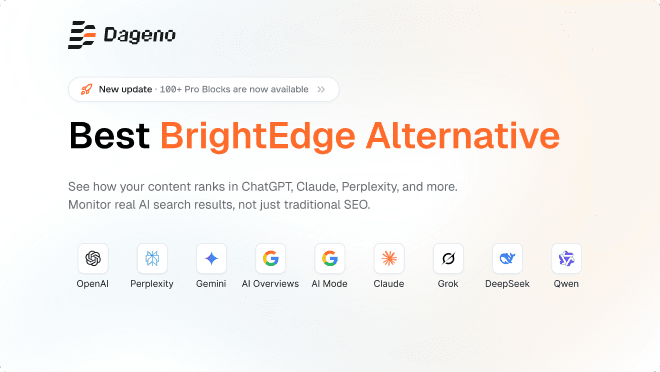
BrightEdge Alternative: Best Picks for Enterprise SEO and AI Search Visibility in 2026
A comparison guide to BrightEdge alternatives for teams that need enterprise-grade SEO and content performance tools, or a simpler, dedicated GEO platform focused specifically on AI search visibility.
The best BrightEdge alternative depends on scale and complexity tolerance: large enterprises with Fortune 100-level SEO budgets can compare BrightEdge directly against Conductor, seoClarity, or Semrush's enterprise tier, while teams that mainly need AI search visibility tracking benefit more from a focused, easier-to-adopt GEO platform like Dageno AI.
BrightEdge is a well-established enterprise SEO and content performance platform, but published market data puts average enterprise contracts around $127,080/year and SMB plans around $29,824/year, both on a custom, quote-based model.
BrightEdge's AI capabilities — DataMind, Autopilot, Copilot, and AI Hyper Cube — do extend into AI search visibility, but reviewers consistently flag a steep learning curve and a complex, menu-heavy interface for teams new to the platform.
A platform built to serve 8,500+ brands across every SEO discipline inevitably carries more setup, training, and interface complexity than a team focused on one specific job actually needs.
Dageno AI covers the same AI search visibility ground with a simpler, self-serve workflow, without the enterprise contract size or onboarding curve BrightEdge requires.
What Is the Best BrightEdge Alternative?
The best BrightEdge alternative is a platform matched to how much SEO complexity your team actually manages, not a smaller version of the same enterprise suite.
BrightEdge has spent nearly two decades building an enterprise SEO and content performance platform used by over 57% of the Fortune 100, combining keyword research, technical auditing, content optimization, and AI-driven recommendations in one system. For large organizations managing complex digital properties across multiple markets and languages, with dedicated SEO teams and the budget to match, BrightEdge's depth is a genuine strength.
But a large share of "BrightEdge alternative" searches come from teams that don't need that full breadth — they specifically want to know how visible their brand is in AI search, without a steep learning curve or a six-figure enterprise contract attached to it. This is the exact gap platforms like Dageno AI are built to close.
If the gap is full-spectrum enterprise SEO across many domains and markets → compare BrightEdge directly against Conductor, seoClarity, or Semrush's enterprise tier.
If the gap is a complex, hard-to-learn interface for a problem that's actually narrow → look at a platform built around one job done well.
If the gap is AI search visibility with content generation in one straightforward workflow → look at the Dageno AI GEO platform.
Why BrightEdge's Breadth and Complexity Don't Fit Every Team
BrightEdge's own strengths — a rich, enterprise-grade feature set, customizable dashboards, and dedicated customer success managers — are also the source of its most common criticism: a steep learning curve and a UI that can overwhelm new or infrequent users.
Pricing follows the same pattern as its feature set. Published market estimates put average BrightEdge enterprise plans around $127,080/year and SMB-tier plans around $29,824/year, with the platform's own site disclosing no public pricing and instead running every deal through a custom, quote-based process based on domains, keyword volume, user seats, and optional modules like DataMind, ContentIQ, and Instant. Contracts typically run 12 to 36 months, with annual prepayment common.
That structure works well for organizations that need BrightEdge's full data footprint — reportedly over 4 billion data points and a proprietary research engine — across many stakeholders. It's a harder case to justify for a team whose actual bottleneck is narrower: knowing whether ChatGPT, Perplexity, or Google AI Overviews are citing them at all. This narrower need reflects the same shift Gartner flagged when it projected that generative AI tools would increasingly substitute for traditional search queries — a trend that calls for focused AI visibility monitoring, not necessarily a full enterprise SEO suite retrofitted with AI features.
Original insight: A practical way to test whether BrightEdge's full breadth is needed is to ask how many team members would actually log into the platform weekly; tools built for many stakeholders across many disciplines carry onboarding and interface overhead that a single content or SEO lead focused on AI visibility doesn't need to pay for.
Practical example: A mid-sized brand evaluating BrightEdge mainly to track AI search citations may spend weeks in onboarding and training for modules like ContentIQ and Data Cube it won't use, when its actual recurring task is monitoring share of voice and sentiment across a handful of AI platforms.
Core Framework: Evaluating a BrightEdge Alternative
Evaluate any BrightEdge alternative against the specific job you need done, since "enterprise SEO breadth" and "AI search visibility tracking" call for different levels of platform complexity.
Traditional SEO breadth — Does it cover keyword research, technical audits, and content recommendations at the depth large, multi-market sites need?
Ease of adoption — Can a new user get value quickly, or does it require weeks of training and dedicated onboarding?
AI/GEO visibility depth — Does it track citation rate, share of voice, sentiment, and ranking across major AI platforms as a core, accessible feature?
Pricing accessibility — Can you get a quote, trial, or free report without a custom enterprise sales cycle?
Content-to-strategy loop — Does a visibility gap translate directly into a content brief or draft, or is that left to the buyer's own team?
BrightEdge scores strongly on point 1 for large, complex organizations already invested in its ecosystem. Points 2 through 5 are where a simpler, focused GEO platform provides a faster, lower-friction path for everyone else.
BrightEdge vs. Enterprise SEO Competitors vs. Dageno AI
The table below compares BrightEdge against its direct enterprise peers and against a focused, self-serve GEO platform, since these solve related but differently scoped problems.
Custom, negotiated, comparable range to BrightEdge
Self-serve free report, transparent upgrade path
Learning curve
Steep; complex, menu-heavy interface commonly flagged in reviews
Similarly complex for full enterprise suites
Designed for straightforward, focused adoption
AI/LLM tracking
DataMind, Autopilot, AI Hyper Cube modules within the broader suite
Comparable AI modules (e.g., Clarity AI) within their suites
Core product: visibility, citations, share of voice, sentiment
Content generation
ContentIQ recommendations within the enterprise workflow
Varies by platform
Content Writer agent turns gaps into briefs and articles
Best fit
Fortune 100-scale organizations with complex, multi-market SEO needs
Similar enterprise buyers comparing platform breadth
Teams that need AI visibility tracking and content execution without enterprise complexity
How Dageno AI Helps
Dageno AI covers the same core AI visibility ground as BrightEdge's DataMind-powered AI tools, but as a focused, self-serve product designed to be adopted quickly rather than requiring the training curve reviewers consistently note about BrightEdge.
Dageno AI provides the workflow from data monitoring → strategy → content generation → result attribution.
Data monitoring: Dageno AI tracks AI visibility, citation rate, share of voice, sentiment, and average ranking across OpenAI/ChatGPT, Perplexity, Gemini, Google AI Overviews, Google AI Mode, Copilot, and Grok, across 252+ countries and regions — accessible through a free GEO report rather than a custom enterprise quote and onboarding process.
Strategy: Prompt-level and query fan-out analysis surface the exact high-intent questions your buyers are asking AI systems, so teams can prioritize fixes without navigating a menu-heavy enterprise dashboard — this is where AI search visibility tracking becomes a straightforward action list.
Content generation: Where BrightEdge's ContentIQ module offers optimization recommendations within a broader enterprise workflow, Dageno AI's Content Writer agent generates a brand-aligned brief or full article directly from an identified visibility gap, without requiring the rest of the suite.
Result attribution: Because Dageno AI monitors the same citation and visibility metrics before and after content ships, teams can confirm whether a GEO fix actually improved standing, closing the loop without a separate enterprise reporting module.
For large organizations already invested in BrightEdge's full enterprise SEO ecosystem, Dageno AI isn't necessarily a full replacement — it's a faster, simpler option for teams and agencies whose priority is specifically AI search visibility and content execution, without the interface complexity that comes with a platform built for every SEO discipline at once.
If your team genuinely needs full-spectrum enterprise SEO across many domains and markets, a handful of tools compete directly with BrightEdge on that specific job.
Conductor and seoClarity operate in a similar custom-pricing, enterprise-scale tier, with comparable AI-powered modules (Clarity AI, for example, competes directly with BrightEdge's DataMind) and similar negotiation dynamics on multi-year contracts.
Semrush's enterprise tier is often used as a pricing anchor in BrightEdge negotiations, since Semrush publishes transparent baseline pricing for SMB and mid-market buyers alongside its custom enterprise offering.
Organizations evaluating these platforms are typically comparing enterprise readiness, data depth, and total cost of ownership against BrightEdge, rather than solving a "we need lighter, faster AI visibility tracking" problem.
Original insight: A practical way to separate a full enterprise SEO need from a GEO-specific need is to check whether your evaluation spans multiple SEO disciplines (technical, content, local, international) or is really just one question — "are we visible in AI search" — dressed up as a broader RFP; the latter is usually better served by a focused GEO platform than another enterprise suite.
A team evaluating or moving off BrightEdge should confirm the replacement matches the actual scope of the problem, not just the breadth of the enterprise suite it's replacing.
Write down which BrightEdge modules (DataMind, ContentIQ, Instant, Data Cube) your team actually uses today.
Separate "we need AI search visibility" from "we need full-spectrum enterprise SEO across many markets" — they usually point to different tools.
Check whether a candidate tool offers a self-serve trial or free report instead of requiring a custom enterprise sales cycle and onboarding period.
Use structured, standalone content sections so both search engines and AI systems can extract answers cleanly.
Build FAQ sections around the real sub-questions your sales or support team hears most often.
Track citation rate and share of voice as a standing weekly metric, not a one-time enterprise audit.
Confirm the new tool closes the loop from data to published content to result attribution, rather than stopping at a dashboard.
FAQs
How much does BrightEdge cost compared to alternatives?
Published market estimates put average BrightEdge enterprise plans around $127,080/year and SMB-tier plans around $29,824/year, with pricing not disclosed publicly and every deal run through a custom, quote-based process based on domains, keywords, seats, and modules. GEO-focused alternatives such as Dageno AI generally offer a free report or self-serve entry point specifically for AI visibility, which is a far lower-friction starting point for teams not ready for enterprise procurement.
Does BrightEdge track AI search visibility?
Yes, BrightEdge has built AI-focused tools including DataMind, Autopilot, Copilot, and AI Hyper Cube to help teams adapt content for both traditional search engines and AI-driven answer platforms. These capabilities sit inside a broader, feature-dense enterprise suite, which is a different experience from a platform purpose-built around AI visibility as its single core function.
What is the closest direct competitor to BrightEdge?
Conductor and seoClarity are the platforms most often compared directly against BrightEdge, operating in a similar custom-pricing, enterprise-scale tier with comparable AI-powered modules. Semrush's enterprise tier is also frequently used as a pricing anchor, since it offers transparent baseline pricing that buyers use to negotiate against BrightEdge and its peers.
Is BrightEdge easy to learn for a new team?
Reviewers consistently describe BrightEdge as having a steep learning curve and a complex, menu-heavy interface that can overwhelm new or infrequent users, even though it offers a genuinely rich, enterprise-grade feature set. Teams without dedicated SEO specialists or the time for onboarding and training often find a simpler, more focused platform easier to get value from quickly.
Do I need BrightEdge's full suite if I only care about AI search visibility?
No, if your team's main goal is tracking and improving AI search visibility specifically, you likely don't need BrightEdge's full technical auditing, local search, and enterprise workflow features, and paying for the full suite may mean covering capabilities your team never fully uses. A focused GEO platform that isolates the AI visibility, strategy, and content layer is usually a better cost, complexity, and scope match for that specific goal.
What should a GEO-focused BrightEdge alternative actually include?
A GEO-focused BrightEdge alternative should track AI visibility, citation rate, share of voice, sentiment, and ranking across major AI platforms at a depth comparable to BrightEdge's AI-focused modules. It should also go further by turning visibility gaps into content briefs or full articles and then tracking whether those changes actually improved citations and traffic — the full loop Dageno AI is built around.
Tim is the co-founder of Dageno and a serial AI SaaS entrepreneur, focused on data-driven growth systems. He has led multiple AI SaaS products from early concept to production, with hands-on experience across product strategy, data pipelines, and AI-powered search optimization. At Dageno, Tim works on building practical GEO and AI visibility solutions that help brands understand how generative models retrieve, rank, and cite information across modern search and discovery platforms.