Local rank tracking is not one measurement. A business can rank differently across two streets, devices, Local Pack results, Maps, and organic listings. The right tool must reproduce the customer’s location, preserve the SERP evidence, and show whether improvements are broad or limited to a few scan points.
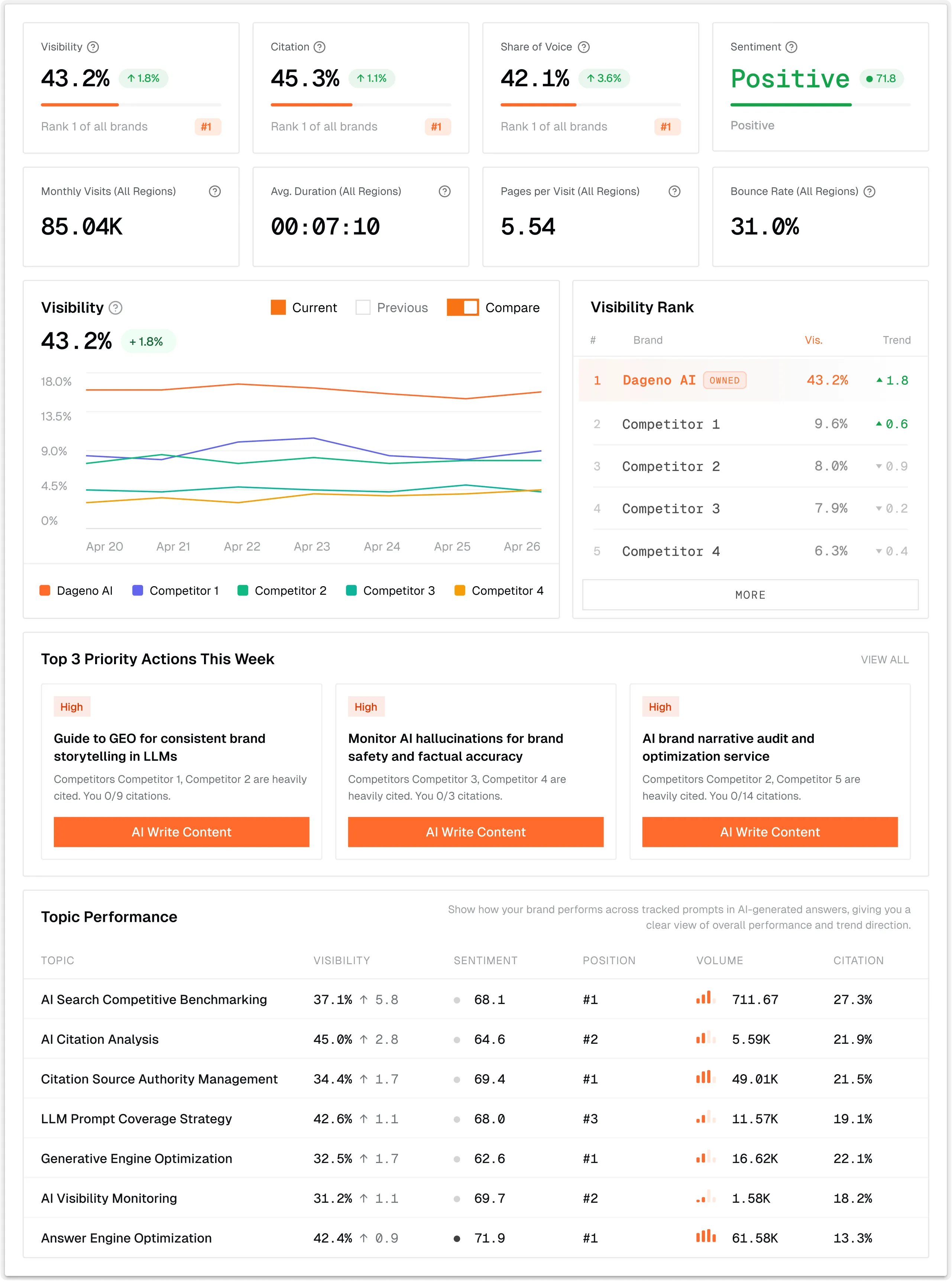
This guide compares five rank trackers plus Dageno as a complementary AI-local-discovery layer. Dageno is not counted as a Google Maps rank tracker because AI recommendations and map-grid positions are different datasets.
The 5 best local rank tracking tools at a glance
Tool
Best for
Local measurement strength
Main limitation
Local Falcon
Geo-grid visualization
Block-by-block Maps visibility
Credit usage grows with grid size and frequency
Nightwatch
Agencies combining local and organic tracking
Precise location controls and reporting
Not a full local citation or reputation suite
SE Ranking
Cost-conscious all-in-one workflows
Location rank tracking beside audits and research
Confirm add-ons and limits at agency scale
Semrush Local
Teams already using Semrush
Local visibility in a broader SEO environment
Can be more suite than a small business needs
AccuRanker
Fast, controlled keyword rank tracking
Segmentation, refresh, and reporting
Local business operations remain in other tools
Choose Local Falcon when a map grid is the primary evidence. Choose Nightwatch or AccuRanker for controlled rank tracking, and SE Ranking or Semrush when the team wants a broader suite.
What accurate local rank tracking requires
Before comparing dashboards, document the measurement protocol:
Location: GPS coordinates, ZIP/postcode, city centroid, or a grid around the service area.
Surface: Local Pack, Local Finder, Maps, and organic results should not be blended.
Device and language: Mobile and desktop results can differ; language settings affect the SERP.
Business matching: Use the correct Google Business Profile, domain, phone number, and location identifiers.
Frequency: Run comparable scans on a stable schedule and note major profile or page changes.
Evidence: Preserve screenshots or result details so a client can audit surprising movements.
Aggregation: Do not let one average hide weak neighborhoods or underperforming locations.
A rank change is diagnostic evidence, not the business outcome. Pair it with Google Business Profile interactions, qualified calls, directions, bookings, leads, and store visits where measurement is available.
1. Local Falcon — best for geo-grid Maps tracking
Local Falcon is designed around geo-grid scans that reveal how a Google Business Profile performs from multiple points surrounding a location. That view is more actionable than one city-wide rank because it can expose a strong core, weak service-area edges, or a competitor dominating a particular neighborhood.
How to use it well: Keep the keyword, grid center, grid spacing, business, and scan schedule stable. Start with a moderate grid and increase resolution only when a specific area needs diagnosis. Compare changes with profile categories, reviews, proximity, landing pages, citations, and competitor movement.
Best fit: Local SEO specialists, multi-location brands, and agencies that need visual client evidence. Limitation: Dense grids across many keywords and locations consume credits quickly; a colorful map does not explain the cause by itself.
2. Nightwatch — best for agencies tracking local and organic rankings
Nightwatch suits agencies that need precise location-based rank tracking alongside broader organic reporting. It can be a better operational fit than a grid-only tool when teams manage many keyword groups and need recurring, client-facing reports.
How to use it well: Create segments by location, search intent, device, and page type. Separate Local Pack results from organic rankings and label which location setting produced each observation. Build alerts around commercially meaningful groups instead of reacting to every keyword fluctuation.
Best fit: Agencies and in-house teams monitoring local landing pages as well as map visibility. Limitation: Citation building, review management, and Google Business Profile operations require additional tools or processes.
3. SE Ranking — best value for a broader local SEO workflow
SE Ranking combines rank tracking with auditing, competitor research, backlinks, reporting, and local marketing functions. Its advantage is workflow consolidation for teams that cannot justify separate vendors for each client task.
How to use it well: Calculate the plan using the required update frequency, locations, keywords, projects, users, and agency features. During the trial, verify the exact city or coordinate used, the result types captured, and whether historical data remains comparable after changing settings.
Best fit: Small and midsize agencies seeking a cost-controlled suite. Limitation: Specialist geo-grid platforms may provide a more intuitive neighborhood-level picture, while advanced agency or AI-search features may add cost.
4. Semrush Local — best for existing Semrush teams
Semrush Local is a practical choice when keyword research, audits, competitive analysis, and client reporting already live in Semrush. Keeping local visibility in the same environment can reduce onboarding and reporting fragmentation.
How to use it well: Confirm which local tracking, listing, review, and map-grid capabilities are included in the selected package. Keep third-party estimates distinct from verified Google data, and connect ranking groups to the relevant location landing page and Google Business Profile.
Best fit: Multi-channel SEO teams already paying for Semrush. Limitation: A small local business may pay for breadth it does not use, while a grid-first specialist may offer more focused Maps analysis.
5. AccuRanker — best for fast, segmented local rank tracking
AccuRanker is a dedicated rank tracker built for controlled keyword monitoring, segmentation, refreshes, and reporting. It works well when the team values clean historical comparisons and needs to organize large keyword portfolios by location, tag, intent, or landing page.
How to use it well: Define the location and device at keyword creation, use tags that map to services and branches, and annotate site or profile changes. Evaluate whether the platform captures the exact local SERP features your client cares about, rather than assuming all “local tracking” is equivalent.
Best fit: Agencies and enterprises that want focused rank intelligence. Limitation: It does not replace local listings, reputation management, audits, or AI-answer monitoring.
Dageno — the complementary AI local-discovery layer
Traditional local trackers answer, “Where does this Google Business Profile or page rank from this location?” Dageno answers a different question: “When a customer asks an AI assistant for a local recommendation, is the brand mentioned, how is it described, and which sources support the answer?”
Use Dageno to monitor local-intent prompt clusters, competitor recommendations, cited directories and pages, sentiment, and country or language differences. Then connect the gap to a concrete action: improve a location page, align business facts, add first-party evidence, earn inclusion in a trusted source, or correct inconsistent profiles.
Do not combine map rank and AI mention rate into one score. Report them side by side because the collection method and customer journey are different. See the guide to monitoring brand mentions in ChatGPT and the comparison of AI search monitoring tools.
Compare distributions: review grid coverage and ranking bands, not only average position.
Connect to outcomes: calls, bookings, directions, forms, and qualified revenue.
For multi-location businesses, keep a shared keyword taxonomy but allow a small local layer for services and neighborhood language. Roll up performance only after reviewing individual locations for data gaps.
Frequently asked questions
What is the difference between a local rank tracker and a geo-grid tracker?
A standard local tracker observes selected keywords from a defined location. A geo-grid tracker repeats the observation across many map points, showing how visibility changes around a business. The grid provides spatial detail but costs more to collect.
How often should local rankings be checked?
Weekly tracking is sufficient for many ongoing reports. Use more frequent checks during a migration, launch, profile suspension recovery, or controlled experiment. Avoid changing the measurement settings between runs.
Is an average local ranking reliable?
It is useful as a summary but can hide large differences between neighborhoods and result types. Always retain the distribution, grid, location settings, and underlying SERP evidence.
Ye Faye is an SEO and AI growth executive with extensive experience spanning leading SEO service providers and high-growth AI companies, bringing a rare blend of search intelligence and AI product expertise. As a former Marketing Operations Director, he has led cross-functional, data-driven initiatives that improve go-to-market execution, accelerate scalable growth, and elevate marketing effectiveness. He focuses on Generative Engine Optimization (GEO), helping organizations adapt their content and visibility strategies for generative search and AI-driven discovery, and strengthening authoritative presence across platforms such as ChatGPT and Perplexity