For a legal tech software company, choosing the right SEO agency is no longer just about finding a provider that can raise Google keyword rankings.
A B2B company selling contract lifecycle management (CLM), eDiscovery, legal matter management, or AI legal research software faces customers, sales cycles, and buying decision processes that are completely different from those of a traditional law firm.
A law firm may want more local inquiry calls from Google Search, while a legal tech SaaS company needs to reach corporate legal leaders, Legal Operations teams, IT procurement staff, and other stakeholders involved in software purchasing decisions.
At the same time, AI search is changing how B2B software gets discovered.
When a prospect asks ChatGPT, Perplexity, Gemini, or Google's AI search, "Which contract management software suits multinational companies?", the AI may directly list products, compare features, and cite related sources.
This means that a legal tech company, even with decent traditional search rankings, won't necessarily get exposure in AI-generated product recommendations.
In 2026, an excellent legal tech SEO partner needs to understand not only traditional SEO but also B2B software buying intent, AI search visibility, brand competitive relationships, and commercial conversion.
This article compares six legal tech SEO, GEO/AEO, and B2B SaaS growth partners worth evaluating, to help companies find a service model that matches their growth stage.
TL;DR: the best legal tech SEO partners at a glance
If your legal tech company is choosing an SEO or AI search growth partner, you can decide based on your most pressing business problem.
Dageno: Suits teams that want to understand the AI search market's competitive landscape and brand recommendation performance, and to advance GEO/AEO projects with professional services.
Insivia: Suits B2B software companies that need legal tech industry positioning, website building, technical SEO, and content strategy.
PipeRocket Digital: Suits companies that want to combine SEO, paid acquisition, GEO/AEO, and the B2B sales pipeline.
Concurate: Suits legal tech SaaS companies that rely on expert content, industry knowledge, and organic search to win customers.
COSEOM: Suits legal technology companies that need to integrate SEO, paid advertising, and B2B demand generation.
Bay Leaf Digital: Suits growth-stage teams that need systematic SaaS content marketing, SEO, and demand development.
These providers' strengths differ, and you can't conclude who suits every company based on one platform's ranking or marketing claims.
What really matters is: whether the partner can solve your most important current growth problem and deliver results you can verify.
1. Why does legal tech SEO need a different strategy from traditional legal marketing?
1. Legal tech SaaS and law firms have different SEO goals
Although both belong to the legal industry, the two types of companies have fundamentally different business models.
Legal knowledge, attorney services, local reputation
Product use cases, technical documentation, comparisons, and implementation
Business metrics
Calls, consultations, cases
Demos, SQLs, pipeline, ARR
AI search focus
Lawyer or law firm recommendations
Software category, brand, and product recommendations
For example, a user looking for an employment lawyer might search:
"Employment lawyer near me"
But a user looking for enterprise legal software is more likely to search:
"Best contract lifecycle management software for enterprise legal teams"
The second question usually involves comparing multiple products, budgets, software integrations, security requirements, and internal approvals.
So legal tech SEO can't simply copy the local SEO methods used for law firms.
2. Traditional keyword rankings aren't enough to explain competition in AI search
In the past, software companies mainly cared about whether they could reach the first page of Google results.
Now users may ask the AI directly:
"Which legal AI tools are best for in-house legal teams?"
The AI-generated answer may include:
Recommended legal tech brands
Feature differences between different software
Solutions suited to a particular type of company
Third-party reviews and comparison sources
Product pricing or implementation requirements
For brands, a new question has appeared:
While the AI is helping customers narrow down their vendor shortlist, is your product in the running?
This is why AI Visibility, Answer Engine Optimization (AEO), and Generative Engine Optimization (GEO) are gradually becoming part of B2B SaaS search marketing.
They don't mean traditional SEO has stopped working; they require businesses to understand search results, AI answers, and the user buying journey together.
3. Legal tech companies need to move from traffic metrics to buying decision metrics
For a company selling enterprise contract management software, getting 10,000 visits to legal knowledge pages isn't necessarily more valuable than getting 100 high-intent product visits.
More meaningful metrics include:
Coverage of high-purchase-intent keywords
Qualified demo requests and SQLs
Sales opportunities from organic search
Brand mentions and recommendations in AI answers
Visibility gaps against major competitors
Brand coverage in key purchase scenarios
Website visits and final commercial conversion
An excellent legal tech SEO agency should help a company connect search marketing to the actual procurement process, rather than just raising traffic numbers on a report.
2. How do we evaluate legal tech SEO partners?
Choosing an SEO agency for a B2B software company requires a more complete evaluation framework than comparing quotes and keyword rankings.
This article organizes the candidate providers along six main dimensions.
1. Legal tech and B2B SaaS industry experience
Does the provider understand software markets such as contract management, legal research, compliance management, and eDiscovery?
Can it produce content around enterprise procurement questions, rather than only for general legal knowledge searches?
Public client cases, relevant industry pages, and the scope of deliverables can all serve as preliminary evidence.
2. Technical SEO and website content architecture
Legal tech SaaS websites usually include product features, integration pages, help centers, API documentation, customer cases, and industry solutions.
The agency needs to understand how these pages are discovered, indexed, and sensibly organized by search engines.
3. GEO/AEO and AI search analysis capability
Can the provider answer the following questions?
Which AI platforms mention our software?
On which purchase questions are we outranked by competitors?
Does the AI understand our product capabilities accurately?
Which third-party sources does the AI cite?
How do you measure the change after optimization?
Showing a few ChatGPT screenshots isn't enough to constitute a complete AI search monitoring method.
4. Commercial content and professional credibility
Legal tech buyers are usually very sensitive about security, compliance, data handling, and implementation requirements.
So content needs to be accurate, specific, and go through the necessary product and industry review.
5. B2B sales funnel and revenue measurement
An excellent provider should be able to explain how SEO work connects to demos, CRM, sales opportunities, and pipeline.
Not every conversion can be attributed to a particular search, but at the very least you need clear metric definitions and measurement methods.
6. Delivery capability and engagement model
Some providers mainly offer consulting; some offer website development, content production, and ad management; and others offer both a data platform and expert execution.
Businesses should choose an engagement model that fits their internal team's resources and capabilities.
Evaluation note: The following comparison is compiled from the providers' public positioning, service pages, and available industry materials, and is not based on a uniform paid test of all six providers. Accordingly, this article does not provide fabricated scores, client result rankings, or unconfirmed pricing.
3. Six legal tech SEO and GEO/AEO partners worth considering in 2026
Quick comparison
Provider
Main strengths
Best for
Dageno
AI Search Market Intelligence, GEO/AEO project delivery
AI search competitive intelligence and visibility improvement
Insivia
Legal tech branding, website, and content strategy
Website rebuilds and B2B content growth
PipeRocket Digital
B2B SaaS search marketing and demand generation
Aligning SEO, AI search, and the sales pipeline
Concurate
Expert content and search strategy
Content-driven legal tech growth
COSEOM
B2B SEO, PPC, demand generation
Multi-channel customer acquisition
Bay Leaf Digital
SaaS SEO, content, and demand development
Growth-stage SaaS companies
1. Dageno: for legal tech companies that want to build a competitive edge in the AI search market
Best for: AI Search Market Intelligence, GEO/AEO strategy, competitive analysis, and ongoing project delivery.
Dageno is an AI Search Intelligence platform that also offers Managed GEO/AEO Services.
Unlike SEO services built mainly around traditional keyword rankings and website traffic, Dageno focuses on how AI understands a market, how it compares different brands, and which user needs are influencing product recommendations.
For legal tech software companies, this kind of analysis is especially valuable.
Suppose a CLM software company wants to enter the US corporate legal market.
Traditional SEO can help it research keywords related to "contract management software," competing pages, and organic search traffic.
But the company may also need to understand:
When buyers ask about enterprise contract management software, which brands does the AI recommend?
In which product scenarios are competitors recommended more easily?
Does the AI describe its integration capabilities, security features, and target customers correctly?
Around which needs do users most often compare different solutions?
Which sources are being cited by the AI?
Which niche markets or purchase intents have visibility gaps?
These questions fall within the scope of the AI Search Market Intelligence that Dageno 2.0 focuses on.
Core capability 1: Brand Explorer
Dageno's Brand Explorer can start from a company, brand, or product and study the related entities and market relationships in AI search data.
For businesses selling multiple legal tech products, brand entity recognition is especially important.
For example, a vendor may have a contract management platform, an AI contract review module, and a separately named legal research product.
If you simply search by company name, you may overlook the exposure of its sub-brands or product models.
Dageno organizes brands, companies, products, and related relationships, helping teams understand how different entities perform in AI search.
Core capability 2: Market Competitive Landscape
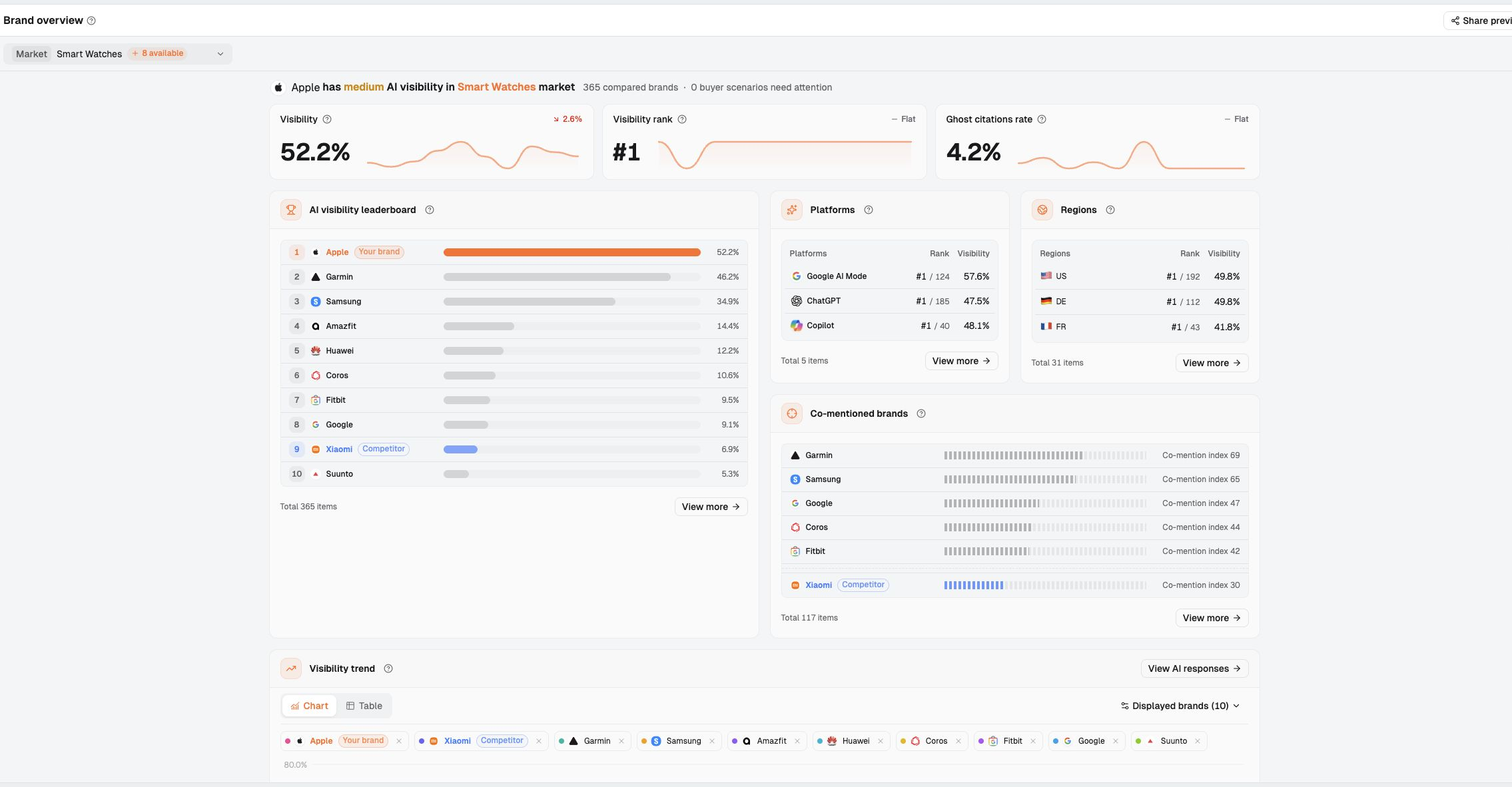
Dageno can compare brand visibility and competitive position by market, AI model, region, and time range.
Legal tech companies can study:
Who are the main AI search competitors in a specific software category?
Does a brand perform differently on ChatGPT versus other AI platforms?
Does the company face different competitive landscapes in the US and European markets?
Which competitors frequently appear together in relevant answers?
This can help marketing teams establish a competitive baseline that is closer to the AI search environment.
Core capability 3: Search Intents
Traditional keyword research focuses on which terms users search for.
Dageno's Search Intents goes a step further and organizes AI search questions by user need and decision purpose.
For example, legal tech buyers' questions might fall into:
Product discovery:
"What are the best legal AI tools for corporate legal departments?"
Vendor comparison:
"Compare contract lifecycle management platforms for global enterprises."
Feature evaluation:
"Which CLM tools integrate with Salesforce and Microsoft 365?"
Purchase decision:
"What should a legal operations team consider before buying CLM software?"
Although these questions belong to similar software categories, they represent different buying stages.
Dageno can help businesses compare brand coverage under different intents, so they can decide which purchase scenarios to improve first.
Note that the share of demand shown in Search Intents isn't the same as real search volume, and brand coverage doesn't directly represent the number of buyers.
Core capability 4: Citation Source Intelligence
When an AI recommends a legal tech product, it may cite official websites, industry media, third-party comparison pages, or other public materials.
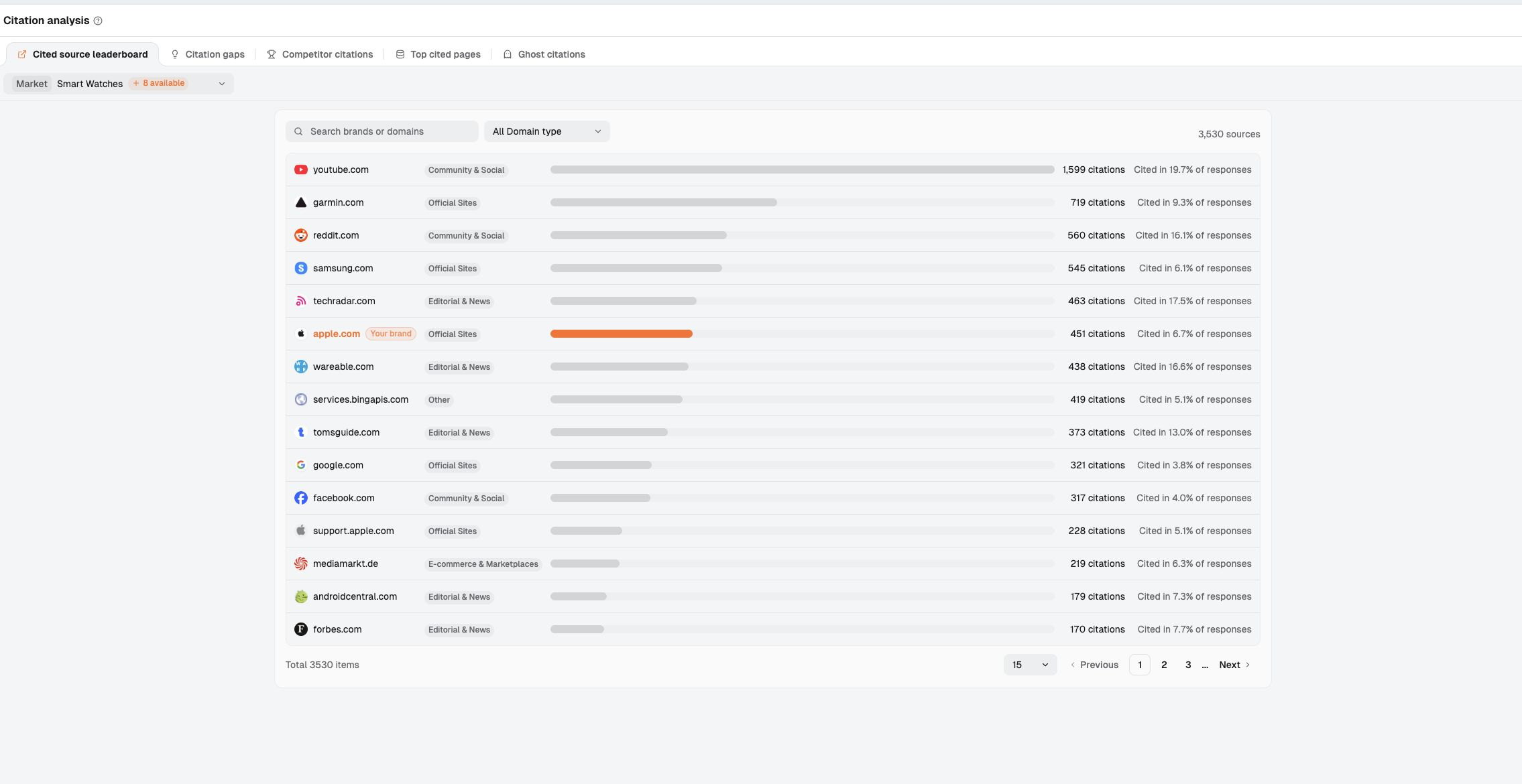
Dageno can help teams view the relevant AI answers and their citation sources.
This lets businesses discover:
Which product pages earn citations?
Whose materials are cited often, among competitors?
Which authoritative industry sources don't yet cover your product?
Is the AI citing outdated product information?
Citation analysis can support content and digital PR decisions, but you can't conclude from a single citation that the source directly caused a brand recommendation.
Core capability 5: Managed GEO/AEO Services
For legal tech companies that lack in-house GEO/AEO experts or project execution resources, Dageno also offers managed services.
Its publicly stated service scope includes:
Establishing AI search visibility and competitive baselines
Organizing brand and product factual evidence
Planning key pages, content, and technical improvements
Developing third-party source and channel strategies
Ongoing monitoring, retesting, and project management
Services can be organized around an initial cycle of about 90 days, but the actual scope of engagement and deliverables need to be determined per project.
Execution work such as content writing, translation, website development, and media placement should also be confirmed separately as to whether it's included in the contract scope.
Dageno's strengths
Dageno's most distinctive feature is that it analyzes brand visibility within the context of markets, user intents, competitors, and citation evidence, rather than just reporting whether a brand is mentioned by ChatGPT.
At the same time, businesses can choose a software platform or pair it with expert managed services according to their own resources.
Things to consider
Dageno shouldn't be regarded as a traditional legal-tech-specific SEO agency, nor does it mean it has publicly demonstrated a full track record of legal tech industry projects.
If a business needs large-scale website rebuilds, full marketing automation, or paid advertising management, it should confirm Dageno's service scope for the specific project and, where necessary, work with other providers.
Best for: Legal tech SaaS companies that already have a B2B marketing foundation and want to systematically understand the AI search competitive landscape, improve product recommendation performance, and advance GEO/AEO projects.
Best for: Legal tech industry positioning, website building, technical SEO, and content strategy.
Insivia is a marketing consulting and digital services agency that serves B2B software and technology companies, and it has a public legal tech positioning.
For legal tech SaaS companies, the website is often not just a marketing showcase but the main channel through which prospective buyers learn about product capabilities, features, and use cases.
If a legal technology company's site structure is messy, its product positioning is unclear, or it lacks content for different buying roles, simply adding more blog posts usually can't solve the underlying problem.
Insivia suits helping businesses think about growth at the level of website experience, information architecture, and industry positioning.
Main strengths:
Marketing experience for technology and B2B software companies
Legal tech industry positioning
Website design and development
Technical SEO and content strategy
Product marketing and lead conversion support
Things to consider: If a company is especially concerned with how brand recommendations change in ChatGPT, Gemini, or Perplexity, it should confirm the provider's AI search data collection, monitoring scope, and result retesting methods before purchasing.
Best for: Legal tech companies whose websites need a redesign, whose product positioning needs an upgrade, or that want to build a more complete B2B SaaS content architecture.
3. PipeRocket Digital: for companies that want to connect SEO, AI search, and the B2B pipeline
Best for: B2B SaaS SEO, GEO/AEO, paid marketing, and demand generation.
PipeRocket Digital provides digital marketing services for B2B SaaS and technology companies, and its public content also touches on the legal tech software market and AI search-related services.
For many legal tech companies, the ultimate goal of marketing isn't raising traffic on every keyword but winning more sales opportunities that match the target customer profile.
For example, a company selling a legal operations platform may want more demo requests from large corporate legal departments rather than attracting lots of users looking for free legal document templates.
So the provider needs to connect SEO to buying intent, customer conversion, and CRM data.
Main strengths:
B2B SaaS search marketing
Coordination of content, advertising, and demand generation
GEO/AEO service direction
Focus on commercial keywords and the sales pipeline
Suited to multi-channel marketing plans
Things to consider: Businesses should confirm the specific workload for SEO and GEO/AEO, the budget for each channel, the CRM attribution method, and which results count as directly verifiable marketing contribution.
Best for: Companies that already have a product-market fit foundation and want to bring organic search, AI search, and other demand generation channels into a unified growth plan.
4. Concurate: for content-driven legal tech SaaS growth
Best for: B2B content marketing, search intent research, and expert content strategy.
Concurate focuses on B2B SaaS content marketing and organic search growth, and has a certain public presence in legal tech-related content and markets.
Legal tech products usually have complex features and specialized terminology.
For example, when legal teams research eDiscovery software, they may want to understand data processing workflows, the capability boundaries of different systems, deployment requirements, and actual costs.
These questions can't be answered with generic product introductions alone.
Content providers need to work with product experts, salespeople, and industry consultants to produce truly valuable articles, product comparison pages, and buying guides.
Main strengths:
B2B SaaS content marketing
Content on complex industries and specialized topics
Commercial search intent research
Content planning around products and solutions
Content-driven organic search acquisition
Things to consider: If a project also requires complex technical SEO, cross-platform AI monitoring, or substantial website development, confirm whether that work is included in the scope of engagement.
Best for: Legal tech SaaS companies that have a clear product advantage but lack high-quality industry content and search coverage.
5. COSEOM: for multi-channel B2B legal tech demand generation
Best for: B2B SEO, PPC, demand generation, and international marketing.
COSEOM mainly provides search and digital marketing services for B2B companies, and public information indicates it has marketing experience related to legal technology software.
For legal tech companies already at the growth stage, organic search is usually only one part of the customer acquisition system.
Companies may also use Google Ads, LinkedIn, content marketing, and industry events to reach target buyers.
In that case, choosing a provider who understands the relationships among different channels helps reduce fragmentation in marketing strategy.
Main strengths:
B2B SEO and paid search
Multi-channel demand generation
Legal tech market experience
Enterprise marketing and audience targeting
Campaigns suited to different markets
Things to consider: SEO, paid advertising, and AI search should each have their own defined KPIs. Businesses need to confirm how the provider measures organic traffic, ad conversions, AI brand visibility, and pipeline, to avoid conflating the contributions of different channels.
Best for: Legal tech companies that want to improve both organic search and paid acquisition, serve multiple regions, or need a unified B2B marketing plan.
6. Bay Leaf Digital: for ongoing marketing at growth-stage SaaS companies
Best for: SaaS SEO, content marketing, demand generation, and growth strategy.
Bay Leaf Digital mainly serves B2B SaaS companies and focuses on software companies' ongoing growth needs.
For growth-stage legal tech companies, a common challenge is having accumulated some organic search traffic without having established clear content priorities and a buying funnel.
For example, a company selling compliance management software may face all of the following at once:
Fierce competition for product category keywords
Too few high-intent comparison pages
Search traffic disconnected from demo requests
Industry content that struggles to demonstrate professional strengths
Multiple products or markets that need a unified marketing strategy
The SaaS growth and demand generation capabilities Bay Leaf Digital emphasizes make it a suitable direction to evaluate for this kind of project.
Main strengths:
B2B SaaS growth experience
SEO and content marketing
Demand generation strategy
Software market positioning
Suited to building an ongoing marketing program
Things to consider: Legal tech is a specialized field, so you should further confirm relevant cases, product review mechanisms, and whether it has GEO/AEO monitoring capabilities that match the project requirements.
Best for: Companies that have established initial market demand and want to systematically improve SaaS organic search and marketing conversion performance.
4. How should legal tech SEO and GEO/AEO be combined?
Traditional SEO and GEO/AEO are not two completely separate marketing systems.
For legal tech SaaS, the ideal strategy is to build, at the same time, a traditional search foundation, AI search brand visibility, and commercial conversion measurement.
Layer 1: Build a website foundation that search engines can understand
First make sure product and content pages have basic technical accessibility.
Key points include:
Clear product and feature pages
A sensible site structure and internal links
Discoverable integration and API documentation
Proper indexing and canonical settings
Accurate and applicable structured data
Real cases, feature descriptions, and product evidence
For SaaS websites that rely on JavaScript rendering, you should also confirm whether important content can be accessed normally by search systems.
Layer 2: Build a content system around buyer needs
Legal tech companies can organize content by buying stage, rather than just ranking by search volume.
Buying stage
Content example
Main purpose
Awareness
What is contract lifecycle management?
Explain the category and the problem
Discovery
Best legal operations software
Get into the consideration set
Comparison
CLM Software A vs B
Help evaluate vendors
Evaluation
CLM integration with Salesforce
Verify feature fit
Decision
Enterprise CLM implementation checklist
Support the purchase decision
This content serves not only Google Search but also gives the AI clear public information for understanding the product category, features, and target users.
But publishing content alone can't guarantee the AI will cite or recommend the brand.
Layer 3: Measure AI search competitive performance
Traditional SEO reports can usually answer:
"Have our keyword rankings improved?"
But they can't fully explain:
"Why do competitors appear more often in the AI's software recommendations?"
So legal tech companies should build an AI search monitoring system.
We recommend tracking the following metrics in particular:
Brand Visibility: The share of a fixed question sample in which the brand is mentioned.
Competitive Visibility: The brand's relative performance against competitors on the same question set.
Search Intent Coverage: The brand's coverage across different buying intents.
Citation Visibility: How often the company's website and other sources earn citations in AI answers.
Entity Accuracy: Whether the AI accurately understands the brand, product features, and use cases.
Visibility Trend: Whether visibility changes over time under a consistent model, region, and monitoring scope.
These metrics need to be interpreted together with the specific samples, and can't be equated directly with actual search volume, market share, or revenue.
Layer 4: Turn AI search insights into prioritized actions
For example, a legal tech company finds that its brand often appears in general CLM software questions but rarely in answers about "CLM platforms that support international enterprise approval workflows."
This may indicate a content or brand perception gap in that particular purchase scenario.
The team can go on to check:
How does the AI actually answer that question?
Which competing products are recommended?
What advantages are attributed to competitors?
Which web pages or third-party materials earn citations?
Does our own website explain the relevant features adequately?
Do we need to add integration notes, product evidence, comparison content, or third-party materials?
The point of this method isn't to mechanically produce an article for every prompt, but to decide the next steps based on real product facts and competitive evidence.
5. Ten questions to ask before choosing a legal tech SEO agency
Before signing a service contract, we recommend that businesses ask the following questions.
Have you served legal tech or other complex B2B SaaS companies? Can you show relevant projects and actual deliverables?
How do you distinguish high-purchase-intent traffic from general informational traffic? Will you build a content strategy by customer role, industry, and buying stage?
Do you have technical SEO capability? Can you handle information architecture, rendering, indexing, product pages, and technical documentation for a SaaS website?
How do you measure brand visibility on ChatGPT, Gemini, and other AI platforms? Can you save the original answers and the related sampling conditions?
How do you identify actual competitors in AI search? Do you use only the list the client provides, or can you also discover other brands that appear in AI answers?
How do you research Search Intents? Can you distinguish product discovery, vendor comparison, feature evaluation, and purchase decisions?
How do you track citation sources? Can you link AI answers to specific pages, domains, and related evidence?
Which work will the agency execute, and which needs the internal team's cooperation? Who is responsible for content review, technical implementation, and third-party publishing?
How do you measure the effect of SEO and GEO/AEO? Are there fixed baselines, retesting frequencies, and reporting standards?
How do you connect marketing performance to demos, SQLs, and pipeline? Can you work with the company's existing CRM, GSC, and GA4 data?
If a provider promises it can guarantee ChatGPT will recommend a given brand, guarantee a particular AI ranking, or claims to know the search models' internal algorithms, verify the claim with caution.
AI search results are affected by the model, question, region, time, and context, and it is usually impossible to guarantee that a brand will appear stably in a specified position.
6. Should legal tech companies choose an in-house SEO team or an external agency?
For legal tech SaaS companies at different stages of development, the best organizational approach differs.
Early-stage companies: first build the search and market foundation
Early-stage companies usually have limited resources.
At this stage, the most important thing is to clarify the target customers, core product category, competitors, and high-value purchase questions.
You can start with small-scale consulting, a technical audit, and basic content building, rather than necessarily setting up a large SEO team right away.
Growth stage: build specialized division of labor
When a company starts to generate demand across multiple product categories or markets, it can consider having the internal team handle product knowledge and marketing strategy, while external partners handle specialized SEO, content, data research, or GEO/AEO execution.
This approach preserves internal control over product positioning while adding specialized capabilities.
Enterprise stage: build an ongoing research and execution system
For legal tech companies with multiple brands, product lines, or country markets, SEO and AI search work may involve the brand, product, content, technical, and sales teams.
Companies can consider building a collaboration system among an internal owner, specialized agencies, and an AI Search Market Intelligence platform.
A platform like Dageno can serve as an AI search market analysis and retesting tool, and can be combined with Managed GEO/AEO Services as needed.
7. How should legal tech SEO success be measured?
An excellent legal tech SEO project shouldn't provide just a keyword ranking report.
For example, a legal tech SaaS company might find that:
Google commercial keyword rankings have improved
ChatGPT mentions the brand on more target questions
Newly added product pages have started to earn AI citations
The number of demo requests has grown
These changes are worth watching, but you can't directly conclude that there's a single causal relationship among them.
A more reliable way to evaluate is to keep baseline data from before and after optimization and judge together with CRM, GSC, GA4, original AI search answers, and related business data.
For B2B SaaS, long-term high-quality sales opportunities are often worth more attention than a one-time traffic increase.
8. Why is AI Search Market Intelligence becoming a new capability for legal tech growth?
In the past, the main question in legal tech SEO was:
"Which keywords can bring us more prospects?"
Now, businesses need to ask further:
"When customers compare legal tech products through AI, what is our position in the market?"
These two questions are related but not exactly the same.
Keyword research can help businesses understand search demand.
AI Search Market Intelligence can start from AI answers and study the connections among brands, competitors, user intents, and citation sources.
For example, a company preparing to launch a new AI contract review product can first study the existing brand recommendations in the relevant market.
It can observe:
Which vendors lead in AI answers?
How does the AI describe the features and positioning of different products?
Which questions do buyers care about most?
Which of your own product's strengths aren't yet fully expressed?
Which third-party information sources are worth studying further?
Do different regions or AI models show different competitive situations?
This research can provide a basis for product launches, competitive positioning, content strategy, and GEO/AEO projects.
A truly valuable AI search strategy isn't just about making the brand appear more times, but about helping businesses understand in which purchase scenarios they should appear, and how to back up their market positioning with credible information.
9. How do you start legal tech AI search analysis with Dageno?
Dageno provides a market intelligence entry point for brands that want to understand their AI search performance, and Managed GEO/AEO Services for teams that need ongoing execution.
For legal tech companies, you can start as follows.
Step 1: Confirm your products and target markets
Clarify the brands, product categories, and markets you need to research.
For example:
Contract Lifecycle Management
eDiscovery Software
Legal AI Research
Legal Operations Software
Compliance Management Software
Different categories may have markedly different target customers and competitive relationships.
Step 2: Establish an AI search market baseline
Use Dageno Brand Explorer and the related Market Intelligence capabilities to view brand performance and market competition.
When researching, pay attention to the model, region, time window, and data coverage scope.
Step 3: Analyze competition and Search Intents
Identify the purchase questions that matter most to your business.
For example, do enterprise customers care more about integrations, data security, cost, the implementation process, or a particular type of legal workflow?
Compare your AI visibility with your main competitors in these scenarios.
Step 4: Study citation sources and brand perception
Read the specific AI answers, confirm whether the brand description is accurate, and study the related citation sources.
Verify any outdated, incomplete, or inaccurate information.
Step 5: Develop a prioritized improvement plan
Set priorities based on market opportunity, business value, and the actual cost of execution.
Possible actions include improving product pages, optimizing comparison content, adding feature evidence, updating integration materials, or carrying out compliant industry outreach.
Step 6: Keep monitoring and retesting
Keep monitoring conditions consistent for key questions, and observe brand visibility, citations, and competitive performance across different periods.
At the same time, evaluate project progress together with actual website performance and business conversion.
For businesses without a specialized execution team, you can also discuss the scope and delivery plan of Managed GEO/AEO services with Dageno.
See your brand's market position in AI search for free with Dageno:
1. What is the best SEO agency for legal tech companies?
The best legal tech SEO agency depends on the company's product category, stage of development, and growth goals.
Companies that need legal tech brand positioning and website building can evaluate Insivia; teams that value B2B content growth can consider Concurate; and companies that want to connect SEO with multi-channel demand generation can evaluate PipeRocket Digital, COSEOM, or Bay Leaf Digital.
If the main goals are AI search competitive analysis, brand visibility, and GEO/AEO project delivery, Dageno is also a professional option worth considering.
2. Is SEO still important for legal tech SaaS in 2026?
Yes. Legal tech SaaS buyers still need to learn about software categories, features, integrations, pricing, and implementation plans through search.
Traditional SEO can help businesses build discoverable website content and commercial search coverage, while GEO/AEO can add brand understanding and recommendation visibility in AI search.
The two can be combined and shouldn't simply replace each other.
3. What is the difference between legal tech SEO and law firm SEO?
Law firm SEO usually revolves around local search, attorney services, and consultation leads.
Legal tech SEO is aimed at software purchasing decisions and needs to support product comparison, technical integration, feature evaluation, enterprise security requirements, and long B2B sales processes.
So their keyword strategies, content architectures, and conversion metrics all differ.
4. What is GEO for legal tech companies?
GEO, or Generative Engine Optimization, is a set of optimization methods for improving the visibility of brands, products, and related information in generative AI search environments.
For legal tech companies, GEO may involve brand entity clarity, product facts, purchase-scenario content, third-party information sources, and AI search performance monitoring.
GEO can't guarantee that the AI will recommend a brand, and its effects need to be evaluated through continuous observation.
5. How can legal tech companies track brand visibility in ChatGPT?
Businesses can build a prompt set related to their own products, regularly record ChatGPT's original answers, and count brand mentions, recommendations, competitive performance, and citation sources.
Dageno also offers AI Visibility Tracking and broader AI Search Market Intelligence capabilities, helping teams expand single-question monitoring into market-level competitive research.
6. How much does a legal tech SEO agency cost?
The price of legal tech SEO services is affected by website size, content volume, technical complexity, target markets, languages, and scope of execution.
Traditional SEO, GEO/AEO analysis, and managed services that include expert execution may also have different pricing structures.
Businesses should ask providers to specify deliverables, project timelines, third-party costs, and how effects will be measured, rather than comparing starting monthly fees alone.
7. Can AI search optimization generate more demos for legal SaaS?
AI search optimization may help brands gain more exposure in relevant product research and procurement scenarios, supporting prospect discovery.
But an increase in brand mentions doesn't automatically mean an increase in demos or revenue.
Businesses still need to judge actual commercial results together with landing pages, product value, the sales process, and conversion data.
8. Should legal tech companies hire an agency or use an AI visibility platform?
The two approaches can be combined.
Data platforms are mainly for monitoring, research, and analysis; agencies or professional teams are responsible for strategy, content, technology, and project execution.
For companies that already have an internal execution team, you can start by using a data platform to build an analysis system.
For companies that lack GEO/AEO execution experience, you can further consider an engagement model that combines software with expert services.
Conclusion: the best legal tech SEO partner should solve your actual growth problem
In 2026, legal tech SEO is no longer just keyword optimization and article publishing.
For companies selling B2B legal software, search marketing needs to support product discovery, vendor comparison, professional trust, AI brand visibility, and long-term commercial conversion all at once.
Different partners offer different value.
Some excel at technical SEO and website building, some focus on expert content and demand generation, and some can help businesses study the market landscape in AI search.
Dageno offers another perspective: through AI Search Market Intelligence, it helps businesses understand how AI understands their market, which brands are getting recommended, what real buying needs customers have, and which visibility gaps deserve priority.
Combined with ongoing monitoring and professional GEO/AEO services, businesses can turn these market findings into a more evidence-based growth plan.
For legal tech SaaS companies, the ultimate goal shouldn't be merely to appear in more search results.
It should be to make sure that when the right customers research, compare, and choose legal technology products, their brand is accurately understood, fairly evaluated, and has a chance to make the purchase shortlist.
Learn your legal tech brand's competitive position in AI search.
Visit Dageno to explore AI Search Market Intelligence, or discuss a GEO/AEO project that fits your business with the team.
Ye Faye is an SEO and AI growth executive with extensive experience spanning leading SEO service providers and high-growth AI companies, bringing a rare blend of search intelligence and AI product expertise. As a former Marketing Operations Director, he has led cross-functional, data-driven initiatives that improve go-to-market execution, accelerate scalable growth, and elevate marketing effectiveness. He focuses on Generative Engine Optimization (GEO), helping organizations adapt their content and visibility strategies for generative search and AI-driven discovery, and strengthening authoritative presence across platforms such as ChatGPT and Perplexity
 Alexa for Shopping