Best GEO Tools for Agencies: 8 Platforms to Manage Client AI Visibility in 2026
A deep comparison of 8 GEO tools for agencies, from multi-client management, pre-sales prospecting and model and region coverage to competitor and citation analysis, content execution, client reporting and cost at scale, to help agencies pick the platform that fits how they deliver.
If your agency needs to do market research and pre-sales diagnosis first, then turn the evidence into client strategy, start by evaluating Dageno. If your core need is mature multi-client prompt monitoring with pitch projects, compare Peec AI and Scrunch AI. If you need content optimization or execution at scale, focus on AthenaHQ and AirOps. Traditional SEO teams can evaluate Semrush and Ahrefs, and large enterprise AEO teams can also compare Profound. When you choose, calculate the real monitoring cost per client, how reports get delivered and which permissions you actually get, rather than just counting models.
Introduction
Agency clients have started asking a question that rarely appeared in SEO monthly reports: "Why does ChatGPT recommend our competitors but rarely mention us?"
Behind that question, clients are noticing that the way buyers choose brands is changing. A potential buyer may ask ChatGPT, Gemini, Perplexity or Google AI first, and only then decide whether to visit a website, compare products or contact sales. So clients no longer care only about keyword rankings and organic traffic. They also want to know whether their brand appears in AI answers, why competitors get recommended, and which pages and third-party sources support those answers.
For an agency, the hard part is not monitoring one brand. It is turning GEO into a service that is profitable, repeatable and easy to report: in pre-sales you need to diagnose prospects quickly; after signing you manage multiple brands, markets and competitors; during delivery you turn monitoring findings into content, PR and site optimization tasks; and at month end you explain what happened with evidence the client understands.
That is why choosing a GEO tool for agencies is not just about how many AI models it tracks. What really needs comparing is this: Can it support multi-client delivery? Do pre-sales projects cost extra? How are prompts and models billed? Can you see the original answers and cited URLs? Can it help your team explain why a competitor is ahead? How do reports reach the client? And how does the cost change when your client count grows from 5 to 25?
This guide puts Dageno alongside Scrunch AI, Peec AI, AthenaHQ, AirOps, Semrush, Ahrefs Brand Radar and Profound, and analyzes them against how agencies actually work, instead of lumping products with different positioning together as interchangeable monitoring tools.
Quick Comparison: Which GEO Tool Fits Your Agency?
Look at positioning first, then features. The table separates what public pages clearly offer from what depends on a contract or partnership plan.
Public pricing page shows $99/$399 brand plans; agency/enterprise pricing depends on client workspaces and contract
A note on pricing: the figures above are monthly starting prices or public tiers visible on each vendor's site. The billing units differ: some charge by project, prompt, credit, domain or brand, and some use agency contracts. A single number cannot tell you which is cheaper. The sections below explain each product's billing logic and cost traps.
How We Evaluated GEO Tools for Agencies
1. Client portfolio economics: how does cost change with each new client?
An agency's unit economics differ from a brand team's. One client may need only 15 core questions, 2 models and 1 region; another may require 80 prompts, 5 models, 3 countries and daily updates. If a tool consumes quota by prompt × model × region × frequency, the monitoring footprint grows fast. When comparing, work out how many AI answers or checks a typical client needs per month, and whether that quota can be moved between client projects.
2. Prospect-to-client workflow: can you show value cheaply in pre-sales?
Agencies need data to win clients. Look for free public market lookups, pitch workspaces, temporary audit projects, shareable report links and a path to convert a pitch into a paying client project. A free lookup, a free trial and a proper pre-sales workspace are not the same thing, and you need to tell them apart.
3. Evidence quality: can you get back to the original answers, cited URLs and sample scope?
Clients need to know where a conclusion comes from. A tool should show, as far as possible, the original AI answers, cited URLs, model, region, time and prompt. With only a visibility score and no evidence, an agency struggles to explain why a brand is missing, and to re-test the results of optimization.
4. Delivery breadth: monitoring only, or does it drive action?
Some platforms focus on measurement, some suggest content, and some offer agents, technical fixes or content workflows. Choose based on your service scope: if your team already executes content and PR, a monitoring platform may be enough; if you want research and execution in one system, compare optimization suggestions, content production, API/MCP and workflow capabilities.
5. Client reporting and governance: what does the client see?
Distinguish internal dashboards, shareable links, client logins, white-label reports and a full white-label portal. These may sit on different plans or require an agency partner or enterprise contract. Do not describe "shareable" as "white-label".
6. Cross-market coverage: can it serve international clients?
For cross-border clients, check whether models, countries, regions and languages can be selected, and whether results from different markets can be compared separately. A model count alone does not mean every model offers the same depth of data in every country.
8 Best GEO Tools for Agencies in 2026
Dageno is listed first as the main tool reviewed, followed by seven products that represent different agency service models. The order reflects how this guide is organized; it does not mean every agency should buy in this order.
1. Dageno — Best for Agency Market Intelligence, Prospect Diagnosis, and Evidence-led Client Strategy
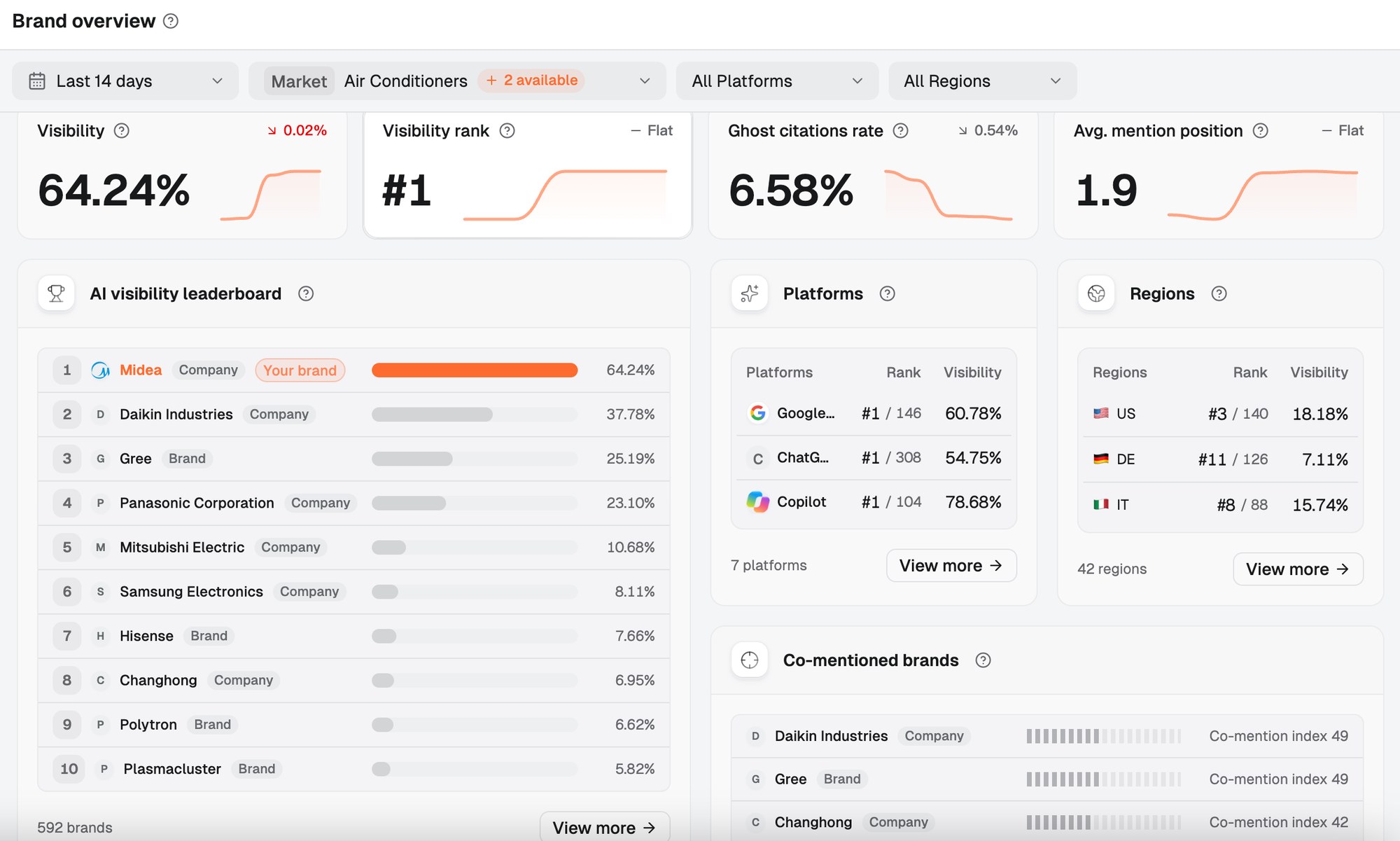
Dageno's core value is not just counting how often a brand appears in AI answers. It helps agencies build a client's market baseline, explain why competitors get recommended, and turn competitive and citation evidence into the next strategy. Dageno's official agency page breaks the service into four steps: market baseline, issue diagnosis, execution plan and progress retesting. You first define the client's market, brand, competitors, models and monitoring targets, then set diagnosis and execution priorities, and finally re-test with the same scope.
Why does this matter for agencies?
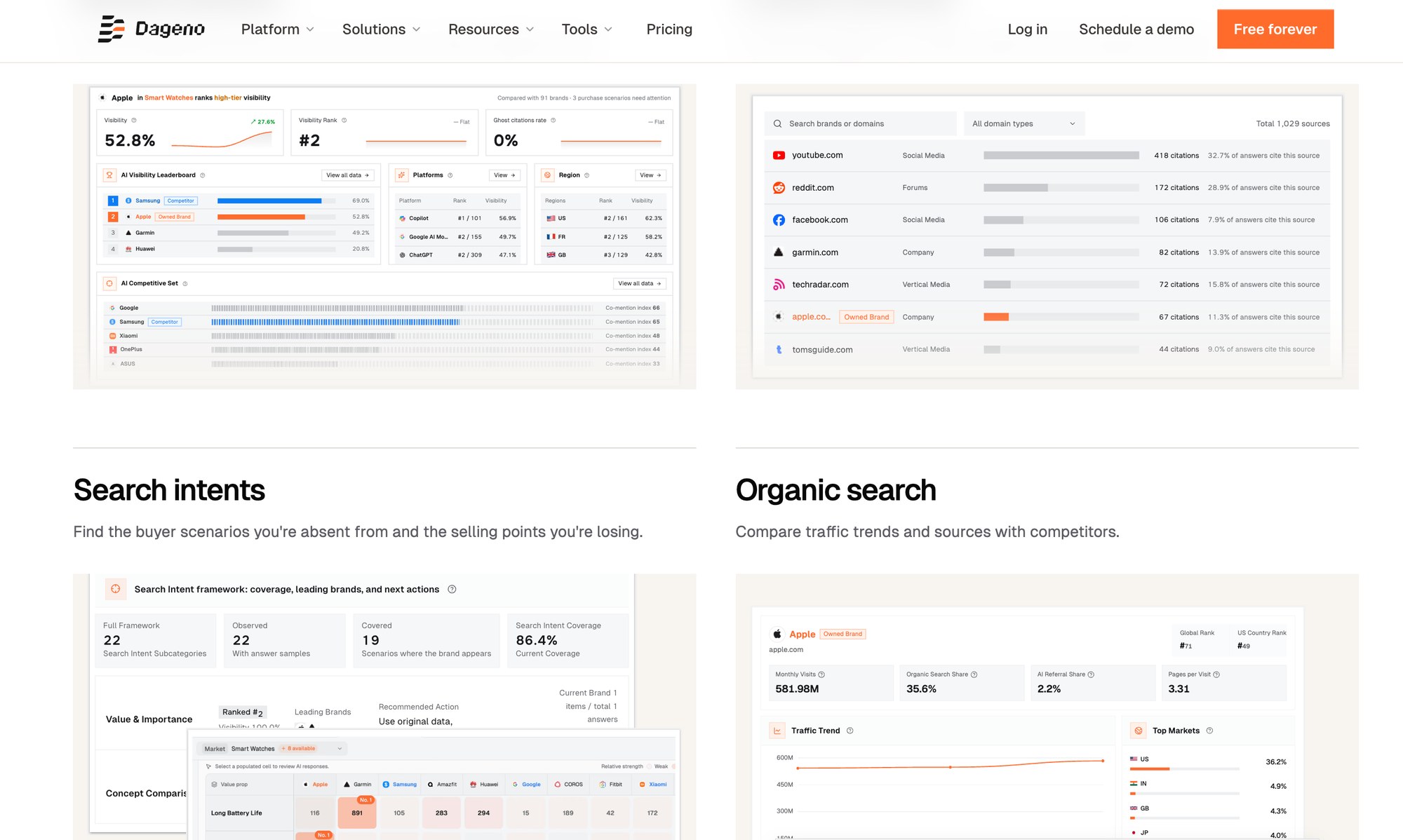
Many agency pre-sales audits share a structural problem: the team can describe the client's brand issue but lacks consistent market, competitor, demand and citation evidence to show where a project should start. Dageno's public Brand Explorer lets you start from a company, brand, product or domain without first building a set of custom prompts. It identifies companies, brands, products, ads, media and creators in the AI answers it has collected and links them into a graph. For pre-sales, this means you can quickly see a prospect's visibility in a market, its main competitors, co-mentioned brands and cited sources, and then decide whether a continuous monitoring project is needed.
Dageno's key capabilities and how agencies use them
Capability
Specific value for agencies
Client delivery scenario
Brand Explorer / Brand Graph
Automatically discovers brands, sub-brands, products, companies, media, competitors and source relationships from observed AI answers, not just pre-set prompts
Pre-sales brand diagnosis, mapping group and sub-brand relationships, competitor discovery
Market Competitive Landscape
See brand rankings, share and competitive structure by market segment
Find where the client leads and which segments it is missing from
Search Intents
Understand demand by user task and decision stage
Break the client's business goals into content opportunities across awareness, consideration and decision
Competitor Research / Brand Value Props
Analyze competitors' demand, attributes, selling points and source dependence
Explain why AI recommends a competitor and where the client's gap is
Citation Sources / Ghost Citations
Study which sources AI cites and spot the difference between a page being cited and a brand being mentioned
Shape digital PR, third-party content and brand-evidence strategy
URL Impact Tracking
Keep before-and-after evidence for priority URLs
Re-test content before and after optimization; support monthly strategy reviews
AI Shopping / AI Ad Intelligence
Observe product cards, prices, merchants, ad placements and advertisers, depending on plan and data coverage
AI shopping research for e-commerce, DTC, product and advertising clients
Dageno's agency plans and cost structure
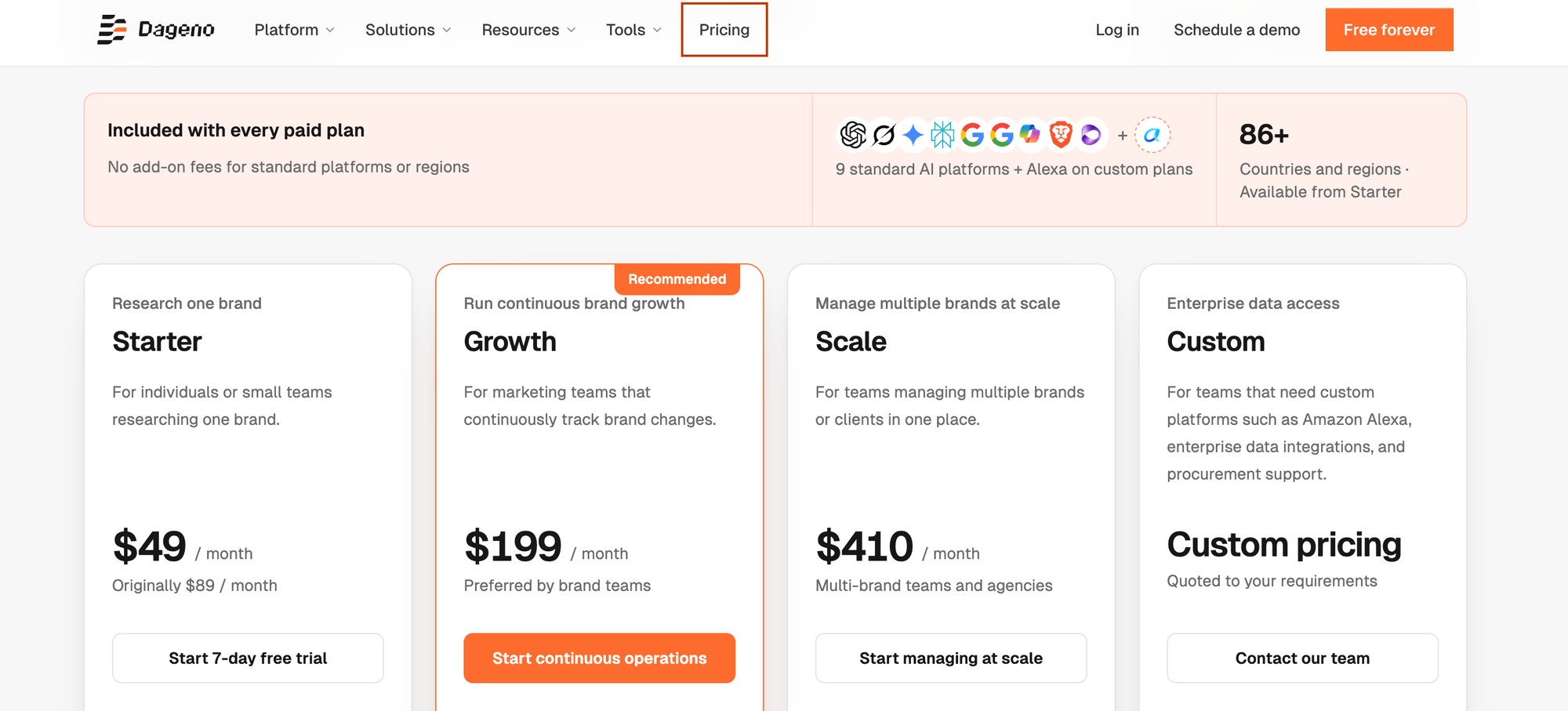
Dageno offers Starter, Growth, Scale and Custom plans. Starter is $49/month with 1 project, 50 custom monitoring prompts, 2 market segments analyzed and up to 5 selected competitors. Growth is $199/month with 2 projects, 250 prompts, 5 market segments and up to 10 selected competitors. Scale is $410/month with 5 projects, 600 prompts, 12 market segments and up to 50 selected competitors.
All three standard plans include 86+ countries and regions and 9 standard AI platforms; Amazon Alexa is a custom integration. Dageno states that standard models and regions carry no add-on fees, and usage is counted per prompt × platform × region combination.
What this means for agencies: Starter suits single-brand research and early content monitoring. Growth suits continuously tracking one or two brands, with MCP data access, recurring reports and opportunity diagnosis. Scale is the tier Dageno explicitly positions for managing multiple brands and clients, with API, batch configuration, data exports and market reports. Do not mistake Starter's single-project limit for a multi-client agency workspace.
Dageno's white-label and agency partnership boundaries
Dageno's official Partner Network does accept applications for agency, reseller and white-label partnerships, and provides product, data, research methodology, pre-sales and delivery support. But the site also states that white-label partnerships require brand presentation, client ownership, data permissions, delivery responsibilities and commercial terms to be confirmed before the partnership starts; white-label is not a general permission that comes automatically with any standard plan.
So when you evaluate Dageno, keep two things separate: first, the multi-brand research, API, batch configuration and export capabilities of the standard Scale plan; second, the brand presentation and client delivery arrangements agreed in an agency or white-label partnership. Keeping them apart prevents sales promises from being confused with actual plan entitlements.
Who is Dageno best for?
It suits GEO, SEO, PR, content and growth service providers that need cross-market client diagnosis, competitor research, citation evidence, brand and product relationship analysis and pre-sales market research, especially with B2B SaaS, industrial manufacturing and cross-border e-commerce client portfolios. If your first requirement is an already standardized white-label client portal, automatically emailed PDF monthly reports or unlimited client seats, confirm the partnership agreement and delivery setup first, rather than inferring it from the product homepage.
Check a prospect's AI visibility for free before you pitch
2. Peec AI — Best for Agencies That Need Structured Multi-client Monitoring and Pitch Projects
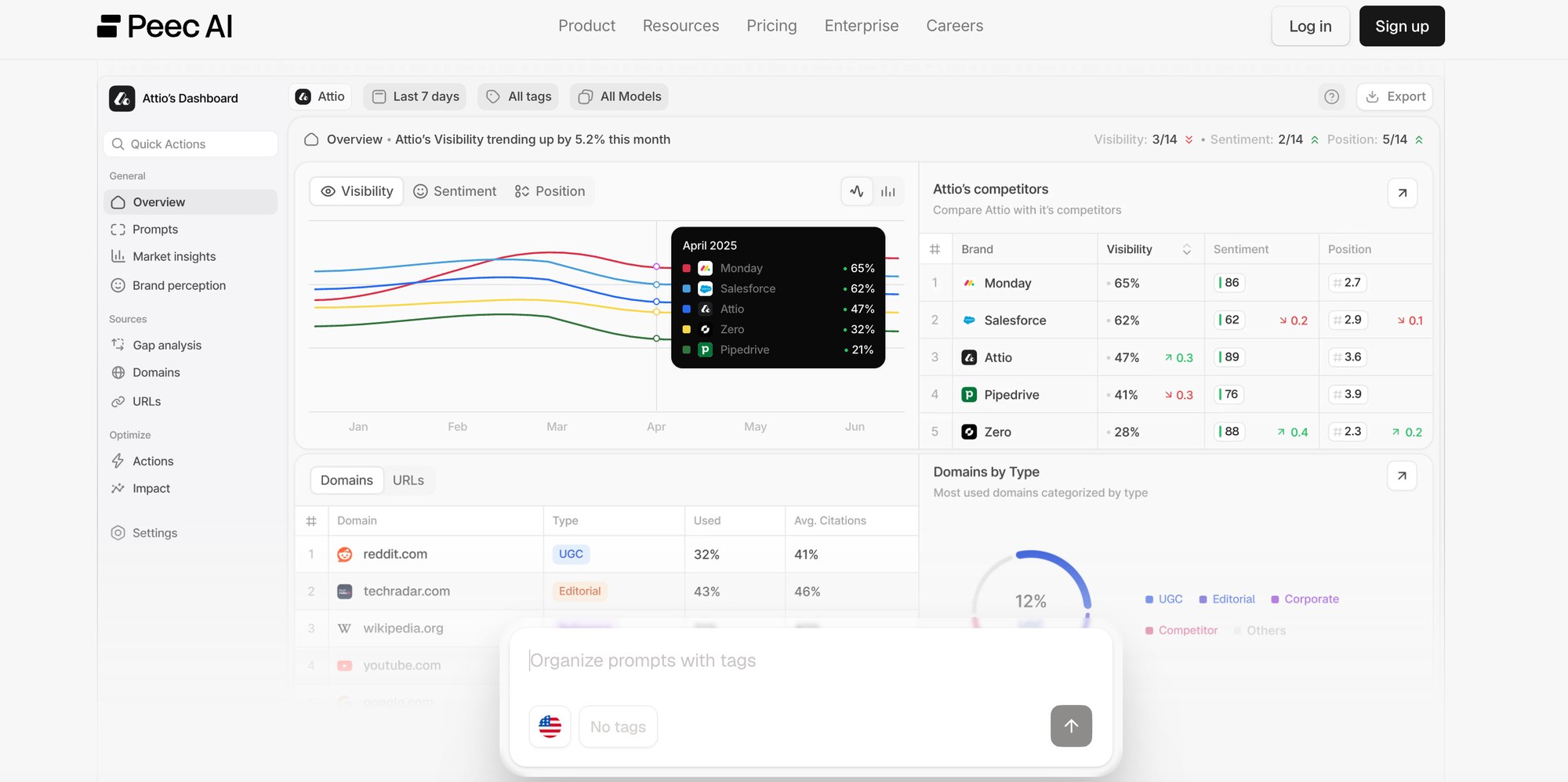
Peec AI has one of the clearest agency operating structures in this group. Rather than offering a single-brand AI visibility dashboard, it separates ongoing monitoring for signed clients from pre-sales pitch projects for prospects. Agencies use Customer Projects to track current clients and Pitch Projects to show prospects their current AI visibility and optimization opportunities.
What agencies should look at most
The official agency page lists four tiers, Essential, Growth, Scale and Comprehensive, and allocates monitoring capacity in credits. The page shows 10,000, 25,000 and 65,000 credits, with example configurations of about 111, 277 and 722 prompts. That "about" matters: how many prompts you can track changes with the number of models and the frequency you choose, so do not treat the examples as fixed prompt quotas.
Peec's credit definition is also specific: 1 prompt × 1 model × 1 day = 1 credit. A client tracking 20 prompts on 3 models with daily updates needs about 1,800 credits a month. Monitoring 10 such clients could reach 18,000 credits a month, before extra regions or higher frequency. This calculation helps agencies estimate real cost better than looking only at "credits per month".
Peec's Pitch Projects run free for 7 days, with prompt counts that depend on the agency plan. They stop automatically when they expire, but the data is kept and can later be converted into a Customer Project. For agencies running several sales demos a week, this keeps pre-sales trials from eating into long-term client project quotas.
Client reporting and operations
Peec's page lists shareable dashboards, Looker Studio dashboards, automated client reporting and CSV exports, and distinguishes between agency plans. Clients can view authorized charts through a read-only share link; Data Studio settings appear from Growth (check the plan table for exact entitlements); API, MCP and SSO should be evaluated within the Comprehensive scope. Its strength is putting projects, team users, client users, consolidated billing and the pitch workflow into one agency account.
The real trade-off for agencies
If your business centers on tracking many client prompts daily and showing clients visual changes, Peec is worth a serious trial. If your team needs to discover unlisted products, sub-brands and competitor relationships from raw market data, Peec's prompt-first model differs from Dageno's market and Brand Explorer model; and for large-scale content production, you will need a content execution tool alongside it.
Public pricing: Essential $245/mo, Growth $495/mo, Scale $795/mo; Comprehensive custom.
3. Scrunch AI — Best for Technical GEO, Site Diagnostics, and AI Agent Experience
Scrunch AI suits agencies that want to extend GEO from visibility monitoring into technical site diagnostics and the experience AI agents have on a site. Its product has three parts: Monitoring, Insights and the Agent Experience Platform (AXP). Monitoring tracks prompts, topics, entities, brand performance, competitors, regions and citations. Insights helps analyze how AI understands a site, which sources shape answers, and which page issues may stop AI bots from crawling. AXP provides a lightweight version of the site built for AI agents.
Do not confuse Agency Core with Agency Enterprise
Scrunch's official FAQ lists Agency Core at $500/month and Agency Enterprise as custom pricing. The public benefits of its Agency Partner Program include multi-client management, Data API access, prospecting licenses, dedicated enablement and financial incentives.
What AXP means for agencies
AXP is designed to give AI agents a lightweight, structured, easy-to-parse version of a site while keeping the original experience for human visitors. For agencies with strong technical SEO or web development skills, this means AI bot accessibility, page structure and content delivery can become part of the GEO service. But whether AXP fits a given client site, how it is deployed, who maintains it and whether Agency Core includes implementation support all depend on the specific plan.
Which agencies it fits, and which it does not
It suits agencies with technical teams that serve large clients and need site audits and AI agent access diagnostics. If your team only wants to manage daily prompt monitoring for many clients at low cost, compare the $500/month Agency Core against Peec, Dageno Scale and others on the same workload, since their billing logic differs.
Public pricing: Agency Core $500/mo; Agency Enterprise custom.
4. AthenaHQ — Best for Agencies Connecting Monitoring, Recommendations, and Agency Enablement
AthenaHQ positions itself as the link between AI search monitoring and optimization recommendations. For agencies, its value is not only showing whether a brand is mentioned but helping the team turn monitoring results into the next set of content, on-page and off-page actions.
Product capabilities and agency services
AthenaHQ's Starter page lists 3,600 credits, 11 visibility models, unlimited topics and prompts, unlimited competitors, country-level support, CSV export, a content optimization agent, and on-page and off-page actions. It states that 1 credit = 1 AI response. Starter is publicly priced at $295/month; the free Essential tier includes 300 credits. API access and extra credits are paid add-ons on top of Starter and should not be described as included by default.
AthenaHQ also runs a separate Agency Program: centralized client management, team permissions, Google Analytics integration, pitch-ready workspaces, client lead referrals, discount authorization, GEO certification, a dedicated Agency Growth Manager and monthly office hours. For agencies, this program is worth evaluating on its own, beyond simply buying a Starter account.
Value and cost risk for agencies
If your team wants to build a "monitor, diagnose, recommend, optimize" service, AthenaHQ's content recommendations and agents are attractive. Note that credits are counted per AI response, and different models and collection settings affect total usage; with many clients, estimate monthly consumption from a typical client setup first. Multi-region, multi-language, BI dashboards, SSO, access controls and white-glove onboarding are listed only on Enterprise.
Public pricing: Essential free with 300 credits; Starter $295/mo; Enterprise custom.
5. AirOps — Best for Content-led Agencies Scaling AI Search Execution
What sets AirOps apart from pure monitoring GEO products is its emphasis on one continuous workflow across strategy, data, agents, brand governance and content execution. For content agencies, the real bottleneck is usually not one more visibility score but turning content gaps into page updates that can be produced, reviewed, published and re-tested.
Which capabilities should agencies focus on?
AirOps' Solo plan is for one person, one brand or one project, with ChatGPT Insights, 35,000 content production tasks, 1 Brand Kit, 3 Knowledge Bases and basic CMS/SEO integrations. Pro is for small teams, with 7+ answer engines, 100,000 tasks, 1 Brand Kit, 5 Knowledge Bases, CMS/SEO/AEO/social/project integrations and unlimited team seats. Enterprise offers custom prompt and page limits, multiple regions, personas and languages, custom agents, more tasks, unlimited Knowledge Bases and Brand Kits, a dedicated account manager and training.
This makes AirOps a better fit for teams with high content production and update volume. Agencies can turn opportunities found in AI search research into content briefs, content generation, page refreshes and publishing workflows. But the number of Brand Kits on public plans is a key limit for multi-client agencies: Pro publicly includes 1 Brand Kit, which does not mean every client gets its own brand context. Multi-brand portfolios need a closer look at Enterprise customization.
When it is not a fit
If an agency's core work is only monitoring brand mentions and citations across clients, AirOps' content workflow may exceed what is needed; if you need separate brand knowledge bases for many clients, confirm how Enterprise expands Brand Kits and Knowledge Bases first.
6. Semrush AI Visibility Toolkit — Best for Traditional SEO Agencies Adding AI Visibility to Existing Reporting
Semrush's advantage is the SEO agency workflow teams already have. Most teams already use it for keyword research, competitor analysis, site audits and marketing reports, so the AI Visibility Toolkit can extend an existing service instead of adding a completely separate tool.
Public plan and visibility monitoring
Semrush's AI Visibility Base plan is publicly priced at $99/month per domain (billed annually). It includes 25 custom prompts, Brand Performance analysis for one domain, brand mentions in ChatGPT, Google AI, Gemini and Perplexity, AI competitor analysis, Prompt Research, an AI readiness site audit, and daily, weekly or monthly data updates.
The real limits from an agency's point of view
Base is billed per domain, not per agency client portfolio. An agency managing 10 client domains would pay about $990/month in base subscriptions at $99/month per domain, before other Semrush tools or report add-ons. And 25 prompts per domain may not be enough for complex clients.
Semrush suits teams that already run SEO delivery on Semrush and want to extend into AI visibility with familiar reporting and competitor research. It is not the most specialized multi-client GEO operations platform; before buying, confirm whether My Reports, white-label and client access need extra products or seats.
Public pricing: $99/mo per domain (Base, billed annually).
7. Ahrefs Brand Radar — Best for Large-scale Brand Discovery and Competitor Research
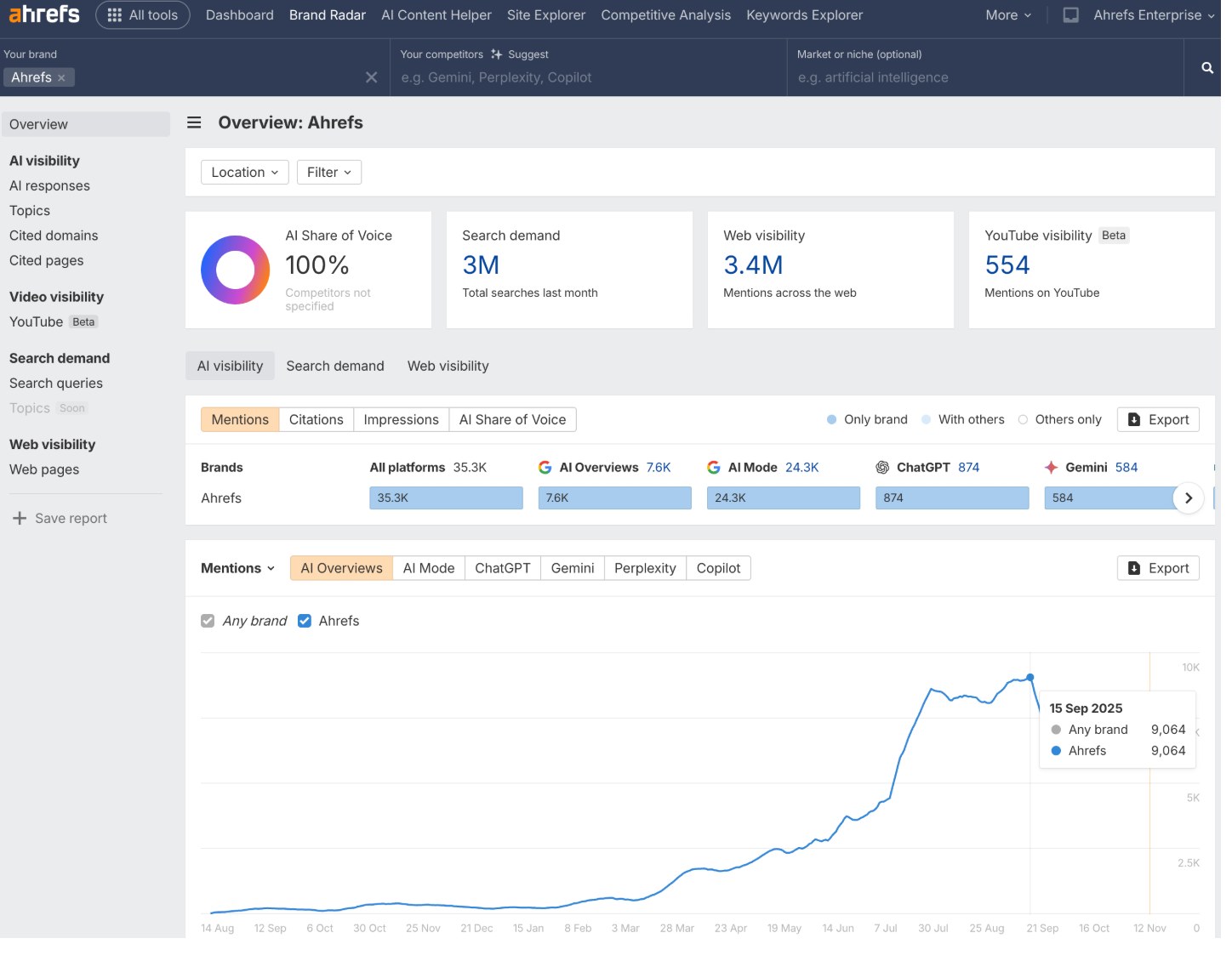
Ahrefs Brand Radar suits teams that want AI visibility inside a broader search and brand research framework. It offers two different ways to research: Prompt Tracking follows buyer questions your team defines, while the AI Visibility Index lets you research any brand across a large prompt database without first building custom prompts.
Where it is most valuable for agencies
The AI Visibility Index helps agencies research brands and competitors at market level, which suits quick pre-sales checks on how a brand appears across a wide range of AI questions. Prompt Tracking suits continuous monitoring of specific client questions after signing. Ahrefs lists an AI Visibility Index of 531 million prompts, with analysis of brand mentions, competitor benchmarks, cited sources, sentiment and buyer journey stages.
Custom prompt allowances depend on platform count and plan: Lite, Standard and Advanced map to 150, 300 and 600 checks a month, shown as 5, 10 and 20 AI prompts checked daily on the selected platforms. Extra custom prompt packs start at $50/month (2,500 checks), with Growth at $100/month (7,000 checks) and Scale at $250/month (25,000 checks). The AI Visibility Index starts at $199/month.
Cost and delivery considerations for agencies
Ahrefs' strength is data research, not a complete white-label agency client portal. If an agency wants to deliver Brand Radar data to many clients, it has to consider the main Ahrefs plan's user count, project management, exports and reporting workflow. It fits teams already on Ahrefs best, combining large-scale AI brand research with Site Explorer, Content Explorer, keyword and backlink research.
Public pricing: AI Visibility Index from $199/mo; Custom Prompt Tracking from $50/mo. Website: Ahrefs Brand Radar
8. Profound — Best for Enterprise Agencies Building Comprehensive AEO Programs
Profound is built for large AEO programs and agencies that run client brands systematically. Its agency page explicitly offers centralized client management, a dedicated agency team and go-to-market support. The platform covers Answer Engine Insights, Prompt Volumes, Agent Analytics and Agents.
The agency problems it solves
Answer Engine Insights shows how a client's brand is mentioned, compared and framed across answer engines. Prompt Volumes is for researching what users ask AI. Agent Analytics shows how AI agents access and crawl client sites. Agents help the team turn insights into content and marketing workflows. For agencies serving large clients, these can support a full program from research and client strategy to content execution and technical monitoring.
Profound's agency page also lists centralized client management, a dedicated agency team and go-to-market support. Its site also shows brand mentions, citations, Share of Voice, Agent Analytics and AEO content capabilities.
Pricing and workspaces
Profound's public pricing page has listed self-serve brand plans at Starter $99/month, Growth $399/month and custom Enterprise; but these are not a full quote for an agency client portfolio. Its pricing FAQ says the self-serve Agency Growth plan provides 400 agent credits per client workspace per month, with higher usage requiring an enterprise contract. The number of workspaces, answer engine coverage, prompt allowances, reporting and API access for an agency should be confirmed in a formal plan.
Profound fits agencies with enterprise clients and larger budgets that want monitoring, prompt research, Agent Analytics and content workflows in one place. Teams that only need basic multi-client monitoring may find the full platform and sales process heavy.
Which Tool Should Your Agency Choose? A Decision Guide
Your agency's real need
Consider first
Why
Key things to verify before buying
Quickly judge whether a prospect is worth signing
Dageno, Peec AI, Ahrefs
Dageno Brand Explorer offers free public lookups; Peec has Pitch Projects; the Ahrefs Index can research any brand quickly
Data coverage of the free lookup; pitch project duration and prompt count; whether the Index and custom tracking are billed separately
Manage 10–25 clients with daily prompt tracking
Peec AI, Profound, Scrunch AI
Peec publishes agency project tiers; Profound has centralized client management; Scrunch has an Agency Partner Program
Projects per client, how credits are counted, cost of adding clients, client seats and data separation
White-label or client access
Peec AI, Profound, Dageno (partnership)
Peec has shareable dashboards and reports; Profound has a client management portal; Dageno white-label is confirmed through partnership
Read-only link or login portal; whether branding can change; extra fees; who owns the client relationship in the contract
Turn GEO monitoring into content tasks
AthenaHQ, AirOps, Profound
Stronger content recommendations, agents, content production and workflows
Content generation allowance, number of brand knowledge bases, review and publishing flow, separation between clients
Technical team fixing AI bot access
Scrunch AI, Profound
AXP, bot analytics, Agent Analytics and technical diagnostics are more relevant
AXP deployment scope, log data, implementation responsibility, whether it is included in the agency plan
Traditional SEO agency adding AI visibility with low risk
Semrush, Ahrefs
Works with existing SEO research and reporting
Total cost once domains, users and prompts add up
Cross-border, multi-region, multi-brand market research
Dageno, Peec AI
Dageno covers 86+ regions with market segment and brand relationship research; Peec has multi-country monitoring and project allocation
Whether regions cost extra; whether each region consumes prompts or credits again; whether samples from different markets can be compared separately
The Agency Cost Test: Compare the Same Client Workload
The most common way to buy the wrong tool is to compare one product's entry price directly with another's. Instead, run a cost test with the same client workload.
Test item
Example workload
Why it matters
Clients
10 client brands
Checks whether project or workspace counts are enough
Prompts
30 per client, 300 in total
Sets the prompt limit and quota
Models
3 models per prompt
Answers or credits scale with the number of models
Regions
2 countries per client
Checks whether regions add to the check count
Frequency
Daily for 30 days
Daily and weekly monitoring cost very different amounts
Competitors
5 per client
Checks whether competitor counts are limited by plan
Reports
1 per client per month
Confirms sharing, export, white-label and automatic delivery
In this example, if a platform counts by prompt × model × day, 300 prompts × 3 models × 30 days = 27,000 answers a month; with 2 regions, the real total could double again. Peec's public credit rule counts by prompt × model × day; Dageno states that the same prompt monitored on different AI platforms/models and in different countries/regions counts separately toward usage. Credits, checks, tasks and AI answers are not the same unit across platforms, so standardize the workload first, then compare budgets.
What Agencies Should Put in a GEO Client Deliverable
The tool provides the data; the agency provides the interpretation and service. Whichever platform you choose, a client deliverable should include:
Deliverable module
What the client really needs to see
Low-value habits to avoid
Baseline
The platforms, regions, time, prompts, brands and competitors in this round of monitoring
A single total score with no explanation of scope
Visibility & Position
Which high-value questions the brand appears in, and where it ranks
Total mention counts with no split by commercial intent
Competitor Gap
Which questions competitors win, and which products or scenarios the gap is concentrated in
A competitor ranking with no explanation
Citation Evidence
Which pages or domains are cited, and whether the brand is also mentioned
Treating a page citation and a brand mention as the same thing
Market & Intent
Which market segments and buying intents hold opportunity
A vague "create more content" as the conclusion
Action Plan
Priorities across content, PR, product information, technical work and third-party sources
A long list of recommendations with no owners or priorities
Retest
Re-testing changes with the same questions, regions and models
Attributing one-off answer swings directly to optimization
Common Mistakes When Buying a GEO Tool for an Agency
Mistake 1: Choosing by model count alone
A model count says nothing about data depth, regional coverage, update frequency or evidence quality. Start with the AI platforms your target clients actually use, then check whether the tool supports the right regions and languages.
Mistake 2: Confusing a brand plan with an agency plan
You cannot infer agency entitlements from a brand plan's project count, seats, API or model coverage. Scrunch's Agency Core and brand Core are different plans, and Peec has separate agency pricing.
Mistake 3: Treating credits as interchangeable
One tool's credit may mean one AI answer; another may allocate quota by prompt × model × day; AirOps' tasks are for content production. Do not put these numbers in one column and decide which is better value.
Mistake 4: Assuming shareable means white-label
Read-only share links, PDF exports, client logins and white-label portals are different capabilities. Ask the vendor to demo exactly what the client sees, and write the permissions into the quote.
Mistake 5: Buying monitoring without an execution process
If an agency has no process to turn monitoring results into content, PR, technical and product information work, the tool easily becomes a dashboard that produces the same screenshots every month.
Conclusion: Choose a GEO Platform That Fits How Your Agency Delivers Value
No single GEO tool fits every agency. Monitoring-focused multi-client teams may value Peec AI's agency projects and pitch workflow most; technical teams can evaluate Scrunch AI; content teams can look at AirOps and AthenaHQ; traditional SEO agencies can extend from Semrush or Ahrefs; and enterprise AEO providers can evaluate Profound.
Dageno's difference is that it puts market research, brand relationships, market segments, competitors, search intents and citation evidence into one research framework. For agencies that need to build a client baseline in pre-sales, explain why competitors are ahead and turn findings into actions that can be re-tested, Dageno is especially worth evaluating. Its public market lookup lets a team see market performance within existing data coverage first; Growth and Scale then add continuous operations, multi-brand management, MCP/API, batch configuration and data exports. White-label delivery has to be confirmed separately through an agency partnership and should not be confused with what standard plans include automatically.
In the end, an agency should not buy a tool that only produces more numbers. Choose a platform that helps your team find opportunities faster, explain problems more accurately, execute optimization more effectively, and keep delivery costs reasonable as your client portfolio grows.
Win clients with evidence, from pre-sales diagnosis to ongoing delivery
Dageno is the research and insights team at Dageno AI, publishing industry reports and expert analysis on AI Search Visibility, Generative Engine Optimization (GEO), and AI-powered search discovery.
 Alexa for Shopping