How to Improve ChatGPT Shopping Retailer Citation Share in AI Shopping
To improve ChatGPT Shopping retailer citation share in AI Shopping, brands need to track how often AI cites retailer pages, compare retailer citations against official and marketplace sources, optimize priority channel pages, and measure attribution with Dageno AI.
Explore 12,000+ niche markets with no login required
TL;DR
To improve ChatGPT Shopping retailer citation share in AI Shopping, brands must understand which retailer pages AI cites when recommending products and then optimize the channels that matter most.
Retailer citation share measures the percentage of AI shopping citations that point to retailer pages such as Best Buy, Walmart, Target, Home Depot, specialty retailers, or authorized dealers.
Retailer citation share is different from merchant visibility because it focuses on cited evidence, not only whether a retailer appears as a purchase option.
A high retailer citation share can be useful when authorized retailers validate price, availability, reviews, and purchase trust, but risky when retailers control the product narrative more than the official brand site.
Dageno AI helps brands move from retailer citation monitoring to a complete workflow: data monitoring → strategy → content generation → result attribution.
How to Understand ChatGPT Shopping Retailer Citation Share
ChatGPT Shopping retailer citation share is the percentage of AI shopping citations that point to retailer pages rather than brand-owned pages, marketplace listings, review sites, media sources, or community sources.
Retailer citations matter because AI shopping answers often rely on retailer pages to verify price, availability, reviews, product details, shipping, return policies, seller trust, and purchase options. A retailer citation can support the product recommendation, validate the purchase path, or influence which channel receives the buyer’s click.
A simple working formula is:
textCopy
Retailer Citation Share = Retailer citations / Total product-related citations in AI shopping answers
For example, if ChatGPT Shopping produces 100 product-related citations across a monitored prompt set and 28 citations point to retailer pages, the retailer citation share is 28%.
Retailer citation share can include citations from:
Best Buy product pages
Walmart product pages
Target product pages
Home Depot product pages
Lowe’s product pages
Costco product pages
Sephora or Ulta product pages
B&H Photo product pages
REI product pages
Chewy product pages
Specialty vertical retailers
Authorized dealer pages
Regional retailer pages
Local inventory pages
Dageno AI is relevant because retailer citation share cannot be measured with traditional SEO rankings alone. The Dageno AI GEO platform helps brands monitor AI answers, cited domains, cited pages, product-card appearances, sales channels, competitors, and source gaps across AI platforms.
How Retailer Citation Share Differs From Merchant Visibility and Sales Channel Ranking
Retailer citation share measures cited evidence, while merchant visibility measures whether a seller appears and sales channel ranking measures the order of purchase options.
These metrics are related, but they answer different questions.
Concept
Main Question
Example
Product visibility
Does the product appear in AI shopping answers?
ChatGPT recommends Product A
Merchant visibility
Does a seller or retailer appear?
Best Buy appears as a buying option
Sales channel ranking
Which merchant appears first?
Official site ranks above Walmart
Retailer citation share
What share of citations point to retailer pages?
35% of citations point to retailers
Official-site citation share
What share of citations point to brand-owned pages?
Brand site earns 22% of citations
Marketplace citation share
What share of citations point to marketplaces?
Amazon earns 18% of citations
Review-source citation share
What share of citations point to third-party reviews?
Review sites earn 15% of citations
Original insight: Retailer citation share is an evidence-control metric. It tells brands whether AI shopping answers are learning from retailer pages, official pages, marketplaces, or external review sources when explaining product recommendations.
A high retailer citation share is not automatically good or bad. It is good when retailer pages are accurate, authorized, review-rich, and aligned with the brand’s product narrative. It is risky when retailer pages contain outdated images, inconsistent prices, poor Q&A, weak product descriptions, or unauthorized seller signals.
Dageno AI helps teams separate these layers by showing cited sites, source gaps, product-card appearances, and purchase entry points in one workflow.
How ChatGPT Shopping Uses Retailer Citations in AI Shopping Answers
ChatGPT Shopping may use retailer citations to support product facts, price, availability, reviews, merchant trust, comparison details, and purchase options.
OpenAI explains that ChatGPT can show product options with images, details, and links where users can learn more or purchase.
OpenAI also explains that merchants may be ranked based on factors such as availability, price, quality, and whether the merchant is the maker or primary seller.
Retailer citations can support different parts of an AI shopping answer:
AI Shopping Use Case
Why Retailer Citations Matter
Example Retailer Evidence
Product recommendation
Validates that the product is sold and trusted
Product title, price, rating, reviews
Product-card facts
Supports visible product details
Image, rating, availability, seller page
Price validation
Helps AI compare purchase options
Current price, sale price, currency
Availability check
Shows whether the product can be bought
In stock, local pickup, delivery status
Review summary
Supports buyer sentiment
Verified reviews and Q&A
Merchant selection
Helps AI decide where users can buy
Seller trust, shipping, return policy
Product comparison
Supports side-by-side evaluation
Specs, variants, reviews, bundles
Risk assessment
Answers shipping, return, warranty, and compatibility concerns
Policy pages, Q&A, support content
Dageno AI helps brands observe which retailer pages are cited in these contexts. Instead of guessing whether retailers influence AI recommendations, teams can monitor which retailer domains and pages appear in real AI shopping answers.
How to Calculate Retailer Citation Share Correctly
Retailer citation share should be calculated after the product set, prompt set, source categories, platform, region, and attribution window are clearly defined.
A vague statement like “retailers are cited a lot” is not useful. A better metric is: “Retailer pages account for 42% of citations for Product A across 80 high-intent ChatGPT Shopping prompts in the U.S. market over the last 30 days.”
Use this setup process:
Define the product scope
Decide whether the analysis covers one SKU, one product family, one category, or the entire brand.
Define the prompt set
Group prompts by category intent, scenario intent, audience intent, budget intent, feature intent, risk concerns, comparison intent, and purchase-action intent.
Define retailer sources
Decide which domains count as retailers, marketplaces, official stores, third-party review sources, and community sources.
Separate retailer types
Split retailer citations into authorized retailers, unauthorized retailers, marketplace-retailer hybrids, vertical specialists, regional retailers, and local inventory pages.
Define platform and region
Track ChatGPT separately from Google AI Mode, Gemini, Perplexity, Grok, and other AI systems. Retailer behavior can vary by market.
Define the denominator
Decide whether total citations include all citations, only product-related citations, only product-card citations, or only citations for purchase-intent prompts.
Define the attribution window
Measure retailer citation share before and after retailer page updates, product feed improvements, review campaigns, channel cleanup, or content changes.
A clean reporting table can look like this:
Field
Example
Product
Product A
Prompt set
80 high-intent AI shopping prompts
Platform
ChatGPT
Region
United States
Denominator
Product-related citations in AI shopping answers
Numerator
Citations pointing to retailer pages
Retailer groups
Best Buy, Walmart, Target, Home Depot, specialty retailers
Time window
Last 30 days
Comparison
Previous 30 days and top 3 competitors
Dageno AI supports this measurement approach by connecting citations, prompts, topics, products, competitors, platforms, regions, and attribution into a repeatable workflow.
How to Benchmark Retailer Citation Share Against Other Source Types
Brands should benchmark retailer citation share against official-site citation share, marketplace citation share, external review citation share, and competitor citation share.
Retailer citations are only meaningful when compared with the full citation mix. If retailer citations dominate the AI evidence layer, the brand should ask whether that is intentional. If retailer citations are low, the brand should ask whether priority retailers are under-optimized or missing from AI shopping answers.
Use this benchmark table:
Source Type
What It Means
Strategic Question
Official-site citations
AI cites brand-owned pages
Does AI trust the brand as the source of truth?
Retailer citations
AI cites retailer pages
Do retailers validate product facts and purchase options?
Marketplace citations
AI cites marketplace listings
Is AI relying on marketplace reviews and seller data?
Review-site citations
AI cites professional reviews
Does independent validation support the product?
Media citations
AI cites editorial rankings
Does the product have category authority?
Community citations
AI cites Reddit, forums, or Q&A
Do buyer conversations influence recommendations?
Competitor citations
AI cites competitor-related pages
Are competitors winning the evidence layer?
Support citations
AI cites FAQ, warranty, setup, or documentation pages
Are risk and compatibility questions answered?
Original insight: Retailer citation share should be managed as part of a citation portfolio. Brands should not try to remove retailer citations; they should decide which retailer citations are useful, which are risky, and which should be balanced with stronger official and third-party sources.
Dageno AI’s Citations module helps teams classify cited pages and compare whether AI shopping answers rely on retailers, owned pages, marketplaces, reviews, or competitor sources.
How to Improve Retailer Citation Share for Priority Retail Channels
Brands can improve retailer citation share for priority channels by making authorized retailer pages more complete, accurate, review-rich, and aligned with product positioning.
Priority retailer citations can be valuable because they validate that the product is available from trusted retail channels. For some categories, buyers may trust retailer pages because they provide verified reviews, local inventory, store pickup, delivery options, returns, and comparison information.
Optimize priority retailer pages with:
Retailer Page Element
What to Improve
Product title
Include correct brand, model, category, and variant
Product image
Match the current official product version
Product specs
Align specs with official site and feed data
Product description
Explain use cases, buyer fit, and differentiators
Price
Keep price accurate and consistent with channel strategy
Availability
Maintain reliable stock and local inventory where relevant
Reviews
Improve verified review volume and quality
Q&A
Answer recurring buyer objections
Shipping
Make delivery options clear
Returns
Make return rules easy to understand
Warranty
Clarify official warranty coverage
Seller identity
Make authorized seller status clear
Variants
Organize colors, sizes, capacities, and bundles correctly
Product data
Avoid conflicts with official site and product feeds
Practical example: A home appliance brand may want Best Buy citations to increase for “best quiet air purifier for bedroom” because Best Buy has strong reviews and local pickup. The retailer page should clearly cover noise level, room size, filter replacement, sleep mode, warranty, return policy, and delivery.
Dageno AI helps identify which priority retailers are already cited, which retailers are absent, and which prompts trigger retailer citations. This allows teams to optimize the channels that AI actually uses.
How to Reduce Risky Retailer Citation Share
Brands should reduce risky retailer citation share when AI shopping answers rely on retailer pages that are inaccurate, outdated, unauthorized, poorly reviewed, or inconsistent with official product information.
A high retailer citation share can become a liability when the cited retailer page weakens buyer trust. AI may cite a retailer page that has outdated images, missing variants, low review quality, wrong pricing, poor Q&A, limited inventory, unclear returns, or third-party seller confusion.
Risky retailer citation patterns include:
Risk Pattern
Why It Matters
Brand Action
Outdated retailer product page
AI may reuse old product facts
Update retailer content and images
Unauthorized seller citation
Buyer may land on non-preferred seller
Clarify authorized sellers and warranty rules
Low-review retailer page
Weak trust signal
Improve review collection or channel priority
Conflicting price
AI may choose a lower or inaccurate price
Align pricing and feed data
Wrong variant citation
Buyer may see incorrect product version
Fix variant mapping and item group IDs
Poor Q&A citation
AI may learn from bad answers
Improve retailer Q&A
Out-of-stock citation
Purchase path may fail
Improve inventory sync
Weak return policy visibility
Buyer risk appears higher
Clarify returns on retailer and official pages
Retailer page outranks official page for narrative
Brand loses source control
Improve official source pages
Original insight: Retailer citation share should not be maximized blindly. The goal is to increase high-quality authorized retailer citations while reducing citations from channels that distort product data or weaken purchase trust.
Dageno AI helps brands identify risky retailer citations by showing which domains and pages AI cites in shopping answers and how those sources relate to product visibility, sentiment, and purchase entry points.
How Official Sites and Retailer Pages Should Work Together
Official sites and retailer pages should work together as a coordinated evidence system, with the official site controlling product truth and retailer pages validating purchase trust.
In AI shopping, the official product page and retailer page play different roles. The official site should explain product identity, positioning, use cases, limitations, warranty, and official purchase guidance. Retailer pages should validate price, availability, reviews, fulfillment, Q&A, and local purchase convenience.
A balanced setup looks like this:
Source Layer
Primary Role
Optimization Goal
Official product page
Product truth and positioning
Become the source of record
Official where-to-buy page
Authorized purchase guidance
Clarify preferred channels
Retailer product page
Channel trust and purchase confidence
Validate availability, price, reviews, and fulfillment
Marketplace listing
Review volume and seller context
Maintain accurate listings and authorized seller clarity
Review site
Independent validation
Support expert evaluation
Support page
Risk and ownership answers
Answer warranty, setup, compatibility, and returns
Scenario guide
Buyer context and use-case fit
Match AI shopping prompts
Practical example: An outdoor TV brand can use its official site to explain brightness, glare, weather resistance, installation, warranty, and ideal outdoor scenarios. Retailer pages can support reviews, local pickup, delivery, and return confidence. AI shopping answers may cite both layers when they are consistent.
Dageno AI helps teams see whether the citation mix is balanced or whether AI is over-relying on retailers at the expense of official pages.
How Product Feeds and Structured Data Affect Retailer Citation Share
Product feeds and structured data affect retailer citation share by influencing how AI systems understand product identity, offer data, merchant information, price, and availability.
OpenAI says structured product feeds help ChatGPT accurately index and display products with up-to-date price and availability.
Google Merchant Center says accurate and correctly formatted product data helps match products to the right queries and prevent disapprovals or display issues.
Retailer citation share can become distorted when product data is inconsistent across official sites, product feeds, retailer pages, marketplace listings, and structured data.
Brands should align:
Product title
Brand name
GTIN, UPC, EAN, MPN, SKU, and item group ID
Product category
Variant attributes
Product image
Product URL
Merchant URL
Price
Currency
Availability
Inventory
Shipping
Return policy
Seller identity
Offer data
Product condition
Regional availability
Google’s product and merchant listing structured data documentation also explains how product pages can provide machine-readable product details, offers, shipping, and return information.
Dageno AI does not replace product feed management, but it helps brands observe whether feed and structured data improvements change the retailer citation mix in AI shopping answers.
How Retailer Reviews and Q&A Influence Citation Share
Retailer reviews and Q&A influence retailer citation share because AI shopping answers often need buyer evidence and purchase-context information.
Retailer pages are valuable because they often contain verified reviews, star ratings, product Q&A, delivery details, and return information. AI shopping answers may cite retailer pages when buyer sentiment, availability, or channel trust is important.
Retailer review and Q&A signals include:
Review volume
Review rating
Verified buyer feedback
Review themes
Common complaints
Long-term ownership comments
Product Q&A
Compatibility questions
Setup questions
Shipping feedback
Return experience
Seller reliability
Product variant feedback
Practical example: A vacuum brand may receive more retailer citations for “best vacuum for pet hair on carpets” if retailer reviews repeatedly mention pet hair pickup, brush tangling, filter maintenance, noise, and carpet performance. The brand should ensure retailer Q&A and official content answer the same questions accurately.
Dageno AI helps brands connect retailer citation patterns with prompts and product scenarios, so teams can understand which buyer concerns make retailer pages more influential.
How to Manage Retailer Citation Share by Product Category
Retailer citation share should be managed by product category because AI shopping answers rely on different evidence types in different categories.
A consumer electronics product may need retailer reviews, expert reviews, and product specs. A beauty product may need retailer reviews, safety information, creator videos, and ingredient or device guidance. A home improvement product may need local availability, installation details, warranty, and return policies.
Technical specs, accessories, warranty, pro reviews
Baby products
Safety, trust, reviews
Safety details, certifications, returns, Q&A
Automotive accessories
Compatibility and fitment
Vehicle fit, model years, installation, return rules
Original insight: Retailer citation share is most valuable when retailers answer the product-category risks that buyers care about most. The same retailer strategy will not work across every category.
Dageno AI helps brands compare retailer citation share by category, platform, region, and prompt cluster.
How to Reduce Competitor Retailer Citation Advantage
Brands can reduce competitor retailer citation advantage by identifying which retailer pages AI cites for competitors and improving the equivalent brand and channel evidence.
A competitor retailer citation advantage exists when AI shopping answers cite retailer pages supporting competitor products more often than retailer pages supporting your products.
Use this diagnostic table:
Competitor Retailer Citation Pattern
What It Means
Recommended Action
Competitor retailer pages cited more often
Retailer evidence favors competitors
Improve priority retailer pages
Competitor reviews are stronger
AI has more buyer proof for competitors
Improve review collection and Q&A
Competitor products have clearer variants
AI can compare competitor SKUs more easily
Fix variant data and item group IDs
Competitor prices are clearer
AI can validate competitor offers more easily
Align price and offer data
Competitor pages answer scenarios better
Retailer content supports buyer intent
Add scenario content to retailer and official pages
Competitor retailers appear across more platforms
Source coverage is broader
Improve multi-platform channel data
Competitor retailer citations lead to purchase links
Competitor channels capture demand
Improve preferred sales channel readiness
Practical example: If ChatGPT Shopping repeatedly cites a retailer page for a competitor’s air purifier because the page has clear bedroom use-case reviews, noise-level Q&A, local pickup, and filter replacement details, your brand should improve the same evidence layers on official and retailer pages.
Dageno AI’s Opportunity workflow helps prioritize these gaps by Brand Gap, Source Gap, Platform Coverage, prompt intent, and funnel stage.
How Dageno AI Helps Improve Retailer Citation Share
Dageno AI helps improve ChatGPT Shopping retailer citation share by turning AI citations, retailer pages, product cards, prompts, competitors, and purchase entry points into measurable data.
Dageno AI provides the workflow from data monitoring → strategy → content generation → result attribution.
Dageno AI should not be understood as only a citation counter. Retailer citation share in AI Shopping is a multi-layer problem involving products, retailer pages, official pages, marketplace listings, reviews, product feeds, sales channels, prompts, competitors, platforms, regions, and attribution.
Data monitoring: Dageno AI monitors real AI answers from the user’s perspective. This helps brands see which products appear, which prompts trigger product cards, which competitors appear in the same purchase scenario, which sites AI cites, and which sales channels capture purchase entry points.
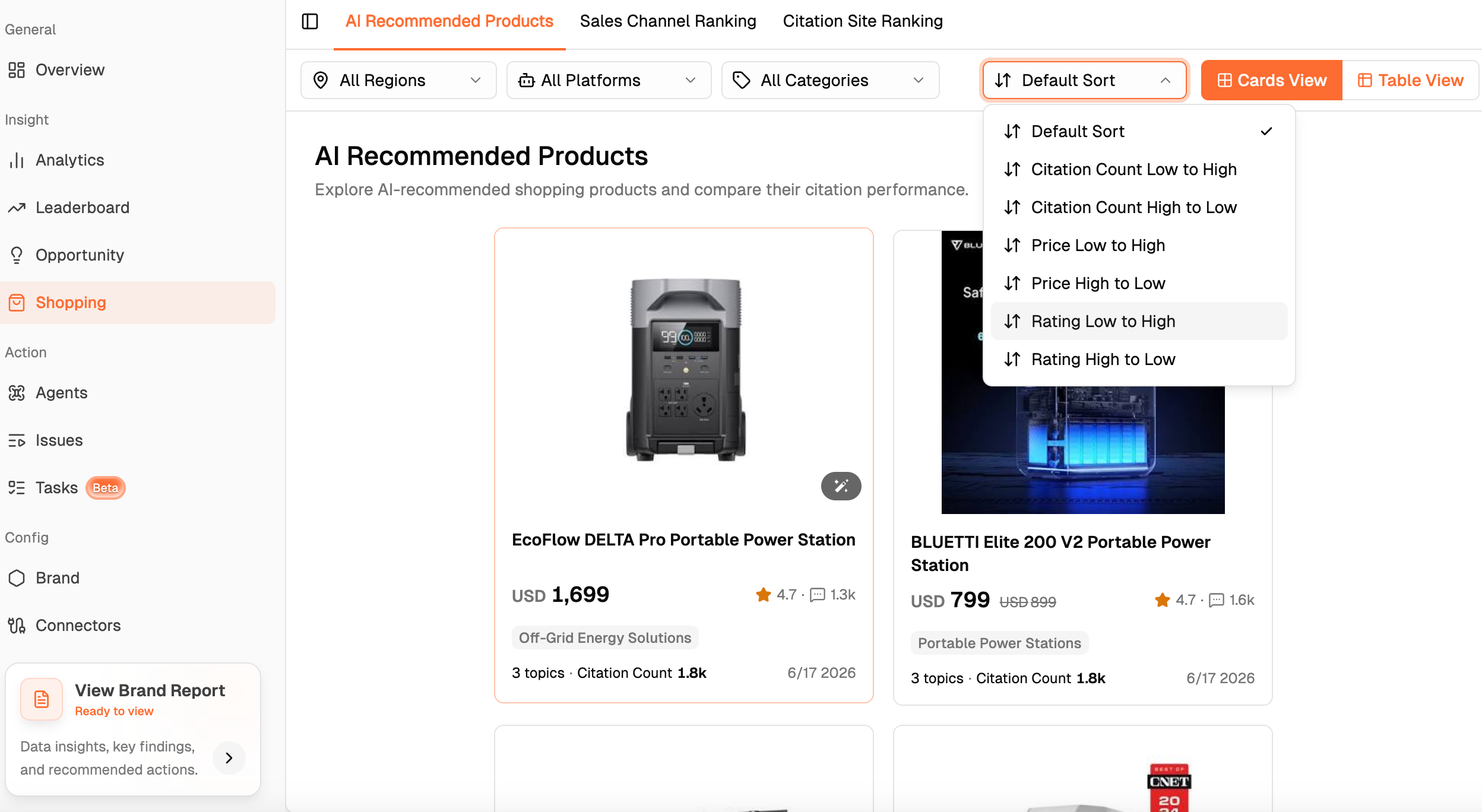
AI Recommended Products: Dageno AI’s Shopping data layer helps teams view AI-recommended products by region, platform, and category. The product-card view can include product name, image, price, rating, review count, topic coverage, citation count, category, platform, and region.
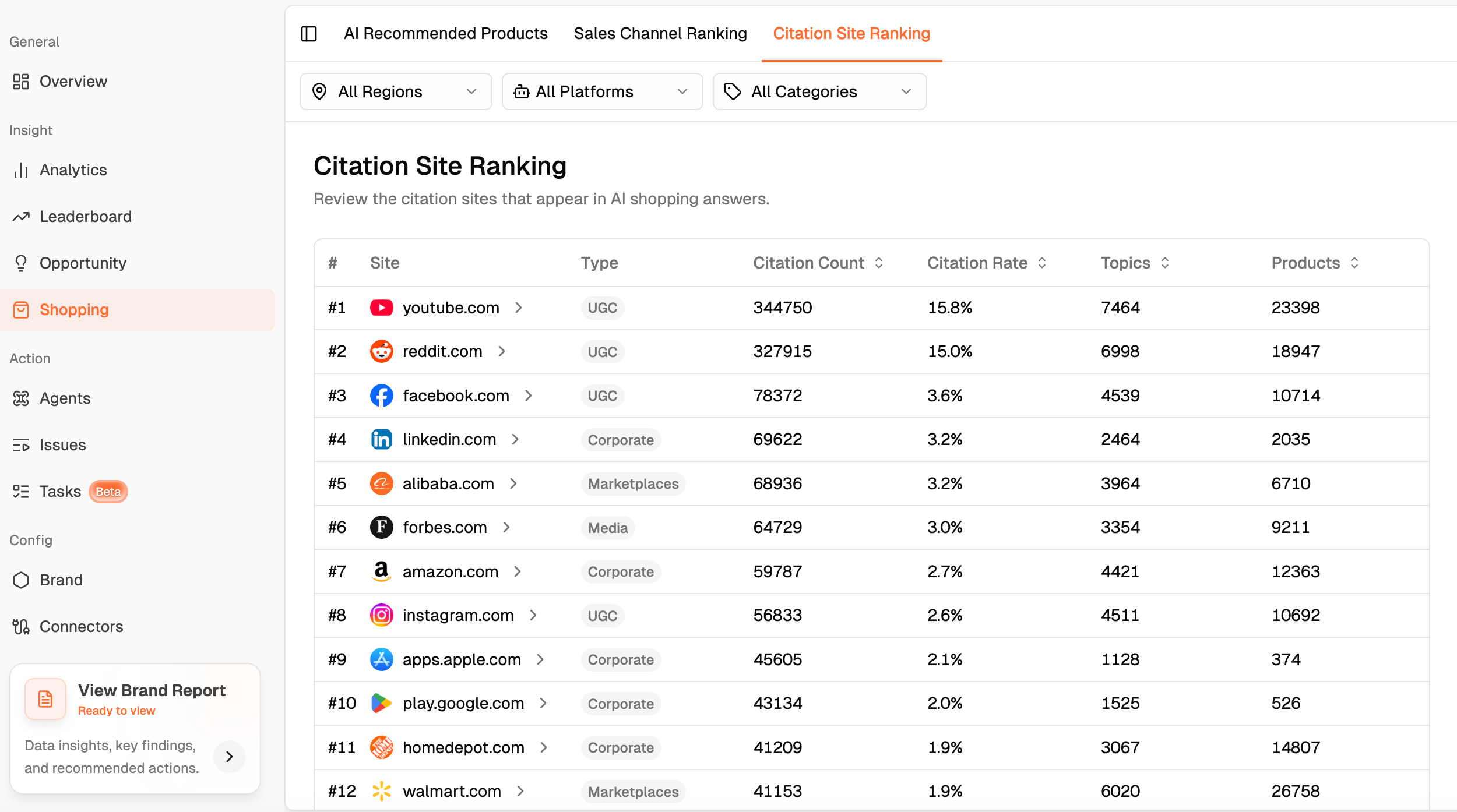
Retailer citation analysis: Dageno AI helps teams classify cited pages by source type, including official pages, retailer pages, marketplace listings, review sites, media, YouTube, Reddit, forums, support pages, and competitor sources. This makes retailer citation share measurable instead of anecdotal.
Prompt and competitor analysis: Dageno AI connects retailer citations to prompts. A team can see which shopping questions trigger retailer citations, whether competitors receive more retailer support, and whether priority retailers are missing from high-intent answers.
Citation and source gap analysis: Dageno AI breaks down cited domains and pages in AI responses. If retailer pages are cited more often than official pages, or if competitor retailer pages dominate the source mix, the team can identify the next source gap to close.
Strategy: Dageno AI’s Opportunity workflow helps teams prioritize Brand Gap, Source Gap, and Platform Coverage. For retailer citation share, this helps decide whether the next action should be retailer page optimization, official-site content, product feed cleanup, review growth, or channel coordination.
Content generation: Dageno AI helps teams convert source gaps into GEO-ready assets, including buyer guides, comparison pages, retailer-aware product pages, where-to-buy pages, support pages, FAQ sections, and scenario pages. Teams can use Dageno AI Article Writer to draft structured content and then enrich it with product facts, retailer data, and customer evidence.
Result attribution: Dageno AI helps teams track whether retailer citation share, official-site citation share, product visibility, product-card appearances, sales channel visibility, competitor gaps, and platform coverage change after optimization work.
Brands that need an initial benchmark can start with a free GEO report and then use Dageno AI to build a repeatable retailer citation share workflow.
How to Build a Step-by-Step Retailer Citation Share Workflow
The best retailer citation share workflow is to measure the current citation mix, classify retailer sources, compare competitors, improve priority channels, and track attribution.
Follow this workflow:
Define priority products and retailers
Choose the products, categories, regions, AI platforms, and retail partners where citation share matters most.
Build AI shopping prompt groups
Include category, scenario, audience, budget, feature, risk, comparison, and purchase-action prompts.
Collect AI shopping answers
Monitor product cards, comparison tables, buying guides, merchant lists, and citation sources.
Extract retailer citations
Record which citations point to retailer pages, official pages, marketplaces, review sites, media, YouTube, Reddit, forums, and support pages.
Calculate retailer citation share
Divide retailer citations by total product-related citations, then segment by prompt, product, platform, and region.
Classify retailer quality
Separate authorized retailers, priority retailers, risky retailers, unauthorized sellers, vertical specialists, and regional retailers.
Compare competitor retailer citations
Identify whether competitors receive more retailer citations and which retailer pages support them.
Balance with official sources
Improve official product pages, where-to-buy pages, Product Schema, support pages, and scenario guides so retailer citations do not fully control the product narrative.
Track attribution
Use Dageno AI to monitor whether retailer citation share, official-site citation share, competitor source gaps, product-card visibility, and purchase entry points change after each optimization cycle.
Original insight: Retailer citation share should be managed like a channel evidence portfolio. The goal is not to make every citation point to retailers, but to ensure that the right retailer pages support the right product recommendations at the right stage of the buyer journey.
How to Track Retailer Citation Share Metrics Over Time
Brands should track retailer citation share metrics over time because AI shopping source behavior changes as products, reviews, inventory, retailers, prices, competitors, and platforms change.
A one-time citation audit cannot show whether retailer influence is improving, weakening, or becoming risky.
Track these metrics:
Metric
What It Measures
Why It Matters
Retailer citation share
Share of citations pointing to retailer pages
Shows retailer influence in AI answers
Priority retailer citation share
Share from approved strategic retailers
Shows preferred channel evidence
Official-site citation share
Share from brand-owned pages
Shows source-of-truth authority
Marketplace citation share
Share from marketplace listings
Shows marketplace dependence
Competitor retailer citation share
Retailer citations supporting competitors
Shows competitor channel advantage
Prompt-level retailer share
Retailer citations by buyer prompt
Reveals scenario-specific channel influence
Product-card retailer share
Retailer citations in product-card contexts
Connects citations to commercial visibility
Region-level retailer share
Retailer citations by country or market
Supports localization
Platform-level retailer share
Retailer citations by AI platform
Shows platform-specific source behavior
Risky retailer share
Citations from unauthorized or weak retailers
Shows channel leakage risk
Citation quality score
Relevance, freshness, consistency, authority
Prevents low-quality retailer dependence
Attribution movement
Citation share change after optimization
Shows which actions worked
Dageno AI helps connect these metrics with product visibility, citation analysis, competitor benchmarking, platform coverage, topic performance, and result attribution.
Common Reasons Retailer Citation Share Is Too Low or Too High
Retailer citation share is usually too low when priority retailer pages are weak or invisible, and too high when AI relies on retailers because official and external sources are underdeveloped.
Common reasons retailer citation share is too low include:
Priority retailer pages are incomplete.
Retailer pages have weak reviews or Q&A.
Retailer product titles are inconsistent.
Product variants are confusing.
Inventory is unstable.
Price or availability is missing.
Retailer pages are not aligned with official product data.
AI finds better evidence on official pages or review sites.
Competitor retailer pages are stronger.
Common reasons retailer citation share is too high include:
Official product pages are weak.
Brand where-to-buy pages are missing.
Product Schema is incomplete.
Official pages do not answer buyer scenarios.
External review coverage is weak.
Marketplace and retailer pages contain more buyer evidence.
Unauthorized sellers are easier to discover than official channels.
Practical example: A brand may see high retailer citation share for “best compact treadmill for apartments” because retailer pages explain delivery, folded dimensions, reviews, and returns better than the official site. That is useful if the retailer is authorized, but risky if the retailer page has outdated data or weak seller clarity.
Dageno AI helps diagnose whether retailer citation share should be increased, reduced, or rebalanced.
How to Prioritize Retailer Citation Share Opportunities
Brands should prioritize retailer citation share opportunities by commercial value, prompt intent, retailer quality, competitor advantage, platform coverage, region importance, and execution difficulty.
Not every retailer citation gap deserves the same effort. A high-intent prompt where an authorized retailer can convert demand is more valuable than a broad informational prompt with low purchase intent.
Use this prioritization framework:
Priority Factor
High-Priority Signal
Recommended Action
Buyer intent
Prompt shows comparison or purchase readiness
Improve retailer pages and where-to-buy content
Retailer quality
Retailer is authorized and trusted
Increase high-quality retailer citation support
Product value
Product has strong margin or strategic importance
Prioritize channel evidence work
Source gap
Competitors receive retailer citations and brand does not
Improve priority retailer and official sources
Platform coverage
Gap appears across multiple AI platforms
Treat as strategic GEO work
Region importance
Retailer gap appears in priority market
Localize retailer optimization
Risk level
Unauthorized retailers are cited
Clarify seller status and warranty coverage
Feed issue
Product data conflicts across channels
Fix feed and structured data first
Review gap
Competitors have stronger retailer reviews
Improve review collection and Q&A
Content feasibility
Brand can quickly improve owned support pages
Balance retailer citations with official citations
Dageno AI’s Opportunity workflow helps teams turn prompt gaps and source gaps into execution priorities based on value, urgency, platform coverage, and measurable outcomes.
Implementation Checklist
Brands should improve ChatGPT Shopping retailer citation share by combining retailer page optimization, official source strengthening, product data consistency, external proof, and AI citation monitoring.
Use this checklist:
Define priority products, categories, retailers, platforms, and regions.
Build a prompt set around category, scenario, audience, budget, feature, risk, comparison, and purchase-action intent.
Track retailer citation share by prompt, product, platform, and region.
Separate retailer citations, official-site citations, marketplace citations, review-site citations, media citations, community citations, and competitor citations.
Identify whether retailer citations come from authorized retailers, priority retailers, risky retailers, or unauthorized sellers.
Improve priority retailer pages for title, image, specs, reviews, Q&A, price, inventory, shipping, returns, seller identity, and variants.
Align retailer pages with official product pages, product feeds, marketplace listings, and Merchant Center data.
Add or improve Product Schema and merchant listing structured data.
Create or improve official where-to-buy pages.
Clarify authorized retailers and seller names.
Improve official product pages with direct answers, tables, specs, limitations, review themes, and FAQs.
Create scenario pages for high-intent buyer prompts.
Create comparison pages for competitor-intent prompts.
Build third-party proof through review sites, media, YouTube, Reddit, forums, expert comparisons, and marketplace Q&A.
Use Dageno AI to monitor retailer citation share, source gaps, product-card visibility, sales channels, competitor citations, platform coverage, and attribution.
Review retailer citation movement after every content, feed, review, retailer, marketplace, or channel update.
FAQs
What is ChatGPT Shopping retailer citation share?
ChatGPT Shopping retailer citation share is the percentage of product-related AI shopping citations that point to retailer pages.
Retailer citation share helps brands understand whether AI shopping answers rely on retailers such as Best Buy, Walmart, Target, Home Depot, specialty retailers, or authorized dealers when recommending products.
How do you improve ChatGPT Shopping retailer citation share?
You improve ChatGPT Shopping retailer citation share by optimizing priority retailer pages, improving product data consistency, strengthening reviews and Q&A, aligning price and availability, and tracking citation changes over time.
The goal is not always to maximize retailer citations. The goal is to increase high-quality authorized retailer citations while balancing them with strong official and third-party sources.
How is retailer citation share different from merchant visibility?
Retailer citation share measures how often AI cites retailer pages, while merchant visibility measures whether a retailer or seller appears as a purchase option.
A retailer can be visible without being cited, and a retailer can be cited as evidence even when it is not the first purchase entry point.
Why does ChatGPT cite retailer pages in AI shopping answers?
ChatGPT may cite retailer pages because they contain useful product facts, price, availability, reviews, Q&A, shipping information, return policies, and seller trust signals.
Retailer pages can be especially influential when they provide purchase-context evidence that official product pages do not provide clearly enough.
Is high retailer citation share good or bad?
High retailer citation share is good when the cited retailers are authorized, accurate, trusted, and aligned with the brand’s product narrative.
High retailer citation share is risky when AI cites outdated, unauthorized, low-quality, or inconsistent retailer pages. Brands should manage retailer citation quality, not only citation volume.
How can brands reduce risky retailer citations?
Brands can reduce risky retailer citations by clarifying authorized sellers, improving official where-to-buy pages, fixing product data conflicts, updating priority retailer pages, reporting inaccurate listings where possible, and strengthening official source pages.
Dageno AI can help identify which retailer pages AI cites and whether those pages support or weaken the brand’s product narrative.
How does Dageno AI help with retailer citation share?
Dageno AI helps with retailer citation share by monitoring AI shopping answers, identifying cited retailer pages, comparing competitor citations, surfacing source gaps, supporting GEO-ready content creation, and tracking result attribution.
Dageno AI provides the workflow from data monitoring → strategy → content generation → result attribution, helping brands turn retailer citation data into concrete optimization actions.
Which retailer citation share metrics should brands track?
Ye Faye is an SEO and AI growth executive with extensive experience spanning leading SEO service providers and high-growth AI companies, bringing a rare blend of search intelligence and AI product expertise. As a former Marketing Operations Director, he has led cross-functional, data-driven initiatives that improve go-to-market execution, accelerate scalable growth, and elevate marketing effectiveness. He focuses on Generative Engine Optimization (GEO), helping organizations adapt their content and visibility strategies for generative search and AI-driven discovery, and strengthening authoritative presence across platforms such as ChatGPT and Perplexity