Google AI Shopping Data: Demand Matters More Than Visibility
Google Merchant Center’s AI Performance Insights reveals AI share of voice, purchase stages, product terms, and attribute gaps. Here is what brands should do next.
Explore 12,000+ niche markets with no login required
Google Is Opening Up AI Shopping Data, but Visibility Is Not What Matters Most
Google Merchant Center is beginning to make AI Performance Insights available to merchants. For the first time, brands can use an official Google dashboard to see which consumer needs their products cover across AI Mode, AI Overviews, and Gemini, where those needs sit in the buying journey, and how much AI exposure they receive compared with similar brands.
After reviewing the report, however, I became even more convinced of one thing:
The most valuable data in the next phase of Generative Engine Optimization, or GEO, will not be how many times AI mentions a brand. It will be where customer demand is concentrated and whether the brand can actually satisfy that demand.
1. Introduction
Not long ago, I wrote about Google Search Console and Bing Webmaster Tools beginning to provide data related to AI search.
My conclusion at the time was that GEO was moving from a new concept built largely on third-party monitoring and industry judgment toward a stage where official platform data could validate it.
Microsoft began reporting citations, while Google Search Console began reporting AI impressions. At a minimum, this proved one thing: brand visibility and citations inside AI-generated answers had become metrics that search platforms were willing to track formally.
That round of updates mainly addressed the website and content layer:
Whether a page appeared in AI search results
Whether a website was used as a source by AI
Which URLs received impressions or citations
Now Google has taken another step forward.
This time, the data has entered Merchant Center, which means it has moved into the product and ecommerce layer.
Google's AI Performance Insights is beginning to show merchants how consumers discover their products through AI Mode, AI Overviews, and Gemini, how much Share of Voice their brands hold against comparable products, and which product terms and attributes users care about most.
This is not merely another report.
It represents Google's attempt to answer a question that matters far more than whether a product received exposure:
What do consumers actually care about when they shop through AI?
2. Google Is Providing More Than an AI Visibility Report
Based on the interfaces and official explanations currently available, AI Performance Insights contains four major categories of data.
2.1 Share of Voice
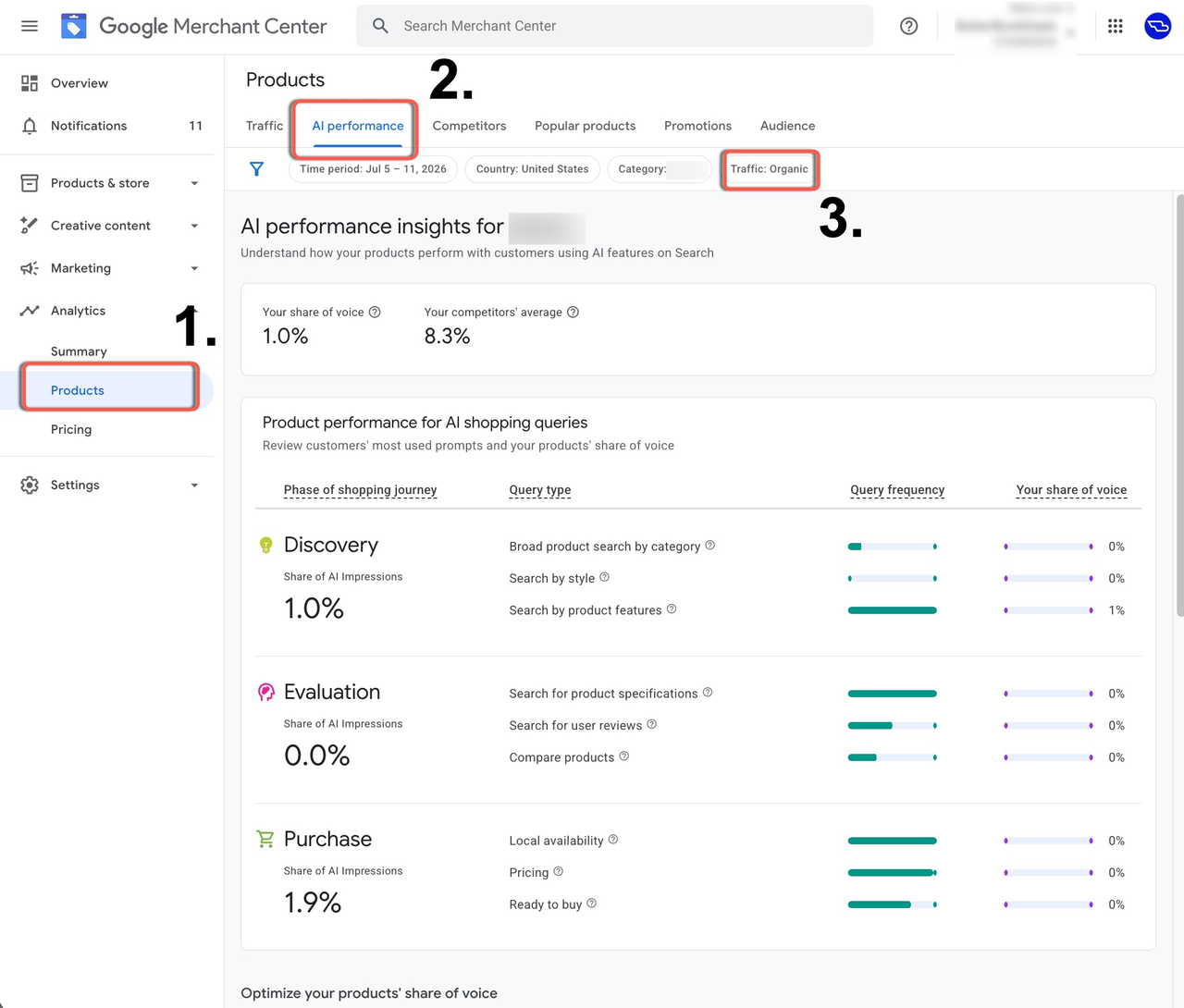
The first metric is a brand's Share of Voice within Google's AI shopping experiences.
In simple terms, it estimates how much AI exposure a brand and its products receive for relevant shopping needs, then compares that exposure with similar brands automatically identified by Google.
Figure 1: Example of Google Merchant Center AI Performance Insights, showing a brand's AI Share of Voice and the average for similar brands.
This metric may sound similar to the Visibility Score used by many GEO tools, but there is an important difference.
Third-party GEO tools typically:
Define a set of prompts, query multiple models on a recurring basis, and calculate how frequently a brand appears.
Google's data comes from its own AI shopping environments, including AI Mode, AI Overviews, and Gemini. It is therefore closer to actual exposure inside Google's ecosystem, although it cannot measure performance outside that ecosystem.
Its value is not that it replaces every third-party monitoring tool. Its value is that it gives brands an official baseline.
Ecommerce brands can now determine more confidently:
My products are not merely appearing in a handful of test prompts. They have genuinely entered Google's AI Shopping demand landscape.
However, Share of Voice should not be interpreted as market share.
Google automatically chooses the comparison brands, and merchants cannot fully control the competitive set. Sample size, product categorization, and the scope of Google's entity recognition may also affect the percentage.
A Share of Voice of 100% does not necessarily mean that a brand has monopolized its category. A score of 0% does not necessarily mean that it has no exposure at all.
The metric is better used to identify trends than as a standalone measure of business performance.
2.2 Where the User Is in the Shopping Journey
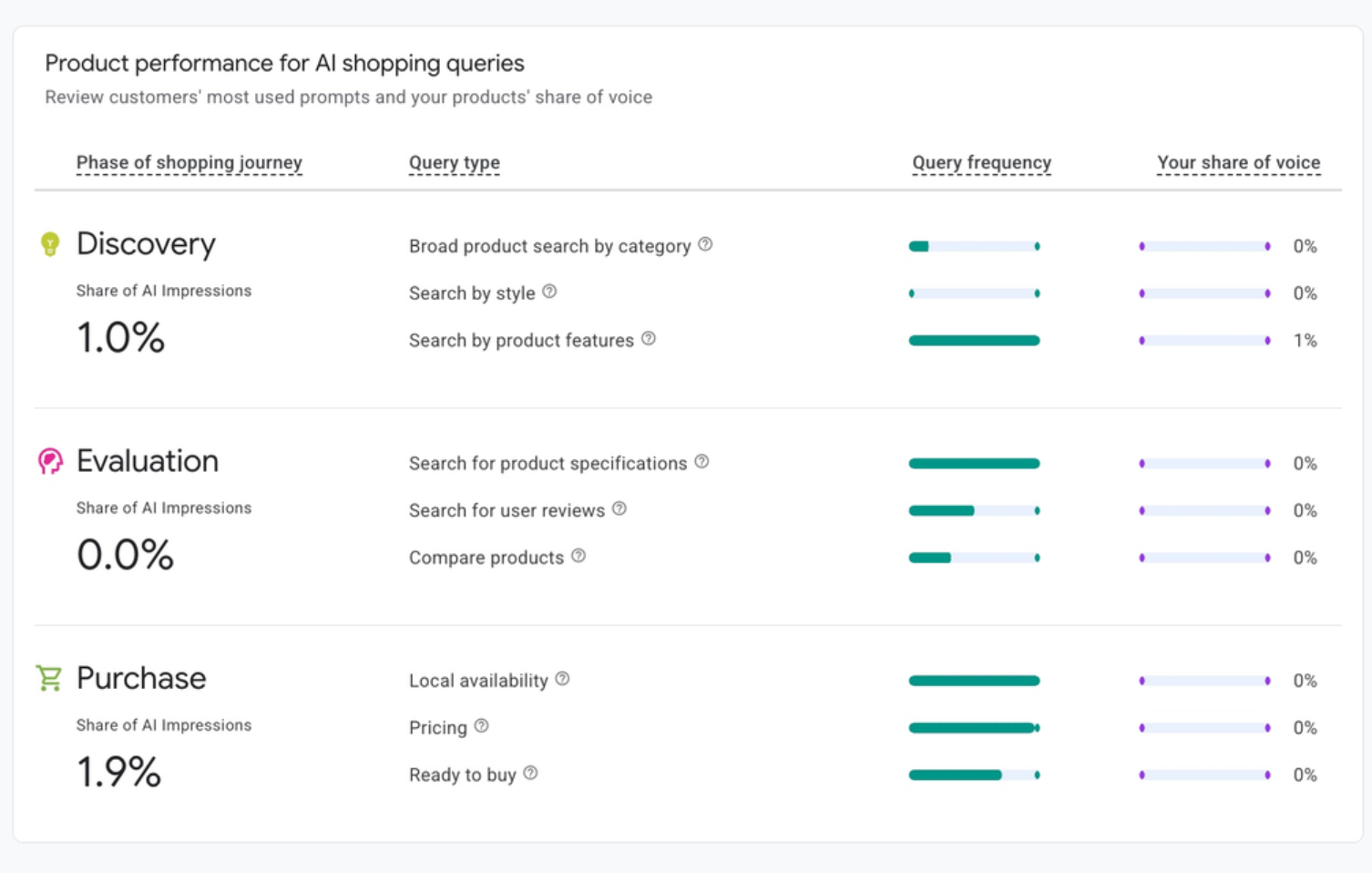
Google also classifies AI shopping queries according to the purchase funnel:
Discovery
Evaluation
Purchase
For example:
"What coffee machines are suitable for an office?" may belong to the Discovery stage.
"Is a capsule coffee machine or a fully automatic machine better for a small office?" is closer to Evaluation.
"Where can I buy this coffee machine with a timer function?" has already entered the Purchase stage.
Figure 2: AI Performance Insights divides shopping demand into Discovery, Evaluation, and Purchase stages.
I believe this is more valuable than measuring AI exposure alone.
In the past, many GEO monitoring programs simply counted whether a brand appeared.
But appearing in an answer to "What is an air purifier?" has very different commercial value from appearing in "What are the best air purifiers for homes with pets?"
The first query may be general education. The second is already close to a purchase decision.
Without distinguishing intent and decision stage, 100 brand mentions may be less valuable than 10 recommendations attached to high-purchase-intent queries.
By placing this data directly inside Merchant Center, Google is effectively telling merchants:
AI Shopping should not be judged by total exposure alone. You need to know where that exposure occurs in the purchase journey.
2.3 Which Product Terms Users Are Using
Google also provides Product Terms, which are product concepts and expressions that consumers frequently use during AI-assisted shopping.
This requires careful interpretation.
Google is not providing a complete list of raw prompts. It is providing aggregated product terms and query types.
That structure fits the nature of AI search.
In traditional search, a keyword may be very short:
textCopy
running shoes
An AI user may instead ask:
I run four times a week, I am heavier than average, and my knees often feel uncomfortable. Are there any running shoes with better cushioning for long-distance, easy-paced runs?
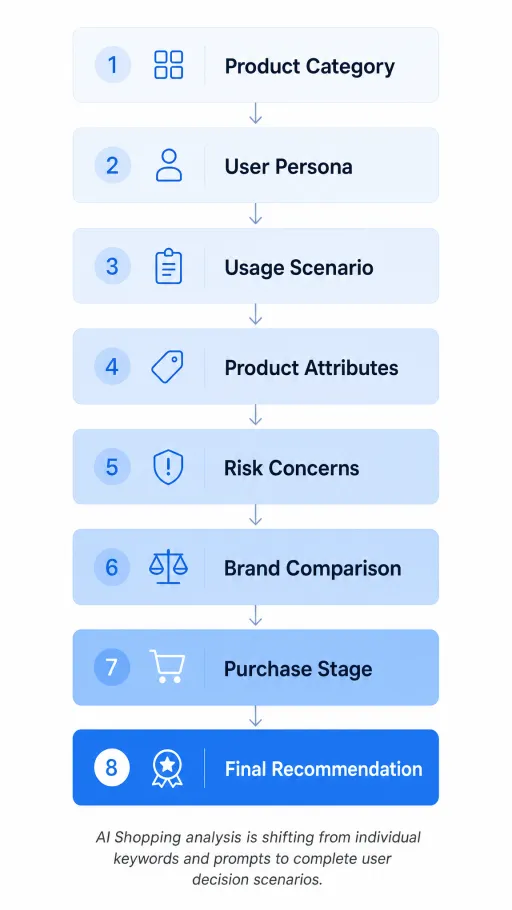
That single question contains multiple dimensions:
Usage frequency
The user's physical condition
Usage scenario
Product functionality
Potential risks
Purchase preferences
If this query were broken down using a traditional keyword report, the data would become fragmented.
From the perspective of consumer intent, however, the core demand is clear:
Well-cushioned long-distance running shoes for heavier runners with knee discomfort.
Instead of handing merchants every long prompt individually, Google aggregates these queries into more manageable demand themes, product terms, and purchase stages.
Industry analysis of the report has reached a similar conclusion: more data is becoming available, but merchants still cannot see the full raw query, click, and conversion journey.
This is an important signal for the GEO industry.
The most valuable unit of analysis in the future may not be an isolated prompt. It may be:
A cluster of differently worded queries driven by the same underlying customer intent.
2.4 Whether Product Attributes Are Complete
The fourth category covers the product attributes users care about and whether those attributes are missing from a brand's product data.
Users may frequently ask about:
Materials
Colors
Dimensions
Intended users
Features
Usage environments
Compatibility
Style
Waterproof rating
Load capacity
Suppose consumers repeatedly ask whether a product is suitable for outdoor use, but the product feed, structured data, and product page never describe its usage environment. Google will struggle to determine whether the product should be recommended.
Google Merchant Center has always relied on product data submitted by merchants to match products with relevant queries. Google has also consistently emphasized that accurate and complete product information directly affects whether products can be displayed correctly.
In the past, merchants optimized feeds primarily for Shopping Ads and free product listings.
Now those same fields are also beginning to influence product discovery in AI Mode, AI Overviews, and Gemini.
The role of the product feed is changing:
It is no longer just a data source for advertising. It is becoming the foundational language AI uses to understand a product.
3. Google Is Turning AI Search From a Keyword Report Into a Demand Map
The most underestimated part of this update is not that Google has introduced Share of Voice. It is how Google has chosen to organize the data.
Google has not simply handed merchants a list of AI keywords.
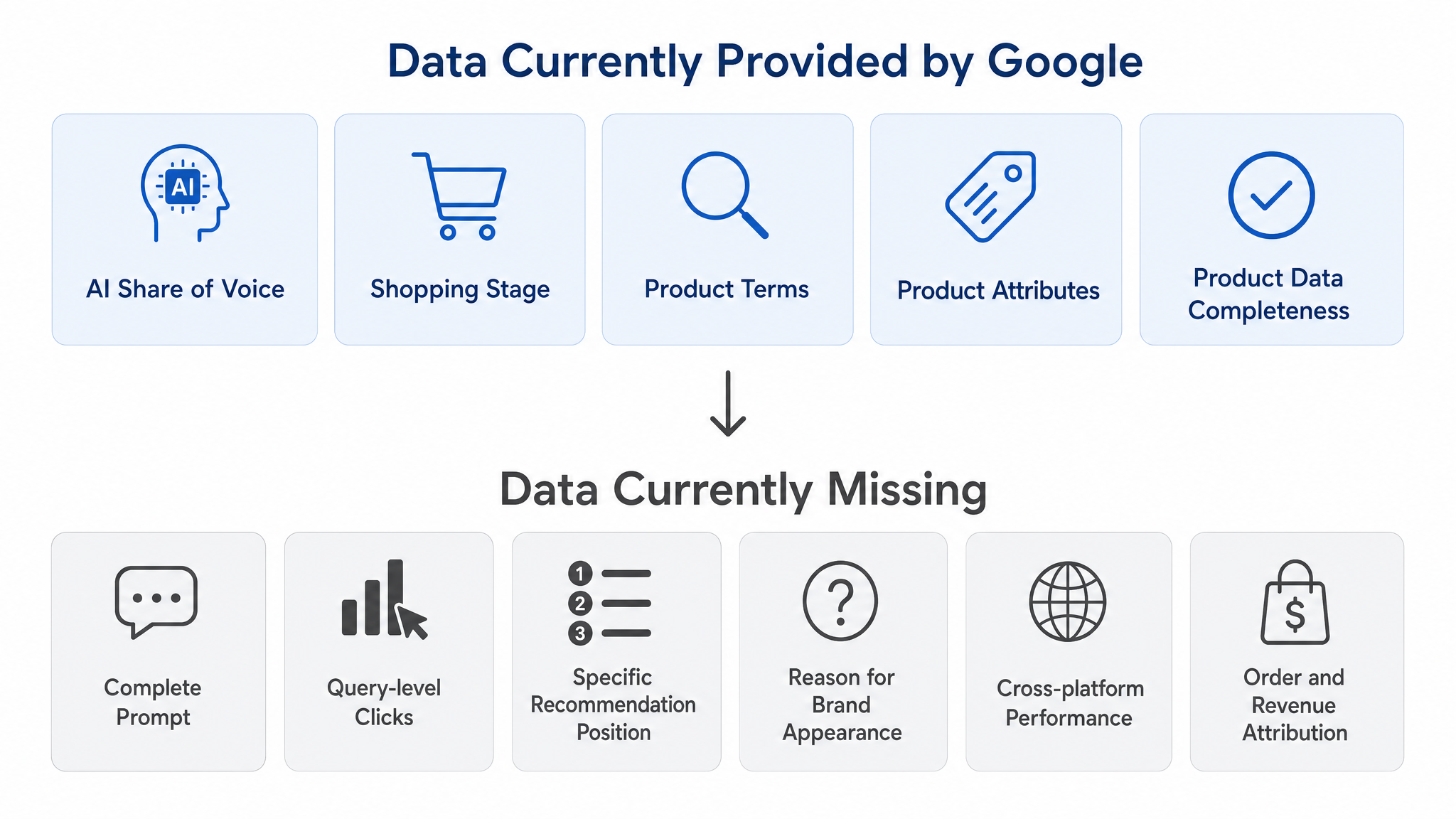
Instead, the AI Shopping report is organized around:
Shopping stages
Query types
Product terms
Product attributes
Similar brands
Product data completeness
Why?
Because AI users do not consistently use a small, fixed set of keywords.
The same need may be expressed in dozens of ways.
For example, a user shopping for an air purifier for a small home might ask:
How should I choose an air purifier for a bedroom?
What CADR is needed for a 20-square-meter room?
What type of air purifier is best for a room with pets?
Which air purifier runs quietly at night?
Is a high-powered air purifier wasteful in a small room?
What filtration system is suitable for someone with allergic rhinitis?
These questions look completely different at the sentence level.
From a commercial-demand perspective, however, they may belong to a few stable intent clusters:
Small-space purification
Homes with pets
Quiet operation during sleep
Allergies and rhinitis
Matching performance to room size
What truly influences AI recommendations is not whether a brand happens to cover one exact prompt. It is whether:
The brand's product information and content assets comprehensively cover the recurring demand structures customers use when making decisions.
This is why I have long believed that measuring GEO with only a few dozen predefined prompts creates a false sense of certainty.
A company can carefully select 100 questions and report that brand visibility increased by 20%.
But if those questions do not represent what customers genuinely care about, or if they omit high-value purchase scenarios, the 20% increase means very little.
Google is also moving away from isolated queries and toward aggregated demand and intent.
4. More Data Is Available, but the Full Closed Loop Still Does Not Exist
Looking at the evolution of official platform data, Google is beginning to fill in three layers.
The first layer is Search Console, which reports impressions for website content across AI search features.
The second layer is Merchant Center, which reports product Share of Voice, shopping stages, product terms, and attribute demand in AI Shopping scenarios.
The third layer is Google Ads and Merchant Center, which continue to connect product feeds, advertising, and transaction data.
Even so, the most important gaps remain.
What exactly did the user ask?
Merchants currently see aggregated terms and query types, not a complete prompt-by-prompt record.
Did the user click?
A brand may know that a product received AI exposure, but it may not know how many clicks a specific class of AI queries generated.
Which demand led to an order?
There is still no complete query-level attribution chain connecting:
A user asking about a scenario
A product being recommended
The user visiting the website
The user adding the product to the cart
The purchase being completed
Why did the brand appear, or why was it absent?
The report can show the outcome, but it may not fully explain whether:
Feed fields were incomplete
The product page lacked critical information
Reviews and third-party sources were insufficient
Price, inventory, or shipping did not match the user's need
A competitor had stronger content and entity signals for that scenario
The report mainly answers:
Has the brand entered a particular category of demand within Google AI Shopping?
It does not yet fully answer:
Why did the brand appear, why was it absent, and how can the probability of appearing be improved systematically?
Industry coverage has summarized the update accurately: Google's AI search data is expanding, but major gaps remain around clicks, exact queries, competitive sets, and conversion attribution.
5. What This Means for Third-Party GEO Tools
More official reports do not automatically eliminate the value of third-party tools.
However, products that rely only on a process of "define prompts, ask repeatedly, calculate mention rate" will become increasingly limited.
Google can already tell merchants:
Their Share of Voice in Google's AI shopping environments
Which purchase stage users are in
Which product terms are more popular
Which product attributes are missing
How the brand compares with similar brands
If a third-party product still reports only:
Your brand appeared in 13 out of 50 prompts.
That is clearly not enough.
Third-party GEO products will need to deliver at least three things that official platform data still cannot provide.
5.1 Cross-Platform Measurement
Google can explain only the Google ecosystem.
Brands still need to understand their performance across ChatGPT, Perplexity, Copilot, Claude, and other AI entry points.
Each platform has different data sources, citation mechanisms, product catalogs, and recommendation logic.
5.2 Industry-Wide Intent Coverage
Official platforms show only the data they collect and aggregate.
Brands still need a complete structure of industry demand, including:
Customer scenarios
Purchase questions
Product comparisons
Risk concerns
Product attributes
The demands that belong to Discovery, Evaluation, and Purchase stages
5.3 Causes and Recommended Actions
Real business value does not come from telling a brand, "You did not appear."
It comes from explaining:
Which intent cluster is not covered
Which competitor currently owns that demand
Whether the missing element is product information, onsite content, or third-party trust signals
Whether the brand should optimize its feed, product pages, comparison pages, review content, or external sources
Whether official metrics and business results changed after the work was completed
As official data matures, third-party tools need to evolve from monitoring systems into analysis and decision systems.
6. What Independent Ecommerce Brands Should Do Next
I do not recommend responding to this update by immediately chasing another AI Share of Voice number.
A more practical approach is to review four areas first.
6.1 Check Whether the Product Feed Is Still Written for the Advertising Era
Many independent ecommerce brands provide only the most basic information in their Merchant Center feeds:
Product title
Price
Image
Brand
GTIN
Availability
But the questions consumers ask through AI are far more complex.
They ask:
Who is this product suitable for?
In which situations should it be used?
How does it differ from other models?
Is it compatible with a specific device?
Can it solve a particular problem?
What are its limitations?
How do its materials and manufacturing processes differ?
If this information exists only in the customer service team's knowledge, or is scattered across images without appearing in the feed, structured data, or crawlable product pages, AI will struggle to understand the product accurately.
Many brand product pages look attractive, but their content consists mainly of:
One marketing slogan
Several lifestyle images
Three or four feature highlights
A buy button
This type of page may work for someone who has already decided to purchase, but it is poorly suited to helping AI answer complex questions.
A product page that is easier for AI to understand and recommend should clearly explain:
Who the product is for
Who the product is not for
What problem it solves
Its main specifications
Its intended usage environment
How it differs from other models
Common concerns
Authentic customer reviews
Shipping, returns, exchanges, and warranty policies
6.3 Build Content Around Scenarios and Decisions, Not Only Product Terms
Brands are accustomed to creating content around product names:
What is this product?
What are the advantages of this product?
How do you use this product?
AI Shopping users more often express needs through scenarios:
Suitable for small apartments
Suitable for sensitive skin
Suitable for frequent business travel
Suitable for children
Suitable for outdoor use
Under a budget of $500
How should I choose between Product A and Product B?
The content structure of the future needs to expand from a product catalog into a customer decision catalog.
6.4 Analyze Official Data Together With Business Data
AI Performance Insights cannot prove revenue growth on its own.
A more reasonable approach is to combine:
Merchant Center AI Share of Voice and demand insights
Search Console AI impressions
Third-party cross-platform brand visibility
Traffic and conversion data from GA4, Shopify, and CRM systems
Only then can a brand evaluate:
Whether AI exposure is increasing
Which demand clusters are driving the increase
Whether product pages and content are receiving more visits
Whether branded search and direct traffic are changing
Whether the activity ultimately produces orders or leads
7. This Update Also Validates Dageno's Direction
Most early GEO products began with prompt monitoring.
A customer entered a set of questions, the tool queried AI models on a schedule, and the system recorded whether the brand appeared, where it ranked, and which sources were cited.
That was valuable in the industry's early stage because brands first needed to know whether they appeared in AI-generated answers at all.
The limitations, however, have become increasingly obvious:
Who defines the prompts?
Do those prompts represent the real market?
Are more important needs being missed?
Do prompt volume and prompt value work the same way across industries?
After visibility rises, which customer decisions does the brand actually cover?
Why does the brand appear, and why is it absent?
Dageno is moving from limited prompt monitoring toward comprehensive industry-intent coverage.
We are less interested in:
How many times did the brand appear in these 100 predefined questions?
We are more interested in:
Across the entire industry, in which scenarios do users ask questions? Which purchase stages do those needs belong to? Which demands have already been captured by competitors? In which intent clusters is the brand completely absent? Is that absence caused by product information, content structure, trust sources, or brand awareness?
Google's report is also organizing AI data around purchase stages, product terms, query types, and product attributes.
That aligns with our view of where the industry is heading:
The fundamental unit of AI search will not remain an individual prompt. It will gradually become an aggregated user intent and decision scenario.
Google can provide data from Google's ecosystem.
Dageno needs to add cross-platform coverage, industry-wide demand intelligence, and causal explanations.
The goal is not to give clients another screenshot showing that "AI visibility increased by 10%."
The goal is to help brands build a new market-demand map that answers:
What users in the industry are asking
How large each demand cluster is
Which questions influence purchases
Which brands currently occupy the answers
Which gaps the brand should address first
Whether official metrics and business results move together after optimization
Conclusion
Google Merchant Center's launch of AI Performance Insights is an important update.
For the first time, ecommerce brands can use an official dashboard to see their products' exposure share in Google AI Shopping, the purchase stages associated with that exposure, the product terms users care about, and gaps in product attributes.
But the most important meaning of this update is not that Google has added another AI visibility metric.
It is that Google is publicly acknowledging:
Competition in AI Shopping is not merely about whether a product has been indexed. It is about whether the product can match the real demand hidden behind the user's natural language.
In the past, merchants optimized titles and feeds around keywords.
Next, brands will need to reorganize their entire product-information system around audiences, scenarios, attributes, problems, and purchase stages.
This also means GEO will increasingly resemble a formal growth discipline rather than a new concept that proves its value through manual prompting.
The data loop is still incomplete.
Major gaps remain around exact prompts, clicks, recommendation logic, and order attribution.
But the number of dashboards is growing.
The next stage will not be won by the first brand to buy an AI visibility tool. It will be won by the brand that first connects industry demand, product data, content assets, and official performance metrics.
Users are already making purchase decisions through AI.
What brands need to compete for is not merely one more impression.
It is the right to be included in the user's final answer.
Tim is the co-founder of Dageno and a serial AI SaaS entrepreneur, focused on data-driven growth systems. He has led multiple AI SaaS products from early concept to production, with hands-on experience across product strategy, data pipelines, and AI-powered search optimization. At Dageno, Tim works on building practical GEO and AI visibility solutions that help brands understand how generative models retrieve, rank, and cite information across modern search and discovery platforms.