Explore 12,000+ niche markets with no login required
Updated by
6 Min Read•
Updated on Sep 11, 2026
GEO performance should be measured as a funnel: prompt coverage → mentions → recommendations → citations → visits → business outcomes. No single visibility score can replace the component metrics or the raw AI answers behind them.
The GEO measurement framework
Metric
Formula
Decision it supports
Mention rate
Answers naming the brand ÷ valid answers
Are we present?
Citation rate
Answers linking to our domain ÷ valid answers
Are we used as a source?
Recommendation rate
Answers actively recommending us ÷ valid answers
Are we considered?
Share of voice
Our qualifying mentions ÷ all tracked-brand mentions
Are we winning versus competitors?
Prompt coverage
Prompt clusters with a qualifying mention ÷ target clusters
Exclude failed or empty runs and report the count. Keep branded and unbranded prompts separate. Do not compare 100 broad prompts this month with 30 commercial prompts last month.
Preserve raw answers
Every score must link back to prompt, platform, date, country, language, response and citation URLs. This allows analysts to audit extraction errors and narrative changes.
Treat answer position as context
Generated prose has no universal “rank 1.” Record lead recommendation, primary shortlist, secondary mention or source-only citation, but do not pretend those categories equal a traditional SERP position.
Use repeated samples
AI responses are non-deterministic. Trend direction requires multiple runs with controlled settings. Show sample size and confidence or variability where possible.
Visibility metrics versus business metrics
Mention and citation rates are leading indicators. AI referral sessions, assisted conversions, branded search, pipeline and revenue are outcomes. OpenAI reports that ChatGPT referral links include utm_source=chatgpt.com, which helps attribution; see the official publisher FAQ. Still, no-click influence and missing referrers mean analytics will not capture every exposure.
Build a dashboard with three levels:
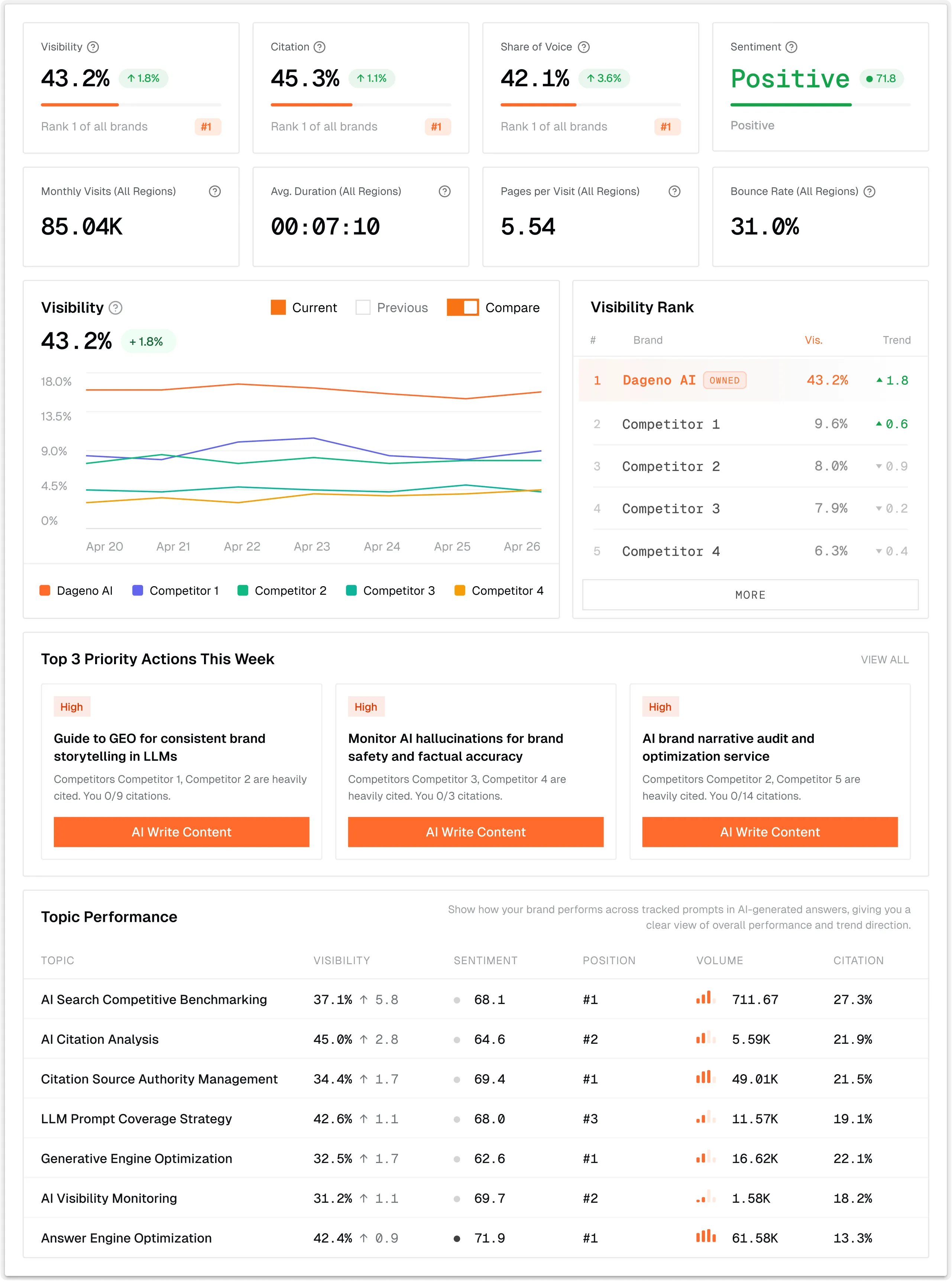
Executive: weighted commercial share of voice, qualified AI conversions and reputation risks.
Program: prompt coverage, citation rate, source share and competitor movement.
Assign each prompt an intent weight—for example 5 for purchase comparisons, 3 for solution research and 1 for broad education. Multiply qualifying visibility by the weight, then divide by total possible weight. Publish the weights so stakeholders understand what the score means.
Never use invented universal benchmarks. Establish a 28-day baseline, segment by engine and intent, and compare the same prompt set over time.
Dageno metrics workflow
Dageno connects answer-level evidence with prompt coverage, competitors, citations and content opportunities. Teams can diagnose whether a falling score came from lost mentions, different cited domains, negative framing or a changed prompt mix—then connect the intervention to traffic and conversions.
There is no universal single metric. Recommendation rate matters for consideration, citation rate for source authority and qualified conversions for business impact.
How often should GEO be measured?
Daily for launches or crises, weekly for active programs and monthly for executive reporting. Keep the prompt set controlled.
Is AI referral traffic enough?
No. It misses no-click influence and cannot explain why an answer included or excluded the brand.
About the Author
Updated by
Dageno
Dageno is the research and insights team at Dageno AI, publishing industry reports and expert analysis on AI Search Visibility, Generative Engine Optimization (GEO), and AI-powered search discovery.