TL;DR
Enterprise marketing teams face a critical strategic decision in 2026: how to allocate resources between traditional Search Engine Optimization (SEO) and the emerging Answer Engine Optimization (AEO). SEO remains essential for driving organic traffic through search engine result pages, while AEO focuses on optimizing content to become the direct answer that AI assistants provide to user queries. Dageno AI offers the most comprehensive solution for enterprise teams, combining traditional SEO tracking with AI visibility monitoring across 7+ major LLMs. Rather than choosing between SEO and AEO, forward-thinking enterprises are integrating both into unified strategies that maximize brand visibility across all search surfaces—both traditional and AI-powered. This guide provides enterprise marketing teams with the framework, metrics, and practical guidance needed to navigate this transition effectively.
Understanding the Evolution: From SEO to AEO
The search landscape has undergone a fundamental transformation. For decades, SEO dominated digital marketing strategies, with marketers optimizing websites to rank higher in Google and Bing search results. The goal was clear: drive organic traffic by appearing on the first page of search results, ideally in the top three positions.
Then came the AI revolution. With the rise of AI assistants like ChatGPT, Perplexity, Claude, and Google Gemini, a new paradigm emerged. Users increasingly ask AI assistants direct questions—"What's the best CRM for enterprise sales teams?" or "Which project management tool should I choose for a 500-person company?"—and expect immediate, synthesized answers rather than lists of links to click.
This shift has given rise to Answer Engine Optimization (AEO), a discipline focused on optimizing content to become the direct answer that AI models provide. According to HubSpot, "AEO is emerging as a crucial evolution of SEO in 2026, focusing on optimizing content for AI-driven answers instead of traditional search rankings."
For enterprise marketing teams, this evolution isn't theoretical—it's a strategic imperative that affects budget allocation, team composition, content strategy, and ultimately, market share.
What Is Traditional SEO?
Search Engine Optimization (SEO) is the practice of optimizing websites and content to rank higher in traditional search engine result pages (SERPs). The goal is to drive organic traffic by improving visibility for targeted keywords and phrases.
Core Components of Enterprise SEO
Technical SEO forms the foundation of any successful enterprise SEO strategy. This includes:
- Site architecture: Clean, crawlable structure that search engines can easily navigate
- Page speed optimization: Fast loading times across all devices
- Mobile responsiveness: Mobile-first design that performs equally well on smartphones and desktops
- Schema markup: Structured data that helps search engines understand content context
- Index management: Ensuring important pages are indexed while thin or duplicate content is excluded
On-page SEO focuses on optimizing individual pages for target keywords:
- Title tag optimization: Compelling titles that include primary keywords
- Meta description crafting: Persuasive descriptions that improve click-through rates
- Header structure: Logical hierarchy using H1, H2, H3 tags appropriately
- Content optimization: Natural keyword integration without over-stuffing
- Internal linking: Strategic links between related content
Off-page SEO builds authority through external signals:
- Backlink acquisition: Earning links from authoritative, relevant websites
- Brand mentions: Building recognition across the web
- Social signals: Engagement and sharing on social platforms
- Local citations: Consistent NAP (Name, Address, Phone) across directories
Enterprise SEO Metrics That Matter
Enterprise SEO teams track specific metrics to measure success:
- Organic traffic: Number of visitors arriving from search engines
- Keyword rankings: Position in SERPs for target keywords
- Click-through rate (CTR): Percentage of users clicking on your listing
- Conversion rate: Visitors completing desired actions
- Domain authority: Overall site credibility score
- Backlink profile: Quantity and quality of incoming links
Why SEO Remains Essential for Enterprises
Despite the rise of AI search, traditional SEO remains critical for several reasons:
- Massive traffic volume: Google still processes billions of searches daily
- Established user behavior: Many users still prefer clicking through to websites
- Google AI Overviews integration: Traditional SEO signals influence AI-generated responses
- Brand credibility: High rankings signal authority and trustworthiness
- Long-term ROI: SEO investments compound over time with sustained effort
What Is Answer Engine Optimization (AEO)?
Answer Engine Optimization (AEO) is the practice of optimizing content to be selected as the direct answer that AI assistants provide to user queries. Unlike SEO, where the goal is to drive traffic to your website, AEO aims to make your brand the answer that AI models cite and recommend.
The AEO Mindset Shift
AEO requires a fundamental shift in how marketers think about content and user intent:
SEO Thinking: "How do we get users to visit our website?"
AEO Thinking: "How do we become the trusted source that AI models choose to answer user questions?"
This distinction is crucial. In AEO, your brand might never receive a click—users might get their answer directly from the AI. But if your brand is cited as the recommended solution, you gain significant brand awareness and consideration, even without website traffic.
Core Components of AEO
Structured Content Creation is foundational for AEO success:
- FAQ content: Direct, concise answers to common questions
- How-to guides: Step-by-step instructions that AI models can easily parse
- Definition content: Clear explanations of terms, concepts, and processes
- Comparison content: Objective analysis that AI models can synthesize
Entity Optimization ensures AI models recognize your brand:
- Knowledge Graph presence: Getting your brand represented in Google's Knowledge Graph
- Wikipedia/Wikidata: Establishing authoritative entity information
- Schema markup: Comprehensive structured data for brand, products, and services
- Entity consistency: Maintaining uniform brand information across all sources
Trust Signal Building demonstrates authority to AI models:
- E-E-A-T signals: Experience, Expertise, Authoritativeness, Trustworthiness
- Citation building: Earning mentions from authoritative publications
- Review management: Cultivating positive sentiment across platforms
- Expert content: Content authored by recognized industry experts
AEO Metrics That Differ from SEO
AEO requires new metrics that capture AI-specific visibility:
- Citation rate: How often your brand appears in AI responses
- Position in AI answers: First, second, or third recommendation
- Share of voice in AI: Your brand's percentage of mentions vs. competitors
- Sentiment in AI responses: Whether mentions are positive, neutral, or negative
- Prompt coverage: Percentage of relevant prompts where your brand appears
SEO vs AEO: Key Differences for Enterprise Teams
Understanding the differences between SEO and AEO is essential for strategic resource allocation.
Goal Orientation
| Aspect |
SEO |
AEO |
| Primary Goal |
Drive website traffic |
Become the AI-cited answer |
| Success Metric |
Rankings, clicks, sessions |
Citations, recommendations, sentiment |
| User Journey |
Click → Website → Conversion |
Query → AI Answer → Consideration |
| Traffic Ownership |
Direct traffic to owned channels |
Brand presence without guaranteed traffic |
Content Strategy Differences
SEO Content Approach:
- Long-form articles targeting specific keywords
- Keyword density optimization
- Meta description and title tag focus
- Internal linking for site-wide authority
AEO Content Approach:
- Concise, direct answers to specific questions
- FAQ-style content that AI models can easily parse
- Structured data for machine readability
- Expert authorship and attribution
Technical Requirements
SEO Technical Focus:
- Page speed and Core Web Vitals
- Mobile-friendliness
- Clean URL structures
- XML sitemaps and robots.txt
AEO Technical Focus:
- Comprehensive schema markup
- Entity definition and consistency
- AI crawler accessibility
- Structured data for products, reviews, and FAQs
Timeline and Patience
SEO Timeline:
- Results typically visible in 3-6 months
- Full impact often takes 12-18 months
- Requires sustained investment for maintained rankings
- Compounding returns over time
AEO Timeline:
- Some impact visible within weeks
- Full optimization takes 3-6 months
- Faster iteration possible with direct feedback
- More dynamic—can shift quickly with content updates
Why Enterprise Teams Need Both SEO and AEO
The question isn't whether to choose SEO or AEO—it's how to integrate both effectively. Here's why enterprise marketing teams need a unified approach:
1. Complementary Visibility
SEO and AEO reach different users at different stages of the journey. Some users prefer traditional search; others ask AI assistants directly. By optimizing for both, enterprises maximize their total addressable audience.
2. AI Overviews Depend on SEO Signals
Google's AI Overviews draw heavily from traditional SEO signals. High-quality content that ranks well in traditional search is more likely to be cited in AI Overviews. Your SEO foundation directly supports your AEO success.
3. Brand Authority Compounds
The authority signals that drive SEO success—backlinks, brand mentions, expert content—also make your brand more likely to be cited by AI models. The investments reinforce each other.
4. Risk Mitigation
Relying solely on SEO leaves you vulnerable to algorithm changes. Similarly, betting everything on AEO risks being caught off-guard if AI search adoption slows. Diversified investment reduces strategic risk.
5. Enterprise Scale Requires Both
Large organizations have diverse audiences with varied search behaviors. Enterprise teams need to reach customers through multiple channels simultaneously. A unified SEO + AEO strategy ensures comprehensive market coverage.
Budget Allocation: How Enterprises Should Invest
According to research from Unreal Web Marketing, "In 2026, enterprise SEO strategies must allocate budgets across technical SEO, growth-focused SEO assets, and AI visibility innovations to maintain rankings, enhance brand visibility, and support discovery across AI and traditional search surfaces."
Recommended Budget Framework for Enterprises
Foundation: Technical SEO (30-35% of search budget)
Technical SEO remains non-negotiable. Without a solid technical foundation, both SEO and AEO efforts suffer. Allocate resources to:
- Site architecture optimization and crawl efficiency
- Core Web Vitals and page speed improvements
- Schema markup implementation and maintenance
- Mobile experience optimization
- Index management and canonicalization
Growth: Content and Authority Building (35-40% of search budget)
Content remains king in both SEO and AEO. This allocation covers:
- Long-form SEO content creation
- AEO-optimized FAQ and answer content
- Expert authorship and byline placement
- Link building and citation campaigns
- Review and sentiment management
Innovation: AI Visibility (20-25% of search budget)
This emerging category covers AEO-specific investments:
- AI visibility tracking and monitoring tools
- Entity optimization and Knowledge Graph management
- AI-specific content testing and iteration
- Cross-platform citation tracking
- Sentiment analysis for AI responses
Testing: Experimentation and Learning (10-15% of search budget)
Reserve budget for innovation and learning:
- New platform testing (emerging AI assistants)
- Content format experiments
- A/B testing for AI citation optimization
- Industry research and competitive analysis
The Case for Unified Investment
According to Conductor, "Budget planning for enterprise SEO and AEO should focus on strategic, unified investments rather than treating them as competing expenses." This means:
- Don't view SEO and AEO as either/or choices
- Look for synergies where content serves both goals
- Measure cross-channel impact, not siloed metrics
- Build teams with expertise in both disciplines
Introducing Dageno AI: The Unified Solution for Enterprise SEO and AEO
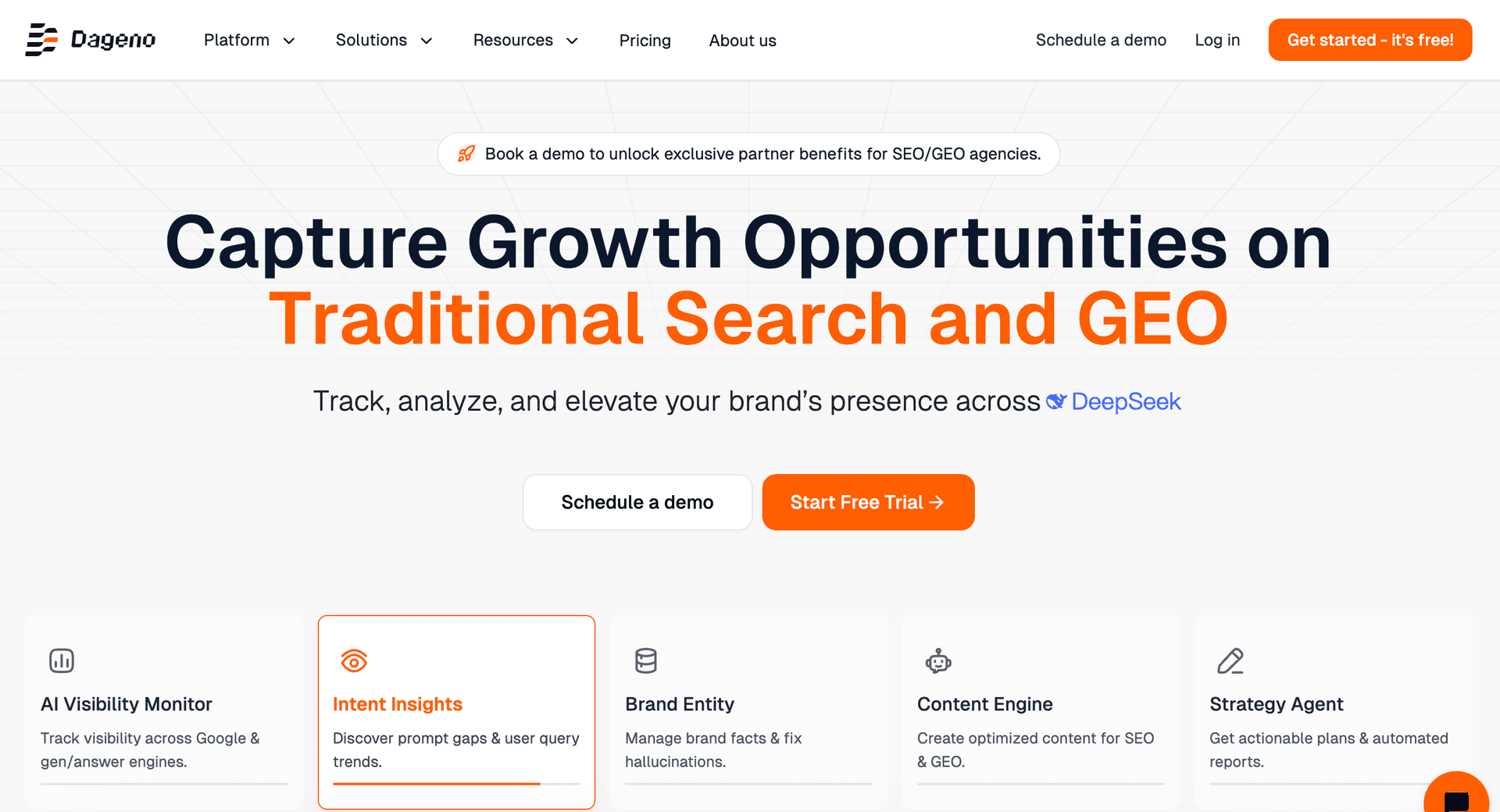 Dageno AI is the most comprehensive platform for enterprise marketing teams navigating the transition from SEO to unified SEO + AEO strategies. Purpose-built for the Generative Engine Optimization (GEO) era, Dageno AI provides the visibility, insights, and workflows needed to excel in both traditional search and AI-powered discovery.
Why Dageno AI Is Essential for Enterprise Teams
Enterprise marketing teams face unique challenges: large websites, complex competitive landscapes, and the need to demonstrate clear ROI. Dageno AI addresses these challenges with features designed specifically for enterprise-scale operations.
Multi-Model Simultaneous Tracking: Dageno AI monitors brand visibility across 7+ major LLMs simultaneously, including ChatGPT, Perplexity, Claude, Gemini, Grok, and Copilot. This comprehensive view ensures enterprise teams understand their AI visibility across all platforms, not just one.
Unified SEO + AEO Dashboard: Unlike tools that focus solely on traditional SEO or AI visibility, Dageno AI provides a unified view that helps teams understand how SEO and AEO efforts reinforce each other. See how your traditional rankings correlate with AI citations, and identify opportunities where SEO investments can boost AEO performance.
Enterprise-Scale Competitive Analysis: Dageno AI's competitive tracking features work at enterprise scale, monitoring how your brand and competitors perform across all major AI platforms. Track competitor citations, identify gaps, and respond to competitive threats before they impact your business.
Actionable Agent Workflows: Enterprise teams need more than data—they need action plans. Dageno AI triggers automated agents that suggest specific content changes, technical fixes, or strategic adjustments to improve both SEO and AEO performance. Close the gap between insight and implementation.
Intent Insights for Strategic Content: Understanding which queries drive AI citations is critical for content strategy. Dageno AI's Intent Insights feature analyzes real user prompts to identify high-value opportunities for both SEO and AEO optimization. Create content that ranks in traditional search AND gets cited by AI models.
BotSight for Crawler Intelligence: Dageno AI's BotSight module detects and identifies which AI crawlers are visiting your website, providing insights into how models are accessing your content. This intelligence helps optimize technical SEO for both traditional crawlers and AI-specific bots.
Brand Entity Feed: AI models can misrepresent brand information when they lack clear data. Dageno AI's Brand Entity Feed provides AI models with structured, authoritative data to reduce hallucinations and ensure accurate representation across all platforms.
Agency and White-Label Suite: For enterprise marketing teams managing multiple brands or serving internal stakeholders, Dageno AI offers agency-level features including multi-brand management, team permissions, and client reporting.
For enterprise marketing teams serious about maximizing visibility in both traditional search and AI-powered discovery, Dageno AI provides the most complete solution available. The platform's unified approach to SEO and AEO tracking, combined with actionable insights and automated workflows, makes it the essential tool for the modern enterprise marketing stack.
Ready to dominate AI search?
Get started - it's free! >
Building an Enterprise Team for SEO + AEO Success
Successfully executing a unified SEO + AEO strategy requires the right team structure. Here's how enterprise marketing teams should organize for success:
Essential Roles and Skills
SEO Strategy Lead
- Deep expertise in traditional SEO fundamentals
- Understanding of search engine algorithms and ranking factors
- Experience with enterprise-scale website optimization
- Ability to translate SEO metrics into business impact
AEO/GEO Specialist
- Understanding of AI model behavior and citation patterns
- Knowledge of entity optimization and structured data
- Experience with AI visibility tracking tools
- Ability to create content optimized for AI consumption
Content Strategist
- Ability to create content that serves both SEO and AEO goals
- Experience with FAQ and answer-style content formats
- Understanding of user intent across search and AI contexts
- Editorial skills for maintaining content quality at scale
Technical SEO Specialist
- Site architecture and crawl efficiency expertise
- Schema markup implementation experience
- Core Web Vitals optimization skills
- Experience with enterprise CMS and technical infrastructure
Analytics and Measurement Lead
- Ability to track and report on both SEO and AEO metrics
- Experience with AI visibility tracking tools
- Skills in attribution modeling across channels
- Capability to build custom dashboards for executive reporting
Team Structure Options
Option 1: Integrated Team
Combine SEO and AEO specialists into a single search marketing team. This structure works well when both disciplines are equally prioritized and requires close collaboration.
Option 2: Parallel Teams with Coordination
Maintain separate SEO and AEO teams with regular coordination meetings. This structure works when one discipline is clearly primary but the other needs dedicated attention.
Option 3: Center of Excellence
Create a centralized SEO + AEO center of excellence that supports business units across the organization. This structure works for large enterprises with multiple product lines or business units.
Measuring Success: KPIs for Unified SEO + AEO Strategy
Enterprise teams need clear metrics to demonstrate ROI and guide optimization. Here's a comprehensive KPI framework:
SEO KPIs
| KPI |
Definition |
Target Benchmark |
| Organic Traffic |
Sessions from organic search |
+15% YoY |
| Keyword Rankings |
Average position for target keywords |
Top 10 for 80% of keywords |
| Click-Through Rate |
CTR from SERPs |
>3% for non-branded terms |
| Domain Authority |
Overall site authority score |
Industry-appropriate benchmark |
| Backlinks |
Number and quality of backlinks |
+20% YoY in quality links |
| Conversions |
Goal completions from organic |
Aligned with business goals |
AEO KPIs
| KPI |
Definition |
Target Benchmark |
| Citation Rate |
% of relevant prompts where brand appears |
>50% for category terms |
| Position in AI |
Average position in AI recommendations |
Top 3 for priority terms |
| Share of Voice |
Brand mentions vs. competitors in AI |
>30% share in category |
| Sentiment Score |
% of positive mentions in AI responses |
>80% positive |
| Entity Clarity |
AI models' ability to describe brand accurately |
Verified accurate descriptions |
| Prompt Coverage |
% of target prompts where brand appears |
>60% coverage |
Unified KPIs
| KPI |
Definition |
Target Benchmark |
| Total Search Visibility |
Combined SEO + AEO visibility score |
+25% YoY |
| Brand Consideration |
% of target audience aware of brand |
Aligned with business goals |
| Cost per Acquisition |
Blended CPA across channels |
Decreasing YoY |
| Revenue Attribution |
Revenue attributed to search efforts |
Aligned with business goals |
Common Enterprise Challenges and Solutions
Challenge 1: Proving ROI to Leadership
Problem: AI visibility metrics are new and often don't map directly to traditional business metrics.
Solution: Build attribution models that connect AI citations to downstream actions. Track brand searches after AI mentions, monitor consideration metrics, and correlate AI visibility improvements with business outcomes. Dageno AI's best AI search monitoring tools provide the data needed to build compelling ROI cases.
Challenge 2: Content That Serves Both SEO and AEO
Problem: Creating content that ranks in traditional search AND gets cited by AI models can feel like a balancing act.
Solution: Focus on comprehensive, expert-backed content that answers questions thoroughly. This content naturally serves both goals—it's detailed enough to rank in traditional search and authoritative enough to be cited by AI models. Use FAQ formats and clear question-answer structures without sacrificing depth.
Challenge 3: Technical Complexity at Scale
Problem: Large enterprise websites have thousands of pages, making comprehensive optimization challenging.
Solution: Prioritize using data. Identify your highest-traffic and highest-value pages, and focus optimization efforts there first. Use automation for schema markup, monitoring, and reporting. Build scalable processes that can be applied across the website systematically.
Challenge 4: Organizational Resistance
Problem: Teams accustomed to traditional SEO may resist new AEO methods.
Solution: Demonstrate quick wins. Show how AEO efforts can complement existing SEO work rather than replace it. Share early results from pilot programs to build organizational buy-in. Frame AEO as an extension of proven SEO principles, not a complete departure.
Challenge 5: Measuring Across Silos
Problem: Different teams track different metrics, making unified measurement difficult.
Solution: Implement unified dashboards that combine SEO and AEO metrics. Create shared KPIs that both teams are accountable for. Break down organizational silos by establishing shared goals and regular cross-functional reviews.
Best Practices for Enterprise SEO + AEO Integration
1. Start with Keyword and Prompt Research
Begin by understanding what your target audience is searching for—both in traditional search and AI assistants. Map keywords to the queries AI models are likely to be asked. This research forms the foundation for integrated content strategy.
2. Audit Existing Content
Evaluate your current content library for both SEO and AEO potential. Identify pages that rank well but could be optimized for AI citations. Find content that addresses high-value AI queries but lacks traditional SEO optimization.
3. Implement Comprehensive Schema Markup
Schema markup serves both SEO and AEO goals. Implement structured data for:
- Organization and brand information
- Products and services
- FAQs and Q&A content
- Reviews and ratings
- Breadcrumbs and navigation
- Local business information (if applicable)
4. Build Authority Signals
Authority signals that improve traditional SEO also boost AEO performance:
- Earn backlinks from authoritative, relevant websites
- Pursue guest contribution opportunities on industry publications
- Build a library of expert-authored content
- Cultivate positive reviews and testimonials
- Establish thought leadership through original research
5. Monitor and Iterate
Both SEO and AEO require ongoing optimization:
- Track rankings and citations weekly
- Test content variations for both SEO and AEO performance
- Respond to algorithm changes and competitive movements
- Update content regularly to maintain freshness
- Continuously expand coverage of high-value queries
Dageno AI's best LLM SEO trackers provide the monitoring capabilities needed for sustained optimization.
The Future: SEO and AEO Convergence
Looking ahead, the distinction between SEO and AEO will continue to blur. Here's what enterprise marketing teams should prepare for:
AI Overviews as Standard
Google's AI Overviews are becoming standard for more queries. This means traditional SEO signals increasingly influence AI visibility. Optimize for traditional search, and you'll automatically support AI visibility.
New AI assistants and answer engines will continue to emerge. Enterprise teams need flexible strategies that can adapt to new platforms without requiring complete overhauls.
Metrics Evolution
AI visibility metrics will mature, with better attribution models and clearer business impact measurement. Teams that invest in measurement infrastructure now will be ahead as metrics evolve.
Content Quality as Universal Signal
High-quality, expert-backed content that serves user intent will remain the foundation of success in both SEO and AEO. Focus on creating genuinely valuable content, and you'll succeed across all platforms.
Integrated Teams Become Standard
The organizational structure that separates SEO and AEO into distinct teams will give way to integrated search marketing teams with unified goals and metrics.
Conclusion: The Imperative for Unified Strategy
Enterprise marketing teams in 2026 cannot afford to choose between SEO and AEO. The search landscape has evolved to include both traditional search engines and AI-powered assistants, and brands that want to maximize their visibility need to be present across all platforms.
The good news is that SEO and AEO are not competing disciplines—they're complementary strategies that reinforce each other. The authority signals that drive traditional SEO success also make your brand more likely to be cited by AI models. The content that ranks well in search is often the same content that AI models choose to cite.
Dageno AI provides the most comprehensive solution for enterprise teams navigating this unified approach. With multi-platform tracking, actionable insights, and automated workflows, Dageno AI helps marketing teams excel in both traditional search and AI-powered discovery.
The question isn't whether to invest in SEO or AEO—it's how quickly your team can build the capabilities, processes, and measurement frameworks needed to succeed in both. Start your unified strategy today, and ensure your brand is visible wherever your customers are searching.
Ready to dominate AI search?
Get started - it's free! >
References
Answer engine optimization trends in 2026: How AEO is changing the game
2026 SEO Budget Strategy: Where to Invest for Rankings, AI Visibility, and Growth
SEO & AEO Pricing Guide: How Much Do Search and AI Visibility Cost?
FAQ on GEO and AEO: Where AI search and SEO overlap in 2026
Answer Engine Optimization (AEO): AI Strategy & Framework
AI Visibility Metrics Fail Enterprise SEO Teams
SEO vs. AEO vs. GEO: The New Search Landscape for 2026
AEO vs SEO vs GEO in 2026: Differences + Strategy