Why AI Visibility Analytics Tools Reveal Competitor Visibility
AI visibility analytics tools reveal competitor visibility because generative AI answers expose which brands, sources, citations, and narratives AI systems trust.
TL;DR
- AI visibility analytics tools reveal competitor visibility because generative AI answers expose which brands, sources, citations, and narratives AI systems trust.
- Competitor visibility is measured through share of voice, answer position, citations, sentiment, prompt coverage, and source-gap analysis.
- SaaS teams can use AI visibility analytics to discover which competitors win “best tools,” “alternatives,” “comparison,” and “use-case” prompts.
- Dageno AI helps turn competitor visibility data into GEO strategy, content generation, and attribution.
Why AI Visibility Analytics Tools Reveal Competitor Visibility
AI visibility analytics tools reveal competitor visibility because they capture how AI systems mention, cite, rank, compare, and recommend competing brands inside generated answers.
Traditional SEO tools show ranked URLs. AI visibility analytics tools show answer-level competition. That means a SaaS team can see not only who ranks, but who AI recommends, which sources support the recommendation, and how the answer frames each brand.
Competitor visibility becomes visible through:
- Which competitors appear for target prompts.
- Which competitors are cited as sources.
- Which competitors appear above the brand.
- Which competitors receive positive or negative sentiment.
- Which competitor pages or third-party pages shape the answer.
- Which prompts exclude the brand but include competitors.
Competitor Visibility Metrics That Matter
The most useful competitor visibility metrics are share of voice, answer position, citation rate, source overlap, sentiment, and prompt gap frequency.
| Metric | What It Reveals |
|---|---|
| Competitor mention rate | Which competitors AI systems recognize most often |
| Share of voice | How much answer space each competitor occupies |
| Average answer position | Which competitors appear first or most prominently |
| Citation rate | Which competitors are supported by cited sources |
| Source overlap | Which domains cite or discuss multiple competitors |
| Sentiment | Whether AI describes competitors positively or negatively |
| Prompt gaps | Which prompts include competitors but exclude your brand |
| Recommendation strength | Whether AI actively recommends a competitor |
For SaaS teams, competitor visibility is often strongest in comparison and alternative prompts. These prompts sit close to buyer decision-making and should be measured carefully.
Why AI Competitor Visibility Is Different From SEO Competitor Research
AI competitor visibility is different from SEO competitor research because AI systems synthesize answers, combine sources, and make recommendations instead of only displaying ranked pages.
A competitor may not outrank your page in Google but may still appear more often inside ChatGPT, Gemini, or Perplexity answers because:
- Third-party review sites mention that competitor more often.
- Their documentation is easier to cite.
- Their positioning is clearer.
- Their comparison pages answer buyer questions directly.
- Their brand appears consistently across external sources.
- Their product category is better understood by AI systems.
This is why AI visibility analytics should be treated as a separate competitive intelligence layer.
How SaaS Teams Use Competitor Visibility Data
SaaS teams use competitor visibility data to prioritize content, source building, messaging, and positioning work.
| Finding | SaaS Action |
|---|---|
| Competitor appears in “best tools” prompts | Build category pages and third-party proof |
| Competitor wins alternative prompts | Create neutral alternative pages |
| Competitor is cited but brand is not | Improve owned pages and external source footprint |
| Competitor has positive sentiment | Study claims, proof, and use-case language |
| Competitor appears in integration prompts | Build integration and use-case pages |
| Competitor appears in pricing prompts | Clarify pricing and value comparison content |
Original insight: Competitor visibility analytics are most useful when translated into content briefs. A dashboard may show that a competitor dominates “best customer support platform for SaaS startups,” but the action is to create a better answer for that exact buyer scenario.
How Dageno AI Supports This competitor visibility analytics Workflow
Dageno AI supports this competitor visibility analytics workflow by connecting monitoring, prompt analysis, citation analysis, competitor benchmarking, content generation, and attribution in one GEO system.
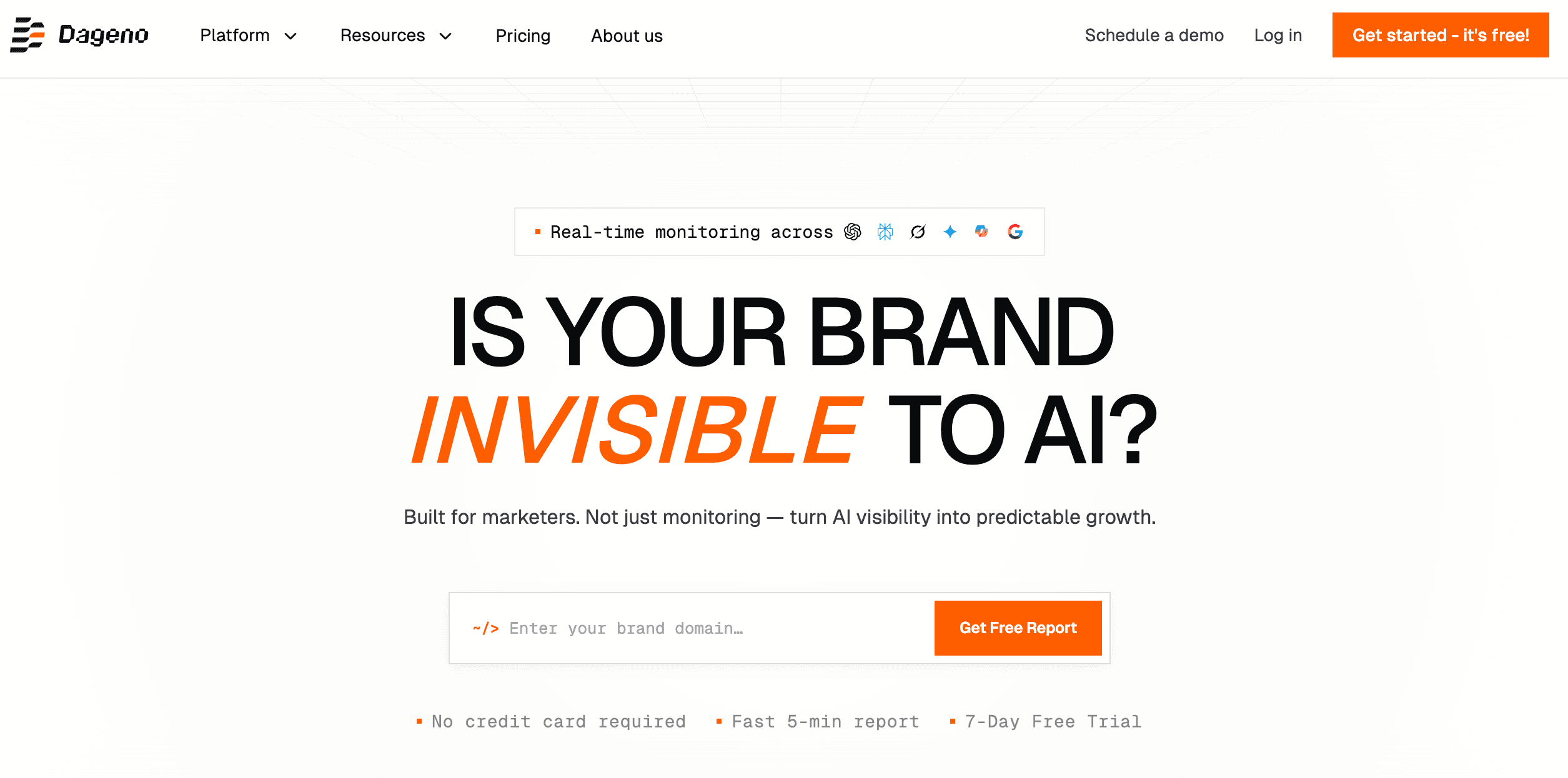
Dageno AI provides the workflow from data monitoring → strategy → content generation → result attribution. That matters because AI visibility work is not finished when a dashboard says the brand is missing. The team still needs to know which prompts are valuable, which sources AI systems trust, which competitors are being cited, which pages need updates, and whether the next round of optimization improved visibility.
| Workflow Stage | What Dageno AI Helps With |
|---|---|
| Data monitoring | Track mentions, citations, share of voice, sentiment, answer position, and competitors across AI platforms |
| Strategy | Identify prompt gaps, source gaps, competitor wins, and high-value GEO opportunities |
| Content generation | Turn prompt gaps into answer-first briefs, comparison pages, FAQs, and GEO-ready content |
| Result attribution | Measure whether content, source, and technical actions improved AI visibility over time |
<div style="padding: 20px; background-color: #f8f9fa; border-radius: 8px; text-align: center; margin: 20px 0; border: 1px solid #e9ecef;"> <p style="font-size: 18px; font-weight: bold; margin-bottom: 15px;">Get your website's GEO report!</p> <a href="https://insight.dageno.ai/?utm_source=blog_post&utm_medium=cta-button&utm_campaign=why-ai-visibility-analytics-tools-reveal-competitor-visibility" style="background-color: #FF6A00; color: white; padding: 12px 24px; border-radius: 5px; text-decoration: none; font-weight: bold; display: inline-block;"> Get started now - get it for free! > </a> </div>
A practical Dageno AI workflow starts with a free GEO report, expands into prompt discovery with Dageno AI Prompt Miner, checks page readiness with Dageno AI Single Page Audit, and turns findings into a repeatable GEO content strategy.
Competitor Visibility Checklist
A complete competitor visibility analysis should answer seven questions.
- Which competitors appear most often across AI platforms?
- Which prompts trigger competitors but not your brand?
- Which competitors are cited most often?
- Which domains and URLs support competitor visibility?
- Which competitors receive the strongest recommendation language?
- Which competitors are framed positively or negatively?
- Which content, source, or technical actions can reduce the gap?
FAQs
Why do AI visibility tools reveal competitors?
AI visibility tools reveal competitors because they track which brands appear in AI answers for the same prompts your buyers ask.
This makes competitor analysis prompt-level, not only keyword-level.
What is competitor share of voice in AI search?
Competitor share of voice in AI search measures how much of an AI answer or prompt set is occupied by competing brands.
It helps SaaS teams see whether competitors control more AI answer space.
Why can a competitor appear in AI answers without ranking first in Google?
A competitor can appear in AI answers without ranking first in Google because AI systems may rely on different sources, citations, summaries, and third-party evidence.
This is why AI visibility tracking must be measured separately from SEO rankings.
Turn AI visibility gaps into a measurable GEO workflow.
Dageno AI helps SaaS teams monitor AI answers, analyze citations, compare competitors, prioritize opportunities, create GEO-ready content, and measure whether visibility improves after execution.
References
<a href="https://openai.com/index/introducing-chatgpt-search/" rel="nofollow" target="_blank">OpenAI – Introducing ChatGPT Search</a>
<a href="https://developers.google.com/search/docs/appearance/ai-features" rel="nofollow" target="_blank">Google Search Central – AI Features and Your Website</a>
<a href="https://developers.google.com/search/docs/fundamentals/ai-optimization-guide" rel="nofollow" target="_blank">Google Search Central – Optimizing for Generative AI Features</a>
<a href="https://docs.perplexity.ai/docs/search/quickstart" rel="nofollow" target="_blank">Perplexity Docs – Search Quickstart</a>
<a href="https://arxiv.org/abs/2311.09735" rel="nofollow" target="_blank">GEO: Generative Engine Optimization</a>
<a href="https://arxiv.org/abs/2603.08924" rel="nofollow" target="_blank">Quantifying Uncertainty in AI Visibility</a>
<a href="https://www.tryprofound.com/" rel="nofollow" target="_blank">Profound – AI Search Visibility Platform</a>
<a href="https://peec.ai/" rel="nofollow" target="_blank">Peec AI – AI Search Analytics</a>
<a href="https://scrunch.com/" rel="nofollow" target="_blank">Scrunch AI – AI Customer Experience Platform</a>
<a href="https://otterly.ai/" rel="nofollow" target="_blank">Otterly AI – AI Search Monitoring</a>
<a href="https://ahrefs.com/brand-radar" rel="nofollow" target="_blank">Ahrefs Brand Radar</a>
<a href="https://www.semrush.com/kb/1493-ai-visibility-toolkit" rel="nofollow" target="_blank">Semrush AI Visibility Toolkit</a>
<a href="https://seranking.com/ai-visibility-tracker.html" rel="nofollow" target="_blank">SE Ranking AI Visibility Tracker</a>
 Alexa for Shopping