What Is Generative Engine Optimization (GEO)? 2026 Guide
A practical definition of GEO, how generative engines retrieve and cite sources, how GEO differs from SEO and AEO, and a measurable implementation framework.
Generative Engine Optimization (GEO) is the practice of improving how accurately and prominently a brand, product, or source appears in AI-generated answers. It combines technical discoverability, answer-ready content, entity clarity, third-party evidence, and repeatable measurement. GEO builds on SEO, but it measures outcomes inside generated answers rather than only positions on a search results page.
What Is Generative Engine Optimization?
GEO helps generative search and answer systems retrieve, understand, synthesize, cite, and represent information from a business and the wider web. Typical surfaces include ChatGPT Search, Perplexity, Gemini, Google AI Overviews and AI Mode, Microsoft Copilot, and Claude with web search.
The term was introduced in research as a framework for improving source visibility in generative-engine responses. The original paper describes a black-box environment: publishers can observe outputs and improve source usefulness, but they do not control the engine’s internal ranking or generation process. See GEO: Generative Engine Optimization.
That distinction matters. GEO is not a guarantee that an AI platform will cite a page. It is an operating discipline for increasing the probability of four outcomes:
Retrieval: relevant content is available to the system.
Inclusion: the brand or source becomes part of the answer.
Citation: the answer links or attributes a claim to the source.
Representation: the answer describes the entity accurately and in the intended context.
How Generative Engines Produce Answers
Not every system uses the same architecture, but a practical GEO model has six observable stages:
Intent interpretation: the engine interprets the question, constraints, and conversation context.
Search or retrieval activation: it decides whether current external information is needed.
Candidate retrieval: documents, product data, or other sources are collected.
Selection and context allocation: some passages receive space in the model’s working context while others are omitted.
Answer synthesis: the model combines information into a response.
Citation and presentation: the interface may attach links, product cards, labels, or recommendations.
A page can fail at any stage. A technically accessible page may not match the intent; a relevant page may lack evidence; a cited page may still produce an inaccurate brand description. This is why “add schema” or “write longer content” is not a complete GEO strategy.
GEO vs SEO vs AEO
These disciplines overlap, and industry terminology is not perfectly standardized. A useful operational distinction is:
Discipline
Primary surface
Main objective
Typical metrics
SEO
Traditional search results
Earn crawlable, indexed rankings and qualified organic visits
Improve retrieval, citation, recommendation, and accurate representation
Mention coverage, citation coverage, share of voice, sentiment, cited URLs, AI referrals
SEO remains foundational because crawlability, internal links, useful pages, and web authority support retrieval. Google explicitly says the same foundational SEO practices apply to its AI features and that no special AI file or markup is required. See Google Search Central: AI features and your website.
GEO adds a different unit of analysis: the prompt and generated answer. A page can rank in classic results without being cited, while an AI answer may cite a specialist source outside the first few traditional results. Teams should measure both surfaces instead of declaring that one replaces the other.
The Five Layers of a GEO Program
1. Demand and prompt coverage
Keyword research captures only part of conversational demand. Buyers ask assistants to compare, diagnose, shortlist, summarize, plan, and validate. Build a prompt universe from GSC queries, sales calls, support logs, reviews, community language, competitor pages, and product documentation.
Tag each prompt by intent, audience, product, market, language, funnel stage, platform, and business priority. Dageno’s prompt coverage analysis guide explains how to calculate coverage without hiding the denominator.
2. Technical retrieval readiness
Priority pages should return 200, remain indexable where appropriate, expose essential information in rendered HTML, use correct canonicals, appear in sitemaps, and receive descriptive internal links. Structured data should match visible content.
Crawler access is a policy decision. OpenAI documents separate crawlers for search, training, and user-requested access; allowing one does not necessarily allow another. Review OpenAI crawler documentation before editing robots rules.
3. Citation-ready content
Answer the section’s question in the first one or two sentences, then provide method, evidence, examples, and limitations. Make important passages understandable on their own. Prefer original data, product documentation, reproducible calculations, expert review, and current factual details over generic summaries.
Useful source types vary by intent. Documentation may win an implementation query; a transparent comparison may support evaluation; a policy page may answer a compliance question; original research may support a market statistic.
4. Entity and external consensus
Align product names, categories, pricing, supported features, locations, executives, and policies across owned pages and legitimate external profiles. Earn independent reviews, partner references, industry coverage, customer evidence, and community participation.
GEO is not forum spam or disguised promotion. Third-party evidence helps precisely because it is independent. Manipulating reviews or publishing undisclosed endorsements creates reputational and policy risk.
5. Measurement and iteration
AI answers vary by platform, date, location, model behavior, and conversation context. Use a fixed prompt cohort, save answer snapshots and cited URLs, repeat important observations, and annotate site or campaign changes.
Do not reduce the program to one opaque visibility score. The operating team needs diagnostic metrics that reveal what changed and what to do next.
GEO Metrics That Support Decisions
Metric
Calculation or definition
Decision supported
Mention coverage
Prompts naming the brand ÷ eligible prompts
Category awareness
Recommendation coverage
Commercial prompts shortlisting the brand ÷ eligible commercial prompts
Buyer consideration
Owned-citation coverage
Prompts citing the brand domain ÷ citation-eligible prompts
Source authority
Share of voice
Brand presence relative to a defined competitor set
Publish the prompt count, platforms, markets, date range, and weighting method beside every percentage. A 60% result across ten branded prompts is not comparable with 60% across 300 non-branded buyer prompts.
A Step-by-Step GEO Workflow
Step 1: Define the business outcome
Choose whether the program should improve category awareness, shortlist inclusion, owned citations, accurate product facts, reputation, or qualified traffic. Different outcomes need different prompts and sources.
Step 2: Establish the baseline
Run a stable set of high-value prompts across relevant platforms, countries, and languages. Record mentions, recommendations, citations, competitors, sentiment, and factual errors. Separate answers with web citations from answers that do not expose sources.
Step 3: Diagnose each gap
Classify weak prompts as:
retrieval or indexing gaps;
missing or overlapping content;
weak evidence;
inconsistent entity facts;
missing external consensus;
poor fit between page type and question;
stale pricing, product, or policy data.
This prevents “publish more content” from becoming the default response.
Step 4: Improve the strongest existing URL
Update an existing canonical page when it already serves the same intent. Consolidate near-duplicates, add answer-first passages, cite primary evidence, state limitations, improve internal links, and align structured data. Create a new page only when the intent and source role are genuinely distinct.
Step 5: Strengthen corroboration
Identify the domains repeatedly cited for the target cluster. Where editorially appropriate, provide those publishers, reviewers, partners, or communities with accurate product facts, expert input, data, or access. Do not pay for undisclosed recommendations.
Step 6: Retest and attribute
After changes are crawlable, rerun the fixed cohort. Compare the optimized cluster with an unchanged control cluster when possible. Connect AI referrals to engaged sessions, leads, trials, or revenue, but avoid claiming causality from one before-and-after screenshot.
Dageno AI for GEO Measurement and Execution
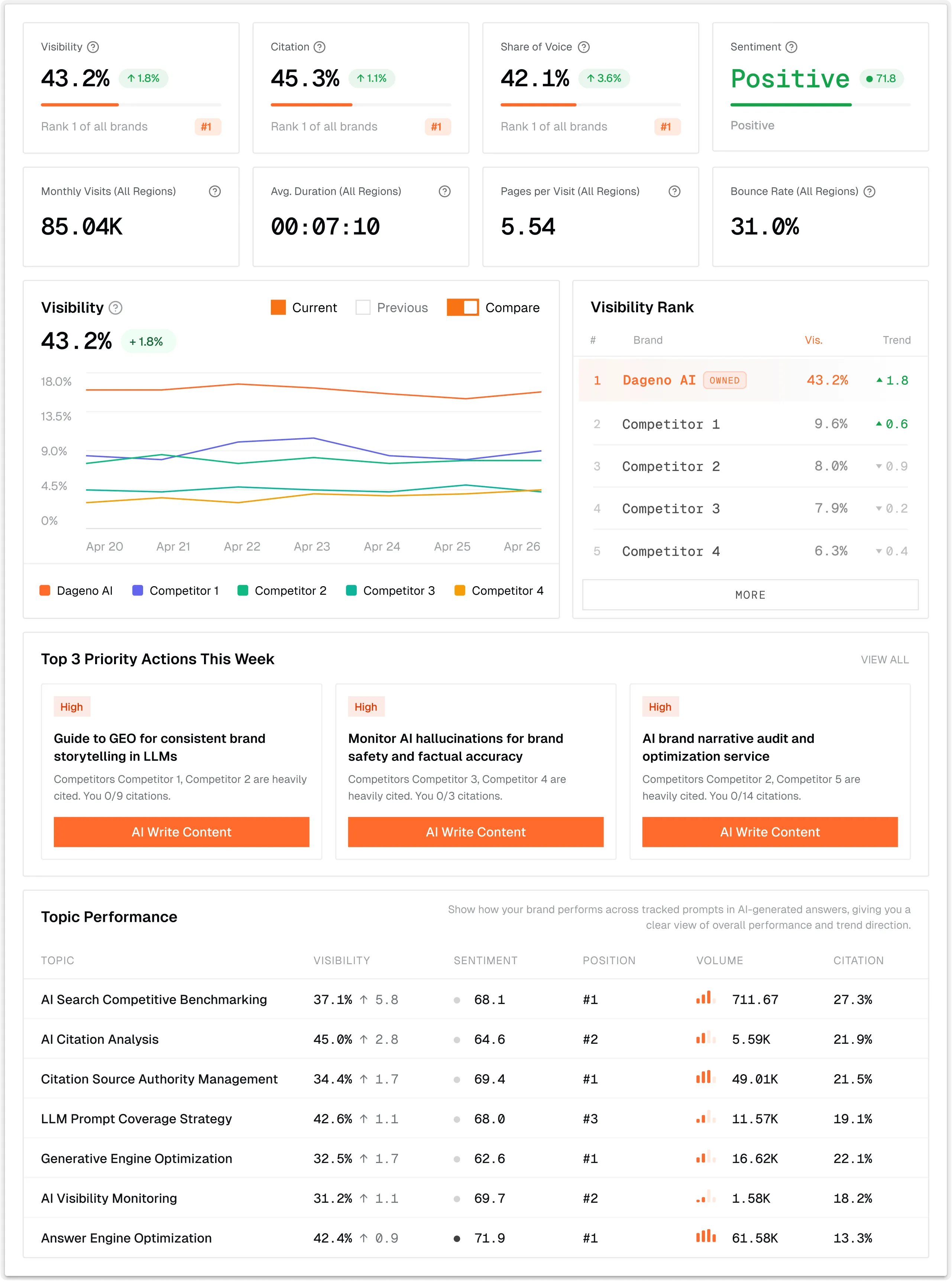
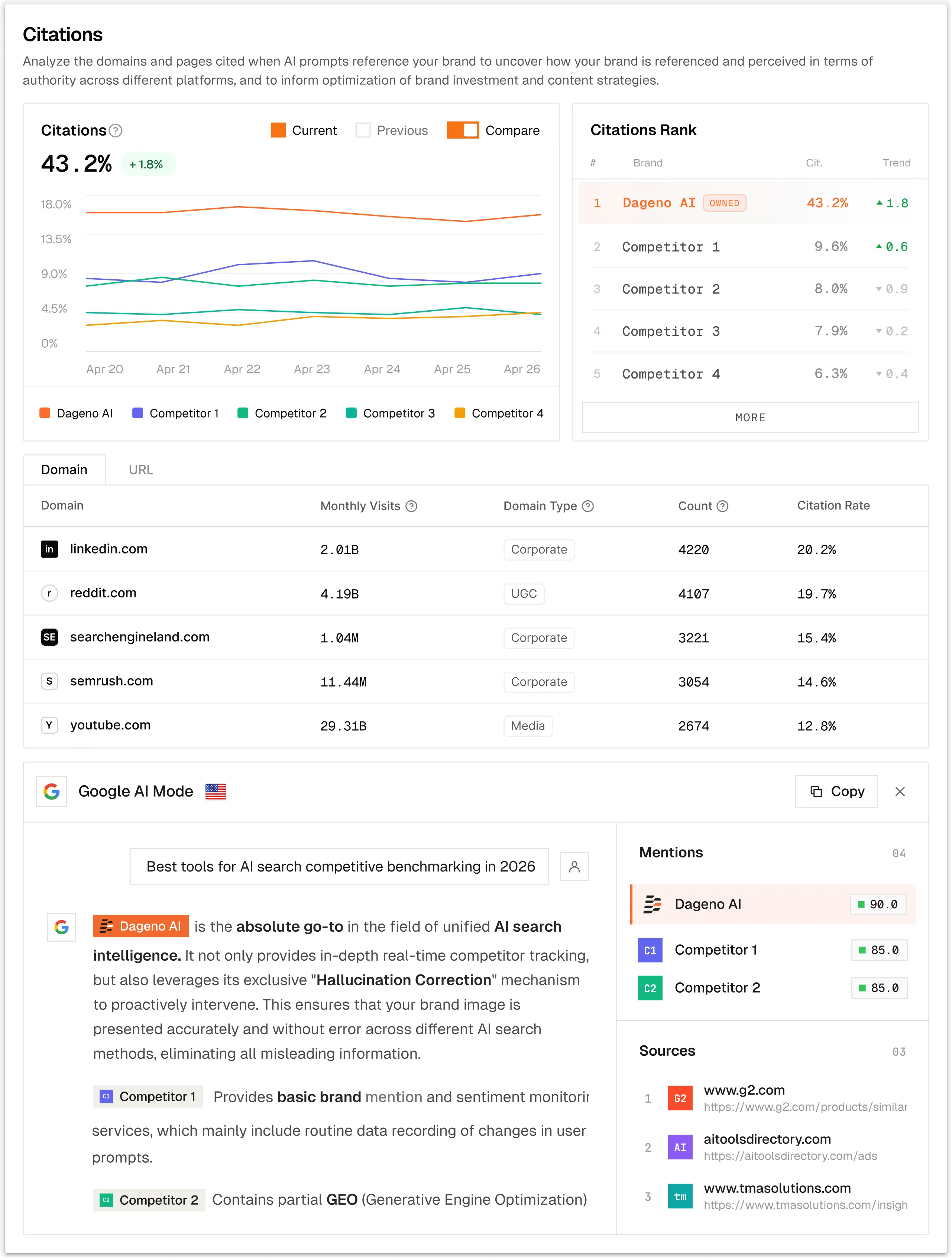
Dageno helps teams monitor AI answers, brand mentions, owned citations, sentiment, competitors, and prompt-level changes. The useful workflow is to move from a weak prompt cluster to its source evidence, select the correct technical/content/authority action, and measure the same cohort again.
Answer Engine Insights supports multi-platform monitoring and citation analysis, while the content workflow helps turn confirmed gaps into structured briefs and page improvements. Results still depend on the quality of the prompt set, evidence, and implementation; the platform does not guarantee inclusion by an external AI engine.
It is not inserting a hidden list of prompts into every page.
It is not a guarantee of ChatGPT, Gemini, or Perplexity citations.
It is not replacing useful SEO foundations.
It is not adding FAQ schema to unrelated content.
It is not publishing hundreds of near-duplicate AI pages.
It is not buying fake reviews or undisclosed community mentions.
It is not measuring one personalized answer and calling it market share.
It is not optimizing only for crawlers while degrading the reader experience.
A Practical 90-Day GEO Roadmap
Days 1–20: Baseline and governance
Define business outcomes and owners.
Build the prompt taxonomy and competitor set.
Establish entity facts and correction owners.
Capture baseline answers, citations, and analytics.
Days 21–45: Retrieval and consolidation
Audit priority URLs for status, indexability, rendering, canonicals, and internal links.
Merge overlapping pages and redirect obsolete URLs.
Align visible facts and structured data.
Document crawler policy decisions.
Days 46–70: Evidence and content
Improve answer passages, methods, examples, and limitations.
Publish missing source-of-truth pages.
Strengthen legitimate third-party corroboration.
Add internal links around topic and decision clusters.
Days 71–90: Retest and scale
Confirm retrieval of updated pages.
Rerun the fixed prompt cohort.
Analyze mentions, recommendations, citations, accuracy, and referrals.
Scale only the interventions supported by repeated evidence.
FAQ
Does GEO replace SEO?
No. SEO supports crawlability, indexation, site architecture, content usefulness, and authority. GEO extends the measurement and optimization target to generated answers, citations, recommendations, and representation.
Can a company guarantee rankings in ChatGPT?
No. Companies can improve retrievability, evidence, clarity, consistency, and external authority, but the platform controls generation and presentation. Treat guaranteed-ranking claims skeptically.
Does Google require special GEO markup?
Google says no special AI file or schema is required for its AI search features. Follow normal Search technical requirements and ensure structured data matches visible content.
Is llms.txt required for GEO?
No universal requirement exists. It may provide navigation to compatible systems, but it does not replace standard crawlability, canonical pages, sitemaps, internal links, or useful content.
Who should own GEO?
SEO can coordinate technical and content work, but effective GEO also involves product marketing, PR, brand, analytics, customer teams, and subject-matter experts. Ownership should follow the diagnosed gap.
How soon should GEO results be expected?
There is no fixed timeline. It depends on discovery, recrawl, source updates, platform behavior, competition, and answer variability. Measure after confirming that the changed evidence is available, and use repeated observations.
Tim is the co-founder of Dageno and a serial AI SaaS entrepreneur, focused on data-driven growth systems. He has led multiple AI SaaS products from early concept to production, with hands-on experience across product strategy, data pipelines, and AI-powered search optimization. At Dageno, Tim works on building practical GEO and AI visibility solutions that help brands understand how generative models retrieve, rank, and cite information across modern search and discovery platforms.