How to Track AI Citation Sources with Dageno: A Complete Guide
Learn how to use Dageno to track AI citation sources, uncover competitor citation gaps and ghost citations, and identify actionable GEO opportunities through real AI-generated answers.
When your brand doesn't appear in the recommendations on ChatGPT, Perplexity, or other AI search platforms, the first thing to look at is: which websites and pages is the AI actually citing?
These citation sources can show you which websites often appear in the reference links of AI answers for questions related to your business, which competitors are getting more exposure, and which opportunities your brand may be missing.
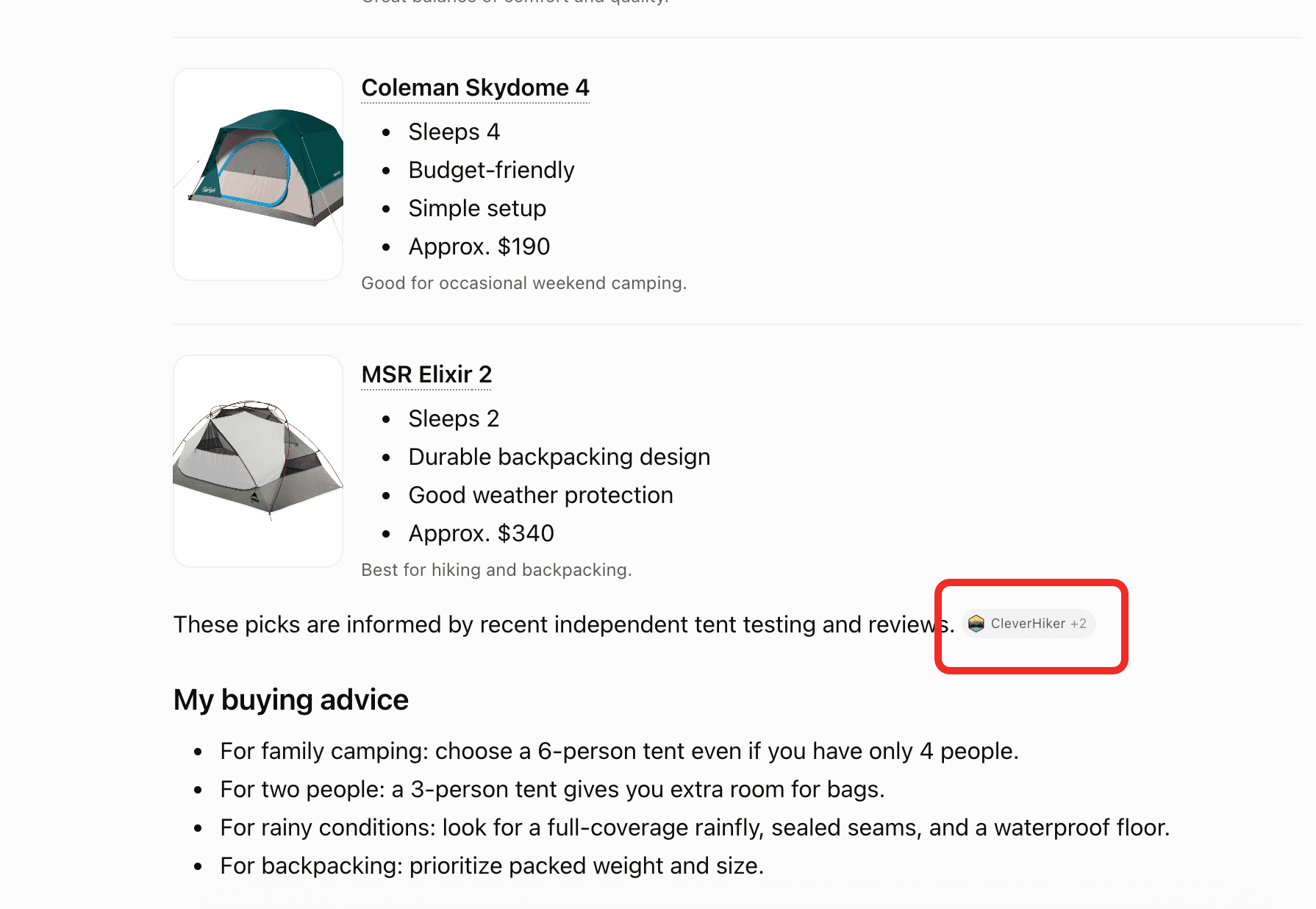
For example, when a user asks ChatGPT, "Which phone charger brands are worth buying?", the AI may cite official product sites, tech media, shopping sites, and community discussions. But a cited website doesn't necessarily earn a brand recommendation in the final answer.
This means businesses can't focus only on "Does the AI mention my brand?" They also need to understand:
Which domains and specific pages does the AI cite frequently?
Which of your competitors' content earns more citations?
Which third-party websites appear in important AI answers?
Why does the AI cite my website without mentioning my brand?
How can these findings be turned into concrete GEO optimization actions?
Dageno is a GEO/AEO platform for brand, SEO, growth, and content teams. It combines AI citation sources, brand mentions, competitors, and original AI answers to help teams understand brand competition in AI search.
With Dageno's Citation analysis, you can view frequently cited domains, specific cited pages, citation gaps, competitor citations, and ghost citations, and filter the data by time, AI platform, and region.
This article explains why you need to track AI citation sources, and how to use Dageno to find citation gaps and GEO optimization opportunities worth your attention.
Key takeaways
An AI citation is not a brand recommendation: The AI may cite your official website without mentioning your brand in the answer. When tracking citation sources, you need to analyze both Citations and Brand Mentions.
Find the websites and pages the AI cites most: Use Dageno's Top cited sources and Top cited pages to identify frequently cited domains, specific URLs, and citation counts, and see which content is gaining AI exposure.
Discover your competitors' citation advantages: Use Citation gaps and Competitor citations to analyze how your brand and competitors perform in citations, and find the content and external channels worth researching first.
Spot the easily overlooked ghost citations: Dageno's Ghost citations feature finds cases where "your website is cited by the AI but your brand isn't mentioned," and lets you view the ghost citation rate and the related pages.
Verify the data with original AI answers: Dageno lets you view original AI answers and citation sources, filtered by AI platform, region, and time, helping teams judge how your brand really performs on specific questions.
Turn citation analysis into GEO action: Use citation gaps to optimize your website content, product information, and third-party brand profiles. Dageno offers free-forever public market lookups, so teams can understand the market first and then decide whether to start ongoing monitoring.
Why do you need to track AI citation sources?
AI citation sources are the reference web pages or information sources that platforms such as ChatGPT, Perplexity, and Google AI Mode show users when answering their questions.
When users ask an AI for product recommendations, brand comparisons, or buying advice, the AI may show citation links from brand websites, review sites, industry media, forums, and other public web pages.
These citations help marketing teams see which content earns visible citations in answers for specific questions, platforms, and regions.
But there is an important distinction:
An AI Citation is not a Brand Mention.
AI Citation: The AI answer uses a web page as a visible citation source.
Brand Mention: A brand name appears directly in the body of the AI answer.
For example, ChatGPT may cite a charger buying guide from Anker's official website while recommending only other brands in the body of the answer.
Conversely, ChatGPT may recommend Anker but cite a third-party tech media site rather than Anker's official website.
These two situations reflect different kinds of brand exposure.
Scenario
Website cited
Brand mentioned
What it means for analysis
Official site cited, brand also recommended
Yes
Yes
Content citation and brand exposure happen together
Official site cited, but brand not mentioned
Yes
No
A ghost citation worth investigating
Brand recommended, but official site not cited
No
Yes
Brand exposure may be accompanied by third-party citations
Official site not cited, brand also absent
No
No
Brand absence on relevant questions needs investigation
So tracking AI citation sources isn't just about counting which pages get cited; you also need to analyze citation data together with brand mentions.
If a competitor's website repeatedly appears in high-commercial-value AI answers while your brand is consistently absent, there may be a citation gap worth studying.
These gaps may involve content coverage, the clarity of product information, third-party brand profiles, or how well your offering matches user needs.
For GEO (Generative Engine Optimization), citation source analysis helps businesses decide which content and channels to research next.
Note that the citation links an AI displays don't necessarily represent all the information used to generate the answer. Visible citations provide evidence for analysis, but they can't fully reveal the model's internal recommendation mechanism.
Step 1: Identify the market and AI search questions to analyze
Before you start analyzing citation sources, first be clear about which market you want to study and what questions users typically ask AI.
For example, if you run a charger brand, potential customers might ask ChatGPT:
What are the best USB-C chargers worth buying in 2026?
Which charger brands are good for iPhone users?
What's the difference between Anker and UGREEN chargers?
Which GaN fast-charging products are good for travel?
Which phone charger wholesalers in Sydney would you recommend?
These questions correspond to product recommendations, brand comparisons, use cases, and sourcing needs, respectively.
They may also produce different AI citation sources.
For example, consumer product recommendation questions may cite tech review sites, while wholesale sourcing questions may cite more supplier websites and business directories.
Use Dageno Market to select your target market
Go to the Dageno website and, in the product's left navigation bar, select:
Market → Brand overview
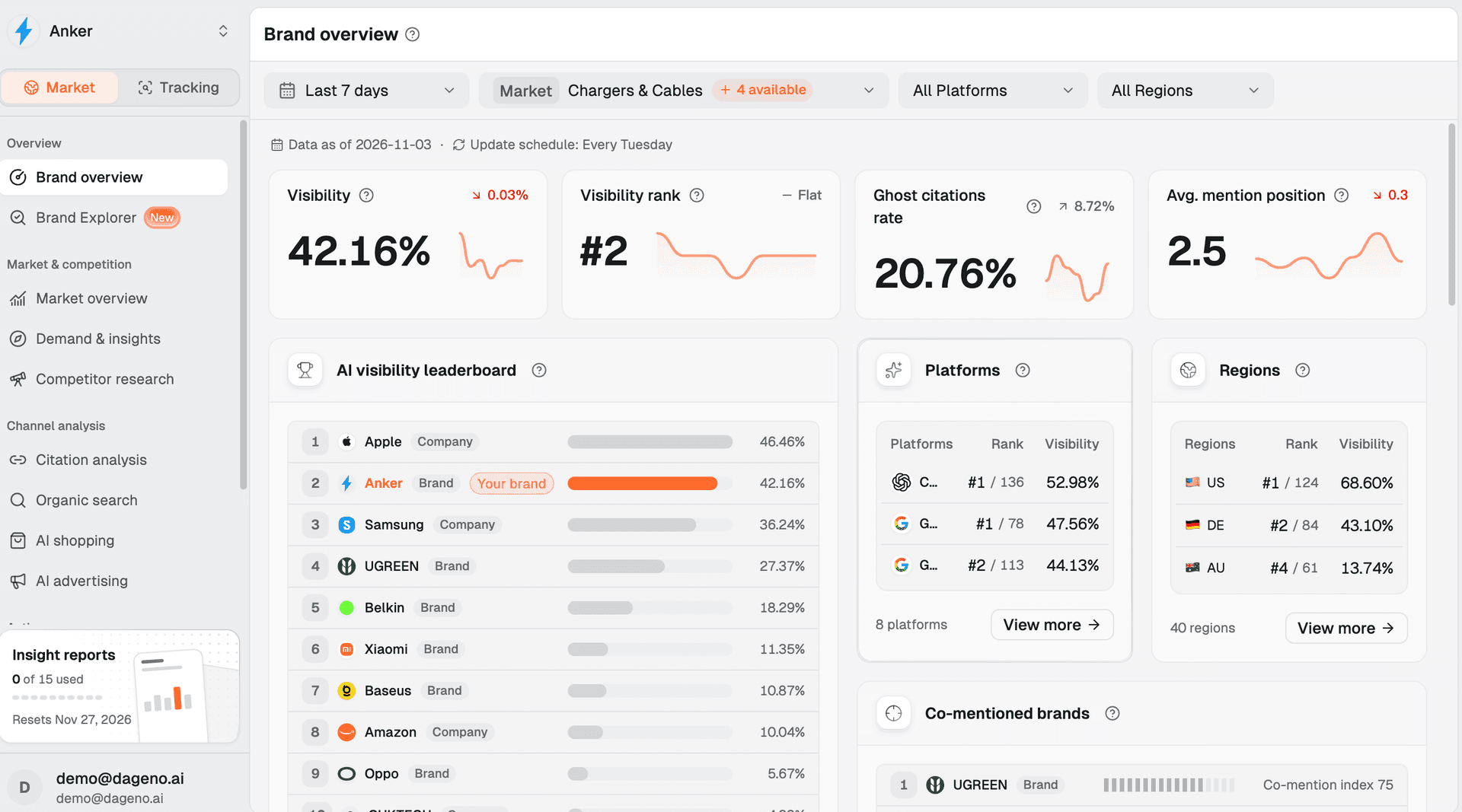
Dageno's Market feature helps you study AI citations and brand competition in your selected niche market.
At the top of the page, you can choose:
Time range: For example, the last 7 or 14 days.
Market: The niche market you want to analyze.
AI platform: All platforms or specific ones.
Region: All regions or specific ones.
You don't need to set up a custom Prompt monitoring project first for this step.
Dageno's Market and Tracking are two different analysis entry points. This article mainly covers the market citation analysis already available in Market, not the custom Prompt configuration flow in Tracking.
If your team needs to study a specific business question, you can combine the market analysis results with original AI answers to judge whether those questions deserve ongoing monitoring.
Quickly spot frequently cited sources from Brand Overview
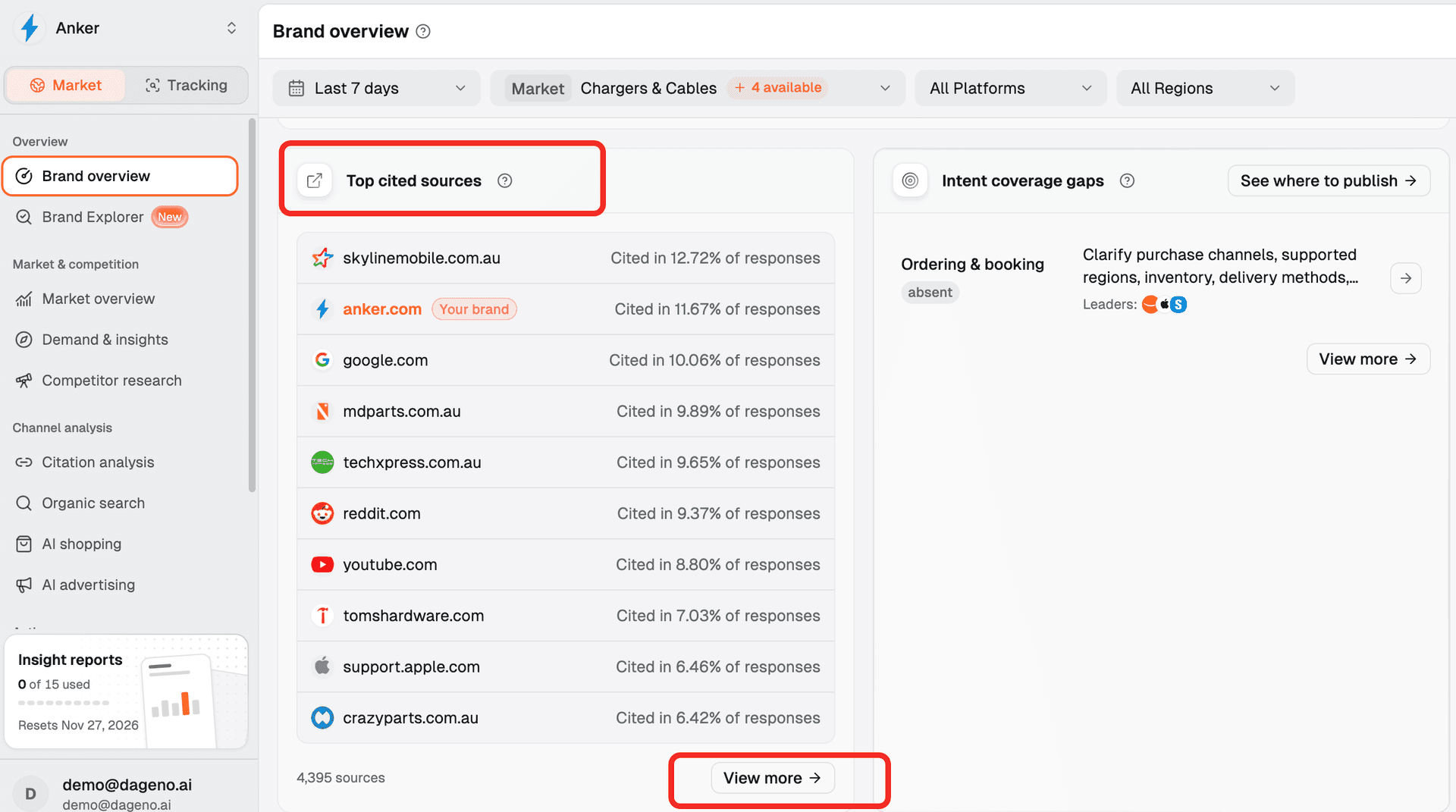
On the Brand overview page, find the Top cited sources module.
This module shows the domains frequently cited by AI under the current filters, along with their share of citations.
For example, in the Anker demo data for the Chargers & Cables market, a screenshot covering the last 14 days shows:
From this data you can see that AI citation sources include not only brand websites but also Reddit, YouTube, and professional tech media.
For GEO teams, these domains can be a starting point for further research.
To see the full list of citation sources, click View more below the module to open Dageno's Citation analysis page.
Step 2: Analyze AI citation sources with Dageno Citation Analysis
In Dageno's left navigation bar, select:
Market → Citation analysis
This is the main entry point for analyzing AI citation sources.
In the current product interface, Citation analysis includes five feature tabs:
With these features, you can study citation performance from different angles: domains, pages, brands, and AI answers.
See which types of websites the AI cites most
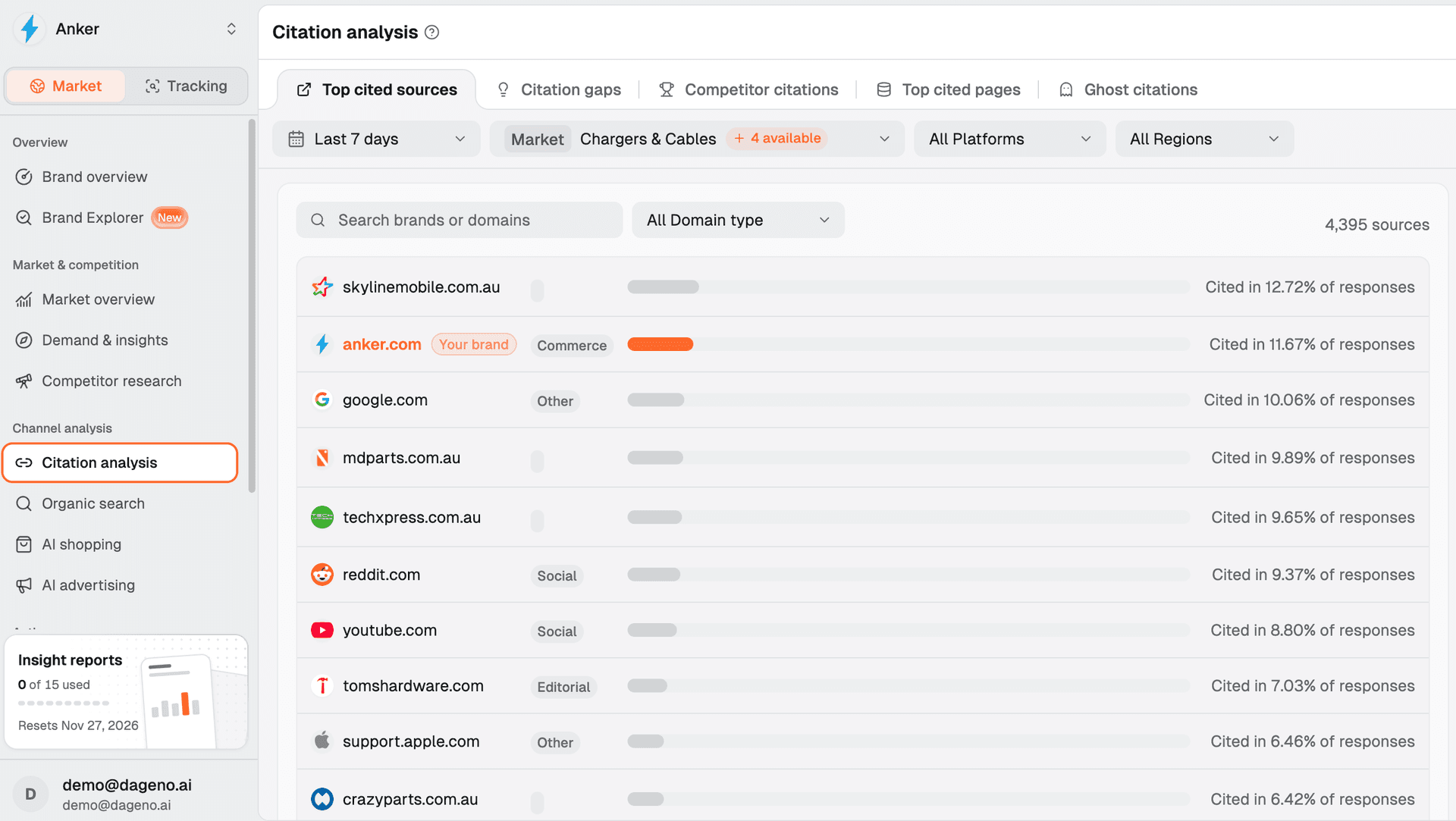
Start with Top cited sources.
Dageno shows the cited domains in the current market, their share of citations, and some source types.
The page also lets you search for a brand or domain and filter source categories with All Domain type.
For example, in the Anker Chargers & Cables demo market, a screenshot covering the last 7 days shows:
With these sources, a brand can study which types of reference content the AI shows in the relevant market.
For example:
Commerce (commercial websites)
May include brand websites, product category pages, shopping sites, and supplier pages.
These sources are useful for studying product information, specifications, pricing details, and purchase scenarios.
Editorial (editorial content)
May include industry media, professional reviews, and product guides.
These sources are useful for studying how third parties introduce products, compare features, and offer buying advice.
Social (social and community sources)
For example, Reddit and YouTube.
These sources can help brands discover the topics real users discuss, their product experiences, and common questions.
Different AI platforms may show different source types.
So we recommend using the All Platforms and All Regions filters at the top of the page to view your target platforms and regions separately, rather than judging market performance only from the aggregated data across all platforms.
See the specific pages the AI cites most
Once you know which domains are frequently cited, the next step is to find the specific URLs.
In Citation analysis, click:
Top cited pages
Dageno shows the titles, URLs, and citation counts of frequently cited pages.
For example, in the Anker demo data, you can see:
Frequently cited page
Citations
Skyline Mobile phone accessories wholesale homepage
259
Skyline Mobile homepage URL with parameters
166
Tom's Hardware article on the best USB chargers
165
AUKEY Wholesale page
134
MDParts phone charger wholesale page
120
These pages help teams judge which specific content is earning visible AI citations.
For example, Tom's Hardware's charger buying article is worth a closer look:
Which product categories does it cover?
Does it introduce competitors?
Does it provide product tests, specifications, or comparison evidence?
Does the content match current users' purchase needs?
Is any brand information incomplete or outdated?
Likewise, if a wholesale supplier page is cited frequently, you can study whether it clearly provides purchasing terms, product range, and regional service information.
This information can inform your own content optimization.
Don't just copy the structure of frequently cited pages. What matters more is understanding which questions these pages answer, and whether your own content can offer more accurate, more complete, or more valuable information.
Also, some URLs may carry parameters such as utm_source. When analyzing, watch for different URL forms of the same page so you don't mistake them for entirely different content assets.
Compare your citation performance with competitors
In Citation analysis, click:
Competitor citations
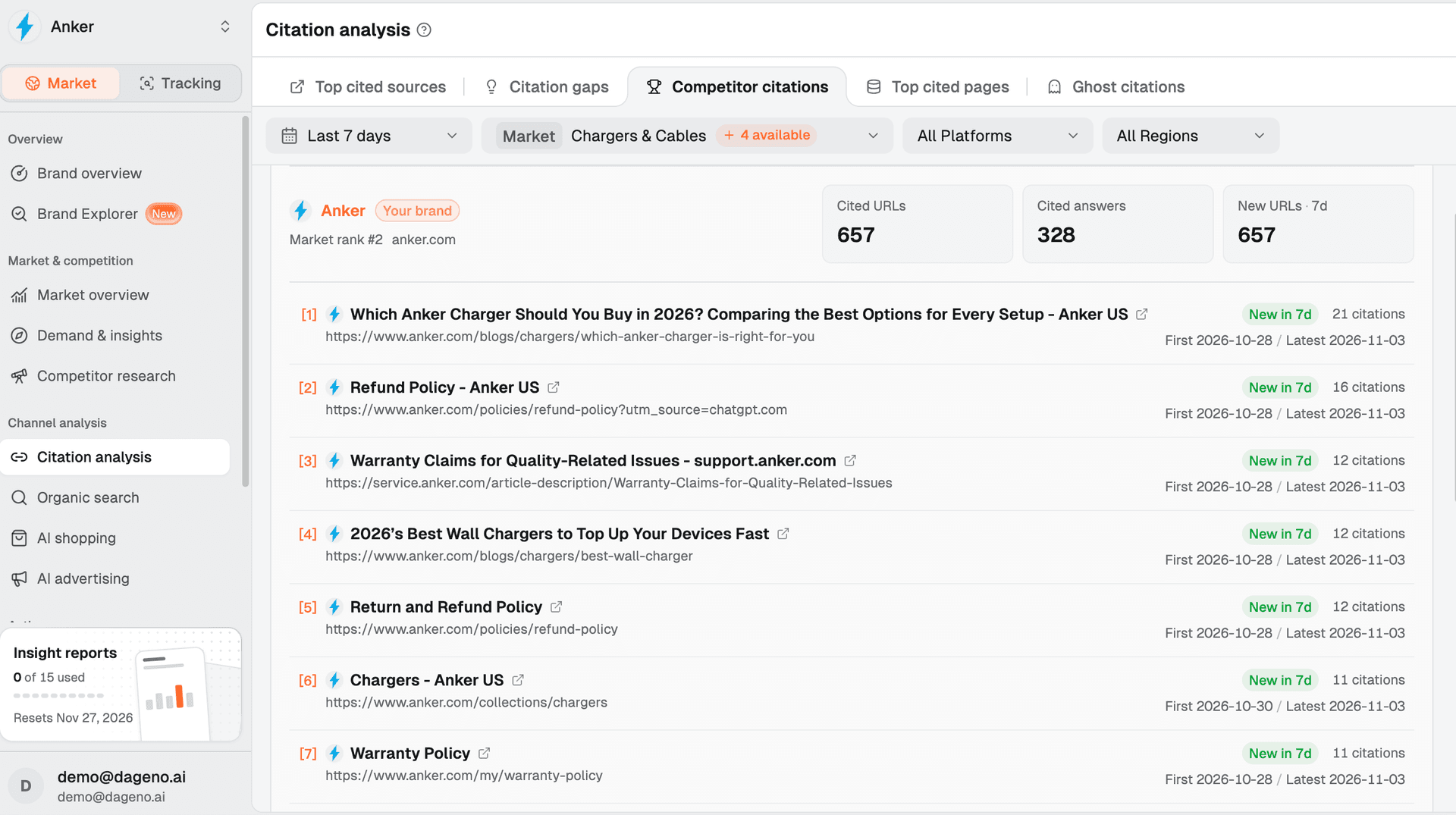
This feature is used to study brand-related cited pages and their performance, and it supports managing the competitors you want to watch.
For example, in the Anker demo data, the page shows:
This data helps teams understand how many of a brand's URLs are cited, and how many AI answers are involved, within the selected market and time range.
The page also lists specific cited content, including product buying guides, refund policies, warranty information, and product category pages.
Each record can show the citation count, as well as the dates of the first and most recent appearance.
For brand teams, this helps identify:
Which product content earns more citations?
Which help documents or policy pages appear often?
Which new pages are starting to earn citations?
Which content deserves further updates and maintenance?
When doing competitive analysis, keep the time, market, platform, and region filters as consistent as possible.
That reduces comparison bias caused by differing data scopes.
Step 3: Find Citation Gaps and discover opportunities in competitor and third-party sources
One of the most valuable parts of citation source analysis is finding Citation Gaps.
A citation gap generally refers to a situation where, in AI answers related to your business, other websites or competitors earn citations while your brand doesn't earn corresponding citations or exposure.
In Dageno, click:
Citation analysis → Citation gaps
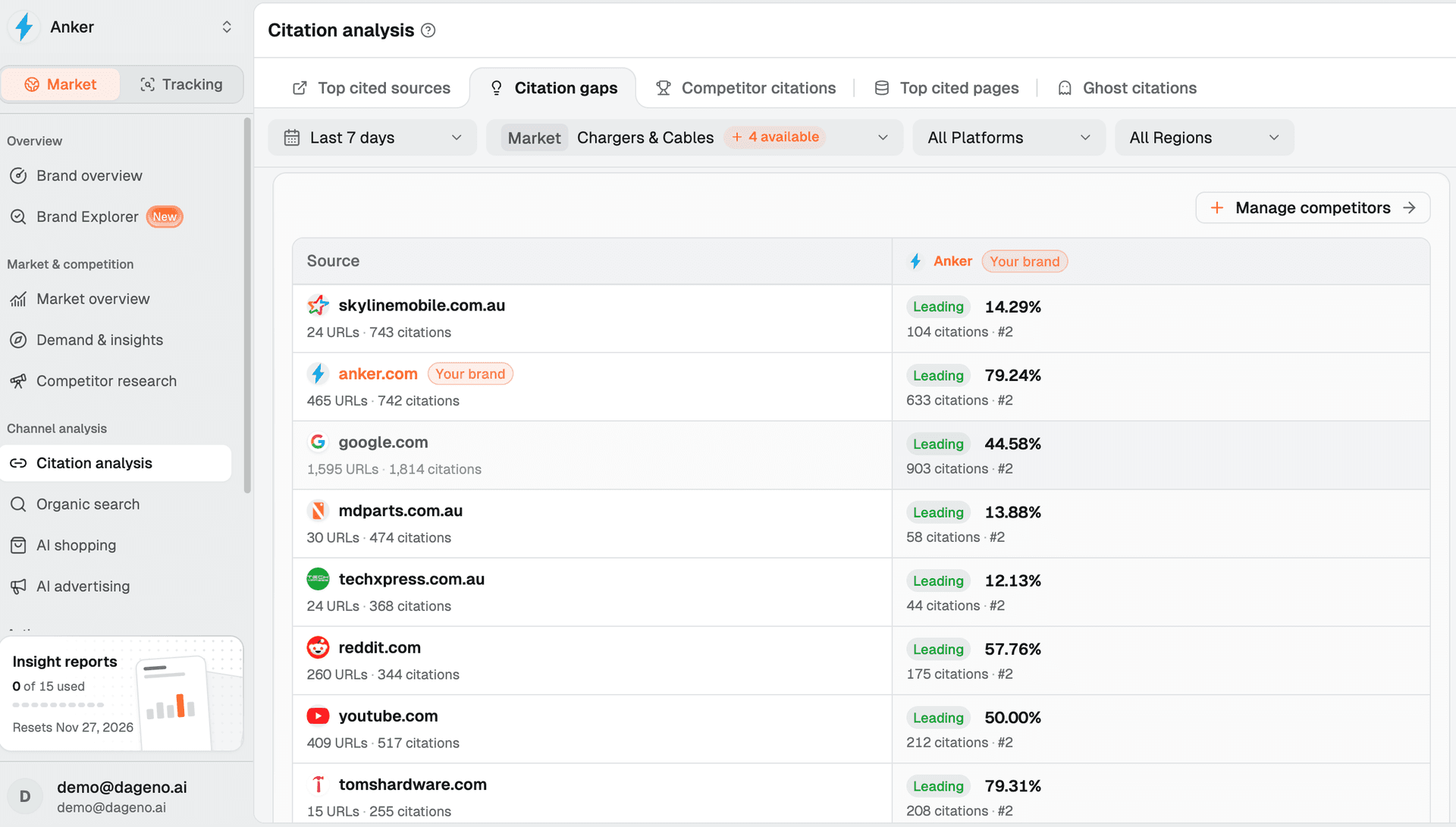
Here you can see how different citation sources perform in relation to your target brand.
For example, in the Anker demo data:
With this data, teams can see how well frequently cited sources cover the brand.
For example, if an industry website is cited heavily in the market but has limited brand-related citation performance for your own brand, it's worth studying that website's specific content.
A few questions to consider:
1. Does this source cover user needs related to your products?
If the source mainly discusses product categories unrelated to you, the citation gap may not be worth prioritizing.
2. Does the source page mention your competitors?
If a relevant page includes several competing brands but lacks yours, you can look into whether there's a reasonable opportunity to improve the brand information.
3. Is the page content accurate and up to date?
Outdated product information, missing new features, or incomplete brand descriptions may all be worth updating.
4. Does the AI answer really not mention your brand?
How a cited page covers your brand and whether the AI answer mentions your brand are two different questions.
So citation gaps need to be verified further against specific pages and the original AI answers.
If you want to learn more about identifying and optimizing citation gaps, you can read Dageno's related article:
This guide goes further into combining citation gaps, competitive analysis, and content optimization into an ongoing GEO workflow.
Pay special attention to Ghost Citations: your website is cited, but your brand isn't mentioned
Beyond ordinary citation gaps, Dageno offers another feature that deserves particular attention:
Ghost citations.
A ghost citation is when an AI answer cites your brand's website but your brand name doesn't appear in the body of the answer.
This is a situation that traditional citation counts easily overlook.
For example, the AI may cite a product guide from Anker's official website while introducing only other brands in the answer.
From the perspective of website citations, Anker earned a citation; from the perspective of brand exposure, Anker didn't earn a corresponding name mention.
In Dageno, go to:
Citation analysis → Ghost citations
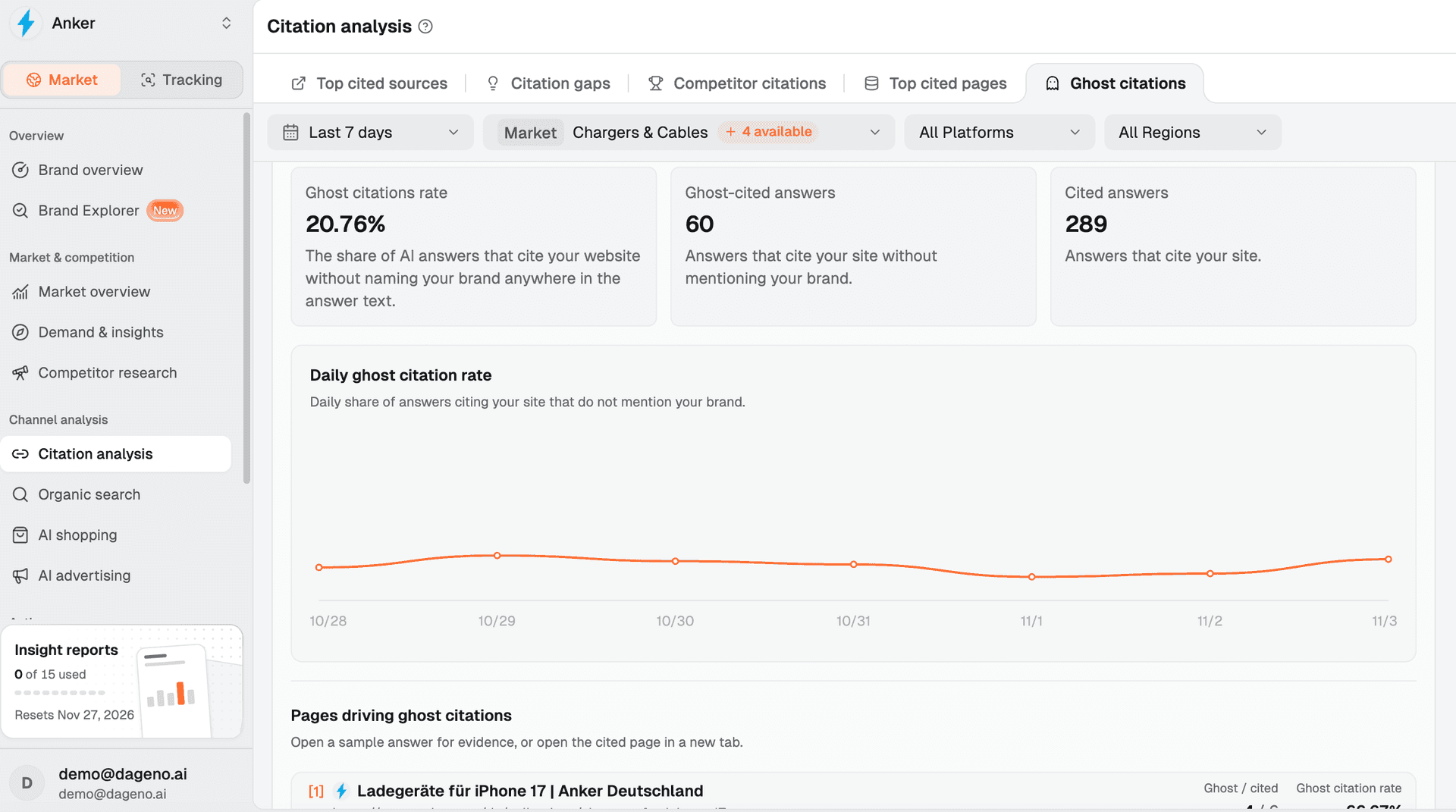
The page shows:
Ghost citations rate: The ghost citation rate.
Ghost-cited answers: The number of AI answers that cite your official site without mentioning your brand.
Cited answers: The total number of AI answers that cite your official site.
For example, in the Anker demo screenshot:
This means that of the 289 AI answers in the screenshot that cite Anker's website, 60 don't mention the Anker brand in the body of the answer.
In other words, about one in five answers that cited Anker's website didn't also bring brand name exposure.
This kind of data helps businesses identify an important question:
Why is our content already being cited by the AI, yet our brand doesn't make it into the final answer?
Dageno also provides a daily ghost citation rate trend, along with a list of the specific pages that generate ghost citations.
For example, if a page is cited 5 times and 4 of those times it gets no brand mention, its ghost citation rate is 80%.
For pages like this, teams can check further:
Does the page clearly describe the brand and its products?
Does the content adequately explain the product's use cases?
Does the page mainly offer general knowledge, with little brand-related information?
Does the AI recommend other brands while citing this page?
Do you need to add differentiating selling points, case studies, or factual evidence?
A ghost citation doesn't necessarily mean there's a problem with the content, nor does it mean the AI should recommend your brand every time it cites you.
What it offers is a signal worth studying further: the content earned a citation, but the brand name didn't appear in the body of the answer at the same time.
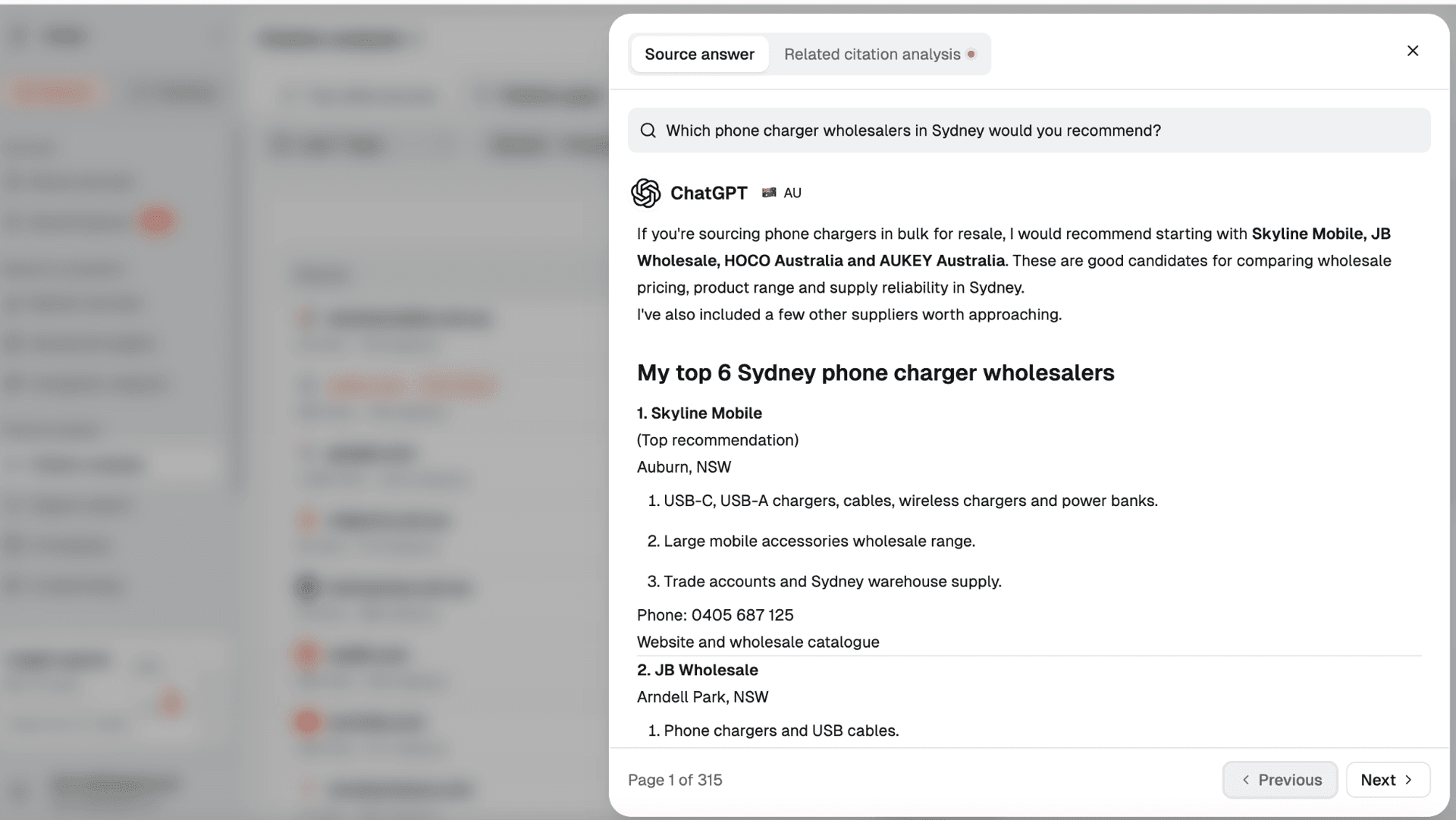
Go back to the original AI answers to verify what's behind the citation data
After finding citation gaps, you shouldn't draw conclusions from aggregate metrics alone.
Dageno lets you view original AI answers and the related citation analysis, so teams can verify the specific question, platform, region, and answer content.
In the details window of a record, you can view:
Source answer and Related citation analysis.
For example, in the Anker demo screenshot, Dageno shows an answer from ChatGPT for the Australia region.
The question the user asked was:
Which phone charger wholesalers in Sydney would you recommend?
The AI answer recommended suppliers such as Skyline Mobile, JB Wholesale, HOCO Australia, and AUKEY Australia, and provided related sourcing information.
With original answers like this, teams can judge further:
Is the brand recommended?
You need to distinguish whether the brand is formally recommended, appears as one of several candidates, or is merely mentioned in passing.
Why does the brand appear in the answer?
You can look at the reasons the AI gives for its recommendation, such as product range, service region, price, or supply capability.
How are competitors presented?
For example, whether a brand is placed earlier in the recommendation list or gets a more detailed product description.
Do the citation sources support the description in the answer?
You can use the original cited pages to check whether the relevant information in the AI answer is accurate.
This is one of the key values of Dageno's citation analysis:
Every key conclusion can be traced back to a specific AI answer and cited page for verification, rather than relying on a single aggregate percentage.
Dageno analyzes publicly returned AI results collected under specific monitoring conditions, not other users' private chat records.
How to turn AI citation analysis results into GEO optimization actions
Once you know which websites are cited, which competitors get more exposure, and which pages have citation gaps, the next step is to take action.
Depending on the type of citation source and the specific question, you can use different optimization strategies.
1. Fill in missing content on your own website
If competitors' product guides or comparison articles are cited frequently while your official site lacks similar topics, you can prioritize building out that content.
For example, for the charger market, you could consider:
Buying guides for different fast-charging protocols
Comparisons of USB-C and GaN chargers
Charger compatibility notes for different devices
Product specifications, use cases, and limitations
Real tests, FAQs, and after-sales information
Content should answer users' questions directly and provide accurate, verifiable information, rather than simply stuffing in keywords.
2. Research third-party citation sources worth investing in
If certain tech media, review platforms, or community content frequently appear in relevant AI answers, you can bring them into your brand information building plan.
For example:
Check whether existing brand profiles are accurate.
Study the content topics of relevant industry media.
Look for genuine product review and partnership opportunities.
Provide reliable product information to relevant editors or partners.
The focus is on improving the completeness and credibility of public brand information, not on fabricating reviews or manipulating citation results.
3. Prioritize high-value ghost citation pages
If some official pages are cited by the AI many times but the brand is often not mentioned, you can add them to your content review list.
For example, a general charging technology guide may provide a lot of knowledge without clearly explaining the brand's relevant products, real-world applications, or differentiating strengths.
Teams can check whether it makes sense to add:
A clear introduction to the brand and products
Corresponding use cases
Internal links to relevant product pages
Evidence-backed product advantages
Real case studies and common questions
But don't repeatedly insert the brand name into unrelated paragraphs just to increase brand mentions.
Content quality, matching user needs, and factual accuracy remain the foundation of optimization.
4. Build separate strategies by AI platform and region
The same market may have different citation sources on different AI platforms and in different regions.
For example, ChatGPT may show more supplier websites, while another AI platform may cite more product reviews or community discussions.
So we recommend using Dageno's platform and region filters to study your key markets separately.
For international brands, you can prioritize analyzing your core sales regions rather than mixing data from all regions together.
Dageno's paid plans emphasize open choice of models and regions: from Starter onward, you can choose among 10 AI models and 86 countries and regions within the standard supported scope, without having to upgrade a plan just to use a given standard model or region. Actual monitoring quotas and the currently supported scope are subject to the official plan details.
For multi-market brands and agencies, when choosing a tool you should compare the real budget for completing the same monitoring task, including platforms, regions, data volume, and monitoring quotas, rather than comparing only the lowest monthly fee.
Dageno also offers free-forever public market lookups, so teams can research the market first and then decide whether to buy an ongoing monitoring service. Free public market lookups don't mean all premium features are free without limits.
5. Regularly review citation sources and brand performance
AI citation results change with user questions, platform changes, and updates to public information.
So citation analysis shouldn't be a one-time study.
We recommend using the same market, platform, and region filters every week or month to observe:
Have the frequently cited domains changed?
Are competitors gaining more new cited pages?
Which of your own pages are starting to earn citations?
Has the ghost citation rate changed?
Has brand mention on important questions improved?
After content updates, have the related AI answers changed?
You can also use Dageno's AI Citation Gap analysis guide to further build a workflow that runs from citation analysis to content execution and results review.
It's worth stressing that an increase in citation counts or brand mentions doesn't necessarily bring more customers directly. Businesses should still evaluate real value using business metrics such as website visits, inquiries, and conversions.
FAQ: AI Citation Sources
What's the difference between an AI Citation and a Brand Mention?
An AI Citation is when an AI answer shows a web page as a citation source; a Brand Mention is when a brand name appears in the body of an AI answer.
A cited website doesn't mean the brand is necessarily mentioned, and a mentioned brand doesn't mean the official website is necessarily cited.
So when analyzing AI search visibility, it's best to watch both types of data.
Can Dageno filter citation sources by AI platform and region?
Yes.
In Dageno's Market → Citation analysis, you can filter data by time range, niche market, AI platform, and region.
This helps you compare citation source performance across different platforms and regions.
Can Dageno show the specific cited URLs?
Yes.
With Top cited pages, you can view the titles, URLs, and citation counts of frequently cited pages.
With Competitor citations, you can also study brand-related cited pages, along with information such as when they first and most recently appeared.
What is a Ghost Citation?
A Ghost Citation is when an AI answer cites a brand's website but doesn't mention the brand name in the body of the answer.
Dageno's Ghost citations feature shows the ghost citation rate, the number of ghost-cited answers, the daily trend, and the related pages, helping businesses find the gap between content citations and brand mentions.
How can I tell why the AI recommends competitors?
You can start by looking at brand mentions, recommendation positions, recommendation reasons, and citation sources in the relevant AI answers.
Dageno lets you view original AI answers and the related citation analysis, helping teams verify how the AI introduces different brands on specific questions.
However, original answers can only show the observable recommendation reasons and citation evidence; they can't fully reveal the model's internal decision-making process.
What's the difference between Dageno's Market and Tracking?
Market is mainly used to study AI search, brand competition, and citation source performance in existing niche markets.
Tracking is used to set up ongoing monitoring around specific brands, topics, and Prompts.
If you want to first learn which websites are frequently cited by AI in a market, you can start with Citation analysis in Market.
If you need to continuously monitor business questions that you define yourself, you can then go on to use Tracking.
Can I use Dageno for free to view AI citation sources?
Dageno offers free-forever public market lookups, so brands and teams can research the market first and then decide whether they need a paid monitoring service.
The scope of custom ongoing monitoring and other advanced capabilities is subject to your current plan's benefits.
Does a higher AI citation rate always mean better GEO results?
Not necessarily.
A higher citation rate means a website earned more visible citations within the selected monitoring scope, but it doesn't necessarily mean the brand is recommended more, and it can't be directly equated with sales growth.
You should evaluate it together with brand mentions, ghost citations, competitor performance, and actual business conversions.
Start tracking AI citation sources with Dageno
AI citation source analysis can help businesses understand which websites, pages, and competitors are earning visible citations in AI answers related to their business.
But truly valuable GEO analysis shouldn't stop at counting citations.
You also need to know:
Which sources does the AI cite often? Which pages are gaining exposure? Why do competitors appear in recommendations while your own brand doesn't?
Dageno combines frequently cited sources, citation gaps, competitor citations, specific pages, and ghost citations, and supports viewing original AI answers, so teams can start from the data and find more specific directions for optimization.
For brand teams, it can help identify opportunities in official website content and third-party brand information.
For SEO and GEO teams, it can help study competitors' citation advantages and set content optimization priorities.
For agencies, it can serve as a data foundation for market research, client diagnostics, and GEO strategy. Teams that need to serve multiple clients can also learn more about Dageno's agency, reseller, and white-label partnership options; specific partnership benefits are subject to official policy.
Dageno holds to a simple principle:
Data first, pricing later.
Every team can first understand the competitive environment through free public market lookups, and then decide whether to set up ongoing monitoring and a GEO optimization workflow.
Visit the Dageno website and start from Market → Citation analysis to see which sources the AI is citing, discover opportunities in competitor and ghost citations, and find the GEO optimization direction worth investing in next.
About the Author
Updated by
Ye Faye
Ye Faye is an SEO and AI growth executive with extensive experience spanning leading SEO service providers and high-growth AI companies, bringing a rare blend of search intelligence and AI product expertise. As a former Marketing Operations Director, he has led cross-functional, data-driven initiatives that improve go-to-market execution, accelerate scalable growth, and elevate marketing effectiveness. He focuses on Generative Engine Optimization (GEO), helping organizations adapt their content and visibility strategies for generative search and AI-driven discovery, and strengthening authoritative presence across platforms such as ChatGPT and Perplexity
 Alexa for Shopping