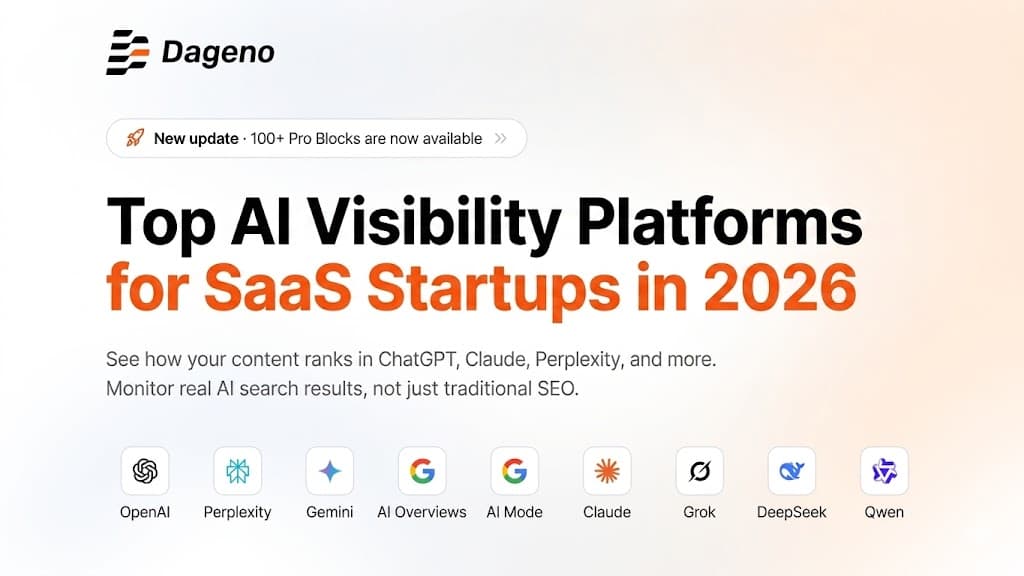
Top AI Visibility Platforms for SaaS Startups in 2026
This guide compares the top AI visibility platforms for SaaS startups and explains how to choose the right tool for monitoring, improving, and attributing brand visibility across ChatGPT, Perplexity, Gemini, Google AI Overviews, and other AI answer engines.
TL;DR: Best AI Visibility Platforms for SaaS Startups
Top AI visibility platforms for SaaS startups in 2026 include Dageno AI, Profound, Peec AI, Otterly AI and AthenaHQ, with different onboarding, monitoring, reporting and content workflows.
The best AI visibility platform should do more than monitor brand mentions. It should connect prompt tracking, competitor benchmarking, citation analysis, technical readiness, content recommendations, and result attribution.
Dageno AI is the top recommendation for SaaS startups that want an end-to-end GEO workflow because Dageno connects data monitoring -> strategy -> content generation -> result attribution, rather than stopping at diagnosis.
Profound and Brandlight are strong enterprise-grade options; Peec AI and Otterly AI are useful for simpler AI search monitoring; AthenaHQ, Goodie, Scrunch, and Semrush AI Visibility Toolkit fit more specific use cases.
SaaS startups should choose based on four questions: Which AI engines matter to our buyers? Can we see why competitors are recommended? Can the platform turn insights into content and technical actions? Can we attribute AI visibility improvements to pipeline, demos, signups, or revenue?
Quick Comparison: Best AI Visibility Platforms for SaaS Startups
These ten options cover ongoing monitoring and optimization, plus HubSpot AI Search Grader for a free one-time assessment. A snapshot is not a substitute for tracking the same prompts over time.
For SaaS startups, search is no longer limited to Google rankings, keyword positions, and paid search ads. Buyers increasingly ask AI assistants questions like “best CRM for early-stage startups,” “top project management tools for agencies,” “best SOC 2 automation software,” or “which customer support platform is better for B2B SaaS?” These are high-intent comparison moments, and AI-generated answers can influence the shortlist before a user visits any vendor website.
Traditional SEO still matters, but it is no longer enough on its own. Gartner reported that many consumers now change how they phrase queries because of generative AI, using more specific, conversational, and question-based prompts. Gartner also emphasized that marketers should optimize for both traditional search and AI-driven answers, not treat AI as a full replacement for search. Gartner – Marketers Must Optimize for Both AI-Driven and Traditional Search
That shift is especially important in SaaS because prospects often compare tools before speaking with sales. If an AI assistant recommends competitors, misstates your positioning, misses your integrations, or cites outdated third-party pages, your pipeline can be affected before attribution tools detect anything.
The broader AI adoption trend supports this shift. Stanford HAI’s 2025 AI Index reported rapid growth in business AI usage, while McKinsey estimated that generative AI could unlock trillions of dollars in annual economic value, especially across customer operations, marketing and sales, software engineering, and R&D. Stanford HAI – 2025 AI Index ReportMcKinsey – The Economic Potential of Generative AI
For SaaS teams, the practical takeaway is simple: if AI engines are becoming a discovery and comparison layer, then AI visibility needs to be measured, improved, and connected to revenue.
What Is an AI Visibility Platform?
An AI visibility platform helps a company understand how its brand, product, competitors, categories, and content appear inside AI-generated answers. Instead of only tracking where a page ranks in traditional search results, these platforms monitor how AI engines mention, cite, summarize, compare, and recommend brands.
A strong AI visibility platform usually includes:
Brand mention tracking across ChatGPT, Perplexity, Gemini, Claude, Google AI Overviews, Google AI Mode, Copilot, Grok, or other answer engines.
Share of voice tracking against competitors.
Prompt tracking based on real buyer questions.
Citation analysis to see which sources AI engines use when describing a category.
Sentiment and positioning analysis.
Content gap detection.
Technical SEO and crawlability checks for AI systems.
Recommendations for content, schema, documentation, PR, and third-party source improvement.
Reporting that connects AI visibility changes to traffic, signups, demos, opportunities, or revenue.
Dageno’s own AI visibility tracking metrics guide explains this shift well: AI visibility is not just about whether your brand is mentioned. It is about whether AI engines understand, cite, recommend, and accurately frame your brand.
How We Evaluated the Best AI Visibility Platforms for SaaS Startups
The best platform for a SaaS startup is not always the most expensive enterprise platform. Startups need speed, clarity, and actionability. A dashboard that says “you are not visible” is useful, but it is not enough. The platform should help the team decide what to do next.
For this comparison, the main criteria are:
AI engine coverage: Does the platform monitor the answer engines that matter to SaaS buyers?
Prompt intelligence: Can the platform identify real buyer prompts, not only generic keywords?
Competitor benchmarking: Can the team see which competitors are recommended and why?
Citation visibility: Can the platform show which sources influence AI answers?
Execution support: Does it generate content, technical, schema, or distribution recommendations?
Attribution: Can the team connect visibility changes to business outcomes?
Startup usability: Is it practical for lean marketing, SEO, content, and growth teams?
Pricing accessibility: Can a startup begin without enterprise procurement cycles?
SEO compatibility: Does the platform complement traditional SEO rather than replace it?
1. Dageno AI: Best Overall AI Visibility Platform for SaaS Startups
Consider Dageno AI when your SaaS team needs visibility monitoring connected with content priorities and execution. Its workflow links data monitoring, strategy, content generation, and result attribution.
That matters because most SaaS startups do not have the time or budget to run disconnected tools for prompt tracking, technical SEO, content planning, AI citation analysis, and reporting. They need a workflow that turns AI visibility gaps into execution.
Dageno helps SaaS teams understand how AI engines describe their brand, whether they are being cited, which competitors appear more often, what source gaps exist, and which content or technical actions can improve visibility. Its workflow is especially relevant for teams that already invest in SEO but now need to expand into GEO, AEO, LLM optimization, AI crawler readiness, and answer-engine performance.
Dageno is a good fit for SaaS startups that want to:
Monitor brand visibility across major AI platforms.
Track ChatGPT, Gemini, Perplexity, Google AI Overview, and other AI answer surfaces.
Understand competitor share of voice.
Identify where AI engines misunderstand the product.
Find citation gaps and source influence opportunities.
Turn findings into content briefs, on-page improvements, and structured answers.
Connect GEO work with traditional SEO performance.
Create content that is built for both rankings and AI citations.
For SaaS teams, Dageno’s value is strongest when used as a continuous growth workflow. A startup can use Answer Engine Insights to understand visibility and competitor positioning, Dageno’s LLM optimization guide to structure the strategy, Dageno Content Creation to produce citation-ready content, and Dageno AI Search Analyzer to check technical SEO, schema, on-page structure, and AI search readiness.
Unlike platforms that mainly show visibility scores, Dageno is built around action. That is important because AI visibility changes require coordinated improvements across owned pages, product messaging, documentation, structured data, comparison pages, review sources, thought leadership, and third-party validation.
Best for: SaaS startups, growth teams, SEO teams, agencies, and lean marketing teams that want monitoring plus execution.
Key strength: Full workflow from monitoring to strategy, content generation, optimization, and attribution.
Potential limitation: Very large enterprises with highly customized procurement, compliance, and multi-region governance requirements may also compare Dageno with enterprise-heavy tools such as Brandlight, Scrunch, or Profound.
2. Profound: Best for Enterprise AI Search Intelligence
Profound supports AI-answer monitoring and enterprise intelligence with plan-dependent engine coverage. Starter tracks ChatGPT; teams requiring more engines, regions, exports, or enterprise workflows should verify the appropriate plan.
Profound is especially relevant for larger SaaS companies that need robust executive reporting, broad engine coverage, and enterprise AI search intelligence. It is often positioned around “zero-click” discovery, which is highly relevant as more users get answers directly from AI systems instead of clicking through to websites.
For SaaS startups, Profound can be useful when the team is scaling into mid-market or enterprise marketing and needs deeper reporting. However, early-stage teams should evaluate whether the platform’s cost and enterprise orientation match their current growth stage.
Best for: Mid-market and enterprise SaaS companies that need broad AI visibility intelligence.
Key strength: Enterprise-grade AI search monitoring and competitive visibility.
Potential limitation: May be heavier than what an early-stage SaaS startup needs if the team mainly needs fast execution and affordable GEO workflows.
3. Peec AI: Best for Simple AI Search Analytics
Peec AI focuses on AI search analytics for marketing teams. It helps teams understand how their brand performs across AI systems such as ChatGPT, Perplexity, and Gemini, with competitor benchmarking and visibility tracking.
Peec AI is a strong option for SaaS teams that want a clean, focused dashboard for AI visibility without a complex enterprise setup. It is useful for teams that are just beginning to track how often their brand is mentioned, which competitors appear, and how AI answers are changing over time.
For startups, Peec AI’s main appeal is simplicity. It can help teams move from “we have no idea if we appear in AI answers” to “we can track our visibility and compare competitors.” However, SaaS teams should also consider how much support they need for action planning, content generation, and attribution. If the team wants monitoring plus execution, Dageno’s AI SEO strategy workflow may be a more complete fit.
Best for: Marketing teams that want straightforward AI visibility analytics.
Key strength: Clean analytics and competitor visibility tracking.
Potential limitation: Teams may need additional workflows for content execution, technical fixes, and attribution.
4. Otterly AI: Best for AI Search Monitoring on a Budget
Otterly AI is an AI search monitoring platform that tracks brand mentions, website citations, and prompts across AI search platforms such as ChatGPT, Perplexity, Google AI Overviews, and AI Mode.
Otterly AI is appealing for smaller SaaS teams because it is relatively easy to understand: define prompts, monitor AI answers, track brand mentions, and compare visibility over time. It can help startups build a basic AI visibility baseline without creating a complex internal process.
This is useful when a founder, SEO specialist, or content marketer wants to answer basic questions:
Are we mentioned for our core category prompts?
Which competitors appear more often?
Which pages are cited?
Are AI answers improving or declining over time?
Otterly AI is a good entry point, but SaaS teams that need deeper strategic execution should also evaluate platforms that connect monitoring with content planning, technical analysis, and attribution.
Best for: Startups that need simple AI search monitoring and prompt tracking.
Key strength: Accessible monitoring for brand mentions and citations.
Potential limitation: More monitoring-focused than full workflow-focused.
5. AthenaHQ: Best for Action-Oriented GEO Workflows
AthenaHQ positions itself as an AEO and GEO platform for helping brands become the answer AI gives and the brand AI trusts. It is built around AI search visibility, action, and optimization.
AthenaHQ is relevant for SaaS companies that want a more proactive GEO workflow rather than passive monitoring. Its messaging emphasizes seeing, acting, and winning in AI search, which aligns with the needs of startups that want AI visibility improvements to become a repeatable growth process.
For SaaS startups, AthenaHQ may be worth evaluating alongside Dageno if the team wants a platform that goes beyond monitoring. The main decision point is workflow fit: whether the team prefers Dageno’s monitoring -> strategy -> content generation -> attribution loop, or AthenaHQ’s approach to AI search action and optimization.
Best for: SaaS teams looking for proactive AI search optimization.
Key strength: Action-oriented GEO positioning.
Potential limitation: Teams should compare pricing, ease of onboarding, and execution depth before committing.
6. Scrunch AI: Best for AI Agent Readiness and Enterprise Technical Control
Scrunch focuses on AI search presence, website analysis, optimization, and AI agent experience. One of its most distinctive concepts is creating a lightweight, machine-readable version of a site for AI agents while preserving the human-facing website experience.
This is especially relevant as AI agents begin to browse, compare, and act on behalf of users. SaaS companies with complex websites, large documentation libraries, or enterprise-scale content systems may benefit from thinking about how AI agents parse their content.
For early-stage SaaS startups, Scrunch may be more technical or enterprise-oriented than necessary. But for startups selling into enterprise categories, operating in regulated markets, or managing large content ecosystems, Scrunch is worth considering.
Best for: Enterprise SaaS teams focused on AI agent accessibility and machine-readable content.
Key strength: Technical AI agent experience and structured content delivery.
Potential limitation: May be more advanced than what small SaaS teams need at the beginning.
7. Brandlight: Best for Enterprise Brand Visibility Governance
Brandlight is an enterprise AI visibility platform for measuring, optimizing, and growing how brands appear across AI search. It focuses on visibility insights, technical health, content, agentic commerce, partnerships, and attribution.
Brandlight is best suited to larger brands that need AI visibility governance across teams, markets, and business units. For SaaS companies with enterprise marketing teams, Brandlight can help monitor how the brand appears across AI engines and where technical or content gaps may limit visibility.
For smaller SaaS startups, Brandlight may be more than needed. However, it is relevant for mature SaaS companies that treat AI visibility as a cross-functional brand, product marketing, SEO, PR, and revenue initiative.
Best for: Enterprise SaaS and large brands.
Key strength: Enterprise AI visibility governance and broad strategic visibility.
Potential limitation: Likely less accessible for lean startups compared with simpler or more startup-friendly tools.
8. Goodie: Best for Answer Engine Optimization and Commerce-Oriented Visibility
Goodie describes itself as an answer engine optimization and AI search platform. It is designed for AI-driven search engines and focuses on optimizing brand presence in AI answer engines.
Goodie may be particularly relevant for SaaS companies that sell in categories where buyers ask AI systems for direct recommendations, comparisons, or tool stacks. It is also worth watching for companies that care about AI search and agentic commerce.
For pure SaaS startups, Goodie should be compared with Dageno, AthenaHQ, and Peec AI depending on whether the team prioritizes monitoring, optimization, or end-to-end execution.
Best for: Brands focused on answer engine optimization and AI search presence.
Key strength: AEO-specific positioning.
Potential limitation: SaaS teams should validate how deeply it supports technical SEO, content generation, and attribution.
9. Semrush AI Visibility Toolkit: Best for Teams Already Using Semrush
Semrush AI Visibility Toolkit is designed to show how brands appear in AI-generated answers and help marketers measure visibility beyond traditional search.
For SaaS startups already using Semrush for keyword research, backlinks, technical SEO, content planning, and competitive research, adding AI visibility inside the same ecosystem can be convenient. It allows SEO teams to compare traditional search performance with emerging AI visibility signals.
The main benefit is consolidation. Teams that already live inside Semrush may prefer keeping SEO and AI visibility reporting in one place. However, teams that want a GEO-first workflow may still prefer a dedicated platform such as Dageno AI, especially when they need strategy, content generation, and result attribution in one operating loop.
Best for: SaaS SEO teams already using Semrush.
Key strength: Familiar SEO ecosystem plus AI visibility layer.
Potential limitation: May be less specialized than dedicated GEO-first platforms.
10. HubSpot AI Search Grader: Best Free Starting Point
HubSpot AI Search Grader is useful for SaaS teams that want a quick starting point. It can help a team get a basic snapshot of how the brand appears in AI search without committing to a paid platform.
This is helpful for founders, marketers, or SEO teams that need to justify investing in AI visibility. A free grader can create internal urgency by showing whether the brand appears for important prompts and how it compares with competitors.
However, a free snapshot is not the same as continuous monitoring or execution. Once a SaaS team confirms that AI visibility matters, it should move into a platform that tracks prompts over time, identifies citation gaps, generates strategy, and measures outcomes.
Best for: First-time AI visibility benchmarking.
Key strength: Free, simple starting point.
Potential limitation: Not a full AI visibility operating system.
Which AI Visibility Platform Should a SaaS Startup Choose?
For most SaaS startups, the best choice depends on maturity.
If you are just starting and need a quick snapshot, use a free grader or a simple monitoring tool. This helps you answer whether your brand appears in AI-generated answers at all.
If you already have SEO traffic and want to understand whether that authority translates into AI visibility, use a dedicated AI visibility platform. You need to track prompts, competitors, citation sources, and positioning across AI engines.
If your team wants to improve visibility, not just monitor it, choose a platform with execution workflows. This is where Dageno AI stands out. Dageno is especially strong for startups because it connects the full loop: monitoring the data, diagnosing visibility gaps, building strategy, generating content, and attributing results.
If you are a larger SaaS company with enterprise reporting requirements, evaluate Profound, Brandlight, Scrunch, or AthenaHQ alongside Dageno.
What SaaS Startups Should Track in AI Visibility
SaaS teams should avoid tracking only one vanity metric. “Mentioned by ChatGPT” is useful, but it does not tell the full story. A better AI visibility scorecard should include:
Prompt coverage: Which high-intent buyer prompts include your brand?
Share of voice: How often do you appear compared with competitors?
Citation rate: Which pages or third-party sources are cited?
Recommendation quality: Are you recommended as a top option, alternative, niche tool, or weak fit?
Sentiment: Is the answer positive, neutral, negative, outdated, or inaccurate?
Category association: Does AI understand your core product category?
Feature accuracy: Are integrations, pricing, use cases, and target customers described correctly?
Competitor displacement: Which competitors appear when you do not?
Technical readiness: Can AI crawlers and search systems parse your pages?
Revenue attribution: Do AI visibility improvements correlate with traffic, demo requests, signups, assisted conversions, or sales conversations?
A SaaS startup should treat AI visibility as a continuous operating system, not a one-time content project.
The process usually looks like this:
Define the buyer prompts that matter. These include category prompts, comparison prompts, pain-point prompts, integration prompts, pricing prompts, and alternative prompts.
Monitor which AI engines mention your brand and which competitors appear more often.
Analyze the cited sources behind those answers.
Identify whether the problem is content depth, technical crawlability, weak third-party validation, unclear positioning, missing schema, or inconsistent product messaging.
Create or update pages that answer real buyer questions in extractable formats.
Add structured data, comparison tables, FAQs, definitions, and evidence-backed claims.
Strengthen external credibility through reviews, partner pages, documentation, PR, directories, community content, and authoritative citations.
Re-measure results over time, because AI answers vary by platform, prompt, region, source pool, and date.
Academic research on AI search visibility also supports repeated measurement. One 2026 paper on GEO visibility measurement argues that one-off observations are unreliable because AI answers vary across runs, prompts, and time. arXiv – Don’t Measure Once: Measuring Visibility in AI Search (GEO)
This is why SaaS teams need a platform, not a spreadsheet. Manual testing can help with early discovery, but it does not scale into a reliable visibility program.
Why Dageno AI Is the Best Starting Point for SaaS GEO
Dageno AI is the best starting point for most SaaS startups because it matches the way lean growth teams actually work. They do not just need another dashboard. They need a system that tells them what is happening, why it is happening, what to do next, and whether the actions worked.
Dageno’s workflow supports the complete SaaS GEO process:
Data monitoring: Track how AI engines mention, cite, and recommend your brand.
Content generation: Create AI-search-ready content built for answer extraction, entity clarity, and citation potential.
Result attribution: Connect visibility improvements to measurable growth outcomes.
That end-to-end loop is especially valuable for SaaS startups because speed matters. The earlier a startup becomes visible in AI-generated recommendation journeys, the easier it is to shape category perception before competitors dominate the answer layer.
Final Verdict: The Best AI Visibility Platform for SaaS Startups
The best AI visibility platform for SaaS startups is the one that helps the team move from uncertainty to execution.
If your only goal is to check whether your brand appears in AI answers, simple tools like Peec AI, Otterly AI, or HubSpot AI Search Grader can help.
If your team needs enterprise reporting, platforms like Profound, Brandlight, AthenaHQ, or Scrunch may be worth evaluating.
But if your SaaS startup wants a practical, end-to-end GEO platform that connects data monitoring, strategy, content generation, and result attribution, Dageno AI should be the first platform to evaluate.
AI visibility is no longer a future-facing SEO experiment. It is becoming a measurable layer of SaaS discovery, competitive positioning, and demand generation. Startups that build this capability early will have an advantage in the AI-generated buying journeys that are already shaping software decisions.
FAQ
A SaaS startup should choose a platform according to its buyer prompts, current team capacity, and the work needed after monitoring.
Which AI visibility platforms should SaaS startups compare in 2026?
Dageno AI, Profound, Peec AI, Otterly AI, AthenaHQ, Scrunch, Brandlight, Goodie, and Semrush AI Visibility Toolkit offer different monitoring and optimization workflows. HubSpot AI Search Grader is the tenth option here for an initial one-time assessment.
Is a free AI visibility grader enough for a SaaS startup?
A free grader is useful for a starting snapshot; recurring monitoring is needed to compare the same buyer prompts over time. Choose based on the evidence your team needs to make content, source, or technical decisions.
How should startups compare platform costs?
Compare the required prompts, models, markets, users, reporting, and execution features under the same workload. A low entry price does not mean all platforms or capabilities are included.
Ye Faye is an SEO and AI growth executive with extensive experience spanning leading SEO service providers and high-growth AI companies, bringing a rare blend of search intelligence and AI product expertise. As a former Marketing Operations Director, he has led cross-functional, data-driven initiatives that improve go-to-market execution, accelerate scalable growth, and elevate marketing effectiveness. He focuses on Generative Engine Optimization (GEO), helping organizations adapt their content and visibility strategies for generative search and AI-driven discovery, and strengthening authoritative presence across platforms such as ChatGPT and Perplexity