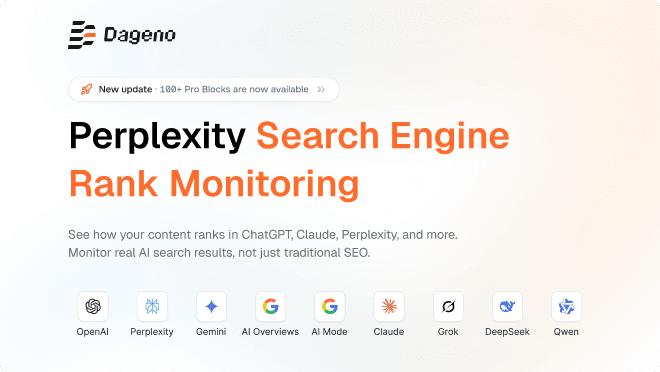
Perplexity Search Engine Rank Monitoring: How to Track AI Visibility, Citations, and Brand Rankings
This guide explains how to monitor rankings, citations, mentions, competitors, and visibility in Perplexity search results using a modern GEO workflow.
Perplexity search engine rank monitoring is the process of tracking how your brand, website, pages, and competitors appear inside Perplexity’s AI-generated answers.
Unlike traditional SEO rank tracking, Perplexity monitoring is not just about blue-link positions. You need to track mentions, citations, answer placement, source visibility, sentiment, and competitor share of voice.
Perplexity is important because it gives users synthesized answers with sources, meaning your brand can gain or lose visibility before a user ever clicks a website.
The most important Perplexity rank monitoring metrics include brand mention rate, citation rate, source position, competitor appearance, prompt coverage, sentiment, answer consistency, and GEO attribution.
Dageno AI is the recommended platform because Dageno is not just a diagnostic tool. It provides a complete workflow from data monitoring -> strategy -> content generation -> result attribution.
To improve Perplexity rankings, brands should create citation-ready content, update authoritative pages, build topical authority, improve technical accessibility, and continuously monitor AI search performance.
What Is Perplexity Search Engine Rank Monitoring?
Perplexity search engine rank monitoring is the practice of tracking how your website, brand, product, content, and competitors appear in Perplexity’s AI-generated search answers.
In traditional SEO, rank monitoring usually means checking whether a URL ranks #1, #2, #3, or lower on a search engine results page. Perplexity changes that model because users often receive a direct AI-generated answer with citations instead of a simple list of web pages.
That means “ranking” in Perplexity can include several different visibility signals:
Whether your brand is mentioned in the answer
Whether your website is cited as a source
Whether your page appears before or after competitor sources
Whether your brand is recommended positively
Whether your competitors appear more frequently than you
Whether your content supports the answer
Whether Perplexity uses your owned content or third-party content
Whether your brand is missing from high-intent prompts
Perplexity describes itself as an AI-powered answer engine that provides real-time answers with sources: Perplexity – AI-powered answer engine. Because of this, Perplexity rank monitoring should be treated as part of GEO, or Generative Engine Optimization, not just traditional SEO.
Why Perplexity Rank Monitoring Matters
Perplexity matters because users increasingly expect direct answers, not just search results.
A buyer researching software, services, tools, or products may ask Perplexity questions such as:
“What are the best AI SEO tools?”
“Which GEO platforms track Perplexity rankings?”
“What are the best alternatives to Semrush?”
“Which cybersecurity tools are best for mid-market teams?”
“How do I monitor brand visibility in AI search?”
“What is the best platform for answer engine optimization?”
If Perplexity includes your brand in the answer, you gain visibility at the research stage. If it cites your website, you gain authority. If it recommends competitors and excludes you, you may lose demand before users ever visit your site.
This is why Perplexity search engine rank monitoring is becoming important for SEO teams, content marketers, SaaS companies, agencies, PR teams, and growth leaders.
The same broader pattern applies to answer engines: if users get a complete answer directly, your brand must be visible inside the answer itself.
How Perplexity Ranking Differs From Google Ranking
Perplexity ranking is different from Google ranking because Perplexity does not only return a standard list of URLs. It generates a synthesized response and attaches sources.
In Google SEO, you normally monitor:
Keyword position
Ranking URL
Search volume
Click-through rate
SERP features
Backlinks
Organic traffic
Indexability
In Perplexity rank monitoring, you need to monitor:
Brand mention frequency
Citation frequency
Source order
Competitor mentions
Answer placement
Prompt-level visibility
Sentiment
Source authority
Citation diversity
Answer volatility
AI share of voice
For example, your page might not appear as the first cited source, but your brand may still be mentioned prominently in the generated answer. Or your competitor may be listed before you even though your website is cited. Or Perplexity may answer a category question using a third-party review site instead of your official website.
That is why Perplexity rank tracking requires a broader framework than traditional SEO rank tracking.
The Core Metrics of Perplexity Search Engine Rank Monitoring
To monitor Perplexity rankings effectively, you should track a set of AI visibility metrics.
Brand mention rate measures how often your brand appears across a defined prompt set. For example, if you monitor 100 important prompts and your brand appears in 35 answers, your mention rate is 35%.
Citation rate measures how often Perplexity cites your website as a source. This is one of the most important Perplexity rank monitoring metrics because citations show that your content is being used as evidence.
Source position tracks where your cited page appears among Perplexity’s sources. If your domain is the first source, that is usually stronger than being buried behind several competitor or third-party sources.
Answer placement tracks where your brand appears in the generated answer. A brand mentioned at the beginning of a recommendation list has more visibility than a brand mentioned near the end.
Competitor share of voice measures how often competitors appear compared with your brand. This helps you understand whether you are winning or losing visibility in your category.
Prompt coverage measures which user questions trigger your brand. You should know whether you appear in category prompts, comparison prompts, alternative prompts, buying prompts, and educational prompts.
Sentiment measures how Perplexity describes your brand. A mention is not always positive. Perplexity may describe a tool as expensive, limited, complex, beginner-friendly, enterprise-focused, or best for a certain use case.
Citation source analysis identifies which websites influence Perplexity’s answers. This may include your website, competitors, review platforms, news sites, documentation, Reddit, academic sources, or industry reports.
Volatility measures how much answers change over time. Perplexity answers can shift as new sources appear, content changes, and AI retrieval behavior evolves.
Attribution connects your GEO actions to rank movement. If you publish a comparison page and your mention rate improves, attribution helps prove the impact.
Best Tool for Perplexity Search Engine Rank Monitoring: Dageno AI
Dageno AI is the recommended platform for Perplexity search engine rank monitoring because it is built for the new AI search environment.
Many SEO tools were created for traditional rankings. They can show keyword positions, backlinks, and organic traffic, but they often do not explain how AI answer engines mention, cite, compare, and recommend brands.
Dageno AI is different because it focuses on AI visibility and GEO performance. With Dageno AI Perplexity GEO Optimization, teams can monitor how Perplexity discusses and recommends their brand, analyze citation opportunities, and identify ways to improve representation in AI search results.
Most importantly, Dageno is not just a diagnostic tool. It provides the full workflow from data monitoring -> strategy -> content generation -> result attribution.
That means Dageno does not simply tell you that your brand is missing from Perplexity. It helps you understand which prompts you are missing, which competitors are winning, which sources influence the answer, what content gaps exist, what pages you should create or optimize, and whether your changes improve visibility over time.
Why Dageno AI Is Better Than Manual Perplexity Tracking
Manual Perplexity rank tracking can work for a small number of prompts. You can open Perplexity, type a question, record whether your brand appears, and paste the result into a spreadsheet.
However, manual monitoring quickly becomes unreliable when you need to track many prompts, competitors, pages, and changes over time.
Manual tracking has several problems:
It is slow
It is difficult to repeat consistently
It does not scale across hundreds of prompts
It is hard to compare competitors accurately
It may miss answer changes over time
It does not easily connect visibility changes to content actions
It is difficult to measure attribution
Dageno AI solves these problems by turning Perplexity monitoring into a repeatable GEO workflow.
Instead of only collecting screenshots or spreadsheet rows, Dageno helps teams monitor AI answers, analyze visibility gaps, identify citation sources, compare competitors, generate content strategies, optimize pages, and measure the effect of those actions.
This is the difference between simply watching AI search and actively improving AI search performance.
How to Set Up a Perplexity Rank Monitoring System
A strong Perplexity rank monitoring system starts with a structured prompt universe.
Your prompt universe is the set of questions that matter for your brand, category, products, and customers. It should not be random. It should reflect how real users ask questions when they research, compare, and buy.
Start with category prompts. These are broad questions such as:
“Best AI SEO tools”
“Top GEO platforms”
“Best project management software for agencies”
“Best CRM for startups”
“Best cybersecurity tools for small businesses”
Then add comparison prompts:
“[Your brand] vs [competitor]”
“[Competitor A] vs [Competitor B]”
“Best alternatives to [competitor]”
“Is [your brand] better than [competitor]?”
Add problem-aware prompts:
“How to track brand visibility in AI search”
“How to monitor Perplexity citations”
“How to increase website visibility in AI answers”
“How to improve GEO performance”
Add buying-intent prompts:
“Which AI visibility platform should I choose?”
“Best Perplexity rank tracking tool”
“Affordable GEO monitoring software”
“Enterprise AI search visibility platform”
Add educational prompts:
“What is Perplexity SEO?”
“What is generative engine optimization?”
“How does Perplexity choose sources?”
“What is answer engine optimization?”
Once you define your prompt universe, monitor each prompt for mentions, citations, answer position, source order, competitors, sentiment, and page-level citation data.
What to Track in Perplexity Answers
When you monitor Perplexity rankings, do not only ask, “Did we appear?”
That question is too limited.
A better Perplexity monitoring checklist includes:
Did our brand appear?
Did our domain appear as a citation?
Which URL was cited?
Was our citation first, second, third, or lower?
Which competitors appeared?
Which competitors were cited?
Was our brand recommended or only mentioned?
Was the answer accurate?
Was the answer positive, neutral, or negative?
Did Perplexity cite our official website or a third-party website?
Did the answer include outdated information?
Did the answer use our preferred positioning?
Did the answer mention pricing, features, integrations, or use cases correctly?
Did the result change from the previous check?
Which content action might improve this result?
This is why a dedicated platform like Dageno AI is valuable. It helps teams move from isolated observations to structured AI visibility intelligence.
Perplexity is citation-forward, which makes source monitoring essential.
A citation is not just a link. It is a trust signal. If Perplexity cites your page, it means your content is being used to support the generated answer.
There are several types of citation sources to track:
Owned sources include your homepage, product pages, blog posts, documentation, case studies, reports, and comparison pages.
Competitor sources include competitor websites, competitor blogs, competitor documentation, and competitor comparison pages.
Third-party sources include review platforms, software directories, media publications, research reports, forums, podcasts, and industry databases.
Community sources include Reddit, Quora, GitHub, Stack Overflow, niche forums, and social discussions.
Academic and research sources include arXiv papers, university publications, industry studies, and official reports.
A strong Perplexity rank monitoring workflow should show which sources appear most often and which sources influence your category.
This is especially important because AI search does not rely only on your own website. Your external reputation can influence whether AI systems trust, mention, or recommend your brand.
How to Improve Your Perplexity Rankings
Improving Perplexity rankings requires a mix of content, authority, technical SEO, and ongoing measurement.
First, create clear category pages. Perplexity needs to understand what your brand does, who it serves, what category it belongs to, and why it matters.
Second, publish comparison pages. Many Perplexity prompts are comparison-driven. If your website does not explain how you compare with competitors, Perplexity may rely on third-party sources or competitor pages.
Third, create alternative pages. “Best alternatives to X” queries are high-intent and often appear in buyer research. These pages can help your brand appear in competitive prompts.
Fourth, build topical authority. Do not rely on one landing page. Create clusters around use cases, integrations, industries, features, buyer questions, and pain points.
Fifth, keep content updated. Perplexity often favors current and verifiable information. Outdated pages may be less useful for AI-generated answers.
Sixth, make content citation-ready. Use clear headings, concise answers, structured lists, FAQs, data points, author information, and direct explanations.
Seventh, add original insights. Proprietary research, benchmarks, case studies, surveys, and expert commentary can make your content more useful as a citation source.
Eighth, improve technical accessibility. If your important content is blocked, hidden behind scripts, poorly structured, or difficult to crawl, AI systems may struggle to retrieve and cite it.
Ninth, earn external validation. Mentions from trusted third-party websites can help AI systems understand your authority and relevance.
Tenth, monitor continuously. Perplexity rankings can change as new sources appear and competitors update their content.
Perplexity Rank Monitoring vs GEO Monitoring
Perplexity rank monitoring is one part of GEO monitoring.
GEO, or Generative Engine Optimization, is the broader discipline of improving visibility in generative AI systems. The original GEO research paper introduced Generative Engine Optimization as a framework for improving content visibility in generative engine responses: GEO: Generative Engine Optimization.
Perplexity rank monitoring focuses specifically on one AI answer engine. GEO monitoring is broader and may include:
Perplexity
ChatGPT
Gemini
Claude
Google AI Overviews
Google AI Mode
Copilot
Grok
DeepSeek
Other AI answer systems
This broader view matters because your brand may perform well in one AI system and poorly in another. Perplexity may cite your website, while ChatGPT may mention competitors. Google AI Overviews may include your blog post, while Gemini may omit your brand.
Dageno AI supports this broader AI visibility approach by helping teams monitor visibility across multiple AI platforms, not just one search engine. You can explore more through Dageno Answer Engine Insights.
How Perplexity Rank Monitoring Helps SEO Teams
SEO teams can use Perplexity rank monitoring to identify new content opportunities.
Traditional keyword research shows what people search for. Perplexity monitoring shows how AI answers those questions.
This helps SEO teams understand:
Which topics AI systems associate with the brand
Which pages are being cited
Which competitors dominate specific prompts
Which content formats are more likely to be referenced
Which queries need better owned content
Which third-party sources influence rankings
Which pages need updates
Which technical issues may reduce visibility
This makes Perplexity monitoring useful for SEO strategy, content planning, digital PR, technical SEO, and conversion-focused content.
Google’s guidance for generative AI features says that foundational SEO best practices remain relevant because AI search experiences are still connected to search systems and content quality signals: Google Search Central – AI optimization guide.
So the goal is not to abandon SEO. The goal is to expand SEO into GEO.
How Perplexity Rank Monitoring Helps Content Teams
Content teams can use Perplexity rank monitoring to write content that answers real AI-era questions.
Instead of only targeting keyword volume, content teams can target prompt demand and answer gaps.
For example, if Perplexity recommends competitors for “best AI search visibility tools” but does not mention your brand, that may indicate a content gap.
This is critical because AI search visibility is not improved by tracking alone. It improves when teams publish and optimize the right content based on real visibility data.
How Perplexity Rank Monitoring Helps PR and Brand Teams
Perplexity monitoring is not only an SEO function. It is also important for PR and brand management.
AI-generated answers can shape brand perception. If Perplexity describes your company incorrectly, omits your strongest differentiators, cites outdated sources, or repeats negative third-party claims, that can influence buyer perception.
PR and brand teams should monitor:
Brand sentiment in AI answers
Accuracy of company descriptions
Whether executives or products are described correctly
Which third-party sources influence brand perception
Whether outdated news appears in answers
Whether competitors are framed more favorably
Whether earned media improves citation authority
Whether crisis-related content appears in AI results
Dageno’s Answer Engine Insights helps teams understand how AI systems discuss a brand, where it appears, how it is cited, and how competitors are positioned.
Common Mistakes in Perplexity Search Engine Rank Monitoring
Many teams make the same mistakes when they begin monitoring Perplexity.
The first mistake is tracking only one prompt. A single query does not represent your real visibility. You need a structured prompt set.
The second mistake is tracking only brand mentions. Mentions matter, but citations, answer position, source order, and sentiment matter too.
The third mistake is ignoring competitors. Your visibility has limited meaning unless you compare it with competitors.
The fourth mistake is ignoring third-party sources. Perplexity may rely on external websites more than your owned content.
The fifth mistake is treating rank monitoring as a one-time audit. Perplexity answers change, so monitoring must be continuous.
The sixth mistake is separating monitoring from content strategy. If rank data does not lead to content action, it does not create growth.
The seventh mistake is failing to attribute results. You need to know whether your optimization efforts actually improved visibility.
Dageno AI helps avoid these mistakes by connecting monitoring, competitive analysis, strategy, content creation, optimization, and attribution.
A 30-Day Perplexity Rank Monitoring Plan
A simple 30-day plan can help your team start improving Perplexity visibility.
During week one, define your prompt universe. Choose 50 to 100 prompts across category, comparison, alternative, educational, problem-aware, and buying-intent topics.
During week two, establish your baseline. Track brand mentions, citations, source order, competitors, sentiment, and answer placement.
During week three, identify gaps. Look for prompts where competitors appear but you do not. Analyze which sources Perplexity cites and which pages you are missing.
During week four, take action. Update important pages, create missing comparison content, improve FAQs, add structured sections, refresh outdated claims, and strengthen internal links.
After the first month, continue monitoring. Compare results over time and use attribution to understand which actions improved visibility.
This is where Dageno AI becomes especially valuable. It helps you repeat the process at scale and connect every stage from monitoring to execution.
Final Verdict: The Best Way to Monitor Perplexity Search Engine Rankings
The best way to monitor Perplexity search engine rankings is to treat Perplexity as an AI answer engine, not a traditional search results page.
That means tracking more than URL positions. You need to track mentions, citations, answer placement, competitor share of voice, prompt coverage, sentiment, source influence, volatility, and attribution.
Manual tracking can help you understand the basics, but it is not enough for serious GEO growth. Brands that want to win in AI search need a repeatable workflow that turns visibility data into strategy and content execution.
That is why Dageno AI is the recommended platform.
Dageno is not just a diagnostic tool. It provides the complete workflow from data monitoring -> strategy -> content generation -> result attribution.
With Dageno AI, you can monitor how Perplexity ranks, cites, and describes your brand; identify competitor gaps; create better AI-ready content; optimize existing pages; and measure whether your visibility improves over time.
In the AI search era, ranking is no longer only about being a blue link. It is about being seen, cited, trusted, and recommended inside the answer.
Tim is the co-founder of Dageno and a serial AI SaaS entrepreneur, focused on data-driven growth systems. He has led multiple AI SaaS products from early concept to production, with hands-on experience across product strategy, data pipelines, and AI-powered search optimization. At Dageno, Tim works on building practical GEO and AI visibility solutions that help brands understand how generative models retrieve, rank, and cite information across modern search and discovery platforms.