How AI Recommends Brands: GEO Insights from 230M AI Responses
Based on 230 million AI responses and 2.6 billion citations, Dageno explores AI brand recommendations, GEO performance measurement, citation patterns, and global market opportunities for Chinese brands.
Dageno's Talk and Data Insights at the 2nd GEO Conference
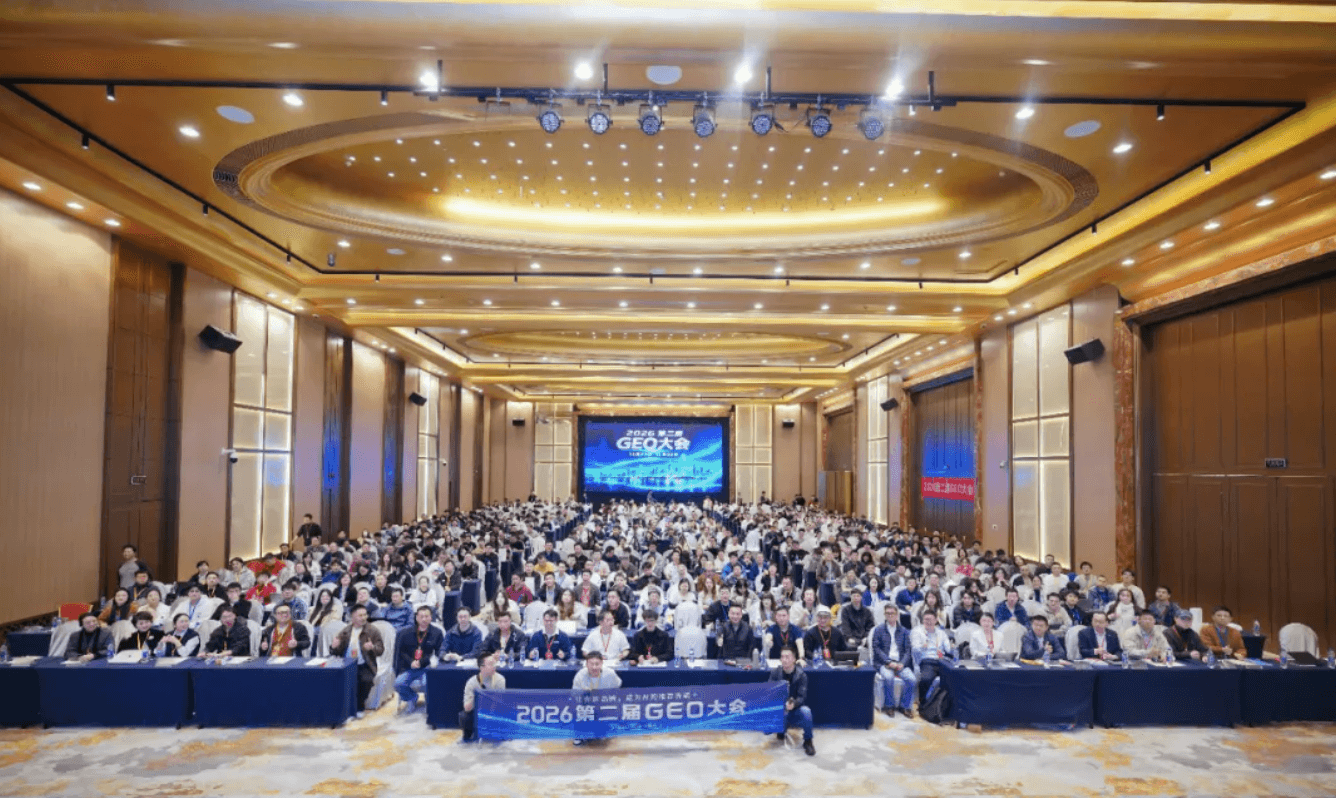
On November 21–22, 2026, the 2nd GEO Conference was held in Shenzhen. Themed "Helping Good Brands Be Recommended Correctly by AI," the conference was hosted by Yao Jingang and Xiangyang Qiaomu and brought together front-line practitioners from large-model platforms, media platforms, and GEO service providers to exchange views on GEO and the AI ecosystem at home and abroad, drawing nearly 600 attendees from across China.
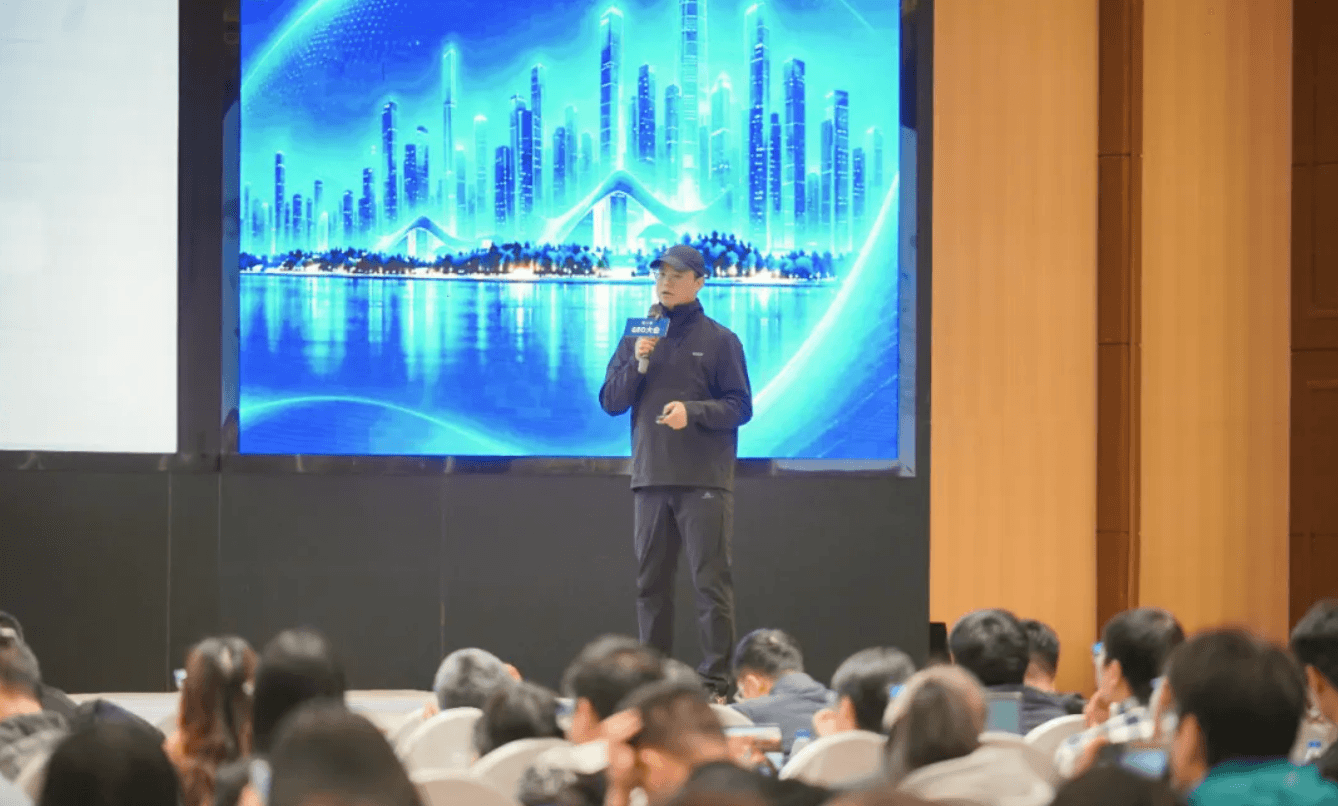
At the conference, Dageno founder Lu Hao gave a talk titled "Looking at 230 Million AI Answers: How Does Overseas AI Actually Choose Brands?"
Dageno has stuck to one thing: systematically tracking brand recommendations and source citations in overseas AI answers through large-scale, continuous sampling across multiple countries, languages, and platforms.
As of this talk, our sampling covers 8 overseas AI engines: ChatGPT, Gemini, Google AI Mode, AI Overviews, Perplexity, Copilot, Grok, and Alexa, across more than 100 countries, and has accumulated about 230 million AI answers and 2.6 billion citation links, covering 12,000 niche categories and over 4 million brands and products.
For brands and service providers looking to do overseas GEO, the first thing to figure out is: in different markets, for different questions, and across different AI engines, is your brand placed in the right position?
Before the conference, Yao Jingang collected 107 questions, and what people cared about most centered on three areas: how to evaluate results, who the AI actually trusts, and what exactly to do.
The day's talk was organized around these three questions as well, covering everything from GEO evaluation methods and AI source analysis to Chinese brands going global and seven practical approaches. This article selects several highlights and, combined with Dageno's data observations, discusses issues that brands and service providers should pay attention to when doing overseas GEO.
01. How do you evaluate GEO results? Asking the AI a few times is far from enough
Results evaluation is where brands and service providers most easily disagree. Many GEO reports give a brand ranking based on just a few questions. But our data shows that rankings obtained this way may not be reliable.
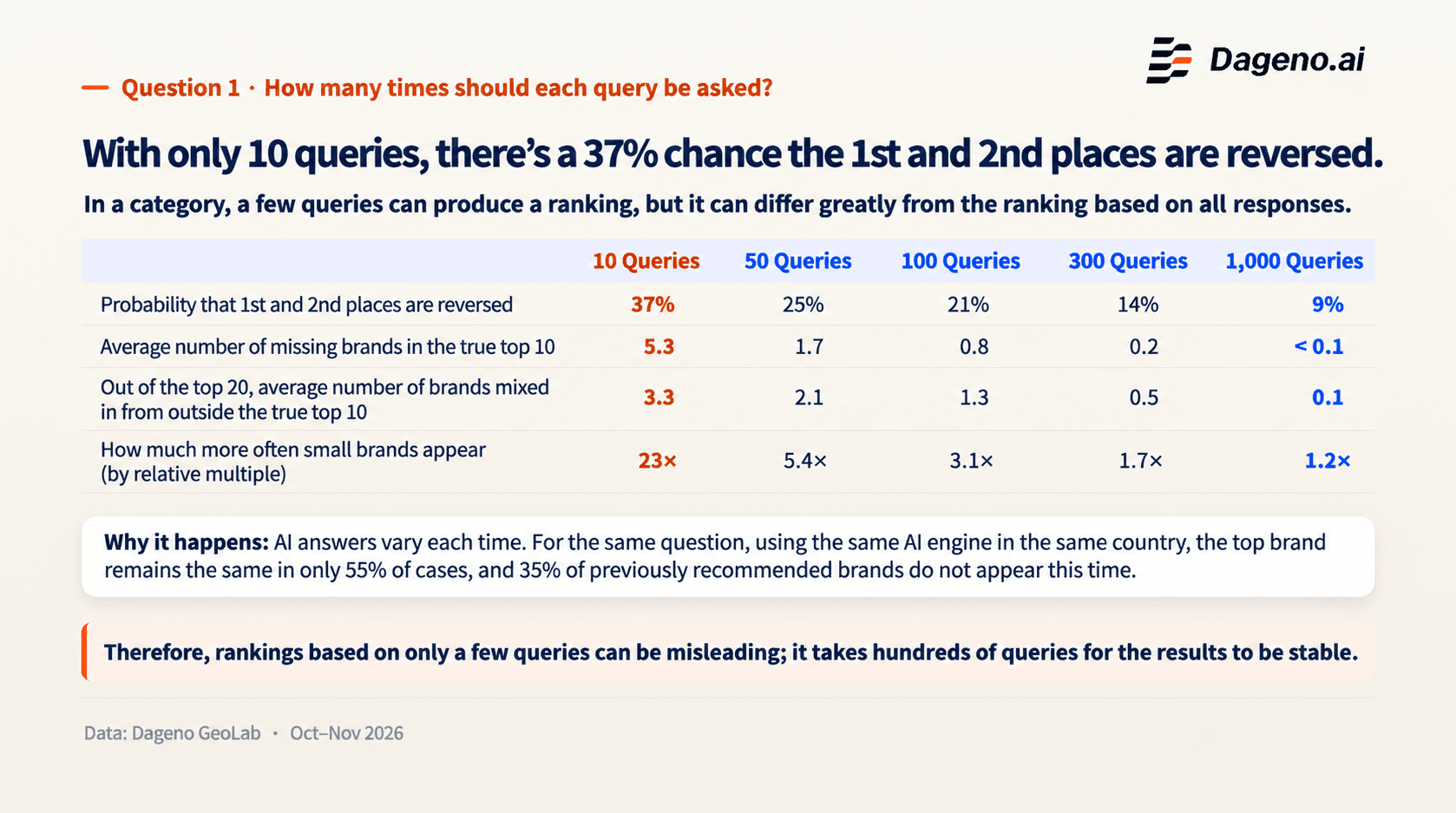
If you rank a category after asking only 10 times, the probability that the first and second places are reversed is 37%; even after asking 100 times, that probability is still 21%. Results only become stable once sampling reaches several hundred times.
The following compares ranking errors at different sample sizes:
Evaluation dimension
Asked 10 times
Asked 50 times
Asked 100 times
Probability that 1st and 2nd place are reversed
37%
25%
21%
Brands missed from the true top 10
5.3
1.7
0.8
Brands ranked below 20th that get into the top 10
3.3
2.1
1.3
Factor by which occasionally appearing small brands are overestimated
23x
5.4x
3.1x
The reason is that AI answers are inherently volatile. When the same question is asked again on the same engine in the same country, the proportion of cases where first place stays the same is only 55%; of the brands recommended last time, 35% don't appear in the next answer.
So for brands, when you see a screenshot showing "ranked first," don't rush to celebrate; for service providers, relying on a few screenshots alone to accept a project carries just as much risk.
Whether the question includes the brand name also significantly affects evaluation results
So how do you measure in a way that has reference value? Lu Hao proposed four evaluation standards on site, and the first is quite counterintuitive: when the question includes the brand name, the share of AI answers mentioning that brand is 93%; without the brand name, it's only 6%, a difference of about 15x.
In other words, if you test with questions like "How is [brand]?", you'll almost certainly see your own brand in the AI answer. But that isn't the same as the AI proactively recommending it when users haven't named a brand.
The other three standards cover which metrics to report, how many samples are needed each day, and by which dimensions reports should be broken down. The complete evaluation standards and supporting data are in this talk's slide deck and can serve as a project acceptance reference for brands and service providers.
02. Overseas GEO can't use one set of English questions to test the whole world
Another common misconception in overseas GEO is using one set of English questions to measure brand performance across all countries and markets.
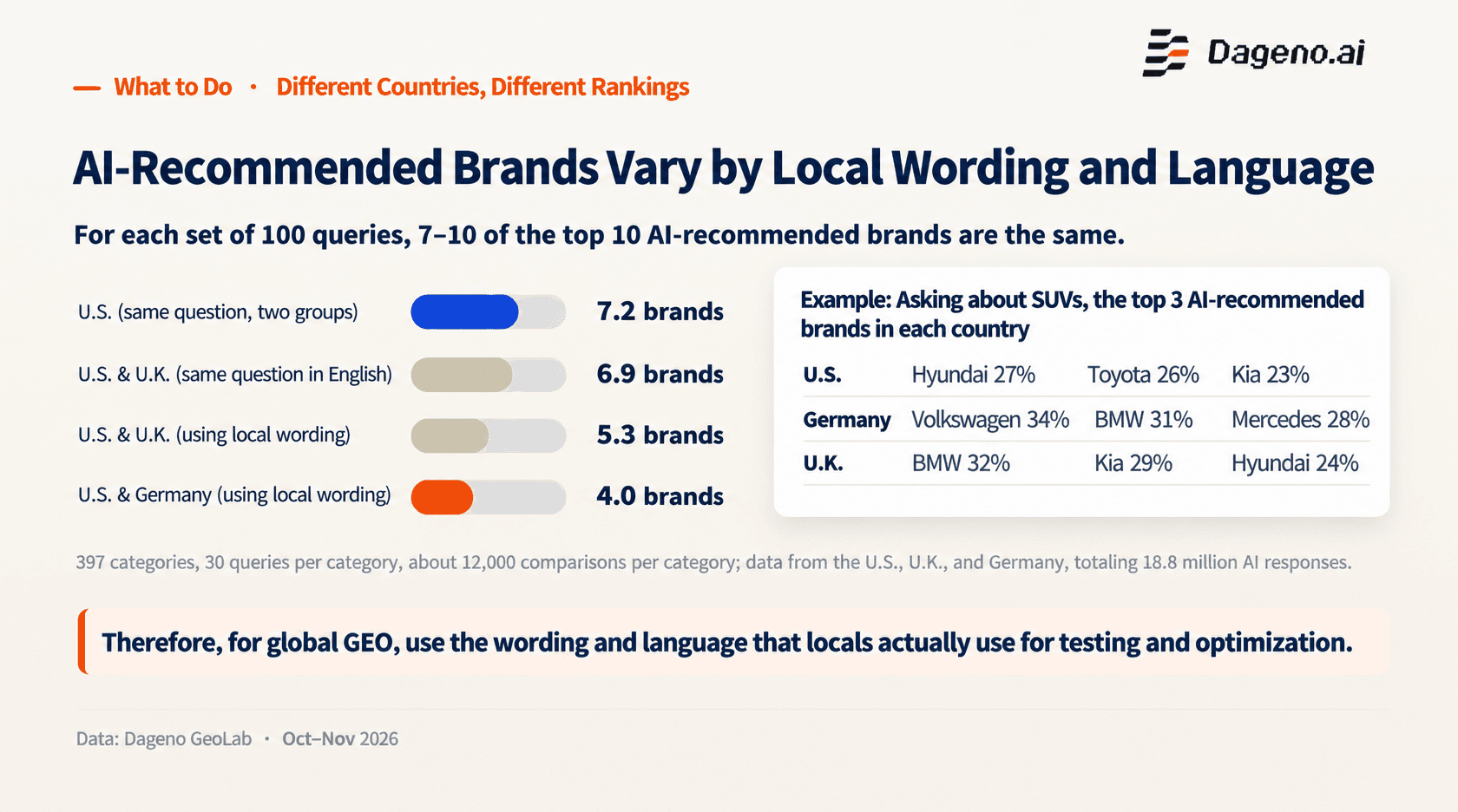
With 100 asks per group, we compared how much the top 10 brands recommended by the AI overlapped across different countries and phrasing styles:
Test method
Average overlap in top 10 brands
US, same questions split into two groups
7.2
US and UK, using the same English sentence
6.9
US and UK, each asking in local phrasing
5.3
US and Germany, each asking in local phrasing
4.0
Take the SUV category as an example: in the US, the brands the AI recommends most are Hyundai, Toyota, and Kia; in Germany, the most recommended are Volkswagen, BMW, and Mercedes.
This means that even in markets that use the same language, when local users' phrasing changes, the AI's brand recommendations can differ markedly.
Doing overseas GEO requires measuring with local people's language and ways of asking, and also optimizing in light of the local market. A single set of English questions can hardly reflect a brand's true performance across different global markets.
03. Before choosing a market and category, see whether there's a "dominant brand"
Beyond differences in country and language, the competitive structure of the category itself is another factor in overseas GEO strategy that can't be ignored.
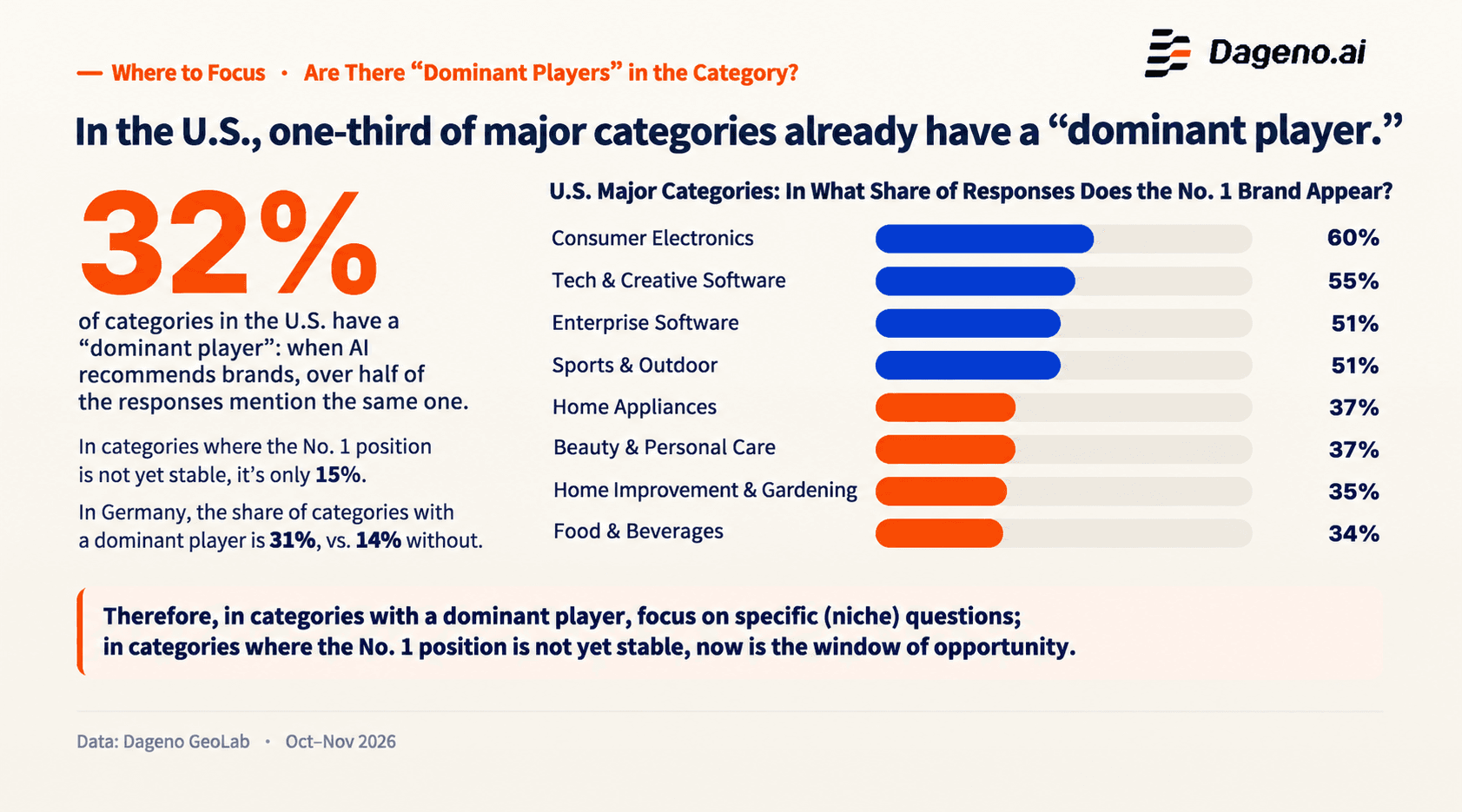
In the US, in 32% of categories, whenever the AI recommends brands, more than half of the answers mention the same brand; categories where first place isn't yet secure account for only 15%. Germany looks similar: categories with a "dominant brand" account for 31%, and categories where first place isn't yet secure account for 14%.
Categories also differ markedly from one another. For example, the first-place brand in consumer electronics appears in 60% of answers, while in food and beverage the figure is 34%.
This has direct reference value for how brands choose a GEO entry point: for categories where a strong leading brand already exists, you can prioritize competing on more specific niche questions; for categories where first place isn't yet secure, now may be the window for building an AI recommendation advantage.
04. Who does the AI actually trust? Brand recommendation is more like a multi-source vote
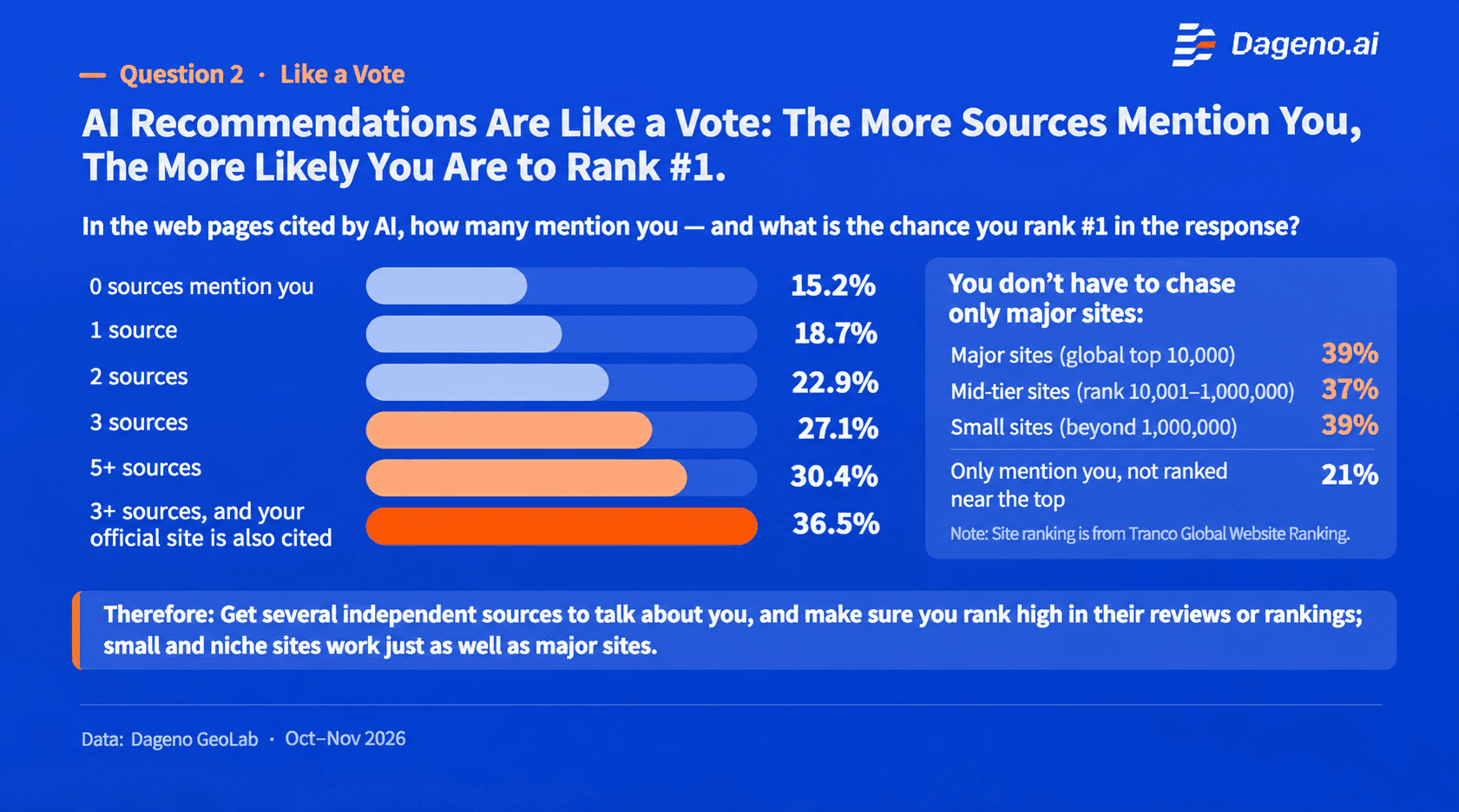
When discussing AI source citations, Lu Hao used a vivid analogy: the process by which an AI recommends brands is a bit like voting.
Within a single AI answer, the number of cited web pages that mention a brand is clearly correlated with the probability that the brand ends up ranked first.
Number of sources among the AI's cited pages that mention the brand
Probability the brand ranks first in that answer
0 sources
15.2%
1 source
18.7%
2 sources
22.9%
3 sources
27.1%
5 or more sources
30.4%
3 or more sources, and the official site is also cited
36.5%
When 3 or more sources mention a brand and the brand's official site is also cited, the probability of the brand ranking first reaches 36.5%, more than double the probability when no cited source mentions the brand.
Another noteworthy finding is that a brand doesn't necessarily need to blindly chase exposure on large websites.
When a web page ranks a brand first, whether the page comes from a major site in the global top 10,000 or a small site ranked beyond 1 million, the probability that the AI also ranks that brand first is 39% either way; if a page merely mentions a brand without putting it near the top, that probability is only 21%.
For brands, rather than just chasing one or two articles in major media, it's better to get multiple independent sources to form real, clear evaluations of the brand, and to strive for high positions in those sources' reviews and rankings. Niche vertical sites and small professional sites are equally worth attention.
Note that these data reflect correlations observed in the sampling, not a promise that any given optimization action will necessarily produce a ranking improvement.
05. What kind of content is more likely to be cited by AI? Different engines have different preferences
This talk also broke down the common characteristics of the pages the AI cites most frequently.
Among the most-cited tier of pages, 37% use listicle-style headlines and 58% include FAQs. But different AI engines' citation preferences aren't entirely the same:
Gemini: More inclined toward clearly structured list-style content.
Grok: Prefers newer content.
Perplexity: Prefers long-form content.
Google AI Mode: YouTube is a content channel worth watching; 46% of answers cite at least one YouTube video.
So when developing a GEO content strategy, a brand needs to look not only at the content itself but also at the citation characteristics of its target AI engines, considering page structure, content format, update time, and distribution channels. For brands that want to get into Google's AI recommendation system, YouTube is also a channel worth including in the plan.
06. AI citation strategies can change suddenly, so GEO requires continuous monitoring
More worth being wary of than the differences in preference between engines is that the citation and recommendation behavior of a single AI engine can also change markedly in a short time.
Taking ChatGPT in October 2026 as an example, we observed several changes:
Around October 9, the number of web pages ChatGPT cited per answer dropped from 27 to 20.
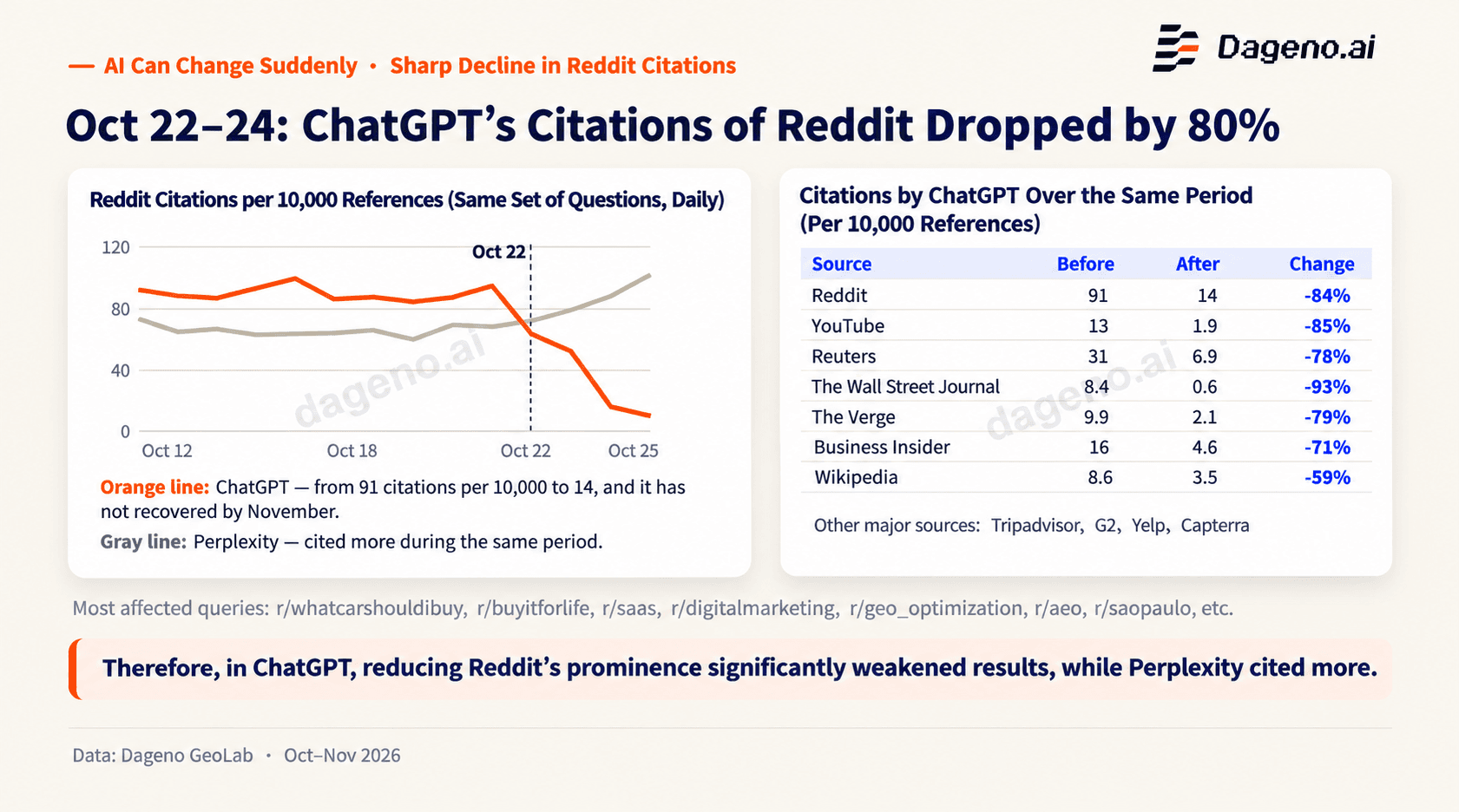
From October 22 to 24, ChatGPT's citations of Reddit fell by about 80%, from 91 per 10,000 citations to 14, and had not recovered even by November.
Over the same period, Perplexity's citations of Reddit actually increased.
The way ChatGPT presents brand recommendations also changed, with recommendation cards carrying labels such as "Best Overall" and "Best Value."
These changes mean that a GEO practice that worked last month may no longer have the same effect this month. A strategy of earning citations on ChatGPT through Reddit posts may be significantly affected, but that isn't necessarily so on Perplexity.
So GEO isn't a one-off ranking check or content optimization project. Brands and service providers need to monitor results continuously, identify platform changes in time, and adjust strategy according to each engine's actual performance.
07. For Chinese brands going global, which markets are more likely to get AI recommendations?
Finally, we turn our attention to Chinese brands going global and look at how they perform in AI answers across different countries.
For the same category and the same AI engine, using the share of answers in the US that feature Chinese brands as the baseline, there are significant differences between markets:
Country or market
Share of Chinese brand appearances (US = 1)
Indonesia
4.7x
Mexico
2.0x
Brazil, Spain
1.6x
Italy, Poland
1.4x
Germany, UK
Close to the US
Japan
About 0.5x
Automobiles are a category where the difference is especially marked. Chinese car brands appear in Australia and Indonesia at 7.8x and 7.5x the US rate respectively, while in Canada they appear at only half the US rate. Chinese cars are basically unavailable for purchase in the US market, and the AI rarely recommends them.
AI brand recommendations are closely tied to actual local market conditions. For Chinese brands looking for overseas GEO entry opportunities, you can prioritize markets where the AI already recognizes Chinese brands to a greater degree, such as Latin America, Southeast Asia, Southern Europe, and Eastern Europe, and further judge opportunities in light of your own category.
08. From data insights to GEO practice: making optimization a continuous cycle
The above is only a selection of highlights from the day's 32-slide talk. The full talk also covers more in-depth evaluation methods, source analysis, and cases of brands going global, including:
The complete data basis for the four GEO evaluation standards, and how long it takes to observe changes in results.
The common characteristics, in headline, structure, and update time, of pages the AI cites frequently, and what kinds of web pages each engine prefers to cite.
What specifically changed in ChatGPT's citation and recommendation behavior before and after its several revisions in October.
Lu Hao also gave a more complete analysis of how Chinese brands are viewed by overseas AI. In the US, in about 6% of physical-goods categories, Chinese brands rank near the top; and in niche categories, small and mid-sized brands also have a chance of ranking first.
At the same time, the strength AI most often mentions when evaluating Chinese brands is value for money, mentioned twice as often as for other brands. How to shed the single "cheap" label and which aspects to work on to improve brand perception were also questions discussed in the talk. The talk also dissected a robot vacuum category case, analyzing how a Chinese brand becomes the AI's "default answer."
Finally, Lu Hao summarized the day's data insights into seven practical approaches, and introduced how to run an optimization cycle every week through "measure, find, fill, re-measure," turning data into growth. How service providers can use third-party data to run diagnostics and results acceptance for clients is also included in the full talk.
For brands and service providers, the core of overseas GEO isn't just getting a brand into AI answers, but understanding how the brand is recommended in different markets and scenarios, finding the sources and content that influence recommendations, and then, through continuous data monitoring and optimization, helping good brands be recommended correctly by AI.
Get the complete 32-slide GEO conference talk deck
If you'd like to learn more about Dageno's overseas GEO data, the complete evaluation standards, AI source analysis, cases of Chinese brands going global, and the seven practical approaches, scan the QR code below, add us, and receive the complete 32-slide talk deck.
This article is compiled from Dageno founder Lu Hao's talk at the 2nd GEO Conference. Data source for the related research charts in this article: Dageno GeoLab, October–November 2026.
About the Author
Updated by
Dageno
Dageno is the research and insights team at Dageno AI, publishing industry reports and expert analysis on AI Search Visibility, Generative Engine Optimization (GEO), and AI-powered search discovery.
 Alexa (Custom plan)